Short answer: The AI software development lifecycle (AI SDLC) is the familiar sequence of requirements, design, planning, build, test, deploy and maintain, with AI doing part or most of the work at each stage. Teams usually move through four levels: AI helps individuals write code, AI agents complete tasks, agents run whole stages, and finally agents run the whole lifecycle with people at approval gates. The gains come when every stage moves together, not just coding.
Definition in one paragraph
An AI SDLC is a way of building software where AI tools and agents take on work at every stage of the lifecycle: turning ideas into requirements, drafting designs, planning tasks, writing code, testing, deploying, documenting and handling user feedback. People define the goals, approve the plan, judge trade-offs and decide what ships. Done well, it makes delivery faster and more predictable. Done partially, with AI only in the coding stage, it moves the bottleneck to review and testing.
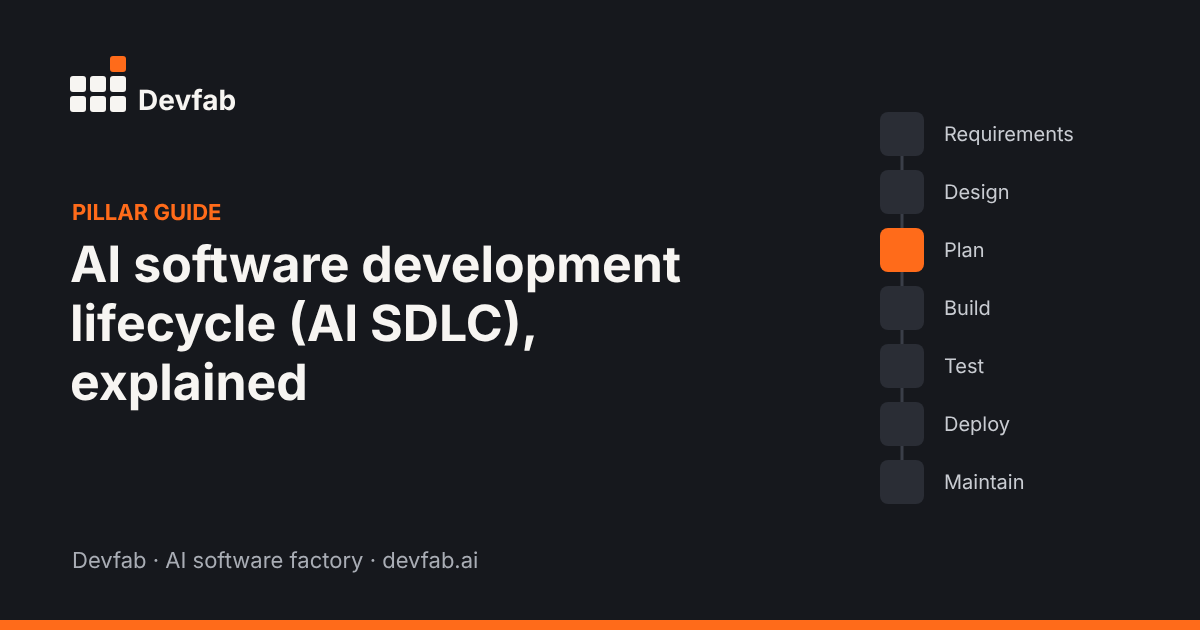
The stages, and what AI does at each
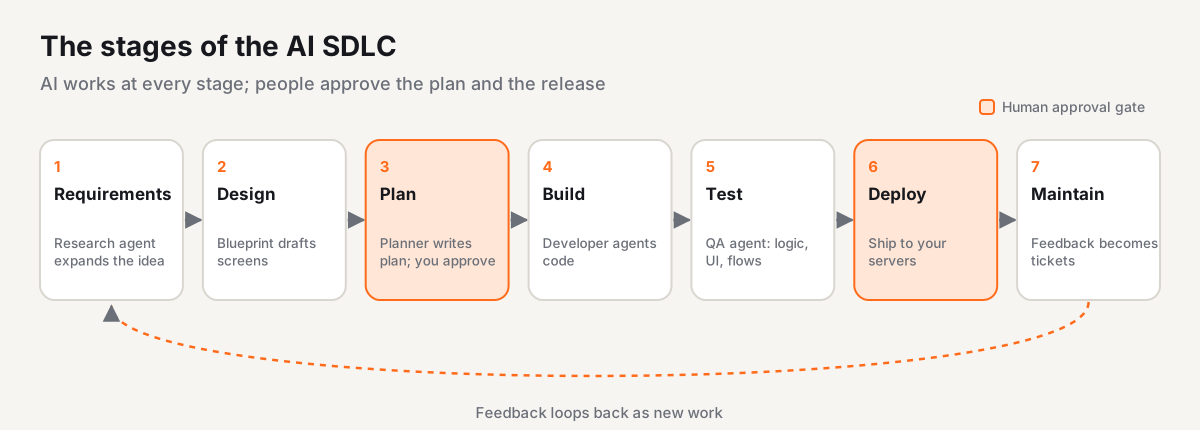
1. Requirements
Before AI: workshops, documents, back-and-forth emails. With AI: a research agent expands a short idea into a spec: users and roles, flows, data, rules, and the domain terms and practices of the industry. It asks clarifying questions instead of guessing. People: describe the need and correct the spec.
2. Design
Before AI: wireframes and mock-ups by a designer. With AI: a blueprint agent drafts screens and flows from the spec, so people can react to something concrete. People: choose, adjust and approve the direction.
3. Planning
Before AI: a tech lead breaks work into tickets and estimates. With AI: a planner agent writes the implementation plan (data model, tasks, order, risks) and splits it into tickets. People: review and approve the plan. This is the most valuable checkpoint in the lifecycle.
4. Build
Before AI: developers write all the code. With AI: coding assistants suggest code; coding agents make multi-file changes and open pull requests; in a factory, a coordinator assigns tickets to several developer agents in parallel. People: review changes, handle hard problems, make architecture calls.
5. Test
Before AI: developers and QA engineers write and run tests. With AI: a QA agent runs logic and unit tests plus UI and flow tests that click through screens and journeys, separately from the agent that wrote the code. People: review the test report and decide what's acceptable.
6. Deploy
Before AI: release engineers and pipelines. With AI: agents prepare environments, run checks and deploy, ideally to infrastructure the customer controls. People: approve the release.
7. Maintain and improve
Before AI: support tickets, triage meetings, bug-fix sprints. With AI: agents categorise and prioritise user reports, reproduce bugs, fix them with awareness of what depends on the changed code, test, and tell the reporter when it's done. People: talk to customers and set priorities.
The four levels of AI adoption
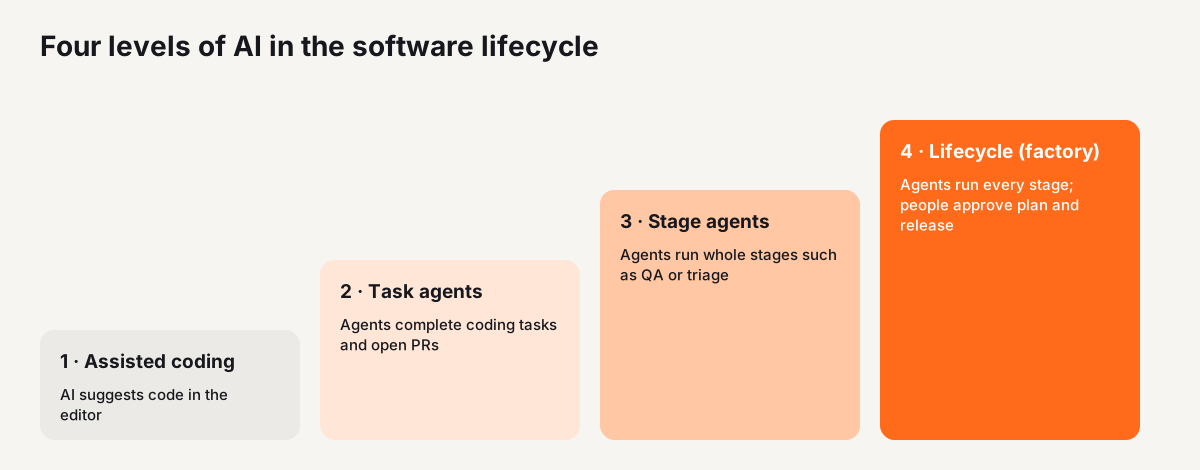
| Level | What AI does | Where people spend time | Typical tools |
|---|---|---|---|
| 1. Assisted coding | Suggests code inside the editor | Everything except typing | Inline assistants |
| 2. Task agents | Completes coding tasks, opens PRs | Planning, review, testing, release | Coding agents, cloud agents |
| 3. Stage agents | Runs whole stages (e.g., QA, triage) | Coordination between stages | Separate agents per stage |
| 4. Lifecycle (factory) | Runs every stage with gates | Approving plans and releases, customers | AI software factory |
Most teams in 2026 are at level 1 or 2. Moving up isn't about better models; it's about connecting the stages so work flows from one to the next with clear approval points.
Who does what: agents and people
As AI takes on more stages, the human job narrows to the decisions that need judgment:
- Deciding what to build and why
- Approving the plan before code is written
- Reviewing results and deciding what ships
- Talking to customers and setting priorities
Everything between those decisions can increasingly be done by agents.
How it differs from coding agents and app builders
| Aspect | Coding agent | AI app builder | AI SDLC run by a factory |
|---|---|---|---|
| Stages covered | Build | Design, build, hosting | All seven |
| Plan approval | Optional | Rare | Built in |
| Separate QA | Up to you | Varies | Built in |
| Deploy to your infrastructure | Up to you | Usually the builder's hosting | Yes |
| After launch | Up to you | Limited | Feedback becomes tickets |
Risks to manage
- Speed without stability. Google's DORA research found in 2025 that AI adoption is associated with higher delivery throughput but also rising instability. Keep testing and review in step with output.
- Silent assumptions. Agents fill gaps in requirements. Plan approval catches them.
- Changes that break connected code. Use dependency awareness on existing codebases.
- Unpredictable cost. Track cost per task and per project.
- Lock-in. Keep code in your own repository and deploy to infrastructure you control.
How to start
- Pick one real project, small but useful.
- Write a one-page spec.
- Use plan approval as your first gate, even if everything else stays manual.
- Add a separate QA step.
- Measure lead time, change fail rate, rework and cost per task before and after.
- Connect the stages, so the output of one is the input of the next.
Where Devfab fits
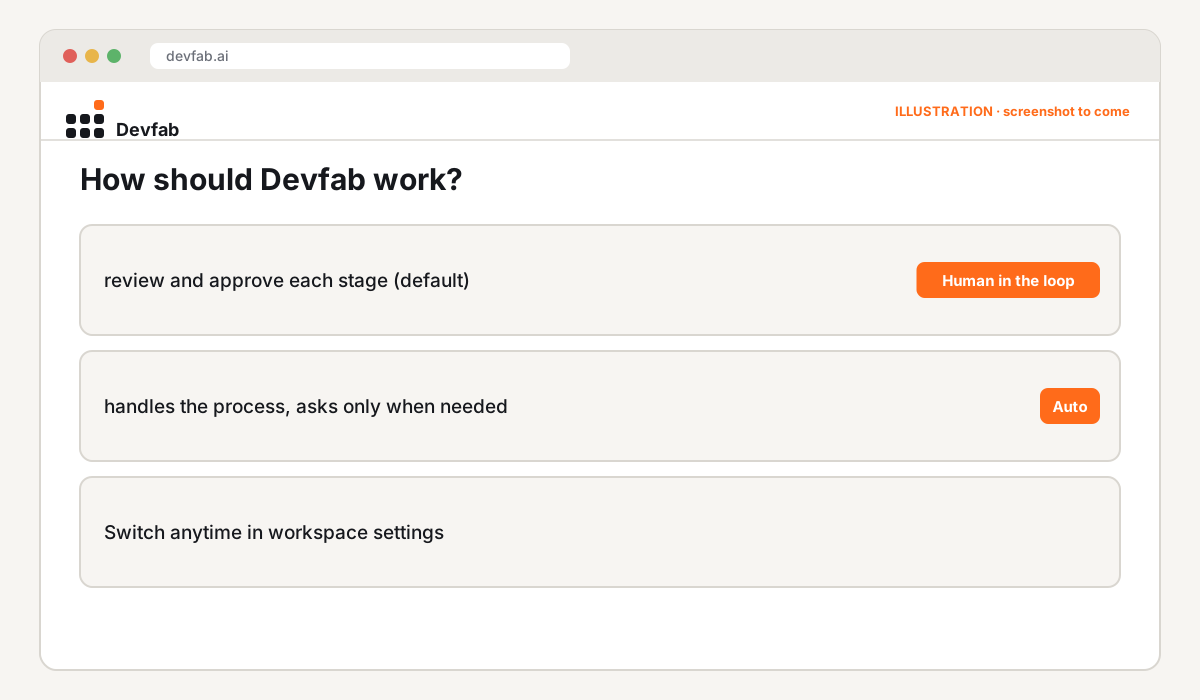
Devfab is an AI software factory: level 4 on the scale above. Its agents (Researcher, Blueprint, Planner, Coordinator, developer agents with ChainFlow, QA agent and Deploy) each run a stage, and you choose how closely to steer: Human in the loop stops for your approval at each stage; Auto runs through and asks only when it needs you.
FAQ
What is the AI SDLC?
The software development lifecycle with AI doing part or most of the work at each stage (requirements, design, planning, build, test, deploy and maintenance), while people approve key decisions.
Is AI SDLC the same as agentic SDLC?
Agentic SDLC is the more advanced form, where agents carry out the stages rather than just assisting people.
Which stage benefits most from AI?
Coding gets the most attention, but planning and testing often give the biggest gains, because they decide how much rework happens later.
Do we need new tools for an AI SDLC?
You can start with the tools you have by adding plan approval and separate QA. A software factory connects all the stages in one place.
Read next
- What is an AI software factory?
- What is Agentic SDLC?
- How to measure AI developer productivity
- How to review a plan written by an AI agent
- How to use AI agents on a large existing codebase
- Autonomous software lifecycle
Try the full lifecycle on one project. Join the Devfab Beta.
Sources: Google Cloud DORA, 2025 year in review; InfoQ: DORA State of AI-assisted Software Development 2025.
Frequently asked questions
What is the AI SDLC?
The software development lifecycle with AI doing part or most of the work at each stage (requirements, design, planning, build, test, deploy and maintenance), while people approve key decisions.
Is AI SDLC the same as agentic SDLC?
Agentic SDLC is the more advanced form, where agents carry out the stages rather than just assisting people.
Which stage benefits most from AI?
Coding gets the most attention, but planning and testing often give the biggest gains, because they decide how much rework happens later.
Do we need new tools for an AI SDLC?
You can start with the tools you have by adding plan approval and separate QA. A software factory connects all the stages in one place.