Short answer: Emergent wins when one build has to produce a web app and an App Store or Google Play app, or when you want to choose the model and bring your own keys. Lovable wins for web apps you'll hand to a developer later, thanks to two-way GitHub sync, ZIP export, Plan mode and enterprise controls.
You run an agency or a small team, and clients keep asking for "an app". Sometimes they mean a web dashboard. Sometimes they mean something in the App Store. Emergent and Lovable both turn a chat into a hosted app, and both publish comparisons. Emergent's own page even concedes several categories to Lovable. This page sorts the claims by source and tells you which tool to pick for which brief.
In this comparison:
- Emergent and Lovable at a glance
- Feature comparison
- Cost model by team size
- Where Emergent wins and where Lovable wins
- Switching from one to the other
Use the sections below as your checklist.
Emergent and Lovable at a glance
Emergent is a chat-driven platform where you "chat with AI agents that design, code, and deploy your application." It targets SMB owners, IT agencies, product managers, operations teams, beginners and experienced developers. The default stack is React or Next.js with Tailwind on the front end, React Native with Expo for mobile, Python FastAPI or Next.js API routes, and MongoDB Atlas. You pick an agent tier (E1, E2 or E3) and an LLM separately. 2026 change: Emergent launched Emmy, a free in-product assistant, on July 31, 2026.
Lovable is a browser-based AI app builder from Stockholm, founded in 2023 as GPT Engineer. It targets people with no coding experience and developers who read and edit the generated code. 2026 changes: new apps use TanStack Start since May 13, 2026; one unified credit balance has applied since June 1, 2026; and from September 9, 2026, Free and Pro data may be used for model training unless users opt out.
Emergent's own comparison (updated September 1, 2026) names itself the winner for deployment and backend, and names Lovable the winner for interface design, testing paths and code handoff. That's a useful starting point, and the docs mostly back it up.
Feature comparison
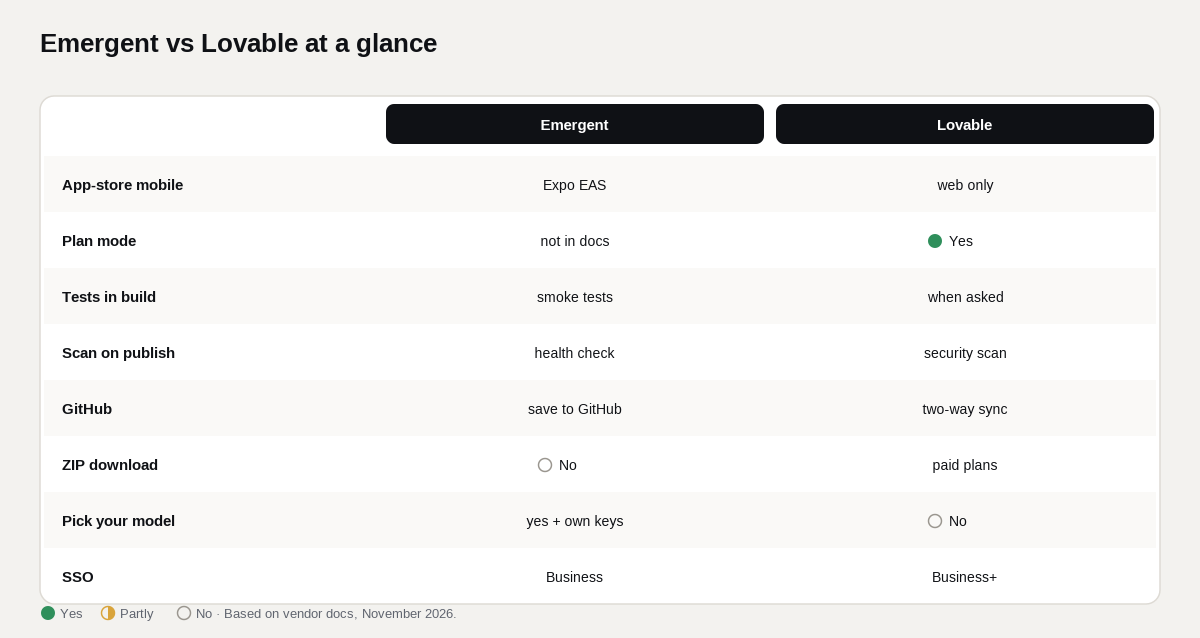
| Aspect | Emergent | Lovable | Source |
|---|---|---|---|
| Where it runs | Web app; building from a phone is supported | Web app with chat, code editor and preview; iOS and Android app for building | Emergent help · Lovable FAQ |
| Output | Web apps plus React Native mobile apps submitted to App Store and Google Play | Web apps only; no React Native projects | Emergent FAQ · Lovable FAQ |
| Planning / spec | Chat with agents; Emmy assistant in product | Plan mode writes a plan for approval; Chat mode makes no changes | Emmy launch · Lovable FAQ |
| Testing | Unit, integration and basic end-to-end smoke tests during the build; pre-publish health check | Browser tests and frontend tests when asked; Quick security scan on every publish | Emergent FAQ · Lovable FAQ |
| Deploy / hosting | Runs on an emergent.host URL behind a CDN; each published app billed monthly in credits | Publish to an HTTPS URL; custom domains on paid plans | Emergent deployment · Lovable FAQ |
| Code ownership / export | Save to GitHub on Standard and above; no ZIP; no mid-job sync | Two-way GitHub sync on one branch; GitLab and Bitbucket; ZIP on paid plans | Emergent FAQ · Lovable GitHub |
| Team / admin | Business: RBAC, SSO, shared workspaces, co-editing; Enterprise: audit logs, deploy to your own cloud | Roles and per-person drafts; SSO from Business; SCIM and audit logs on Enterprise | Emergent pricing · Lovable Enterprise |
| Model choice | Agent tier plus LLM; bring your own OpenAI, Anthropic or Google keys | Lovable selects the model | Emergent FAQ · Lovable FAQ |
| Pricing model | Credits; Free, Standard, Pro, Business, Enterprise | Credits, not seats; Free, Pro, Business, Enterprise | Emergent pricing · Lovable plans |
Cost model by team size
| Team size | Emergent | Lovable | Devfab |
|---|---|---|---|
| 1 person | Free plan with a small monthly credit allowance; Standard adds Save to GitHub; Pro adds Maxx mode | Free plan builds and publishes with daily credits; Pro adds monthly credits and ZIP export | Cost logged per task and per project (Beta) |
| 5 people | Business (custom) for RBAC, SSO, shared workspaces and co-editing | Credits, not seats; collaborators spend the owner workspace's credits; SSO from Business | Cost logged per task and per project (Beta) |
| 25 people | Enterprise (custom): audit logs, self-hosted database, deploy to your own cloud | Enterprise (custom): SCIM, audit logs, publish approval gates | Cost logged per task and per project (Beta) |
The hidden line item is hosting. On Emergent, every published app consumes credits each month while it is live. A review by eesel AI (June 2026; eesel sells a competing product) adds that Emergent's credit burn is hard to predict. Emergent's own page warns that the two vendors' credits "don't represent equal work." Check Emergent's pricing page and Lovable's plans page.
Where Emergent wins
- One brief, web and mobile. Emergent builds React Native apps with Expo and submits them to the App Store and Google Play through Expo EAS.
- Model choice and your own keys. Pick an agent tier and an LLM, or bring OpenAI, Anthropic or Google keys.
- Data not used for training. Emergent's FAQ says your data isn't used to train AI models.
- Your own cloud at the top tier. Enterprise adds a self-hosted database and deploy to your own VPC.
- AI features fast. A Universal LLM Key and integrations such as Stripe, Twilio, Resend and Shopify are in the catalogue.
Where Lovable wins
- Code handoff. Two-way GitHub sync, GitLab and Bitbucket, and a full ZIP on paid plans. Emergent's own page says Lovable's sync "is more developed."
- Plan before build. Plan mode writes a plan you approve before code changes.
- Security and compliance. A Quick security scan runs on every publish; Lovable holds SOC 2 Type II and ISO 27001:2022.
- Team working. Several people work in one project, each in their own draft that is accepted into the project.
Know the limits on both sides: Lovable's terms exclude health, payment card and government ID data, and Emergent processes data in the US and India with no self-serve EU-only hosting.
Switching from one to the other
Emergent to Lovable. On Standard or above, use Save to GitHub. Lovable's Git sync always creates a new repository and cannot link an existing one, so rebuild the web app in Lovable with the repo as reference. The mobile app has no Lovable equivalent; keep it elsewhere.
Lovable to Emergent. Sync to GitHub or download the ZIP. Emergent imports an existing codebase only when you create a new job, so start a new job from that repo rather than syncing mid-job.
Where Devfab fits
Agencies use both tools to show a client something fast. The gap comes after the demo: a plan the client signs off, tickets, tests of real user journeys, a deploy to the client's server and a manual.
App builders automate the first version. Devfab automates the development lifecycle.
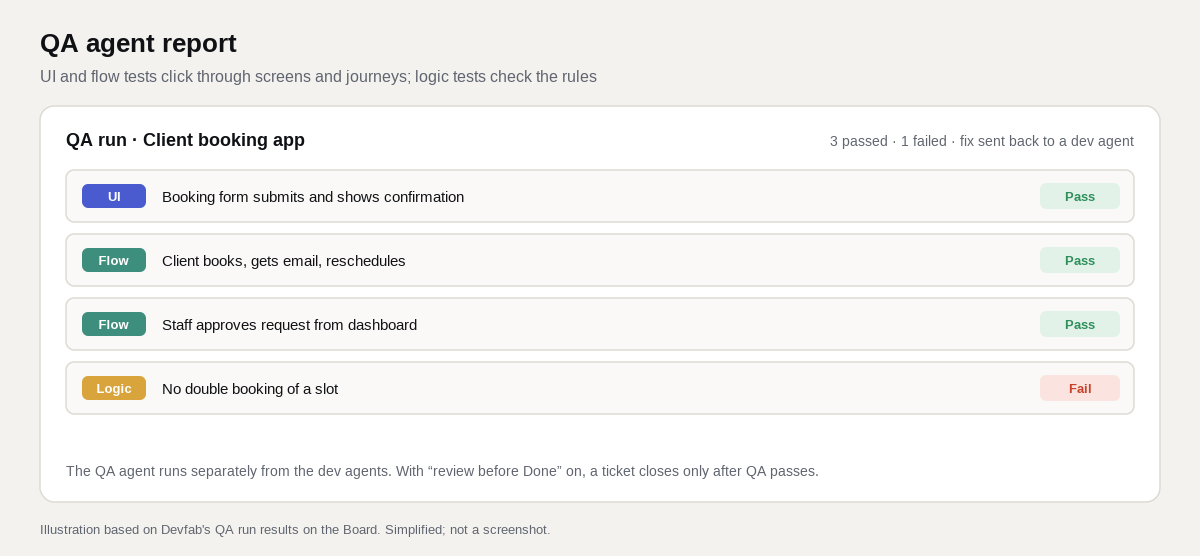
Devfab is an AI software factory. Its research step maps the client's domain first: key terms, best practices and competitors. A person approves the plan, the Coordinator creates tickets, and the QA agent runs UI and flow tests plus logic tests, with an option to require QA review before a ticket is Done. The code stays in your own GitHub account (or your client's organization), and cost is logged after each run, per task and per project.
Devfab's honest limits: it is new and in Beta, with a smaller community and fewer integrations. It is not an editor for hands-on coding, it needs a GitHub account, and it deploys to your own server rather than hosting apps for you. If the job is a quick demo for a pitch, Emergent or Lovable gets there with less process.
FAQ
Can Lovable build an App Store app like Emergent?
Not directly. Lovable's FAQ says it builds web apps only, with no React Native projects. Emergent builds React Native apps with Expo and submits them to the App Store and Google Play through Expo EAS, using your own developer accounts.
Which one costs more to keep an app online?
It depends on the app count. Emergent bills each published app monthly in credits. Lovable uses one credit balance for building, hosting and its built-in backend. Compare both against the number of apps you will keep live.
Is my data used to train AI models?
Emergent's FAQ says your data isn't used to train AI models. Lovable says that since September 9, 2026, Free and Pro data may be used for training unless users opt out; Business and Enterprise are excluded by default.
Can I choose the AI model?
On Emergent, yes: you pick an agent tier and an LLM, and can bring your own OpenAI, Anthropic or Google keys. On Lovable, no: Lovable selects the model.
Read next
- What is an AI software factory?
- Emergent alternatives
- Emergent vs Bolt.new
- How to send a working prototype with every proposal
Turn the demo into a delivered project. Try Devfab Beta
Sources (checked November 13, 2026): Emergent home; Emergent pricing; Emergent Help Center FAQs; Introduction to Emergent; Emergent features and tools; Deployment on Emergent; Meet Emmy (Jul 31, 2026); Emergent: Emergent vs Lovable (updated Sep 1, 2026); eesel AI: Emergent AI pricing (Jun 2026); Lovable FAQ; Lovable for Enterprise; Lovable GitHub Git sync; Lovable plans and credits; Lovable subscription plans; Lovable collaboration.
Frequently asked questions
Can Lovable build an App Store app like Emergent?
Not directly. Lovable's FAQ says it builds web apps only, with no React Native projects. Emergent builds React Native apps with Expo and submits them to the App Store and Google Play through Expo EAS, using your own developer accounts.
Which one costs more to keep an app online?
It depends on the app count. Emergent bills each published app monthly in credits. Lovable uses one credit balance for building, hosting and its built-in backend. Compare both against the number of apps you will keep live.
Is my data used to train AI models?
Emergent's FAQ says your data isn't used to train AI models. Lovable says that since September 9, 2026, Free and Pro data may be used for training unless users opt out; Business and Enterprise are excluded by default.
Can I choose the AI model?
On Emergent, yes: you pick an agent tier and an LLM, and can bring your own OpenAI, Anthropic or Google keys. On Lovable, no: Lovable selects the model.