Short answer: Emergent wins when you want agents to design, build, test and deploy for you, including React Native apps submitted to the App Store and Google Play, with a choice of model. Bolt.new wins when you want a full dev environment in the browser, more ways to start (Figma, GitHub, Lovable) and code you can edit yourself.
You need an app in your customers' hands, web and maybe mobile, and you have no engineering team. Emergent and Bolt.new both promise that from a chat box. Reviews often pick a winner on demo speed. The bigger differences show up later: testing, app store release, and what it costs to keep the app online. This page referees those, with sources.
In this comparison:
- Emergent and Bolt.new at a glance
- Feature comparison
- Cost model by team size
- Where Emergent wins and where Bolt.new wins
- Switching from one to the other
Here is what the vendor docs say, section by section.
Emergent and Bolt.new at a glance
Changes in 2026
- Emergent launched Emmy, a free in-product assistant, on July 31, 2026.
- Bolt.new ran Bolt Forge as a research preview from September 14 to October 14, 2026, for individual Pro users, using open models with opt-in sharing of anonymized sessions (SD Times). Teams and Enterprise were excluded.
Emergent
Emergent is a chat-driven platform where you "chat with AI agents that design, code, and deploy your application." It targets SMB owners, IT agencies, product managers, operations teams and beginners. The default stack is React or Next.js with Tailwind and shadcn/ui, Python/FastAPI or Next.js API routes, MongoDB Atlas and Stripe, varying with your app. Agents run automated unit, integration and basic end-to-end smoke tests during the build, plus a health check before publishing. You choose an agent tier (E1, E2, E3) and the model separately, and can bring your own OpenAI, Anthropic or Google keys.
Bolt.new
Bolt.new, from StackBlitz, runs a whole development environment in the browser on WebContainers, "so you don't have to install anything." Start from a prompt, a Figma frame, Google Stitch designs, a GitHub repo or a Lovable project. Plan mode works through strategy without writing code. Bolt Cloud bundles hosting on a free bolt.host subdomain, databases, auth, file storage, server functions and Stripe payments. Native mobile apps come through Expo. "Bolt handles model selection behind the scenes." It lists SOC 2 Type II.
Feature comparison
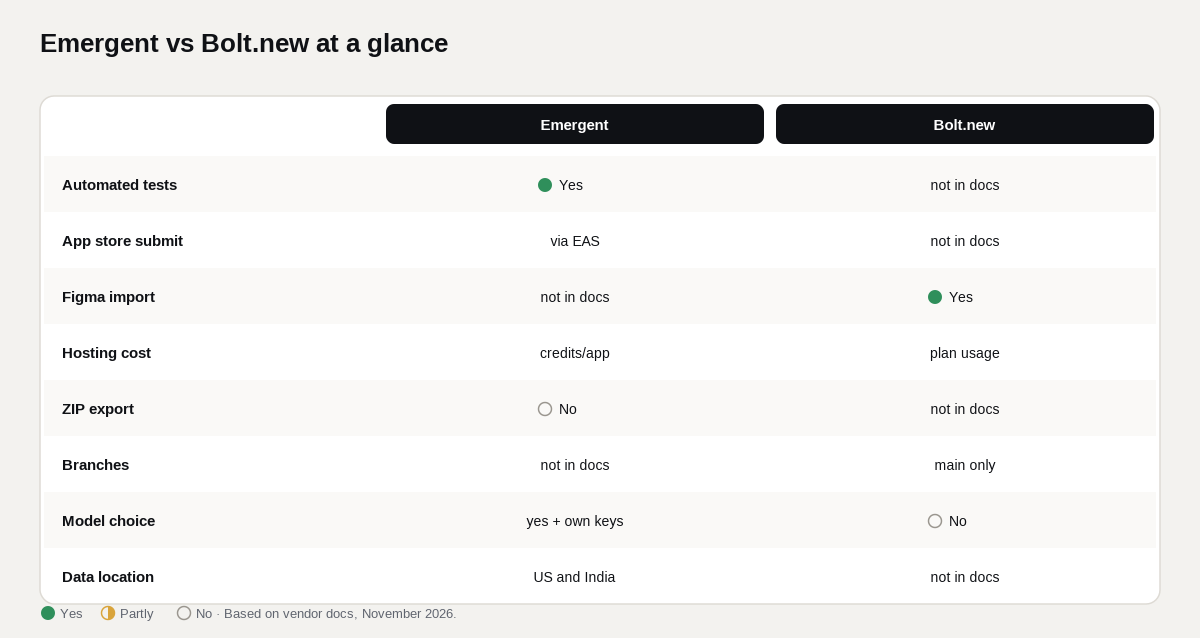
| Aspect | Emergent | Bolt.new | Source |
|---|---|---|---|
| Where it runs | Web app; building from a phone supported | Browser dev environment on WebContainers | Emergent help; Intro to Bolt |
| Planning / spec | Agents design, code and deploy from chat | Plan mode: strategy without code | Emergent; Bolt glossary |
| Testing | Unit, integration and end-to-end smoke tests; pre-publish health check | Version history to restore saved states | Emergent FAQs; Bolt glossary |
| Mobile | React Native via Expo; submits to App Store and Google Play | Native apps via Expo | Emergent FAQs; Intro to Bolt |
| Deploy / hosting | emergent.host behind a CDN; each app billed monthly in credits | Bolt Cloud; site stops if hosting usage runs out | Emergent deployment; Bolt Cloud |
| Code and Git | Save to GitHub on Standard+; no ZIP; import only at job start | Import repos or create a private repo; stays on main | Emergent FAQs; Bolt Git |
| Team / admin | Business: RBAC, SSO, co-editing; Enterprise: audit logs, deploy to your VPC | Teams: central billing, access management; Enterprise: SSO, audit logs | Emergent pricing; Bolt pricing |
| Model choice | Pick agent tier and LLM; bring your own keys | Bolt picks; Standard or Max agent | Emergent FAQs; Bolt agents |
| Pricing model | Credits | Tokens; Teams per member | Emergent pricing; Bolt pricing |
Cost model by team size
| Team size | Emergent | Bolt.new |
|---|---|---|
| 1 person | Free (10 credits a month); Standard USD 20 a month for 100 credits | Free: monthly token allowance with a daily limit; Pro USD 25 a month, no daily limit |
| 5 people | Pro USD 200 a month for 750 credits (Maxx mode); Business (custom) for RBAC, SSO and shared workspaces | Teams USD 30 per member a month; each member's tokens are their own |
| 25 people | Enterprise (custom): audit logs, self-hosted database support, deploy to your VPC | Enterprise (custom): SSO and audit logs |
Prices are from Emergent's pricing page and Bolt's pricing page, as of November 2026. Add hosting: each published Emergent app costs 50 to 1,100 credits a month depending on the publishing tier. A review by eesel AI (June 2026; the vendor sells a competing product) says Emergent's credit burn is hard to predict and fixes cost extra credits. Bolt's paid-plan tokens roll over for up to two months. Devfab (Beta), for reference, logs cost after each run, per task and per project.
Where Emergent wins
- You want tests run for you. Agents run unit, integration and smoke tests during the build.
- You need an app store release. React Native apps submitted through Expo EAS.
- You want model control. Choose the agent tier and model, or bring your own keys.
- Enterprise wants its own cloud. Deploy to your VPC on Enterprise.
Where Bolt.new wins
- You start from a design or another tool. Figma, Google Stitch, GitHub or a Lovable project.
- You want to edit code directly. A full dev environment in the browser, nothing to install.
- You want a simple monthly bill. Hosting is part of plan usage, not a per-app credit charge.
- Git sync is live. Bolt auto-commits each non-breaking change and pulls outside changes.
Switching from one to the other
Emergent to Bolt.new. Use Save to GitHub (Standard plan and above); Emergent has no ZIP download button. Then import that repo in Bolt. Check the stack: Emergent's default backend is Python/FastAPI with MongoDB Atlas, so confirm it runs in Bolt's browser environment.
Bolt.new to Emergent. Connect Bolt to GitHub (owner only) and create a private repo. In Emergent, import the existing codebase when you create a new job. Emergent has no mid-job sync, so finish edits in Bolt first.
Where Devfab fits
Both tools build and host apps from chat. A client project usually needs more: domain research, a plan someone approves, tests on real user journeys, and an app on the client's own server rather than a builder's host.
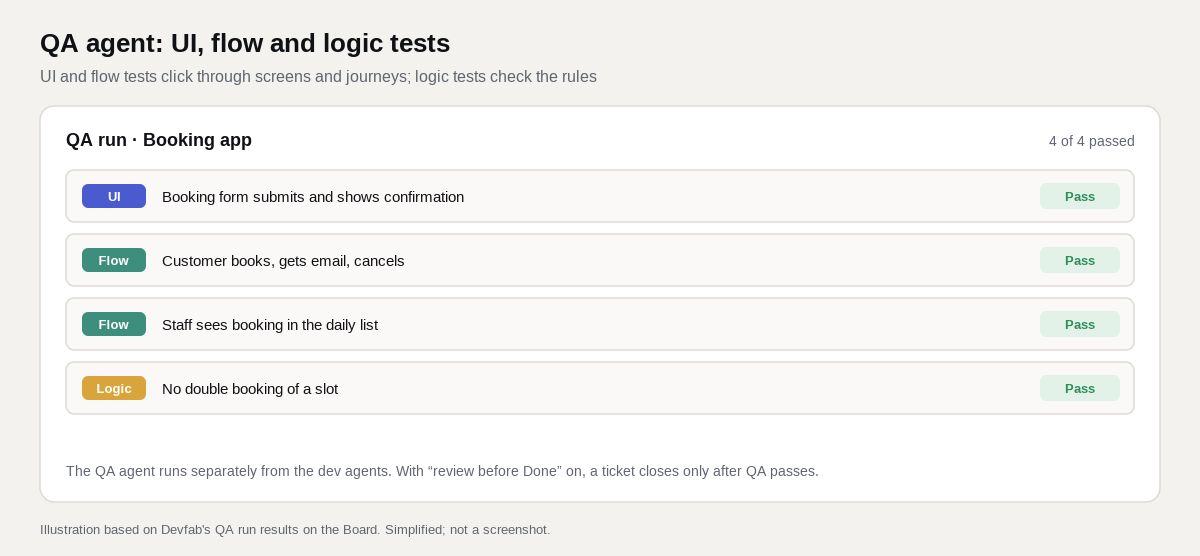
App builders automate the first version. Devfab automates the development lifecycle. Devfab's Researcher maps the domain before the Planner writes. A person approves the plan. The QA agent runs UI and flow tests (screens, buttons and user journeys clicked end to end) plus logic tests, and the "QA agent · review before Done" switch adds that review before a ticket is marked done. Code goes to your own GitHub account (or your organization's), and Deploy ships to your own server.
Devfab's honest limits: it is new and in Beta, with a smaller community and fewer integrations. It is not an editor for hands-on coding, and it needs a GitHub account. For a quick mobile prototype, Emergent or Bolt.new is the simpler pick. See Devfab vs Bolt.new.
FAQ
Which one can publish to the App Store and Google Play?
Emergent says it builds React Native apps and submits them to the App Store and Google Play through Expo EAS, using your own developer accounts. Bolt.new builds native mobile apps through its Expo integration; app store submission was not covered in the Bolt docs we checked.
What does it cost to keep an app live?
On Emergent, each published app is billed monthly in credits, from 50 credits a month at the Starter publishing tier up to 1,100. On Bolt.new, hosting is part of your plan's usage; if it runs out, the site stops displaying publicly until your usage resets.
Can I move an Emergent app to Bolt.new?
Yes, through GitHub. Save the Emergent project to GitHub (Standard plan and above), then import that repo in Bolt. Emergent has no ZIP download button. Going the other way, Emergent imports an existing codebase only when you create a new job.
Where is my data stored?
Emergent says data is processed and stored in the US and India, it is not used to train AI models, and there is no self-serve EU-only hosting. Bolt lists SOC 2 Type II; data location was not covered in the Bolt docs we checked.
Read next
- What is an AI software factory?
- Emergent alternatives
- Bolt.new alternatives
- Emergent vs Lovable
- Devfab vs Bolt.new
Want the app on your own server? Try Devfab Beta
Sources (checked November 13, 2026): Emergent home; Emergent pricing; Emergent Help Center FAQs; Introduction to Emergent; Emergent features and tools; Deployment on Emergent; Meet Emmy (Jul 31, 2026); eesel AI: Emergent pricing (Jun 25, 2026); Intro to Bolt; Bolt glossary; Bolt: choose an agent; Bolt Git integration; What is Bolt Cloud?; Bolt pricing; SD Times: Bolt.new launches Forge (Sep 17, 2026).
Frequently asked questions
Which one can publish to the App Store and Google Play?
Emergent says it builds React Native apps and submits them to the App Store and Google Play through Expo EAS, using your own developer accounts. Bolt.new builds native mobile apps through its Expo integration; app store submission was not covered in the Bolt docs we checked.
What does it cost to keep an app live?
On Emergent, each published app is billed monthly in credits, from 50 credits a month at the Starter publishing tier up to 1,100. On Bolt.new, hosting is part of your plan's usage; if it runs out, the site stops displaying publicly until your usage resets.
Can I move an Emergent app to Bolt.new?
Yes, through GitHub. Save the Emergent project to GitHub (Standard plan and above), then import that repo in Bolt. Emergent has no ZIP download button. Going the other way, Emergent imports an existing codebase only when you create a new job.
Where is my data stored?
Emergent says data is processed and stored in the US and India, it is not used to train AI models, and there is no self-serve EU-only hosting. Bolt lists SOC 2 Type II; data location was not covered in the Bolt docs we checked.