Short answer: Lovable wins when you want a hosted web app with a built-in backend, Plan mode, team roles and enterprise SSO, all billed by credits. Rocket.new wins when you want market research and a PRD before the build, Flutter mobile apps next to Next.js web apps, and GitHub sync that opens pull requests to main.
You have an idea and a deadline, and two prompt-to-app tools on the shortlist. Fans of Lovable say it is the simplest way to get a working web app online. Fans of Rocket.new say it does more: research, a spec, web and mobile in one place. Both camps are partly right. The real split is what you need on day one: a hosted web app, or research and a mobile app too.
In this comparison:
- Lovable and Rocket.new at a glance
- Feature comparison
- Cost model by team size
- Where Lovable wins
- Where Rocket.new wins
Each claim below links to the vendor page we checked.
Lovable and Rocket.new at a glance
Status as of November 2026: both tools are active. Lovable moved new apps to TanStack Start with server rendering on May 13, 2026, and from September 9, 2026, data on Free and Pro plans may be used for model training unless users opt out (Lovable FAQ). Rocket.new made Next.js the default for all new web apps in March 2026 and launched GitHub Sync for Next.js projects at the same time (Rocket changelog).
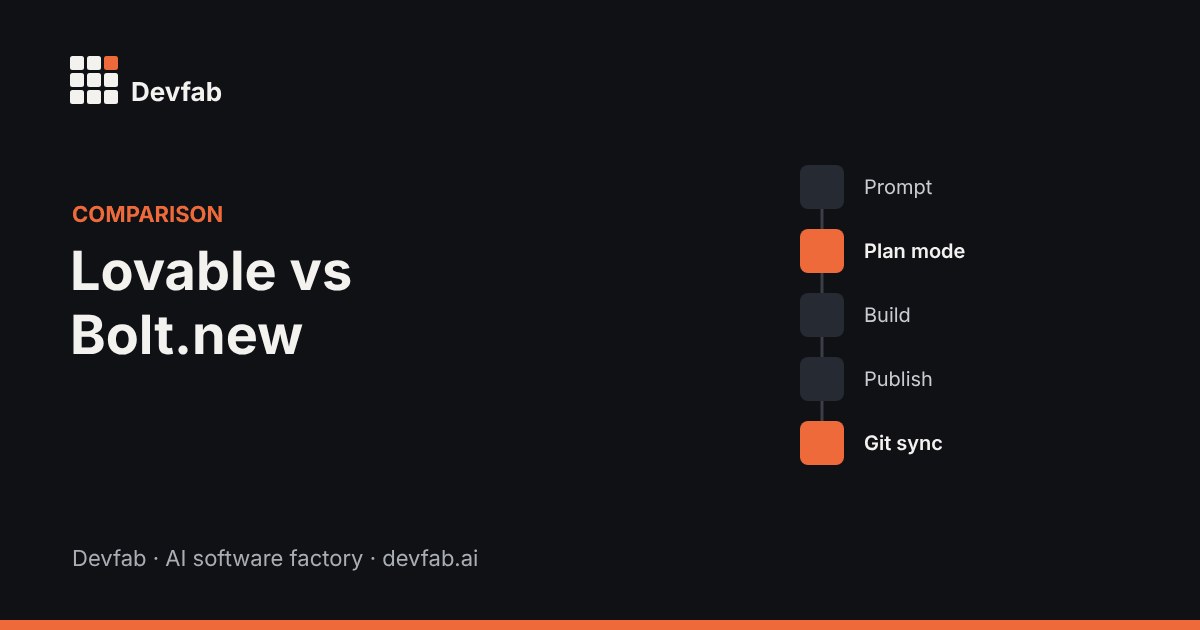
Lovable is a browser-based AI app builder that generates and hosts full-stack web apps from plain-language prompts. Its users range from people with no coding experience to developers who read and edit the code (Lovable FAQ). It has three modes: Build changes the project, Plan writes a plan for approval first, and Chat answers questions without touching code.
Rocket.new calls itself a "vibe solutioning" platform. Solve validates ideas, runs market research and writes PRDs. Build then plans the architecture, writes the code and shows a live preview. Intelligence watches competitors (Rocket docs). Rocket says 1.5 million people have tried it across 180 countries (vendor claim, Rocket homepage).
Think of a clinic booking app. In Lovable you would describe the screens and get a hosted web app with login and a managed database. In Rocket.new you could start with a Solve report on booking apps, then build a web app and a Flutter app for patients.
Feature comparison
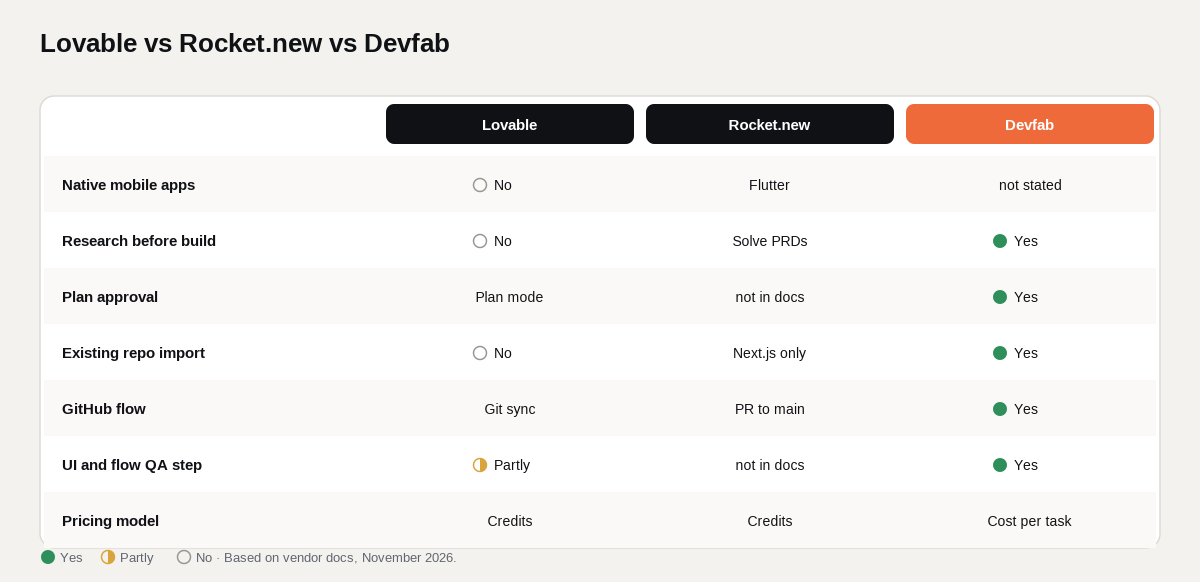
| Aspect | Lovable | Rocket.new | Source |
|---|---|---|---|
| Where it runs | Web app with chat, code editor and preview; iOS and Android app for building from a phone | Hosted web app; refine by Chat, Visual edit or Code editor | Lovable FAQ; Rocket build overview |
| What it builds | Web apps only (TanStack Start for new apps); no framework or database choice | Next.js web apps; Flutter apps for iOS and Android | Lovable FAQ; Rocket intro |
| Planning and spec | Plan mode writes a plan for approval before changes | Solve does market research and writes PRDs before Build | Lovable FAQ; Rocket intro |
| Testing | Tests in a browser and writes frontend tests when asked; security scan on every publish | Polish section covers SEO, accessibility and compliance; a test step is not covered in the docs we checked | Lovable FAQ; Rocket build overview |
| Deploy and hosting | Publish to its own URL with HTTPS; custom domains on paid plans; built-in Postgres, login and storage | One-click launch with custom domains; Android APK, Google Play and App Store for mobile | Lovable FAQ; Rocket build overview |
| Code ownership | Git sync to GitHub, GitLab or Bitbucket (new repo only, one branch); ZIP on paid plans | Pushes to a rocket-update branch and opens a PR to main; ZIP on Pro and above | Lovable GitHub docs; Rocket GitHub docs |
| Team and admin | Viewer, Editor, Admin, Owner roles; SSO from Business; SCIM and audit logs on Enterprise | Unlimited team members on paid plans; SSO via Contact Sales | Lovable collaboration; Rocket pricing |
| Model choice | Lovable picks the model | Connectors for AI models inside apps; model choice for the builder not covered in the docs we checked | Lovable FAQ; Rocket build overview |
| Pricing model | Monthly credits, one balance for building, hosting, backend and AI | One credit pool shared across Build, Solve and Intelligence | Lovable plans; Rocket pricing |
Cost model by team size
| Team size | Lovable | Rocket.new | Devfab |
|---|---|---|---|
| 1 person | Free (5 daily build credits, capped at 30 a month); Pro USD 25 per month (100 credits) | Free (20 one-time credits); Pro USD 25 per month (100 credits) | Cost logged per task and per project (Beta) |
| 5 people | Business USD 50 per month (100 credits, SSO); collaborators spend the owner workspace's credits | Rocket USD 50 per month (250 credits); paid plans include unlimited team members | Cost logged per task and per project (Beta) |
| 25 people | Enterprise, volume-based platform fee (not listed); SCIM, audit logs, publish approval | Booster USD 250 per month (1,500 credits); SSO and data localization via sales | Cost logged per task and per project (Beta) |
Prices as of November 2026 from Lovable pricing and Rocket pricing plans. Both price by plan and credits, not per user, so team cost depends on how many credits the team burns. Devfab is in Beta and offers predictable cost: cost is logged after each run, per task and per project.
Where Lovable wins
- You want one bill for app, hosting and backend. One credit balance covers building, chat, hosting, the managed Postgres backend, in-app AI and connectors.
- Several people edit the same project. Each collaborator works in their own draft that is accepted into the project, with Viewer, Editor, Admin and Owner roles.
- Your security team asks for paperwork. Lovable lists SOC 2 Type II and ISO 27001:2022, SSO via OIDC or SAML, and SCIM and audit logs on Enterprise.
- You need a gate on publishing. Enterprise admins can block publishing or require approval first.
- You want a plan before each change. Plan mode writes a plan you approve before the project changes.
Where Rocket.new wins
- You need native mobile apps. Rocket builds Flutter apps and ships to Google Play and the App Store; Lovable is web only.
- You want research before you build. Solve runs market research and writes PRDs, and Intelligence tracks competitors from the same credit pool.
- Your developers review changes as pull requests. Rocket pushes to a
rocket-updatebranch and opens a PR tomain. - You start from something that exists. Rocket starts from an idea, a URL redesign, a screenshot, a template or a Next.js repo.
- Your whole team should have access. Paid plans include unlimited team members.
Switching from one to the other
From Lovable to Rocket.new. Sync the Lovable project to GitHub, or download the ZIP on a paid plan (Lovable GitHub docs). Rocket's import only accepts Next.js and TypeScript projects, so an older React and Vite Lovable app or a TanStack Start app may not import cleanly (Rocket GitHub docs). Expect to rebuild from a prompt or screenshots instead.
From Rocket.new to Lovable. Download the code on Pro or above, from a web browser (Rocket code editor docs). Lovable's Git sync creates a new repository and cannot link an existing one, so you cannot point Lovable at your Rocket repo. In practice you rebuild in Lovable, using the Rocket PRD as your brief.
Where Devfab fits
Both tools are strongest at the first version. In the docs we checked, neither maps how existing functions and APIs call each other before a change, and neither runs a separate QA step that clicks through user flows before work is marked done.
App builders automate the first version. Devfab automates the development lifecycle. Its Researcher maps the domain, key terms, best practices and competitors before the Planner writes a plan, and a person approves the plan. ChainFlow shows dev agents the impact of a change, so editing the booking flow doesn't quietly break reminders or payments. The QA agent runs UI, flow and logic tests, and code lives in your own GitHub account. Devfab is in Beta, with a smaller community and fewer integrations, and it is not an editor. See Devfab vs Rocket.new and the Rocket.new alternatives list.
FAQ
Is Rocket.new better than Lovable for mobile apps?
For native mobile, yes. Rocket.new builds iOS and Android apps in Flutter and can ship to Google Play and the Apple App Store. Lovable's FAQ says it builds web apps only and does not offer React Native projects.
Do Lovable and Rocket.new charge per user?
No. Both price plans by credits, not seats. Rocket.new says paid plans include unlimited team members. In Lovable, collaborators spend the owner workspace's credits. As of November 2026, both list a Pro plan at USD 25 per month.
Can I bring an existing GitHub repo into Lovable or Rocket.new?
Lovable's Git sync always creates a new repository and cannot link an existing one. Rocket.new can import a GitHub repo, but only for Next.js and TypeScript projects, and only the default branch's latest state comes across.
Which one writes a product spec first?
Rocket.new's Solve mode runs market research and writes PRDs before you build. Lovable's Plan mode writes a plan for approval before it changes the project, but it is a plan for the next change, not a market study.
Read next
Need the app tested and shipped, not just generated? Try Beta
Sources (checked November 2026): Lovable FAQ; Lovable GitHub Git sync; Lovable plans and credits; Lovable collaboration; Lovable for Enterprise; Lovable pricing; Rocket homepage; Rocket docs: Introduction; Rocket docs: Build overview; Rocket docs: Pricing plans; Rocket docs: From GitHub; Rocket docs: Code editor; Rocket changelog, March 2026.
Frequently asked questions
Is Rocket.new better than Lovable for mobile apps?
For native mobile, yes. Rocket.new builds iOS and Android apps in Flutter and can ship to Google Play and the Apple App Store. Lovable's FAQ says it builds web apps only and does not offer React Native projects.
Do Lovable and Rocket.new charge per user?
No. Both price plans by credits, not seats. Rocket.new says paid plans include unlimited team members. In Lovable, collaborators spend the owner workspace's credits. As of November 2026, both list a Pro plan at USD 25 per month.
Can I bring an existing GitHub repo into Lovable or Rocket.new?
Lovable's Git sync always creates a new repository and cannot link an existing one. Rocket.new can import a GitHub repo, but only for Next.js and TypeScript projects, and only the default branch's latest state comes across.
Which one writes a product spec first?
Rocket.new's Solve mode runs market research and writes PRDs before you build. Lovable's Plan mode writes a plan for approval before it changes the project, but it is a plan for the next change, not a market study.