Short answer: Replit wins when you want a cloud workspace where the code is always open, several runtime types and mature admin controls. Emergent wins when a non-developer needs one chat-driven tool that builds a web app and an app-store mobile app, with tests, hosting and a universal AI key included.
Your operations lead wants a field-service app: a web dashboard for dispatch and a phone app for technicians. You don't have a mobile developer. Replit and Emergent both promise to build it from chat. One camp says Replit is the safer, more open platform. The other says Emergent covers mobile without extra work.
This page weighs both, with vendor docs and pricing pages checked in November 2026.
In this comparison:
- Replit and Emergent at a glance
- Feature comparison
- Cost model by team size
- Where Replit wins
- Where Emergent wins
Pick the section that matches your question.
Replit and Emergent at a glance
Replit is a cloud development platform. Its Agent builds, tests and publishes apps from plain-language requests in Replit's browser workspace (Replit Agent overview). Agent 4 launched in March 2026 and runs tasks in parallel (Dealroom, Mar 11, 2026). Core allows one parallel Agent task and Pro up to ten (Replit pricing docs). Since November 6, 2026, the Agent can troubleshoot support issues inside the chat (Replit changelog).
Emergent is a chat-driven platform where you "chat with AI agents that design, code, and deploy your application" (Emergent). It names SMB owners, IT agencies, product managers and operations teams as users. It added Emmy, a free in-product assistant, on July 31, 2026 (Emergent blog). The default stack is React or Next.js with Tailwind and shadcn/ui, React Native with Expo for mobile, Python FastAPI or Next.js API routes, and MongoDB Atlas (Emergent FAQs).
Both are active, and neither changed owner in 2026.
Feature comparison
| Aspect | Replit | Emergent | Source |
|---|---|---|---|
| Where it runs | Browser cloud workspace | Web app; building from a phone supported | Replit Agent; Emergent help |
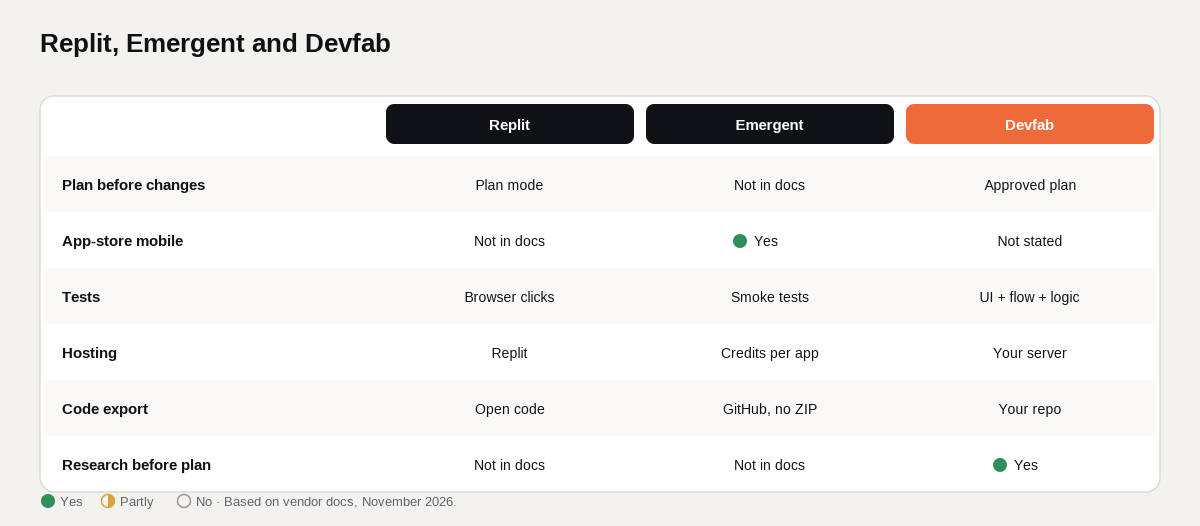
| Planning | Plan mode: task list to approve before changes | Not covered in the docs we checked | Replit Agent |
| Agent and models | Free, Power, Max modes; Auto picks a model per paid task | E1, E2, E3 agent tiers; LLM chosen separately; BYO keys or Universal LLM Key | Replit Agent; Emergent FAQs |
| Testing | App Testing clicks through the app in a browser (Full Stack JS, Streamlit) | Unit, integration and basic end-to-end smoke tests during the build; pre-publish health check | Replit App Testing; Emergent FAQs |
| Mobile | Not covered in the docs we checked | React Native apps submitted to App Store and Google Play via Expo EAS | Emergent FAQs |
| Deploy and hosting | Autoscale, Reserved VM, Static, Scheduled; custom domains | emergent.host URL behind a CDN, billed monthly in credits per app | Replit publish; Emergent deployment |
| Code export | Code open in the workspace | Save to GitHub on Standard and up; no ZIP download | Emergent FAQs |
| Team and admin | SAML SSO, SCIM; Enterprise RBAC, private deployments, audit logs | Business: RBAC, SSO, shared workspaces; Enterprise: audit logs, deploy to your own cloud (VPC) | Replit Enterprise; Emergent pricing |
| Data location | Enterprise can pin deployment geographies | Processed and stored in the US and India; no self-serve EU-only hosting | Replit Enterprise; Emergent FAQs |
Cost model by team size
| Team size | Replit | Emergent |
|---|---|---|
| 1 person | Starter USD 0; Core USD 20 per month (USD 18 annual) with USD 20 in credits | Free (10 credits per month); Standard USD 20 per month, USD 17 annual (100 credits) |
| 5 people | Pro USD 100 per month (USD 90 annual), USD 100 in credits, up to 15 collaborators | Pro USD 200 per month, USD 167 annual (750 credits) |
| 25 people | Enterprise, custom | Business or Enterprise, custom |
Prices as of November 2026 from Replit pricing and Emergent pricing. Replit prices paid Agent work by effort. Emergent also bills each published app monthly in credits, and a June 2026 review says credit burn is hard to predict (eesel AI; the reviewer sells a competing product).
Where Replit wins
- You want the code in front of you while the Agent works, with checkpoints to roll back.
- You want a plan to approve first. Plan mode lists tasks before changes to code or data.
- Your app needs a specific runtime shape: an always-on VM, scheduled jobs or autoscale.
- Data must stay in a chosen region. Enterprise admins can pin deployment geographies.
- Hosting should not be a per-app monthly credit charge on top of building.
Where Emergent wins
- You need a mobile app in the stores. React Native builds go to the App Store and Google Play through Expo EAS.
- You want tests run during the build without asking: unit, integration and smoke tests, plus a pre-publish check.
- You want AI features wired up fast with the Universal LLM Key, or your own OpenAI, Anthropic or Google keys.
- You plan to deploy into your own cloud. Enterprise lists VPC deployment and self-hosted database support.
- You build from your phone. Emergent supports building from a mobile device.
Switching from one to the other
From Emergent to Replit. Use Save to GitHub (Standard plan and up); there is no ZIP download (Emergent FAQs). Then import the repo at replit.com/import. Secrets and database data are not imported, so reconnect MongoDB Atlas or move the data yourself (Replit import docs).
From Replit to Emergent. Push the code to GitHub, then import it when you create a new Emergent job. Emergent cannot sync a codebase into a job that is already running (Emergent FAQs).
Where Devfab fits
Both tools build and host apps from chat. In the docs we checked, neither runs a research step on your domain before planning, and only Replit asks you to approve a plan.
App builders automate the first version. Devfab automates the development lifecycle. For the field-service app, Devfab's Researcher maps terms such as work order, dispatch and proof of visit, plus best practices and competing products, before the Planner writes a plan. A person approves it, and the QA agent clicks the technician's journey end to end. The code sits in your own GitHub account and deploys to your own server. Devfab is in Beta, with a smaller community, and it needs a GitHub account. Mobile app-store builds are not stated. See Emergent alternatives for more options.
FAQ
Can Emergent build mobile apps for the App Store?
Yes. Emergent builds React Native apps and submits them to the App Store and Google Play through Expo EAS. You need your own Apple and Google developer accounts. Replit's docs we checked describe web apps and other deployment types, not app-store submission.
Do Emergent apps cost money after I publish them?
Yes. Published apps run on an emergent.host URL and each one is billed monthly in credits, from 50 credits a month at the Starter publishing tier up to 1,100. Plan that hosting cost into your budget alongside the build credits.
Which is cheaper, Replit or Emergent?
At the entry level they are close. As of November 2026, Replit Core is USD 20 per month with USD 20 in credits, and Emergent Standard is USD 20 per month with 100 credits. At the top, Replit Pro is USD 100 and Emergent Pro is USD 200 per month. Usage decides the real bill on both.
Can I take my code out of Emergent?
Yes, with limits. Save to GitHub is available on Standard and above. There is no ZIP download button, and an existing codebase can only be imported when you create a new job, not synced mid-job.
Read next
- What is an AI software factory?
- Replit alternatives
- Emergent vs Lovable
- Replit vs Base44
- Field service work order app build
Want the app planned, tested and running on your own server? Try Beta
Sources (checked November 2026): Replit Agent overview; Replit pricing; Replit pricing and plans (docs); Replit App Testing; Replit: Publish your app; Replit Enterprise; Replit: Import from GitHub or ZIP; Replit changelog (Nov 6, 2026); Dealroom: Replit Series D and Agent 4 (Mar 11, 2026); Emergent; Emergent pricing; Emergent Help Center FAQs; Emergent: Introduction; Emergent: Deployment; Meet Emmy (Emergent blog, Jul 31, 2026); eesel AI: Emergent AI pricing 2026 (Jun 2026).
Frequently asked questions
Can Emergent build mobile apps for the App Store?
Yes. Emergent builds React Native apps and submits them to the App Store and Google Play through Expo EAS. You need your own Apple and Google developer accounts. Replit's docs we checked describe web apps and other deployment types, not app-store submission.
Do Emergent apps cost money after I publish them?
Yes. Published apps run on an emergent.host URL and each one is billed monthly in credits, from 50 credits a month at the Starter publishing tier up to 1,100. Plan that hosting cost into your budget alongside the build credits.
Which is cheaper, Replit or Emergent?
At the entry level they are close. As of November 2026, Replit Core is USD 20 per month with USD 20 in credits, and Emergent Standard is USD 20 per month with 100 credits. At the top, Replit Pro is USD 100 and Emergent Pro is USD 200 per month. Usage decides the real bill on both.
Can I take my code out of Emergent?
Yes, with limits. Save to GitHub is available on Standard and above. There is no ZIP download button, and an existing codebase can only be imported when you create a new job, not synced mid-job.