Short answer: Pick Tabnine when your code cannot leave your network: it runs in your VPC, on-premises or fully air-gapped, though Tricentis bought it in July 2026 and has not published a roadmap. Pick GitHub Copilot for most other teams: wider IDE coverage, a free tier, cloud agents that open pull requests and GitHub-native admin.
Your security team said no SaaS AI. Your developers said everyone else has Copilot. Someone has to decide, and it got harder this year because Tabnine changed owners. Both tools now ship agents, so the choice is about far more than autocomplete.
In this comparison:
- Tabnine and GitHub Copilot at a glance
- Feature comparison
- Cost model by team size
- Where Tabnine wins
- Where GitHub Copilot wins
This page acts as referee: sourced facts only, and a winner for each situation.
Tabnine and GitHub Copilot at a glance
Status first: Tabnine is now part of Tricentis
On July 30, 2026, Tricentis announced that it had acquired Tabnine. Terms were not disclosed. Tabnine's Enterprise Context Engine will be built into the Tricentis Agentic Quality Engineering Platform. An August 2026 analysis found only one stated commitment: "Existing customers will continue to receive support for the products they use today." There is no published roadmap for the standalone assistant, and Tricentis shut down an earlier acquired product, Flood.io, in 2024. Ask about the roadmap before signing a long contract.
Tabnine
Tabnine is a privacy-focused coding assistant and agent platform for enterprises. A June 2026 review lists support for VS Code, JetBrains IDEs, Android Studio, Eclipse, Visual Studio 2022/2026 and the Tabnine CLI. It has no Xcode or Emacs support, and Neovim works only through a community plugin.
Its main draw is deployment: SaaS, your own VPC on AWS, GCP or Azure, on-premises, or fully air-gapped. The Enterprise Context Engine, launched in March 2026, builds a continuously updated knowledge graph of an organization's code, docs, tickets and APIs. It is used for dependency and impact analysis and to check agent output against your standards.
The Agentic tier adds agents with optional oversight, the CLI with Plan mode, skills, subagents and MCP tools. Agents can implement Jira issues and validate code against the issue's requirements. The typical buyer's IT blocks SaaS AI tools: defense, finance, healthcare, government.
GitHub Copilot
Copilot runs on GitHub.com, in the CLI, in a desktop app and in IDEs. GitHub's feature matrix lists VS Code, Visual Studio, JetBrains IDEs, Eclipse, Xcode and Neovim, with agent mode in all of them except Neovim.
The Copilot cloud agent can research a repository, create an implementation plan and make changes on a branch. It runs in a GitHub Actions-based environment or a cloud sandbox and opens a pull request. Pull request code review is included on paid plans. You can pick models from OpenAI, Anthropic, Google, Microsoft, Moonshot AI and xAI, and the Pro+ and Max plans list Claude and Codex agents.
For organizations, Business and Enterprise add policy management, file exclusions and usage data, with audit logs on Enterprise. Enterprise AI Controls and the agent control plane became generally available on February 26, 2026.
Feature comparison
| Aspect | Tabnine | GitHub Copilot | Source |
|---|---|---|---|
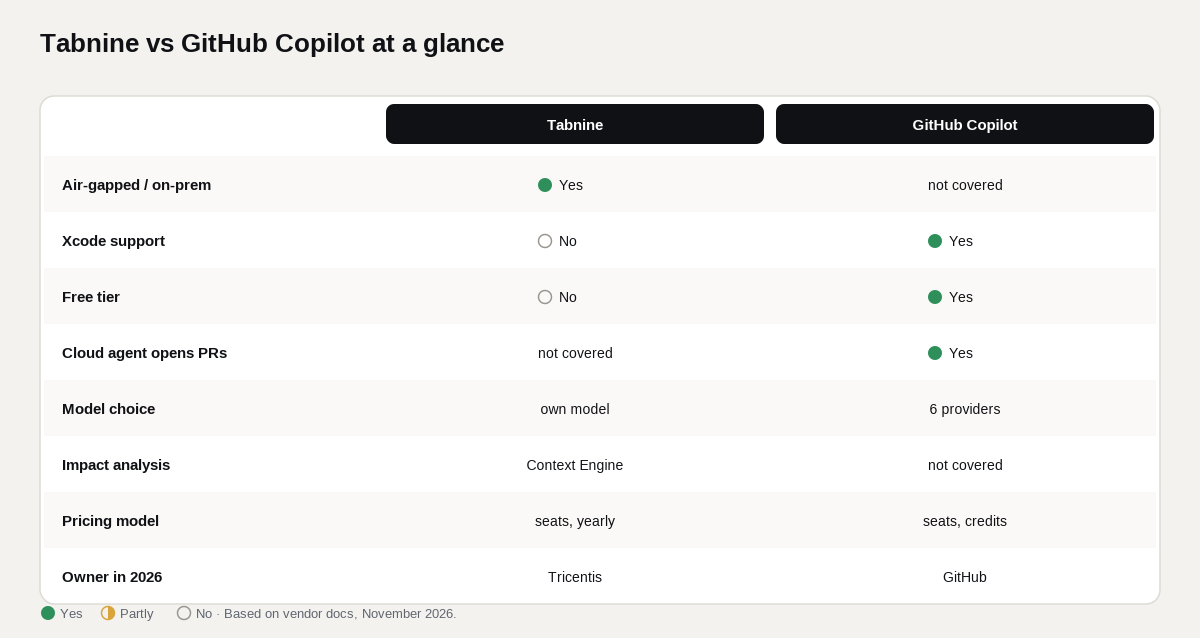
| Where it runs | VS Code, JetBrains, Android Studio, Eclipse, Visual Studio, CLI; no Xcode | VS Code, Visual Studio, JetBrains, Eclipse, Xcode, Neovim; GitHub.com, CLI, desktop app | Tabnine review; Copilot feature matrix |
| Deployment | SaaS, VPC, on-premises or air-gapped | Cloud service; cloud agent runs in GitHub Actions or a cloud sandbox | SD Times; Copilot cloud agent |
| Planning / spec | CLI Plan mode; agents check code against a Jira issue's requirements | Cloud agent researches the repo and writes an implementation plan | Tabnine pricing; Copilot features |
| Agent autonomy | Agents with optional oversight (Agentic tier) | IDE agent mode asks before changes and commands; cloud agent opens one PR per task | Tabnine review; Copilot cloud agent |
| Testing and review | Context Engine checks agent output against standards | PR code review on paid plans; GitHub warns output can contain vulnerabilities | Tricentis; Copilot plans |
| Deploy / hosting | No app hosting in the docs we checked | No app hosting in the docs we checked | Both vendors' docs |
| Code and data | Vendor says it does not retain or train on customer code | Cloud agent works only with GitHub-hosted repositories | beri.net; Copilot cloud agent |
| Team / admin | Enterprise tier; org-wide Context Engine over code, docs, tickets, APIs | Policies, file exclusions, usage data; audit logs and AI Controls on Enterprise | SD Times; AI Controls GA |
| Model choice | Bring your own model (since April 2026) | Models from six providers; Claude and Codex agents on Pro+ and Max | Tabnine review; Supported models |
| Pricing model | Per-user seats billed annually; no free tier, 14-day trial | Free tier; AI credits; per-seat Business and Enterprise with pooled credits | Tabnine review; Copilot plans |
Cost model by team size
| Team size | Tabnine | GitHub Copilot |
|---|---|---|
| 1 person | No free tier; a 14-day trial, then a per-user seat billed annually (Code Assistant or Agentic tier) | Free tier with limited completions, chat and agent use; or Pro, Pro+ or Max with a monthly AI-credit allowance |
| 5 people | Same per-seat tiers, billed annually; pick Agentic if you want agents and the CLI | Business: per granted seat per month with pooled AI credits; extra use billed per credit |
| 25 people | Custom Enterprise for VPC, on-premises or air-gapped; ask about the post-acquisition roadmap | Business or Enterprise; Enterprise adds audit logs and AI Controls; completions don't use credits |
Prices change, so check Tabnine's pricing page and GitHub Copilot plans. Tabnine's official page showed no prices when we opened it, so its tier details come from a June 2026 review. For reference, Devfab (Beta) logs cost after each run, per task and per project.
Where Tabnine wins
- No SaaS AI is allowed. Tabnine runs in your VPC, on-premises or fully air-gapped. Defense, finance, healthcare and government teams often need exactly this.
- Large, older codebases with lots of internal knowledge. The Context Engine maps code, docs, tickets and APIs for dependency and impact analysis. A June 2026 review notes it adds little on brand-new projects.
- You must run your own model. Self-managed models arrived on the agentic tier in April 2026.
- You already use Tricentis. Tabnine's context is being folded into Tricentis's testing platform, which may tie coding and QA together for existing customers.
Where GitHub Copilot wins
- Your code, issues and reviews live on GitHub. You assign work to the cloud agent from an issue or the Agents tab and review a pull request.
- Your developers use Xcode or Neovim. Copilot supports both; Tabnine does not support Xcode, and Neovim support is community-built.
- You want a low-cost start. Copilot has a free tier, and completions don't consume AI credits on any plan.
- You govern many developers. AI Controls, an AI administrator role and audit logs that flag agent actions became generally available in February 2026.
Switching from one to the other
From Tabnine to Copilot:
- Install the Copilot extension in the same IDE. VS Code, Visual Studio, JetBrains and Eclipse are covered by both.
- Move your team's coding rules into
AGENTS.mdor.github/copilot-instructions.md. GitHub's changelog says the cloud agent reads both. - Recreate data controls with Copilot's org policies and file exclusions. Check that the repository is hosted on GitHub, or the cloud agent will not work on it.
From Copilot to Tabnine: install the Tabnine plugin, agree on SaaS, VPC, on-premises or air-gapped deployment with Tabnine, and connect Jira so agents can work issues.
Where Devfab fits
Both tools make a developer faster inside a codebase, and both centre on the IDE and the pull request. Some teams also need the steps around the code: a signed-off plan, user journeys tested end to end, and an app on the client's server.
Coding agents automate the developer. Devfab automates the development lifecycle. Its Researcher maps the domain before the Planner writes a plan, and a person approves it. Dev agents work with ChainFlow, which maps which functions and APIs call each other, an idea close to Tabnine's impact analysis but aimed at the delivery team. The QA agent runs UI, flow and logic tests, and the app deploys to your own server.
Honest limits: Devfab is new and in Beta, with a smaller community and fewer integrations. It is not an editor, and it needs a GitHub account. See Devfab vs GitHub Copilot for the direct comparison.
FAQ
Is Tabnine still available after the Tricentis acquisition?
Yes, existing customers are still supported. Tricentis announced the acquisition on July 30, 2026 and plans to fold Tabnine's Enterprise Context Engine into its quality-engineering platform. It has not published a roadmap for the standalone assistant, so ask for one in writing before a multi-year deal.
Is Tabnine more private than GitHub Copilot?
Tabnine can run in your own VPC, on-premises or fully air-gapped, and says it does not retain or train on customer code. Copilot is a cloud service with admin controls such as file exclusions, policies and audit logs. If code must never leave your network, Tabnine is the fit.
Which has the better coding agent?
For teams on GitHub, Copilot: its cloud agent researches a repository, writes an implementation plan and opens a pull request, and higher tiers add Claude and Codex agents. Tabnine's agents implement Jira issues and check code against the issue's requirements, which suits Jira-centred, regulated teams.
Do we still need Copilot or Tabnine if we use Devfab?
Often yes. Devfab is not an editor for hands-on coding. Developers can keep Copilot or Tabnine in their IDE on the same GitHub repository that Devfab's agents work in, while Devfab runs research, the approved plan, QA and deployment.
Read next
- What is an AI software factory?
- Devfab vs GitHub Copilot: which fits a team that ships client work?
- Tabnine alternatives for teams that ship to production (2026)
- GitHub Copilot alternatives for teams that ship to production (2026)
Keep your assistant, and add a process around the code. Try Devfab Beta
Sources (checked November 13, 2026): Tricentis acquires Tabnine (Jul 30, 2026); Business Wire: Tricentis acquires Tabnine; beri.net: Tricentis bought Tabnine's Context Engine, not your IDE (Aug 2026); SD Times: Tabnine fills the organizational context gap (Mar 4, 2026); DEV Community: Tabnine review 2026 (Jun 2026); Tabnine pricing; GitHub Copilot plans; GitHub Docs: Plans for GitHub Copilot; GitHub Docs: Copilot features; GitHub Docs: Copilot feature matrix; GitHub Docs: About Copilot cloud agent; GitHub Docs: Supported AI models; GitHub Changelog: Enterprise AI Controls GA (Feb 26, 2026); GitHub Changelog: Copilot coding agent supports AGENTS.md.
Frequently asked questions
Is Tabnine still available after the Tricentis acquisition?
Yes, existing customers are still supported. Tricentis announced the acquisition on July 30, 2026 and plans to fold Tabnine's Enterprise Context Engine into its quality-engineering platform. It has not published a roadmap for the standalone assistant, so ask for one in writing before a multi-year deal.
Is Tabnine more private than GitHub Copilot?
Tabnine can run in your own VPC, on-premises or fully air-gapped, and says it does not retain or train on customer code. Copilot is a cloud service with admin controls such as file exclusions, policies and audit logs. If code must never leave your network, Tabnine is the fit.
Which has the better coding agent?
For teams on GitHub, Copilot: its cloud agent researches a repository, writes an implementation plan and opens a pull request, and higher tiers add Claude and Codex agents. Tabnine's agents implement Jira issues and check code against the issue's requirements, which suits Jira-centred, regulated teams.
Do we still need Copilot or Tabnine if we use Devfab?
Often yes. Devfab is not an editor for hands-on coding. Developers can keep Copilot or Tabnine in their IDE on the same GitHub repository that Devfab's agents work in, while Devfab runs research, the approved plan, QA and deployment.