Short answer: GitHub Copilot wins when your code, issues and reviews already live on GitHub and you want AI in that workflow at a low per-seat price, with GitHub-native agent governance. Factory wins when work arrives from Slack, Jira, Linear or Teams, your repos sit on self-hosted GitLab, or you need on-prem or airgapped agents.
You already pay for GitHub Copilot. Now a vendor calling itself a software factory wants a pilot. Your engineering manager asks the fair question: what would Factory do that Copilot can't?
The honest answer depends on where your work lives. If everything is on GitHub, Copilot covers more than most teams use. If tickets live in Jira and code lives on GitLab, the picture changes. Both tools are summarized here from their own docs, checked in November 2026.
In this comparison:
- Factory and GitHub Copilot at a glance
- Feature comparison
- Cost model by team size
- Where Factory wins
- Where GitHub Copilot wins
One odd detail first: Factory can run on your Copilot subscription.
Factory and GitHub Copilot at a glance
Factory sells "software factories" since Factory 2.0, announced on June 15, 2026. That release added Droid Computers, Missions, Automations, Skills and a model Router (Factory news). Its agents, called Droids, run in the Droid CLI (including headless droid exec for CI/CD), the Factory App desktop workspace, IDEs, and Remote Control on the web. Work can be delegated from Slack, Linear, Jira, Microsoft Teams and Google Chat (Factory docs). The domain moved to factory.com this year (Factory).
GitHub Copilot is GitHub's AI assistant, built into GitHub.com, GitHub Mobile, IDEs, the Copilot CLI, Windows Terminal, a Copilot desktop app for parallel agent sessions and GitHub Desktop (GitHub Docs: features). Its cloud agent takes assigned work and opens pull requests. Two 2026 changes matter: plans are now described in GitHub AI Credits, with a new Max tier (GitHub Docs: plans), and a new "Copilot in the cloud" experience reached paid plans from October 28, 2026 (GitHub Docs: cloud agent).
The free tier link: Factory's free plan lets you sign in with GitHub Copilot to supply the inference (Factory pricing). So the choice need not be either-or.
Feature comparison
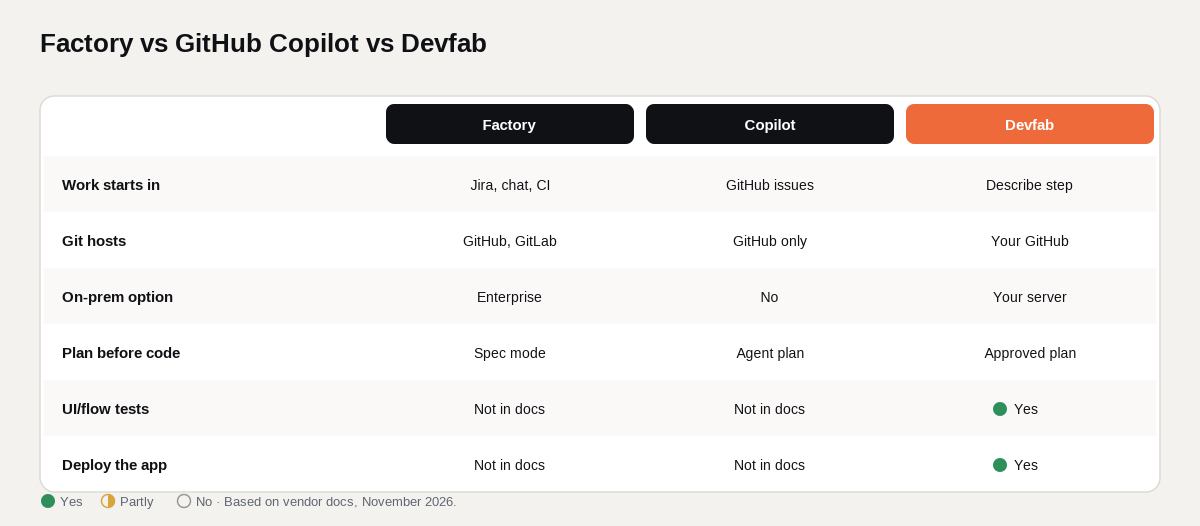
| Aspect | Factory | GitHub Copilot | Source |
|---|---|---|---|
| Where it runs | Droid CLI, desktop app, IDEs (VS Code, Cursor, JetBrains, Zed), web | GitHub.com, IDEs, CLI, Copilot app, Mobile, Desktop | Factory docs; GitHub Docs |
| Where work starts | Slack, Linear, Jira, Teams, Google Chat, CI | Issues, PRs, Agents tab, IDE, CLI, code scanning alerts | Factory docs; GitHub Docs |
| Git hosts for agents | Self-hosted GitHub Enterprise Server and GitLab covered | Cloud agent works only with GitHub-hosted repos | Factory docs; GitHub Docs |
| Planning | Spec and Mission modes, autonomy Off to High | Cloud agent researches the repo and writes a plan | Factory docs; GitHub Docs |
| Scope per task | Missions split work into parallel tracks | Actions-based sessions change one repo, one branch, one PR per task | Factory news; GitHub Docs |
| Code review | Inline PR review, GitHub-event automations | PR review on GitHub and diff review in editors (paid plans) | Factory; Copilot plans |
| Governance | SSO, SAML/SCIM, audit logs, Zero Data Retention on Business | AI Controls and agent control plane GA (Feb 26, 2026), audit logs on Enterprise | Factory pricing; GitHub changelog |
| Hosting of the tool | Enterprise on-prem, data residency; docs cover airgapped | GitHub cloud; cloud sandboxes for the agent | Factory pricing; GitHub Docs |
| Model choice | Router per task, BYOK, open-source or local models | OpenAI, Anthropic, Google, Microsoft, Moonshot AI, xAI models | Factory docs; GitHub Docs: models |
| Deploy your app | Not covered in the docs we checked | Not covered in the docs we checked | — |
Cost model by team size
| Team size | Factory | GitHub Copilot | Devfab |
|---|---|---|---|
| 1 person | Free (bring your own inference) or Pro USD 20 per user per month | Free, or Pro USD 10 per user per month | Cost logged per task and per project (Beta) |
| 5 people | Teams: USD 60 per team per month plus USD 40 per user per month | Business USD 19 per granted seat per month | Cost logged per task and per project (Beta) |
| 25 people | Business or Enterprise, contact sales (Teams stops at 10 seats) | Business USD 19 or Enterprise USD 39 per granted seat per month | Cost logged per task and per project (Beta) |
Prices as of November 2026 from Factory pricing, GitHub Copilot plans and GitHub Docs: plans. Copilot chat and agent work consume AI credits (one credit equals USD 0.01), while completions do not; usage beyond a pooled allowance is billed per credit. Factory states paid usage only as multiples of Pro. Devfab is in Beta and offers predictable cost: cost is logged after each run, per task and per project.
Where Factory wins
- Your tickets aren't on GitHub. Droids take work from Jira, Linear, Slack, Teams or Google Chat (Factory docs).
- Your code isn't on GitHub.com. Self-hosted GitHub Enterprise Server and GitLab are covered; Copilot's cloud agent needs GitHub-hosted repos.
- Bigger units of work. Missions split complex work into parallel tracks, while a Copilot Actions session is scoped to one repo and one PR.
- Strict data rules. On-prem deployment, data residency and airgapped setups are documented on Enterprise.
- Any model, including local ones. BYOK and local models sit next to the Router.
Where GitHub Copilot wins
- Everything already lives on GitHub. Issues, PRs, reviews and the agent share one place and one set of permissions.
- Low per-seat price at scale. Business is USD 19 per granted seat per month, as of November 2026, and Factory's Teams plan stops at 10 seats.
- Agent governance in GitHub. AI Controls add an AI administrator role, agent session search and
actor_is_agentin audit logs (GitHub changelog). - Completions everywhere. Inline and next-edit suggestions in many IDEs don't consume AI credits.
- Third-party agents in one plan. Claude and Codex agents are listed on Pro+ and Max (Copilot plans).
GitHub's own caution applies to both tools: Copilot "can produce incorrect or suboptimal code, including code that contains security vulnerabilities" (GitHub Docs).
Switching from one to the other
Adding Factory next to Copilot. Start on Factory's free tier and sign in with your Copilot account. Install the Droid CLI, connect your tracker, and set autonomy to Low with approval required for shell commands (Factory docs).
Moving from Factory to Copilot. Your code is already in your repository. If it's on GitLab, move it to GitHub first, because the cloud agent only works there. Then assign issues to Copilot and check that branch protection rules grant it a bypass where needed (GitHub Docs).
Where Devfab fits
Take a school portal for a district: parents enroll children, teachers post grades, and the office runs reports. Factory or Copilot can write each ticket. In the docs we checked, neither researches school enrollment rules before planning, clicks through a parent's enrollment journey as a test step, or deploys the portal to the district's server.
Coding agents automate the developer. Devfab automates the development lifecycle. The Researcher maps the domain before the Planner writes a plan, and a person approves it. ChainFlow maps which functions and APIs call each other and what is deployed, so changing enrollment doesn't break class rosters or parent notices. The QA agent runs UI, flow and logic tests, and Deploy ships to your own server.
Devfab is in Beta, with a smaller community and fewer integrations, and it needs a GitHub account. See Devfab vs GitHub Copilot.
FAQ
Can I use my GitHub Copilot subscription with Factory?
Yes, on Factory's free tier. Factory's pricing page says the free tier lets you bring your own inference by signing in with ChatGPT, GitHub Copilot or OpenRouter, or by adding your own API keys. Paid Factory tiers include usage instead.
Does GitHub Copilot's cloud agent work with GitLab?
No. GitHub's docs say Copilot cloud agent only works with repositories hosted on GitHub. Factory's docs cover self-hosted GitHub Enterprise Server and GitLab. Copilot's IDE features still work in your editor whatever your Git host is.
Which is cheaper for a team of 25?
On list prices, Copilot. Copilot Business is USD 19 per granted seat per month with pooled AI credits, as of November 2026. Factory's Teams plan stops at 10 seats, so a team of 25 goes to Factory Business or Enterprise, which are priced by sales.
Do both tools plan before they write code?
Yes. Copilot's cloud agent can research a repository and create an implementation plan before changing code. Factory has Spec and Mission modes and lets you set autonomy from Off to High, with rules that allow, require approval for or block shell commands.
Read next
- What is an AI software factory?
- GitHub Copilot alternatives
- Factory AI alternatives
- Claude Code vs Factory
Need the plan, tests and deploy, not only the pull request? Try Beta
Sources (checked November 2026): Factory homepage; Factory pricing; Factory 2.0 announcement (Jun 15, 2026); Factory docs index; GitHub Copilot plans; GitHub Docs: Plans for Copilot; GitHub Docs: Copilot features; GitHub Docs: About Copilot cloud agent; GitHub Docs: Supported AI models; GitHub Changelog: Enterprise AI Controls GA (Feb 26, 2026).
Frequently asked questions
Can I use my GitHub Copilot subscription with Factory?
Yes, on Factory's free tier. Factory's pricing page says the free tier lets you bring your own inference by signing in with ChatGPT, GitHub Copilot or OpenRouter, or by adding your own API keys. Paid Factory tiers include usage instead.
Does GitHub Copilot's cloud agent work with GitLab?
No. GitHub's docs say Copilot cloud agent only works with repositories hosted on GitHub. Factory's docs cover self-hosted GitHub Enterprise Server and GitLab. Copilot's IDE features still work in your editor whatever your Git host is.
Which is cheaper for a team of 25?
On list prices, Copilot. Copilot Business is USD 19 per granted seat per month with pooled AI credits, as of November 2026. Factory's Teams plan stops at 10 seats, so a team of 25 goes to Factory Business or Enterprise, which are priced by sales.
Do both tools plan before they write code?
Yes. Copilot's cloud agent can research a repository and create an implementation plan before changing code. Factory has Spec and Mission modes and lets you set autonomy from Off to High, with rules that allow, require approval for or block shell commands.