Short answer: Cursor wins when developers want an AI-first editor with Plan Mode, parallel cloud agents and Bugbot reviews, and a SaaS service is acceptable. Tabnine wins when security rules block SaaS AI, because it runs in your VPC, on-premises or air-gapped, inside JetBrains, Eclipse and Visual Studio, though its July 2026 sale to Tricentis adds roadmap risk.
Your security team has a short answer for most AI coding tools: no code leaves the building. Your developers have heard what Cursor can do and want it anyway. So the real question is not which tool is smarter. It is which one your compliance rules allow, and what you give up for it. This page weighs both sides fairly, with sources.
In this comparison:
- Cursor and Tabnine at a glance
- Feature comparison
- Cost model by team size
- Where Cursor wins
- Where Tabnine wins
Ownership changed for both tools this year, so that comes first.
Cursor and Tabnine at a glance
Tabnine now belongs to Tricentis. Tricentis announced the acquisition on July 30, 2026, with no terms disclosed. Tabnine's Enterprise Context Engine will be built into the Tricentis Agentic Quality Engineering Platform (Tricentis). The only stated customer commitment is that existing customers "will continue to receive support for the products they use today." Analysts flag roadmap risk for the standalone and air-gapped assistant, noting Tricentis shut down an earlier acquired product, Flood.io, in 2024 (beri.net, Aug 2026).
Tabnine is a privacy-focused AI coding assistant and agent platform. It is built for organizations whose IT blocks SaaS AI tools, such as defense, finance, healthcare and government, and for teams standardized on JetBrains, Java or Android (DEV Community, Jun 2026).
Cursor now belongs to SpaceX. The deal for Anysphere, Cursor's maker, was confirmed on June 16, 2026 (The Next Web), and Cursor says it closed in its August 14 post (Cursor blog). Cursor is an AI code editor plus a coding agent that also runs in a CLI, as cloud agents, on mobile and through SDKs (Cursor docs).
Feature comparison
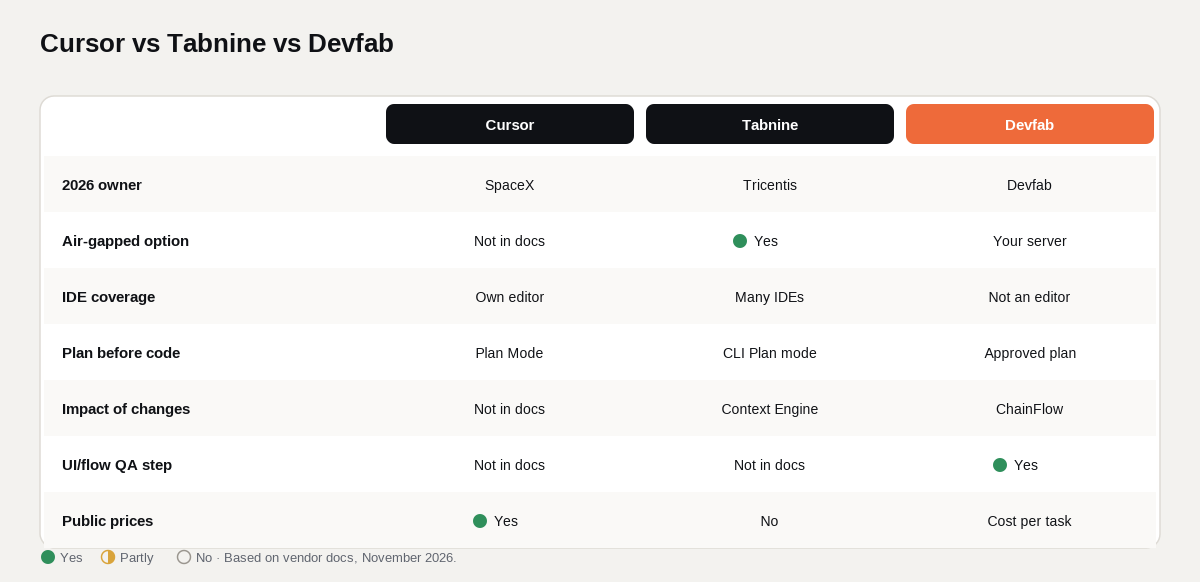
| Aspect | Cursor | Tabnine | Source |
|---|---|---|---|
| Where it runs | Its own editor, CLI, cloud agents, mobile, SDKs | Plugins for VS Code, JetBrains, Android Studio, Eclipse, Visual Studio; Tabnine CLI | Cursor docs; DEV review |
| Deployment | SaaS; Self-Hosted Machines for cloud-agent tool execution | SaaS, VPC, on-premises or fully air-gapped | Cursor cloud agents; SD Times |
| Planning | Plan Mode drafts an editable plan before code | Plan mode in the Tabnine CLI | Cursor Plan Mode; DEV review |
| Agents | Cloud agents in isolated VMs, many in parallel | Agents implement Jira issues and check code against the issue's requirements | Cursor cloud agents; Tabnine pricing |
| Codebase context | Agent researches the codebase in Plan Mode | Enterprise Context Engine: a knowledge graph of code, docs, tickets and APIs used for impact analysis | Cursor Plan Mode; SD Times |
| Review and testing | Bugbot reviews PRs; Autofix pushes fixes | Agent output checked against standards | Bugbot; Tricentis |
| Model choice | Claude, Gemini, GPT, Grok, Composer and others | Self-managed models (bring your own) on the agentic tier, since April 2026 | Cursor docs; DEV review |
| Team and admin | SSO on Teams; SCIM, audit logs, model restrictions on Enterprise | Enterprise tier on custom terms | Cursor Enterprise; Tabnine pricing |
| Deploy your app | Not covered in the docs we checked | Not covered in the docs we checked | — |
| Pricing model | Free tier, monthly tiers with a usage pool, Teams per seat | Per-seat subscription billed annually; no free tier, trial only | Cursor pricing; DEV review |
Cost model by team size
| Team size | Cursor | Tabnine | Devfab |
|---|---|---|---|
| 1 person | Free; Plus USD 8 per month (Grok models only); Premium USD 30 per month | Per-seat subscription, billed annually; no free tier | Cost logged per task and per project (Beta) |
| 5 people | Teams from USD 30 per user per month | Code Assistant or Agentic tier, per seat | Cost logged per task and per project (Beta) |
| 25 people | Teams, or Enterprise (custom) | Enterprise (custom), including private deployment | Cost logged per task and per project (Beta) |
Cursor prices as of November 2026 from Cursor pricing. Tabnine's pricing page showed no plan prices when we checked in November 2026, so only the model is listed; ask Tabnine for a quote. Devfab is in Beta and offers predictable cost: cost is logged after each run, per task and per project.
Where Cursor wins
- You want the most capable agent workflow in one editor, with Plan Mode, chat and agents in the same place.
- You run work in parallel. Cloud agents run in isolated VMs, each on its own branch.
- You want PR reviews that also fix. Bugbot flags bugs and security issues, and Autofix pushes fixes.
- You want a free or low-cost start. Tabnine has no free tier.
- You want a clearer roadmap. Tabnine's standalone plans after the Tricentis deal are not public.
Where Tabnine wins
- No SaaS AI is allowed. Tabnine runs in your VPC, on-premises or fully air-gapped.
- Your developers stay in their IDEs. It supports JetBrains, Eclipse, Visual Studio and Android Studio, not just one editor.
- You need organization-wide context. The Enterprise Context Engine maps code, docs, tickets and APIs for impact analysis.
- You bring your own model. Self-managed models run on the agentic tier.
- You already use Tricentis for testing and want coding context tied to your QA platform.
Switching from one to the other
From Tabnine to Cursor. Tabnine runs inside your existing IDE, so your code is already in your repository. Install Cursor, open the repo, and set up rules and MCP servers. Before you move a regulated team, check whether Self-Hosted Machines and enforced Privacy Mode meet your rules (Cursor Enterprise).
From Cursor to Tabnine. Install the Tabnine plugin in the IDE your team uses, or the Tabnine CLI. Ask Tabnine sales about deployment options and about the product roadmap under Tricentis before signing a multi-year deal.
Where Devfab fits
Take a clinic booking app for a hospital group. Patients book, staff move slots, and reminders go out. Cursor or Tabnine can help developers write that code. In the docs we checked, neither researches the clinic domain before planning, routes a project plan to a person for approval, runs UI and flow tests on patient journeys, or deploys the app.
Coding agents automate the developer. Devfab automates the development lifecycle. Devfab's Researcher maps the domain first, then the Planner writes a plan a person approves. ChainFlow maps which functions and APIs call each other, so changing the booking step doesn't break reminders or billing. The QA agent runs UI, flow and logic tests, and Deploy ships to your own server, with code in your own GitHub account.
Devfab is in Beta, with a smaller community and fewer integrations, and it is not an editor or an air-gapped assistant. See Devfab vs Cursor.
FAQ
Who owns Tabnine now?
Tricentis, the software testing company. It announced the acquisition on July 30, 2026, without disclosing terms. Tabnine's Enterprise Context Engine will be built into the Tricentis Agentic Quality Engineering Platform. The announcement does not say whether the standalone assistant will continue.
Can Cursor run fully on-premises like Tabnine?
Not in the pages we checked. Cursor offers Self-Hosted Machines, which run cloud-agent tool execution on hardware you manage, and Privacy Mode can be enforced across an organization. Tabnine can be deployed as SaaS, in your VPC, on-premises or fully air-gapped.
How much does Tabnine cost compared with Cursor?
Tabnine's official pricing page showed no plan prices when we checked in November 2026; it sells per-user seats billed annually, with a Code Assistant tier and an Agentic tier. Cursor lists Teams from USD 30 per user per month and a free tier, as of November 2026.
Which works in more IDEs?
Tabnine. A June 2026 review lists VS Code, JetBrains IDEs, Android Studio, Eclipse and Visual Studio, plus a CLI. Cursor is its own editor, with integrations listed for JetBrains and Xcode.
Read next
- What is an AI software factory?
- Tabnine alternatives for teams that ship to production
- Tabnine vs GitHub Copilot
- Cursor alternatives for teams that ship to production
Need a plan, tests and a deploy, not just faster typing? Try Beta
Sources (checked November 2026): Tricentis acquires Tabnine (Jul 30, 2026); beri.net: Tricentis bought Tabnine's Context Engine, not your IDE (Aug 2026); SD Times: Tabnine fills the organizational context gap (Mar 4, 2026); DEV Community: Tabnine review 2026 (Jun 2026); Tabnine pricing; Cursor docs; Cursor pricing; Cursor Plan Mode; Cursor cloud agents; Cursor Bugbot; Cursor Enterprise; Cursor blog: Joining SpaceX; The Next Web: SpaceX makes its Cursor takeover official.
Frequently asked questions
Who owns Tabnine now?
Tricentis, the software testing company. It announced the acquisition on July 30, 2026, without disclosing terms. Tabnine's Enterprise Context Engine will be built into the Tricentis Agentic Quality Engineering Platform. The announcement does not say whether the standalone assistant will continue.
Can Cursor run fully on-premises like Tabnine?
Not in the pages we checked. Cursor offers Self-Hosted Machines, which run cloud-agent tool execution on hardware you manage, and Privacy Mode can be enforced across an organization. Tabnine can be deployed as SaaS, in your VPC, on-premises or fully air-gapped.
How much does Tabnine cost compared with Cursor?
Tabnine's official pricing page showed no plan prices when we checked in November 2026; it sells per-user seats billed annually, with a Code Assistant tier and an Agentic tier. Cursor lists Teams from USD 30 per user per month and a free tier, as of November 2026.
Which works in more IDEs?
Tabnine. A June 2026 review lists VS Code, JetBrains IDEs, Android Studio, Eclipse and Visual Studio, plus a CLI. Cursor is its own editor, with integrations listed for JetBrains and Xcode.