Short answer: Applitools wins when visual bugs are your main risk, when you must test on-prem or in a dedicated cloud, or when you want to add AI checks to an existing Selenium, Playwright or Cypress suite. mabl wins when you want agents to author, heal and triage functional web, mobile and API tests in one platform.
You test a property listings site. The search works and every functional test passes. Then a customer emails a screenshot: on one browser the price overlaps the photo, and the "Book a viewing" button sits off screen.
That is the old split between "does it work?" and "does it look right?". Applitools grew up on the second question; mabl on the first. In 2026 each reaches into the other's ground, so the choice is less obvious. Here's what their own pages say, checked in November 2026.
In this comparison:
- Applitools and mabl at a glance
- Feature comparison
- Where Applitools wins
- Where mabl wins
- Where Devfab fits
Here is how the two compare, section by section.
Applitools and mabl at a glance
Applitools has two products. Eyes offers "visual and functional testing of your web and mobile applications with advanced Visual AI". Autonomous lets you "create, execute, and analyze functional, visual, and API tests" (Applitools). It pairs "a Deterministic Language Model (DLM) with mature Visual AI": large language models help with authoring and test data, but runs use its own deterministic model (same source; Applitools blog). Its homepage pitches AI-written code: "AI writes code fast. Know it works and looks right", and lists an MCP server.
mabl is an agentic test automation platform for web, iOS, Android, API and AI apps (mabl). Agents author tests from inputs such as Jira requirements, investigate every failure and heal broken steps (same source). On October 22, 2026 it announced an agentic testing harness for code written by coding agents, with guardrails and a knowledge graph that maps changes to tests (SD Times).
Both are active. Both test apps you already have.
Feature comparison
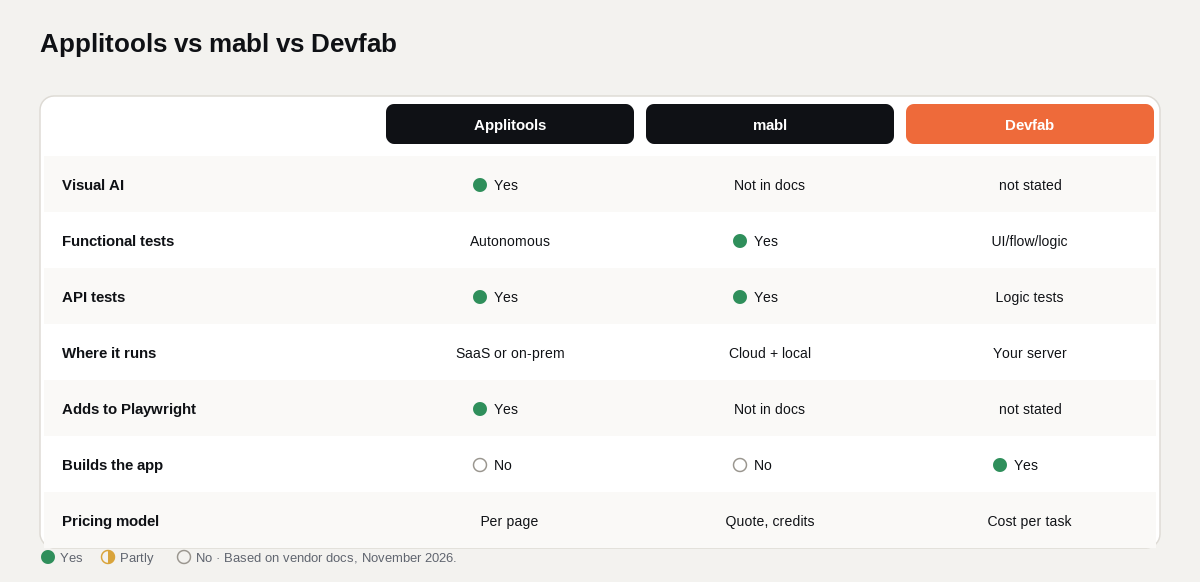
| Aspect | Applitools | mabl | Source |
|---|---|---|---|
| Core strength | Visual AI (Eyes) | Agentic functional testing | Applitools; mabl |
| Test types | Functional, visual, API (Autonomous); web and mobile | Web, iOS, Android, API, AI apps | Applitools; mabl |
| Authoring | SDKs, codeless recorder, NLP builder, website crawler | Agents author from inputs such as Jira requirements | Applitools; mabl |
| Works with existing suites | Selenium, Playwright, Appium, Cypress; SDKs for Java, Python, JavaScript, C#, Ruby | Postman import for API tests | Applitools FAQ; mabl platform |
| Run-time model | Deterministic model at run time | Adaptive auto-healing | Applitools; mabl |
| Deployment | SaaS, dedicated cloud (AWS, Azure, GCP) or on-prem | Cloud, plus local and CI Runner runs | Applitools; mabl pricing |
| Coding agents | MCP server listed under Create | MCP server for IDE, Cursor or CLI | Applitools; mabl platform |
| Security | ISO 27001, SOC 2 Type II, SSO/SAML | SOC 2 Type II, SSO/SAML, RBAC | Applitools; mabl platform |
| Pricing model | Per page; one-year contracts; no public prices | Quote-based annual credits; unlimited users | Applitools pricing; mabl pricing |
Cost model by team size
| Team size | Applitools | mabl | Devfab |
|---|---|---|---|
| 1 person | Free account: 1 user, 100 checkpoints a month | Free trial, then a quote | Cost logged per task and per project (Beta) |
| 5 people | Starter: 3 users, public cloud only; quote | Quote; users unlimited | Cost logged per task and per project (Beta) |
| 25 people | Eyes or Ultrafast Test Cloud: unlimited users, dedicated cloud or on-prem; quote | Quote; local and CI Runner runs don't use credits | Cost logged per task and per project (Beta) |
Plan details as of November 2026 from Applitools pricing and mabl pricing; neither lists prices. Applitools defines a page as "a unique validation that is created in the test code". Devfab is in Beta and offers predictable cost: cost is logged after each run, per task and per project.
Where Applitools wins
- Visual regressions reach users. Visual AI catches layout and rendering problems that functional checks pass over.
- You already have a test suite. Add Eyes to Selenium, Playwright, Appium or Cypress tests through SDKs in five or more languages.
- Data can't leave your network. On-prem and dedicated-cloud deployments are offered.
- Auditors want ISO 27001. Applitools lists ISO 27001 and SOC 2 Type II.
- You want predictable runs. Tests execute on a deterministic model, with language models kept to authoring.
Where mabl wins
- Functional journeys are the main risk. Agents author, run, heal and triage tests across web, mobile and API.
- Coding agents write much of your code. The October 2026 harness adds guardrails and change-impact checks before a PR.
- Your QA process uses test-case tools. Xray, Zephyr, TestRail and Azure DevOps integrations are listed in the harness announcement.
- Many people need seats. Users, apps and workspaces are unlimited under the contract.
- CI-heavy teams. Local and CI Runner runs don't consume cloud credits.
Each has documented limits. Applitools lists no prices, contracts run a year, and Starter is public-cloud only (Applitools pricing). mabl lists no prices, doesn't mention accessibility testing on the product pages we opened, and had not released desktop testing at its October 2026 announcement.
Switching from one to the other
From mabl to Applitools. Decide whether you want Autonomous (create and run tests in Applitools) or Eyes on top of a code suite. For Autonomous, start with the website crawler or NLP builder and rebuild your critical journeys. For Eyes, write the journeys in Playwright or Cypress and add visual checkpoints through the SDK.
From Applitools to mabl. List the journeys your Autonomous or SDK-based tests cover. Recreate them in mabl from linked Jira requirements so its agents draft the tests, and connect GitHub PR checks. If visual checks were the reason you chose Applitools, confirm what you need before dropping Eyes; the mabl pages we checked lead with functional testing.
Where Devfab fits
Applitools and mabl check the listings site after it is built. Neither, in the pages we checked, researches the property market, plans the app, or deploys it.
Devfab is an AI software factory. The Researcher maps the domain first (listing fields, agent roles, viewing requests, competing property portals) and suggests a prototype, and Blueprint drafts the screens. A person approves the plan. ChainFlow maps which functions and APIs call each other, so a change to listing search shows its impact on map pins, saved searches and alert emails. The QA agent runs UI and flow tests plus logic tests as one step of the lifecycle. Coding agents automate the developer. Devfab automates the development lifecycle.
Devfab is in Beta, has a smaller community and fewer integrations, and needs a GitHub account. A visual testing layer like Applitools can still sit on top of what Devfab deploys. See Devfab vs mabl.
FAQ
Is Applitools only for visual testing?
No. Applitools Eyes is its Visual AI product, and Applitools Autonomous creates, runs and analyzes functional, visual and API tests. Visual AI is still its distinctive strength, and Eyes can be added to existing Selenium, Playwright, Appium or Cypress suites.
Can I use Applitools and mabl together?
Nothing in either vendor's pages we checked describes a direct integration between them. Teams that want both usually keep functional journeys in one platform and add Applitools Eyes through its SDKs to a code-based suite, such as Playwright or Cypress.
Which one can run on-premises?
Applitools. It offers SaaS, a dedicated cloud on AWS, Azure or GCP, or on-prem, though its Starter plan is public-cloud only. mabl is a cloud platform; it also supports local and CI Runner runs that don't use cloud credits.
How do Applitools and mabl price?
Neither lists prices on the pages we checked. Applitools prices per page, meaning each unique validation in your test code, with one-year contracts and a free account of 1 user and 100 checkpoints a month. mabl is quote-based with annual cloud credits and a free trial.
Read next
- Applitools alternatives
- mabl alternatives
- Best end-to-end testing tools
- What is an AI software factory?
Looks right and works right starts with the plan. Try Beta
Sources (checked November 2026): Applitools homepage; Applitools pricing; Applitools FAQ; Applitools Autonomous and Eyes: new AI features (Applitools blog, Aug 7, 2025); mabl AI test automation; mabl platform; mabl pricing; mabl introduces agentic testing harness (SD Times, Oct 2026).
Frequently asked questions
Is Applitools only for visual testing?
No. Applitools Eyes is its Visual AI product, and Applitools Autonomous creates, runs and analyzes functional, visual and API tests. Visual AI is still its distinctive strength, and Eyes can be added to existing Selenium, Playwright, Appium or Cypress suites.
Can I use Applitools and mabl together?
Nothing in either vendor's pages we checked describes a direct integration between them. Teams that want both usually keep functional journeys in one platform and add Applitools Eyes through its SDKs to a code-based suite, such as Playwright or Cypress.
Which one can run on-premises?
Applitools. It offers SaaS, a dedicated cloud on AWS, Azure or GCP, or on-prem, though its Starter plan is public-cloud only. mabl is a cloud platform; it also supports local and CI Runner runs that don't use cloud credits.
How do Applitools and mabl price?
Neither lists prices on the pages we checked. Applitools prices per page, meaning each unique validation in your test code, with one-year contracts and a free account of 1 user and 100 checkpoints a month. mabl is quote-based with annual cloud credits and a free trial.