Short answer: Pick mabl when you already have an app and need an independent test platform across web, mobile and API, with a ship or no-ship verdict before each release. Pick Devfab when you deliver new client apps and want research, an approved plan, build, UI and flow tests and deploy to your own server in one tracked process.
You run delivery at an agency. A client wants an equipment rental app: customers reserve a lift or a generator, staff check it out, and the depot sees what comes back damaged. Your testers are already stretched across three other client projects.
Do you buy a better test platform, or change how the app gets built in the first place? mabl and Devfab answer different halves of that question. This page is fair about both.
In this comparison:
- What each tool is built for
- Switching triggers
- Cost model by team size
- Where mabl is the better choice
- Where Devfab is the better choice
The short version: one tests code you have, the other produces it.
What each tool is built for
mabl tests software you already have. It is a SaaS platform whose agents author tests from inputs such as Jira requirements, investigate every failure and heal broken steps (mabl AI test automation). It covers web end-to-end, iOS and Android, API (with Postman import) and AI features, in "a single test suite with a unified results dashboard" (mabl platform). Recent news matters here: on October 22, 2026, mabl announced an "agentic testing harness" aimed at code written by coding agents. It adds guardrails, a knowledge graph that maps a change to its tests and highlights coverage gaps, and change-impact checks from the terminal before a PR (SD Times). Earlier, in April 2026, "Active Coverage" turned authoring, failure analysis, recovery and execution into one continuous process (mabl blog).
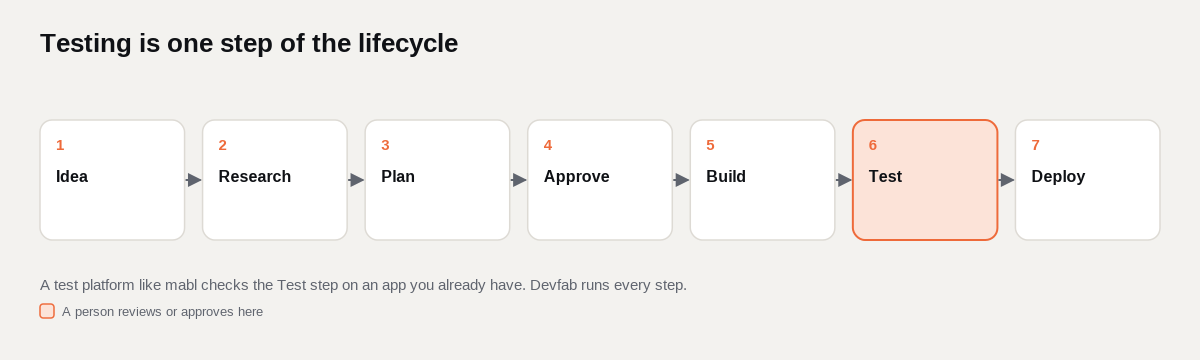
Devfab builds the software, then tests it. Devfab is an AI software factory in the Autonomous Software Lifecycle category. A Researcher maps the domain first (for the rental app: deposits, damage checks, availability windows and competing rental tools), then suggests a prototype. The Planner writes a plan, and a person approves the plan before the Coordinator creates tickets for dev agents. ChainFlow maps which functions and APIs call each other and what is deployed, so a change shows its impact before it breaks something. The QA agent runs UI and flow tests, clicking screens, buttons and journeys end to end, plus logic tests. Deploy ships to your own server, and the code lives in your own GitHub account.
Coding agents automate the developer. Devfab automates the development lifecycle. Its QA agent is one step of that lifecycle, not a separate test product.
Switching triggers
| Trigger | mabl | Devfab | Source |
|---|---|---|---|
| You need new apps built, not only tested | Tests existing apps; building is outside its scope | Plans, builds, tests and deploys | mabl platform |
| You need tests on native mobile apps | iOS and Android supported | Not stated | mabl AI test automation |
| You want public prices | Quote-based, no public prices | No price; cost logged per task and per project (Beta) | mabl pricing |
| You test desktop apps | "Coming soon" as of Oct 2026 | Not stated | SD Times |
| You need accessibility checks | Not mentioned on the product pages we opened | Not stated | mabl platform |
| You want a person to approve the build plan | Not part of a testing tool | Yes, a person approves the plan | — |
| You need test-case tools like Xray or TestRail | Integrations announced Oct 2026 | Not stated | SD Times |
Cost model by team size
| Team size | mabl | Devfab |
|---|---|---|
| 1 person | Free trial, then a quote; cloud runs use credits | Cost logged per task and per project (Beta) |
| 5 people | Quote; users, apps and concurrency unlimited | Cost logged per task and per project (Beta) |
| 25 people | Quote; annual credit allocation; local and CI Runner runs don't use credits | Cost logged per task and per project (Beta) |
mabl lists no prices on its pricing page, as of November 2026. Because users are unlimited, mabl's cost follows how many cloud runs you make rather than headcount. Devfab is in Beta and offers predictable cost: cost is logged after each run, per task and per project.
Moving from mabl to Devfab
Most teams won't move tests from mabl to Devfab. They move the building to Devfab and decide whether to keep mabl as an outside checker. If you do:
- Get the code into your GitHub. mabl tests a running app; it doesn't hold your source. Make sure the repo sits in your own GitHub account or your organization's.
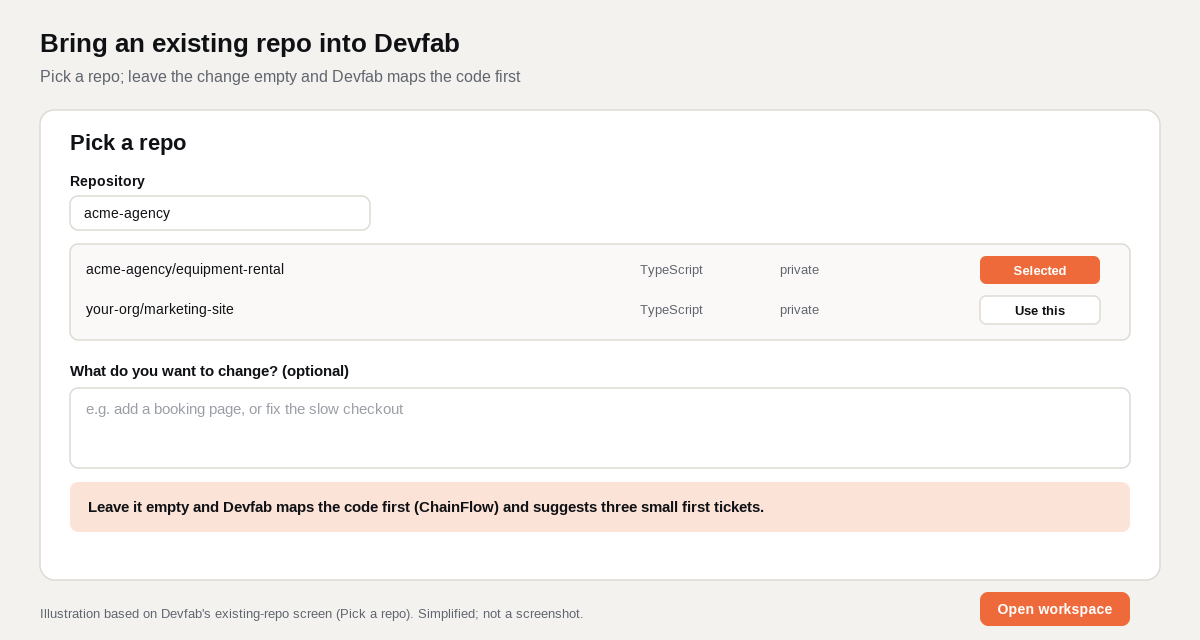
- In Devfab, choose "Work on an existing project" and pick the repo.
- Leave the change box empty. ChainFlow maps the code first and suggests three small first tickets.
- Approve the plan. The Coordinator creates tickets and assigns dev agents.
- Let the QA agent run UI, flow and logic tests on the changes.
- Keep mabl pointed at staging if you want an independent verdict. mabl posts GitHub PR status checks and inline result comments (mabl platform).
Where mabl is the better choice
- You already have the app. If the product is built and only testing is weak, a test platform is the direct fix.
- Native mobile and API in one suite. mabl runs web, iOS, Android and API tests with one results dashboard.
- Independent check on coding agents. mabl's MCP server connects to your IDE, Cursor or CLI, and the harness maps changes to tests. mabl reports coding agents made 3.0M MCP tool calls to it in a recent 90-day period (SD Times).
- Enterprise QA processes. Xray, Zephyr, TestRail and Azure DevOps test-case integrations, plus SOC 2 Type II, SSO/SAML and RBAC.
- Many apps, many testers. Unlimited users, apps and workspaces suit a central QA group.
Where Devfab is the better choice
- Research before the plan. The Researcher maps key terms, best practices and competitors for the client's domain, then suggests a prototype. A test platform starts after that work is done.
- ChainFlow sees the impact of a change. Change how rental deposits work, and ChainFlow shows the link to checkout, payment refunds, damage reports and customer notifications before dev agents touch the code.
- Testing is built into delivery. The QA agent runs UI and flow tests plus logic tests as part of each build, with the "QA agent · review before Done" switch in workspace controls.
- A person approves the plan, so the client sees what will be built before agents start.
- Docs and deploy. Blueprints, sequence flows and user manuals, and Deploy to your own server.
- Cost per task and per project, logged after each run, which helps an agency account for each client.
Devfab's honest limits: it is in Beta, has a smaller community and fewer integrations than mature platforms, is not an editor for hands-on coding, and needs a GitHub account. It does not claim mobile device testing or test-case management integrations.
FAQ
Is mabl a competitor to Devfab?
Only partly. mabl tests apps that already exist: web, mobile, API and AI features. Devfab plans, builds, tests and deploys an app, and its QA agent is one step of that lifecycle. A team that only needs stronger regression testing on an existing product should look at mabl first.
Can I use mabl and Devfab together?
Nothing stops you. Devfab puts the code in your own GitHub account and deploys to your own server, so mabl can test the running app like any other web app. mabl also posts results as GitHub pull request checks. We have not documented a direct integration between the two.
How much does mabl cost?
mabl does not publish prices. As of November 2026 it quotes each customer, cloud runs use credits from an annual allocation, local and CI Runner runs do not use credits, and users, apps and concurrency are unlimited. There is a free trial.
Does Devfab's QA agent replace a QA platform like mabl?
Not for every team. Devfab's QA agent runs UI and flow tests plus logic tests on the app Devfab builds. mabl adds things outside that scope, such as mobile device testing, test-case management integrations like Xray and TestRail, and a release verdict across many apps.
Read next
- What is an AI software factory?
- mabl alternatives
- Playwright vs mabl
- AI code review vs QA agent
- Devfab vs QA Wolf
Building client apps and testing them as you go? Try Beta
Sources (checked November 2026): mabl AI test automation; mabl platform; mabl pricing; mabl blog: Introducing Active Coverage (Apr 23, 2026); SD Times: mabl introduces agentic testing harness (Oct 2026).
Frequently asked questions
Is mabl a competitor to Devfab?
Only partly. mabl tests apps that already exist: web, mobile, API and AI features. Devfab plans, builds, tests and deploys an app, and its QA agent is one step of that lifecycle. A team that only needs stronger regression testing on an existing product should look at mabl first.
Can I use mabl and Devfab together?
Nothing stops you. Devfab puts the code in your own GitHub account and deploys to your own server, so mabl can test the running app like any other web app. mabl also posts results as GitHub pull request checks. We have not documented a direct integration between the two.
How much does mabl cost?
mabl does not publish prices. As of November 2026 it quotes each customer, cloud runs use credits from an annual allocation, local and CI Runner runs do not use credits, and users, apps and concurrency are unlimited. There is a free trial.
Does Devfab's QA agent replace a QA platform like mabl?
Not for every team. Devfab's QA agent runs UI and flow tests plus logic tests on the app Devfab builds. mabl adds things outside that scope, such as mobile device testing, test-case management integrations like Xray and TestRail, and a release verdict across many apps.