Short answer: Pick Playwright if engineers own tests and want a free, modern framework. Pick Cypress for deep CI debugging, or Selenium for the widest language support. Pick QA Wolf to hand testing to a service, mabl or Momentic for AI platforms, and Applitools for visual bugs. Devfab fits when you need the app built, with tests inside.
You're about to choose an end-to-end testing tool, and every list you read ranks the same names in a different order.
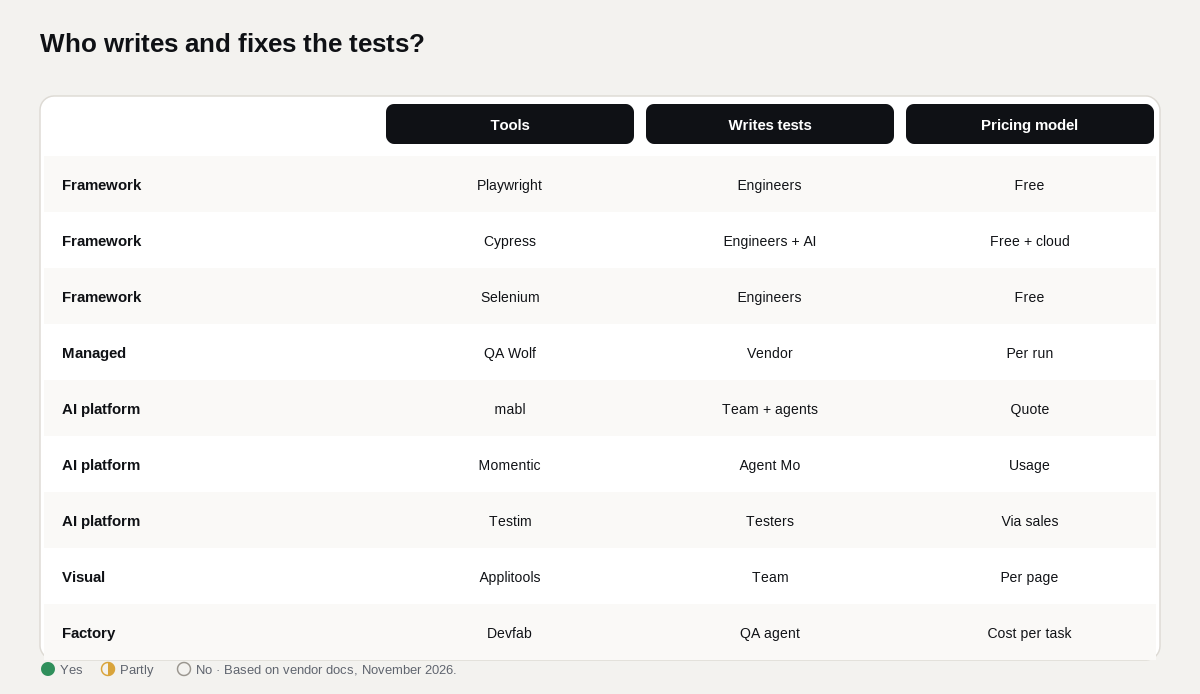
The order matters less than one question most lists skip: who will write and fix the tests? An engineer in code, a tester with a recorder, an AI agent, or a vendor's staff. Get that right and the shortlist shrinks to two. This guide groups nine tools by that question, with facts from vendor pages checked in November 2026.
In this guide, you'll learn:
- How we picked and compared
- Quick comparison table
- The tools one by one
- Where a dedicated testing tool beats Devfab
- How to choose
Each section stands on its own, so skip to your situation.
How we picked and compared
We included tools that run real user journeys in a browser or on a device, from login to checkout, and that are active as of November 2026. We read each vendor's own product, docs and pricing pages, plus one trade-press report, and cite them inline. We did not run hands-on benchmarks, and we don't repeat vendor benchmark claims as facts.
We grouped the tools into five kinds:
- Frameworks you code: Playwright, Cypress, Selenium.
- Managed service: QA Wolf.
- AI test platforms: mabl, Momentic, Tricentis Testim.
- Visual layer: Applitools.
- Software factory with a QA step: Devfab.
For each we note where it runs, who writes tests, how upkeep works, how it prices, and its documented limits.
Quick comparison table
| Tool | Kind | Who writes tests | Platforms | Pricing (as of November 2026) |
|---|---|---|---|---|
| Playwright | Open-source framework | Engineers, or Test Agents | Chromium, Firefox, WebKit | Free |
| Cypress | Framework plus cloud | Engineers; cy.prompt, Studio AI | Browsers; cy.prompt Chromium only | App free; Cloud Starter USD 0, Team from USD 67/month billed annually |
| Selenium | Open-source framework | Engineers | Chrome, Firefox, Edge, Safari | Free |
| QA Wolf | Managed service plus platform | QA Wolf agents or engineers | Web, iOS, Android, Windows | USD 1 per web run, USD 2 per mobile/desktop run |
| mabl | AI test platform | Your team with agents | Web, iOS, Android, API | Quote-based credits |
| Momentic | AI test platform | Agent Mo plus developers | Web, iOS, Android | Free (USD 50 usage); Scale USD 500/month |
| Tricentis Testim | AI-assisted UI automation | Testers by recording or description | Web, mobile, Salesforce | No public prices |
| Applitools | Visual AI plus AI authoring | Your team; codeless or SDKs | Web and mobile | Per page; no public prices |
| Devfab | AI software factory | QA agent, one lifecycle step | Apps Devfab builds | Cost logged per task and per project (Beta) |
The tools one by one
Playwright
Best for: engineering teams that want a free, modern framework and tests as code in their repo.
- One API for Chromium, Firefox and WebKit on Linux, macOS and Windows, in TypeScript, Python, .NET and Java (Playwright).
- Auto-waiting, retrying assertions, tracing with DOM snapshots and network logs, and parallel runs by default (same source).
- Test Agents: Planner writes a Markdown test plan, Generator writes test files, Healer repairs failing tests (Playwright Test Agents).
- Playwright MCP drives the browser through accessibility snapshots, so no vision model is needed (Playwright MCP).
- Maintained by Microsoft and free; no paid tier on playwright.dev (Playwright).
Limits: a framework, not a service. You host runs, CI and upkeep yourself.
Cypress
Best for: web teams that debug many CI failures and want a cloud for replay and flake detection.
- The Cypress App runs tests in a real browser locally or in CI and is MIT-licensed (Cypress pricing).
- cy.prompt turns natural-language steps into Cypress commands; it moved to beta in 15.13.0 (cy.prompt docs).
- Cypress Cloud adds Test Replay, Smart Orchestration, Flake Detection, UI Coverage and Accessibility (Cypress).
- Cloud MCP gives coding agents CI failures and flake history (same source).
- Starter is USD 0 with 500 test results a month; Team is from USD 67 per month billed annually, as of November 2026 (Cypress pricing).
Limits: cy.prompt runs in Chromium browsers only, needs a Cloud account, and doesn't support cy.request(), canvas or iframes (cy.prompt docs).
Selenium
Best for: teams with existing suites in Java, C# or Ruby, or that need Safari and a standard protocol.
- Built on the W3C WebDriver standard (Selenium).
- Controls Chrome, Firefox, Edge and Safari (same source).
- Scripts in Java, Python, C#, Ruby, JavaScript or Kotlin (same source).
- Selenium Grid runs tests across machines, browsers and operating systems in parallel (same source).
- Actively released: version 4.53 shipped on November 17, 2026 (same source).
Limits: a plain automation framework. AI authoring and self-healing come from tools built on top, such as Testim, which runs on any compatible Selenium grid.
QA Wolf
Best for: teams without QA staff that want someone else to own end-to-end coverage.
- Agents plan coverage, write tests, select tests per pull request, investigate failures and file bugs (QA Wolf pricing).
- Tests web, iOS, Android and Windows, including real iPhone and iPad devices (QA Wolf).
- Tests are open-source Playwright and Appium code you can export anytime (QA Wolf pricing).
- Coverage-as-a-Service: QA Wolf engineers write, run and maintain the suite with an "80%+ automated coverage" guarantee (same source).
- USD 1 per web run and USD 2 per mobile or desktop run, with no seat fees, as of November 2026 (same source).
Limits: cost grows with tests times runs; flakes are retried up to three times rather than removed.
mabl
Best for: QA teams that want one platform for web, mobile, API and AI-app tests.
- Agents author tests from inputs such as Jira requirements, investigate failures and heal broken steps (mabl).
- Web, iOS, Android and API tests (with Postman import) in one suite and dashboard (same source; mabl platform).
- October 2026 harness: a knowledge graph mapping changes to tests, and Xray, Zephyr, TestRail and Azure DevOps integrations (SD Times).
- SOC 2 Type II, SSO/SAML and RBAC (mabl platform).
- Quote-based; local and CI Runner runs don't use credits (mabl pricing).
Limits: no public prices; desktop testing was "coming soon" as of October 2026.
Momentic
Best for: developer teams that want AI-written tests stored as files in the repo.
- Agent Mo explores web, iOS and Android apps, finds bugs and writes tests (Momentic).
- Approved flows become Momentic YAML tests in a pull request in your repo (same source).
- Tests PR preview deployments and posts a review with a commit check (same source).
- Built on Playwright, with an MCP server and a Claude Code plugin (Momentic docs index).
- Free is USD 0 with USD 50 of usage; Scale is USD 500 per month, as of November 2026 (Momentic pricing).
Limits: usage doesn't roll over; results are kept only for a limited period on Free and Scale.
Tricentis Testim
Best for: testers doing UI regression on web, mobile or Salesforce, especially in Tricentis shops.
- Owned by Tricentis since an acquisition announced on February 9, 2022 (Tricentis).
- Self-healing AI-powered locators; tests built by recording or by description (Testim).
- Salesforce support with metadata-based locators for dynamic Lightning elements (same source).
- Runs locally, on Testim's grid or any compatible Selenium grid (same source).
- Copilot writes JavaScript custom steps from a description (Testim Copilot).
Limits: no public prices or edition matrix; no Testim-specific MCP server documented (Testim Enterprise).
Applitools
Best for: teams whose bugs are visual: layout, rendering and cross-browser differences.
- Eyes adds Visual AI; Autonomous creates functional, visual and API tests (Applitools).
- Works with Selenium, Playwright, Appium and Cypress, with SDKs in Java, Python, JavaScript, C# and Ruby (Applitools FAQ).
- Runs on a deterministic model at test time, with LLMs for authoring (Applitools).
- SaaS, dedicated cloud on AWS, Azure or GCP, or on-prem (same source).
- Priced per page; a free account includes 1 user and 100 checkpoints a month (Applitools pricing).
Limits: no public prices; contracts run a year.
Devfab
Best for: agencies and IT teams that need a client app researched, planned, built, tested and deployed, not only tested.
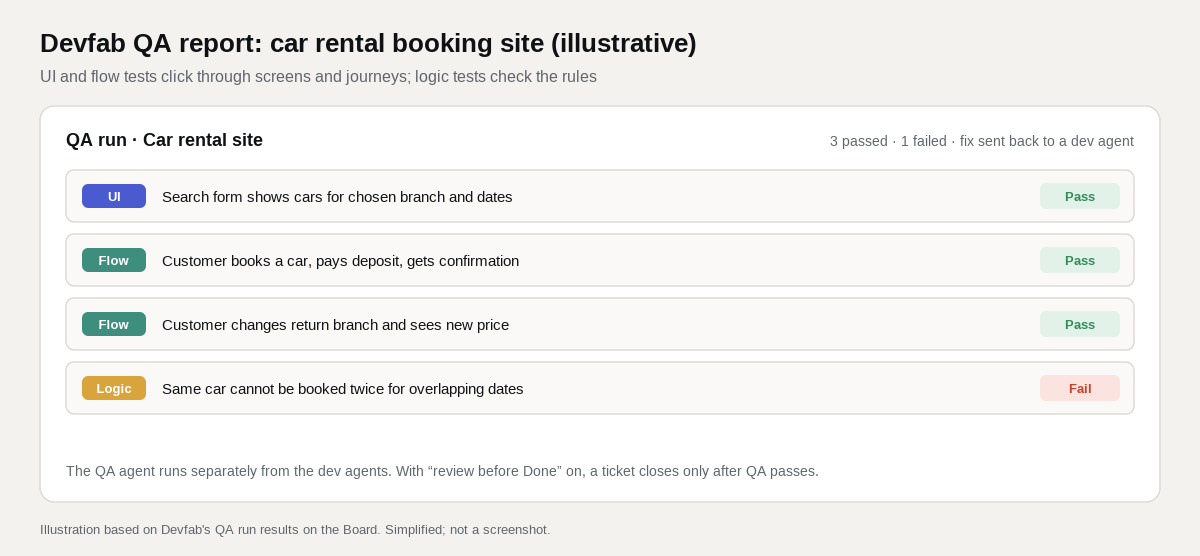
Take a car rental booking site. Devfab's Researcher maps the domain first (pickup branches, vehicle classes, deposits, rival booking sites) and suggests a prototype. The Planner writes the plan, and a person approves it. ChainFlow maps which functions and APIs call each other, so a change to the booking checkout shows its impact on payments, vehicle availability, confirmation emails and SMS reminders. The QA agent runs UI and flow tests (screens, buttons and user journeys clicked end to end) plus logic tests. Code lives in your GitHub account, and Deploy ships to your own server. Cost is logged after each run, per task and per project.
Coding agents automate the developer. Devfab automates the development lifecycle.
Limits: in Beta, with a smaller community and fewer integrations than mature platforms. Not an editor for hands-on coding, needs a GitHub account, and it is not a test tool for apps built elsewhere.
Where a dedicated testing tool beats Devfab
- Your app already exists. Any tool above tests it as it is; Devfab's QA agent tests what Devfab builds or changes.
- You need mobile devices or Windows. QA Wolf, mabl and Momentic document iOS and Android; QA Wolf adds Windows. Devfab doesn't state device testing.
- You need visual or Salesforce checks. Applitools and Testim are built for them.
- You want tests as a standalone, portable suite. Playwright, Cypress and Selenium tests are plain code you can run anywhere.
How to choose
- Engineers own quality and budget is tight? Playwright, or Selenium if your suites are in Java or C#.
- CI failures take up most of your sprint? Cypress with Cypress Cloud.
- No QA staff? QA Wolf, ideally on its managed tier.
- QA team covering web, mobile and API? mabl.
- Developers want AI-written tests in the repo? Momentic.
- Salesforce or a Tricentis contract? Testim.
- Visual bugs reach users? Add Applitools to whatever you run.
- The app isn't built yet, or keeps breaking when changed? Devfab, then point any tool above at the deployed app.
See also QA Wolf vs mabl and Playwright vs Cypress.
FAQ
What is the best end-to-end testing tool in 2026?
For most engineering teams, Playwright: it is free, covers Chromium, Firefox and WebKit, and now ships planner, generator and healer test agents. If you'd rather not own tests, QA Wolf. If a QA team needs web, mobile and API in one platform, mabl.
Is Playwright better than Cypress for end-to-end testing?
It depends on the need. Playwright covers Chromium, Firefox and WebKit in four languages and is fully free. Cypress offers a strong paid cloud with Test Replay, flake detection and UI coverage. cy.prompt, its AI step writer, runs in Chromium browsers only.
Are there free end-to-end testing tools?
Yes. Playwright and Selenium are free and open source, and the Cypress app is MIT-licensed, with a free Cypress Cloud Starter plan. Momentic has a free plan with USD 50 of usage per month, as of November 2026. You still pay for CI time and upkeep.
Which end-to-end testing tools use AI?
QA Wolf, mabl, Momentic, Testim and Applitools all use AI to write, heal or triage tests. Playwright ships Test Agents and an MCP server, and Cypress has cy.prompt and Studio AI. Selenium itself is a plain automation framework.
Is Devfab an end-to-end testing tool?
Not on its own. Devfab is an AI software factory that researches, plans, builds, tests and deploys apps. Its QA agent runs UI and flow tests plus logic tests on the app it builds. To test an app built elsewhere, use a dedicated tool from this list.
Read next
- AI test automation vs scripted test automation
- Best AI testing tools for AI-generated code
- What is an AI software factory?
Building the app as well as testing it? Try Beta
Sources (checked November 2026): Playwright homepage; Playwright Test Agents docs; microsoft/playwright-mcp (GitHub MCP listing); Cypress homepage; Cypress pricing; cy.prompt docs; Selenium homepage; QA Wolf homepage; QA Wolf pricing; mabl AI test automation; mabl platform; mabl pricing; mabl introduces agentic testing harness (SD Times, Oct 2026); Momentic homepage; Momentic pricing; Momentic llms.txt (docs index); Testim product page (Tricentis); Testim Copilot; Testim Enterprise; Tricentis acquires Testim (Feb 9, 2022); Applitools homepage; Applitools pricing; Applitools FAQ.
Frequently asked questions
What is the best end-to-end testing tool in 2026?
For most engineering teams, Playwright: it is free, covers Chromium, Firefox and WebKit, and now ships planner, generator and healer test agents. If you'd rather not own tests, QA Wolf. If a QA team needs web, mobile and API in one platform, mabl.
Is Playwright better than Cypress for end-to-end testing?
It depends on the need. Playwright covers Chromium, Firefox and WebKit in four languages and is fully free. Cypress offers a strong paid cloud with Test Replay, flake detection and UI coverage. cy.prompt, its AI step writer, runs in Chromium browsers only.
Are there free end-to-end testing tools?
Yes. Playwright and Selenium are free and open source, and the Cypress app is MIT-licensed, with a free Cypress Cloud Starter plan. Momentic has a free plan with USD 50 of usage per month, as of November 2026. You still pay for CI time and upkeep.
Which end-to-end testing tools use AI?
QA Wolf, mabl, Momentic, Testim and Applitools all use AI to write, heal or triage tests. Playwright ships Test Agents and an MCP server, and Cypress has cy.prompt and Studio AI. Selenium itself is a plain automation framework.
Is Devfab an end-to-end testing tool?
Not on its own. Devfab is an AI software factory that researches, plans, builds, tests and deploys apps. Its QA agent runs UI and flow tests plus logic tests on the app it builds. To test an app built elsewhere, use a dedicated tool from this list.