Short answer: For free screenshot checks you own, pick Playwright. For visual checks inside a low-code test tool, Tricentis Testim or mabl. For someone else to write and run the suite, QA Wolf. For tests as files your coding agent can drive, Momentic. Devfab fits only if the real gap is the build process, not visual testing.
You picked Applitools because a layout bug embarrassed you once. Maybe a parent portal for a school district rendered the sign-up button off screen on one browser. Now the renewal is near. You can't compare it on price, because there is no public price, and the contract runs a year. Others want a tool their coding agents can drive.
Those are the usual triggers. The right replacement depends on which one is yours.
In this guide, you'll learn:
- Why teams leave Applitools
- The seven alternatives in one table
- Where Applitools is still the better choice
- How to choose
Each tool below gets a verdict, a trade-off and its pricing model.
Why teams leave Applitools
Status, November 2026: active. Applitools sells two products. Eyes does "visual and functional testing of your web and mobile applications with advanced Visual AI". Autonomous lets you "create, execute, and analyze functional, visual, and API tests" (Applitools). Its current pitch targets AI-written code: "AI writes code fast. Know it works and looks right." The homepage lists an MCP server so coding agents can fix UI issues themselves (Applitools).
The reasons teams look elsewhere are mostly commercial, not technical:
- No public prices. Applitools prices per page, where "a page equals a unique validation that is created in the test code". The pricing page lists Starter, Eyes and Ultrafast Test Cloud plans with no prices (Applitools pricing).
- Annual contracts. Contracts run one year (Applitools pricing).
- Starter is public cloud only, with 3 users. Dedicated cloud and on-prem sit on the higher plans (Applitools pricing).
- The free tier is small. A free account includes 1 user and 100 checkpoints a month (Applitools pricing).
If your trigger is budget visibility, start with Playwright or a tool with a public price. If your trigger is "we need more than visual checks", look at the end-to-end platforms.
Quick comparison
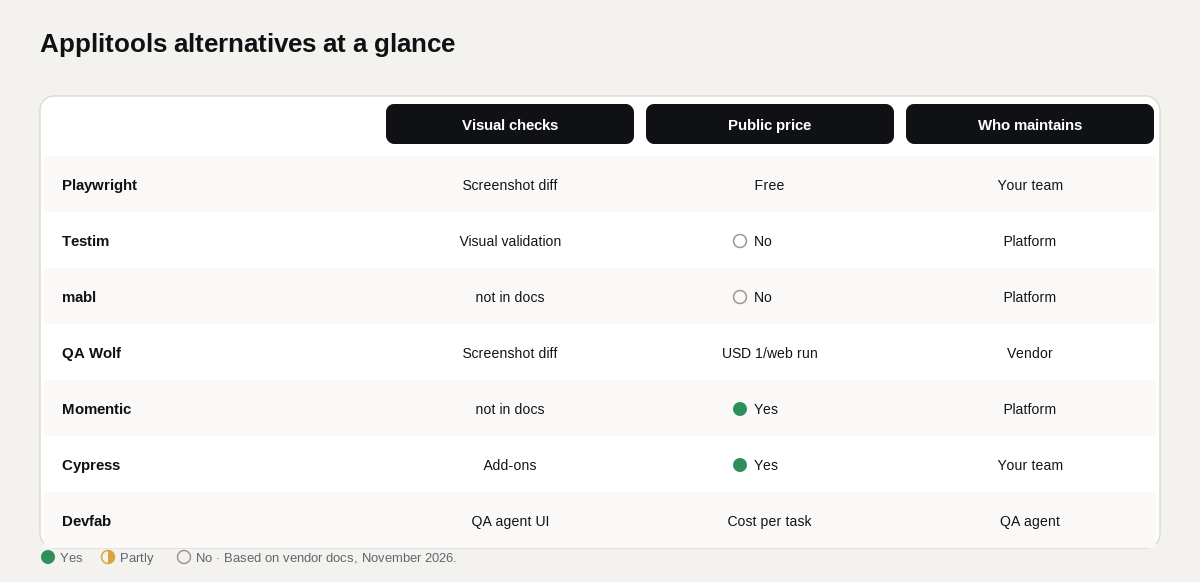
| Tool | Best for | Visual checks | Pricing model (Nov 2026) | Source |
|---|---|---|---|---|
| Playwright | Engineers who want free tests as code | Screenshot comparison with baselines | Free, open source | Playwright docs |
| Tricentis Testim | Low-code UI regression, Salesforce | Element- or page-level visual validation | Not listed; free trial, Enterprise via sales | Testim |
| mabl | One platform for web, mobile, API | Not covered in the pages we checked | Quote-based; credits for cloud runs | mabl pricing |
| QA Wolf | Managed coverage by agents and engineers | Screenshot diffing, web only | USD 1 per web run, USD 2 per mobile or desktop run | QA Wolf pricing |
| Momentic | Tests as YAML in your repo | Not covered in the pages we checked | Usage-based; Free USD 0, Scale USD 500/month | Momentic pricing |
| Cypress | Teams already on Cypress | UI Coverage and Accessibility add-ons | Free App; Cloud by test results | Cypress pricing |
| Devfab | Teams whose gap is the whole build process | QA agent UI and flow tests, not a visual AI tool | Cost logged per task and per project (Beta) | Devfab |
The alternatives
Playwright
Verdict: the closest free swap if visual regression is your main use. Best for: engineering teams that want visual and functional tests as code at no licence cost. Trade-off: pixel comparison, not Visual AI; you host runs and maintain baselines. Pricing: free and open source; no paid tier on playwright.dev (Playwright).
await expect(page).toHaveScreenshot()compares a page with a stored reference image. The first run writes the baseline;--update-snapshotsrefreshes it (Playwright docs).- Sensitivity is set with
threshold(default 0.2) andmaxDiffPixels(Playwright docs). - Baselines differ by browser and platform. The docs warn that rendering varies with "the host OS, version, settings, hardware, power source" and headless mode (Playwright docs).
- It runs on Chromium, Firefox and WebKit, and ships Planner, Generator and Healer test agents (Playwright Test Agents).
Tricentis Testim
Verdict: the best fit for low-code UI teams, especially on Salesforce. Best for: QA teams that need stable UI regression on web, mobile or Salesforce apps. Trade-off: no public prices or edition matrix on the pages we opened. Pricing: "Get started free" trial and an Enterprise edition through sales (Testim Enterprise).
- Offers element- or page-level visual validation alongside functional tests (Testim).
- "AI-powered locators self-heal" to reduce maintenance (Testim).
- Salesforce tests use metadata-based locators for dynamic Lightning elements (Testim).
- Tests run locally, on Tricentis's grid or any compatible Selenium grid (Testim).
mabl
Verdict: pick it when you want one platform for many test types and a release verdict. Best for: QA teams covering web, iOS, Android, API and AI features in one suite. Trade-off: quote-based pricing, so it doesn't fix the "no public price" problem. Pricing: no public prices; cloud runs use credits from an annual allocation; local and CI runner runs don't; 14-day trial (mabl pricing).
- Agents author tests from inputs such as Jira requirements, investigate every failure and heal broken steps (mabl).
- Promises "an independent verdict before every release" for AI-generated code (mabl).
- An MCP server connects mabl to your IDE, Cursor or CLI; GitHub PR checks are supported (mabl platform).
- An October 2026 "agentic testing harness" maps a change to its tests and highlights coverage gaps (SD Times, Oct 2026).
QA Wolf
Verdict: the choice when you want someone else to own the suite. Best for: teams without QA staff who need web, mobile and desktop coverage. Trade-off: per-run billing grows with suite size and run frequency. Pricing: USD 1 per web or Linux Electron run, USD 2 per mobile or desktop run, no seat fees, as of November 2026; managed tiers by quote (QA Wolf pricing).
- Visual diffing uses
toHaveScreenshotagainst a baseline, with a diff viewer in the editor; it is web only (QA Wolf docs). - QA Wolf's docs advise against screenshot checks on timestamps, live data or animations (QA Wolf docs).
- Tests export as open-source Playwright and Appium code (QA Wolf pricing).
- Coverage-as-a-Service guarantees "80%+ automated coverage" on managed tiers (QA Wolf pricing).
Momentic
Verdict: good when your coding agent should create and run tests. Best for: developer teams that review tests as pull requests. Trade-off: visual AI is not its headline; monthly usage doesn't roll over. Pricing: usage-based, no seat fees; Free USD 0 with USD 50 of usage, Scale USD 500 a month with USD 500 of usage, as of November 2026 (Momentic pricing).
- Its agent Mo explores web, iOS and Android apps, files bugs and opens PRs with YAML tests (Momentic).
- MCP server and a Claude Code plugin (Momentic docs index).
- SOC 2 Type 2, SSO, RBAC and audit logs (Momentic).
Cypress
Verdict: a sensible move only if your team already runs Cypress. Best for: developers who want a free framework plus a cloud for replay and flake data. Trade-off: its visual features are UI Coverage and Accessibility add-ons, not a screenshot-diff engine in the pages we checked. Pricing: free MIT-licensed App; Cloud Starter USD 0, Team from USD 67 a month billed annually, as of November 2026 (Cypress pricing).
- Test Replay, Flake Detection and Smart Orchestration in Cypress Cloud (Cypress).
- cy.prompt turns plain-English steps into tests, in beta since 15.13.0, Chromium only (cy.prompt docs).
- Applitools itself integrates with Cypress, so some teams keep both (Applitools FAQ).
Devfab
Verdict: not a visual testing tool. Consider it when the trouble starts before testing. Best for: agencies and IT teams that need an app planned, built, tested and deployed, with records of each step. Trade-off: in Beta, smaller community, fewer integrations; not an editor; needs a GitHub account. Pricing: predictable cost; cost is logged after each run, per task and per project.
Coding agents automate the developer. Devfab automates the development lifecycle. The Researcher maps the domain before the Planner writes a plan, and a person approves it. ChainFlow maps which functions and APIs call each other, so dev agents see what a change touches: edit the sign-up form and it flags enrolment records and confirmation emails. The QA agent runs UI and flow tests (screens, buttons and user journeys clicked end to end) plus logic tests, then Deploy ships to your own server.
Where Applitools is still the better choice
- Visual regressions are your main risk. Layout, rendering and cross-browser drift on AI-written UI is what Applitools is built for.
- You need on-prem or a dedicated cloud. Applitools offers SaaS, a dedicated cloud on AWS, Azure or GCP, or on-prem (Applitools).
- You have suites in several frameworks. SDKs for Java, Python, JavaScript, C#, Ruby and more work with Selenium, Playwright, Appium and Cypress (Applitools FAQ).
- You want deterministic runs. Applitools pairs "a Deterministic Language Model (DLM) with mature Visual AI", using LLMs for authoring but not for runs (Applitools).
- Security reviews are strict. ISO 27001 and SOC 2 Type II, with SSO/SAML (Applitools).
How to choose
- Name the trigger. Price visibility points to Playwright, QA Wolf, Momentic or Cypress. Breadth of test types points to mabl or Testim.
- Count your noisy pages. Pages with live data, timestamps or animation suit Visual AI better than pixel diffs.
- Decide who maintains baselines. Your engineers (Playwright, Cypress), a platform (mabl, Testim, Momentic) or a vendor's people (QA Wolf).
- Check where tests live. In your repo as code or YAML, or inside a vendor platform.
- Ask whether testing is really the gap. If plans, scope and deploys are the problem, a test tool won't fix them; see AI code review vs a QA agent.
FAQ
What is the best free alternative to Applitools?
Playwright. It is free and open source, and its toHaveScreenshot assertion compares each screenshot with a stored baseline. You tune sensitivity with threshold and maxDiffPixels. You run and maintain it yourself, and baselines differ by browser and operating system.
Why doesn't Applitools list prices?
Applitools prices per page, where a page is a unique validation in your test code, and its pricing page shows plans but no prices. Contracts run one year. A free account includes 1 user and 100 checkpoints a month.
Is pixel comparison as good as Visual AI?
Not for every page. Playwright's own docs warn that rendering varies with the host OS, settings, hardware and headless mode, and QA Wolf advises against screenshot checks on timestamps, live data or animations. Applitools positions its Visual AI for exactly those noisy cases.
Does Devfab replace Applitools?
No. Applitools checks how an app you already have looks and works. Devfab plans, builds, tests and deploys an app, and its QA agent runs UI, flow and logic tests as one step. Dedicated visual AI testing is not something Devfab claims.
Read next
- What is an AI software factory?
- Testim vs Applitools
- Applitools vs mabl
- Best AI testing tools for AI-generated code
Is the gap the build process, not the screenshots? Try Beta
Sources (checked November 2026): Applitools homepage; Applitools pricing; Applitools FAQ; Playwright homepage; Playwright visual comparisons; Playwright Test Agents; Tricentis Testim; Testim Enterprise; mabl AI test automation; mabl platform; mabl pricing; mabl agentic testing harness (SD Times, Oct 2026); QA Wolf pricing; QA Wolf docs: visual diffing; Momentic homepage; Momentic pricing; Momentic llms.txt; Cypress homepage; Cypress pricing; cy.prompt docs.
Frequently asked questions
What is the best free alternative to Applitools?
Playwright. It is free and open source, and its toHaveScreenshot assertion compares each screenshot with a stored baseline. You tune sensitivity with threshold and maxDiffPixels. You run and maintain it yourself, and baselines differ by browser and operating system.
Why doesn't Applitools list prices?
Applitools prices per page, where a page is a unique validation in your test code, and its pricing page shows plans but no prices. Contracts run one year. A free account includes 1 user and 100 checkpoints a month.
Is pixel comparison as good as Visual AI?
Not for every page. Playwright's own docs warn that rendering varies with the host OS, settings, hardware and headless mode, and QA Wolf advises against screenshot checks on timestamps, live data or animations. Applitools positions its Visual AI for exactly those noisy cases.
Does Devfab replace Applitools?
No. Applitools checks how an app you already have looks and works. Devfab plans, builds, tests and deploys an app, and its QA agent runs UI, flow and logic tests as one step. Dedicated visual AI testing is not something Devfab claims.