Short answer: Bolt.new wins when you want a free tier you can build on, Figma or Lovable imports, any GitHub repo, and hosting with Stripe built in. Rocket.new wins when you want market research and a PRD before the build, Flutter mobile apps, unlimited team members per plan, and changes delivered as pull requests to main.
You need a working app before the next client meeting, and two builders keep coming up. Bolt.new is the one your developers have heard of. Rocket.new is the one with the bold claims about research. Both build from a prompt and host the result. Where they differ is what happens before the build and after it: research and specs on one side, GitHub and team billing on the other.
In this comparison:
- Bolt.new and Rocket.new at a glance
- Feature comparison
- Cost model by team size
- Where Bolt.new wins
- Where Rocket.new wins
Read it top to bottom, or jump to the part you need.
Bolt.new and Rocket.new at a glance
Status as of November 2026: both active. Bolt ran a research preview called Forge for individual Pro users from mid-September to mid-October 2026, using open models with opt-in sharing of anonymized sessions; Teams and Enterprise were excluded (SD Times). Rocket.new made Next.js the default for new landing pages in February 2026 and for all new web apps in March 2026, when it also launched GitHub Sync (Rocket changelog, Feb; Rocket changelog, Mar).
Bolt.new comes from StackBlitz. It runs the full dev environment in your browser on WebContainers. It is aimed at "everyone": non-coders who chat, developers who edit code, PMs, marketers, agencies and students (Intro to Bolt). Bolt picks the model for you; Standard and Max agents trade speed for reasoning (Bolt agents).
Rocket.new is a prompt-to-app builder with two extra modes. Solve validates ideas, runs market research and writes PRDs. Intelligence monitors competitors. Build then plans the architecture, writes the code and shows a live preview (Rocket docs). Web apps use Next.js; iOS and Android apps use Flutter.
Take a tenant maintenance request app for a property manager. Tenants report a leak with photos, staff assign a contractor, and the tenant sees status updates. Rocket could start with a Solve report on maintenance apps and then build a Flutter app for tenants. Bolt could start from a Figma mockup and have a hosted web app with sign-in and a database on Bolt Cloud.
Feature comparison
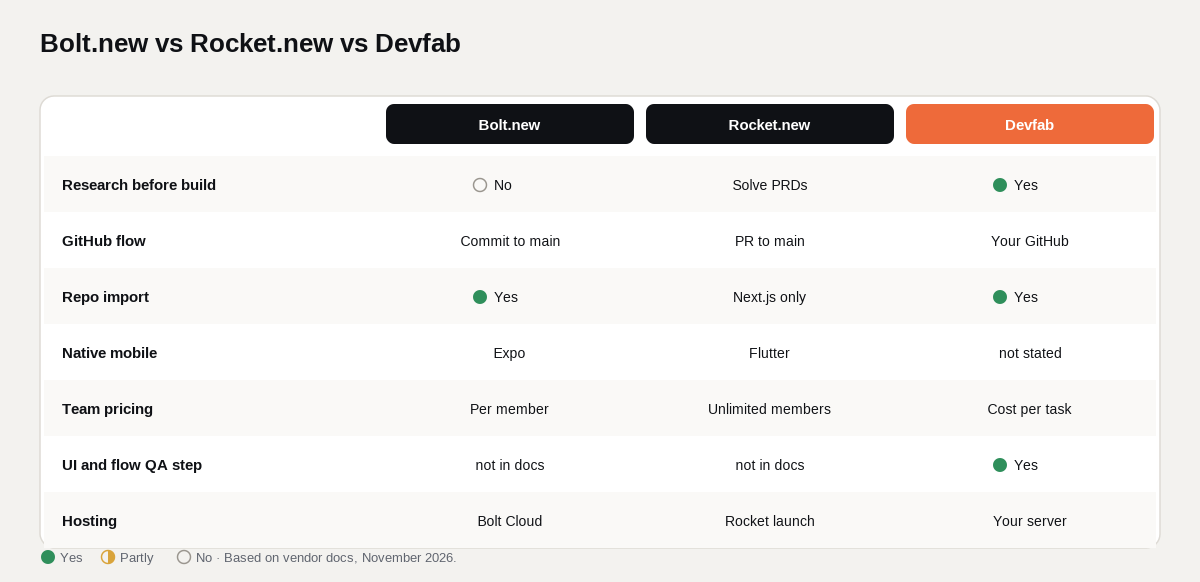
| Aspect | Bolt.new | Rocket.new | Source |
|---|---|---|---|
| Where it runs | Browser, on WebContainers | Hosted web app; Chat, Visual edit or Code editor | Intro to Bolt; Rocket build overview |
| Starting points | Idea, Figma, Google Stitch, GitHub repo, Lovable project | Idea, URL redesign, screenshot or wireframe, template, GitHub repo | Intro to Bolt; Rocket build overview |
| Research and spec | Plan mode, no code generated | Solve: market research, PRDs, reports; Intelligence: competitor monitoring | Bolt glossary; Rocket docs |
| Mobile | Native apps via Expo | Flutter; Android APK, Google Play, App Store | Intro to Bolt; Rocket build overview |
| Hosting and backend | Bolt Cloud: bolt.host subdomain, custom domains on paid plans, databases, auth, storage, functions, Stripe | One-click launch with custom domains; connectors for payments, databases, email, analytics, CRM | Bolt Cloud; Rocket build overview |
| GitHub flow | Auto-commits each non-breaking change to main; cannot switch branches | Pushes to rocket-update and opens a PR to main; import for Next.js + TypeScript only | Bolt Git docs; Rocket GitHub docs |
| Code download | Via GitHub | ZIP on Pro and above, web browser only | Rocket code editor |
| Team and admin | Teams: central billing, access management, user provisioning; SSO and audit logs on Enterprise | Unlimited team members on paid plans; SSO via sales | Bolt pricing; Rocket pricing |
| Pricing model | Tokens per member; paid tokens roll over for a limited period | One credit pool across Build, Solve and Intelligence | Bolt pricing; Rocket pricing |
Cost model by team size
| Team size | Bolt.new | Rocket.new | Devfab |
|---|---|---|---|
| 1 person | Free (1M tokens a month, 300K daily limit); Pro USD 25 per month (from 10M tokens) | Free (20 one-time credits); Pro USD 25 per month (100 credits) | Cost logged per task and per project (Beta) |
| 5 people | Teams USD 30 per member per month (tokens per member, not shared) | Rocket USD 50 per month (250 credits), unlimited members | Cost logged per task and per project (Beta) |
| 25 people | Teams per member, or Enterprise (custom) with SSO and audit logs | Booster USD 250 per month (1,500 credits), unlimited members; SSO via sales | Cost logged per task and per project (Beta) |
Prices as of November 2026 from Bolt pricing (monthly billing) and Rocket pricing plans. Rocket offers 20% off with yearly billing; Bolt says yearly billing saves "up to 28%". Devfab is in Beta and offers predictable cost: cost is logged after each run, per task and per project.
The pricing shapes pull in opposite directions. Bolt's cost grows with headcount. Rocket's grows with how much the whole team builds, since everyone draws on one pool.
Where Bolt.new wins
- You want to build on a free plan. Bolt's Free tier gives monthly tokens; Rocket's Free plan is a one-time grant of 20 credits.
- Your repo isn't Next.js. Rocket imports Next.js and TypeScript repos only; the Bolt Git docs we read list no such limit.
- You start from Figma, Google Stitch or Lovable. Bolt imports all three.
- You want hosting, auth and Stripe in one place. Bolt Cloud bundles them, with no limit on the number of databases.
- You need per-user admin. Teams adds access management and user provisioning; Enterprise adds SSO and audit logs.
Where Rocket.new wins
- You want a spec before the code. Solve writes PRDs and market research; Intelligence tracks competitors.
- Developers review every change. Rocket opens a pull request from
rocket-updatetomain, while Bolt commits tomaindirectly. - You need Flutter apps in the stores. Rocket covers Android APKs, Google Play and the App Store.
- Many people need access. Paid plans include unlimited team members.
- You build lots of marketing pages. Rocket added 25,000+ landing page templates in March 2026, and its Polish section covers SEO and accessibility.
One caution for Bolt users: when a plan's hosting usage runs out, the site "stops displaying publicly until your usage resets" (Bolt Cloud). Watch usage on client-facing sites.
Switching from one to the other
From Bolt.new to Rocket.new. Your Bolt project is already in GitHub. If it is a Next.js and TypeScript app, import the repo into Rocket; only the default branch's latest state comes across, with no issues, PRs, Actions or history (Rocket GitHub docs). Other stacks need a rebuild from a prompt or screenshots.
From Rocket.new to Bolt.new. Rocket's GitHub Sync keeps your code in a repo. Import that repo into Bolt (Bolt Git docs). Remember that Bolt stays on main, so merge Rocket's open pull request first.
Where Devfab fits
Rocket researches before it builds, and Bolt hosts what it builds. Neither, in the docs we checked, maps how existing functions and APIs depend on each other before a change, or runs a separate QA step that clicks through user journeys before work is done.
App builders automate the first version. Devfab automates the development lifecycle. Its Researcher maps the domain, key terms, best practices and competitors before the Planner writes a plan, and a person approves the plan. ChainFlow shows dev agents that changing how requests are assigned also touches contractor notifications, tenant status updates and billing. The QA agent runs UI, flow and logic tests, and Deploy ships to your own server. Devfab is in Beta, with a smaller community and fewer integrations, it is not an editor, and it needs a GitHub account. See Devfab vs Bolt.new and Devfab vs Rocket.new.
FAQ
Which is cheaper for a team, Bolt.new or Rocket.new?
It depends on team size and usage. As of November 2026, Bolt Teams is USD 30 per member per month, and each member's tokens are separate. Rocket.new prices per plan, from Pro at USD 25 per month to Booster at USD 250 per month, and paid plans include unlimited team members sharing one credit pool.
How do Bolt.new and Rocket.new work with GitHub?
Bolt imports a repo or creates a private one, auto-commits each non-breaking change, and stays on the main branch. Rocket.new pushes changes to a rocket-update branch and opens a pull request to main, and can pull main back. Rocket's repo import works for Next.js and TypeScript projects only.
Which one builds native mobile apps?
Both. Bolt builds native mobile apps through its Expo integration. Rocket.new builds iOS and Android apps in Flutter and covers Android APKs, Google Play and the Apple App Store.
Does Rocket.new really do market research?
Rocket.new's Solve mode validates ideas, runs market research and writes PRDs and structured reports, and Intelligence monitors competitors. Full Solve and competitive intelligence are on the upper tiers. Bolt's Plan mode works through strategy without generating code, but it is not a market research tool.
Read next
Want research, review and QA on every change, not just the first build? Try Beta
Sources (checked November 2026): Intro to Bolt; Bolt glossary; Bolt: Choose an agent; Bolt Git integration; What is Bolt Cloud?; Bolt pricing; SD Times: Bolt.new launches Forge (Sep 17, 2026); Rocket homepage; Rocket docs: Introduction; Rocket docs: Build overview; Rocket docs: Pricing plans; Rocket docs: From GitHub; Rocket docs: Code editor; Rocket changelog, Feb 2026; Rocket changelog, Mar 2026.
Frequently asked questions
Which is cheaper for a team, Bolt.new or Rocket.new?
It depends on team size and usage. As of November 2026, Bolt Teams is USD 30 per member per month, and each member's tokens are separate. Rocket.new prices per plan, from Pro at USD 25 per month to Booster at USD 250 per month, and paid plans include unlimited team members sharing one credit pool.
How do Bolt.new and Rocket.new work with GitHub?
Bolt imports a repo or creates a private one, auto-commits each non-breaking change, and stays on the main branch. Rocket.new pushes changes to a rocket-update branch and opens a pull request to main, and can pull main back. Rocket's repo import works for Next.js and TypeScript projects only.
Which one builds native mobile apps?
Both. Bolt builds native mobile apps through its Expo integration. Rocket.new builds iOS and Android apps in Flutter and covers Android APKs, Google Play and the Apple App Store.
Does Rocket.new really do market research?
Rocket.new's Solve mode validates ideas, runs market research and writes PRDs and structured reports, and Intelligence monitors competitors. Full Solve and competitive intelligence are on the upper tiers. Bolt's Plan mode works through strategy without generating code, but it is not a market research tool.