Short answer: For a close swap on web apps, pick Lovable. For a cloud IDE with browser-based app testing and many deploy types, pick Replit. For native mobile, pick FlutterFlow. If the app must be planned, tested and deployed to your own server as code you own, Devfab fits better than another builder.
You used Rocket to research an idea, write the PRD and get a first app. That part worked. Then the B2B quote tool had to connect to your real repo, and the gaps showed.
The common triggers are concrete. Rocket's GitHub import only supports Next.js with TypeScript. Code download needs a paid plan. And one credit pool covers building, research and competitor monitoring, so heavy research eats into build work.
In this guide, you'll learn:
- Why teams leave Rocket.new
- Quick comparison
- The alternatives
- Where Rocket.new is still the better choice
- How to choose
Pick the trigger that matches yours and read from there.
Why teams leave Rocket.new
Rocket is active and growing. Its homepage says 1.5 million people have tried it across 180 countries (Rocket). It pairs a builder with Solve, which runs market research and writes PRDs, and Intelligence, which tracks competitors (Rocket docs). The reasons teams look elsewhere are specific:
- Repo import is narrow. Importing from GitHub is "available for Next.js + TypeScript tasks only," and only the default branch's latest state comes in: no issues, PRs, Actions or git history (Rocket docs: From GitHub).
- Code access depends on plan. ZIP download "requires a paid plan (Pro or above)" and works only in a web browser, not the mobile clients (Rocket docs: Code editor).
- Stack choice is shrinking. In March 2026 Rocket stopped using React for new web apps ("All new web app use cases are now built with Next.js"), and in February it dropped HTML for new landing pages (Rocket changelog, March; Rocket changelog, February).
- One credit pool for everything. Build, Solve and Intelligence share credits, and full Solve and competitive intelligence sit on the upper tiers (Rocket pricing).
- Testing is not a named step. The pages we checked cover building, an Advisor Agent and a Polish section for SEO, accessibility and compliance, but not a separate test run (Rocket docs: Build).
How we compared
We read vendor docs, pricing pages and changelogs, re-checked on November 20, 2026, plus dated reviews where named. We did not run hands-on tests. Each tool was judged on what a team needs after the prototype: Git and code access, testing, deploy options, team controls and pricing model.
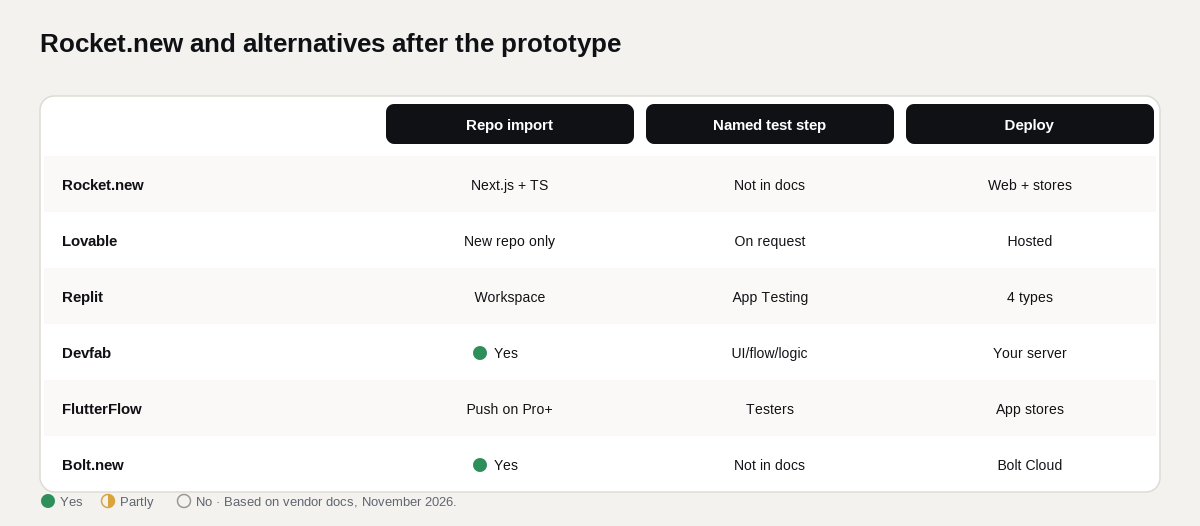
Quick comparison
| Tool | Best for | Code and Git | Testing | Deploy | Pricing model (Nov 2026) |
|---|---|---|---|---|---|
| Rocket.new (baseline) | Research + PRD + first app | PR to main; ZIP on Pro+ | Not a named step | One-click web; app stores | Per plan, shared credits |
| Lovable | Hosted web apps | Git sync to GitHub, GitLab, Bitbucket | Browser tests on request; security scans | Publish with HTTPS; custom domains on paid | Per plan, credits |
| Replit | Cloud IDE + agent | Full workspace code | App Testing clicks through the app | Autoscale, Reserved VM, Static, Scheduled | Per account, effort-based |
| Devfab | Planned, tested apps you own | Normal codebase in your GitHub | QA agent: UI, flow and logic tests | Your own server | Cost logged per task and per project |
| FlutterFlow | Native mobile apps | Code download on Basic+; GitHub push on Pro+ | Preview, test sign-in, testers | App Store and Google Play | Per tier, shared AI allowance |
| Bolt.new | Zero-setup builds in a tab | GitHub import and auto-commit | Not covered in the docs we checked | Bolt Cloud hosting | Tokens, per member on Teams |
The alternatives
Lovable
Verdict: the nearest like-for-like swap for web apps. Best for: founders and startups who want hosting, database and auth on one bill. Trade-off: no choice of framework, database or model, and web apps only. Pricing: Free USD 0; Pro USD 25 per month; Business USD 50 per month; priced by credits, not seats, as of November 2026 (Lovable pricing).
- Plan mode writes a plan for approval before Build mode changes code (Lovable FAQ).
- Git sync works with GitHub, GitLab or Bitbucket, but always creates a new repository and syncs one branch (Lovable docs: GitHub).
- A quick security scan runs on every publish; Lovable says scans "do not guarantee" security (Lovable FAQ).
- Not HIPAA-compliant and does not sign BAAs (Lovable FAQ).
Replit
Verdict: best when you want an agent and a full cloud IDE in one place. Best for: builders who drop into code often and need different runtime shapes. Trade-off: App Testing covers only full-stack JavaScript and Streamlit web apps. Pricing: Starter USD 0; Core USD 20 per month; Pro USD 100 per month; Enterprise custom, as of November 2026 (Replit pricing).
- Plan mode produces a task list to approve before Agent changes code or data (Replit docs).
- App Testing lets the agent click through the app in a real browser and fix issues (Replit docs: App Testing).
- Deploy as Autoscale, Reserved VM, Static or Scheduled, with custom domains (Replit docs: Publish).
- Enterprise admins can ban public apps, require security scans and pin deployment regions (Replit Enterprise).
Devfab
Verdict: the pick when "ship to production" means a planned, tested codebase on your own server. Best for: agencies and enterprise teams who own the code and answer for quality. Trade-off: in Beta, smaller community, fewer integrations, not an editor for hands-on coding, needs a GitHub account. Pricing: predictable cost; cost is logged after each run, per task and per project.
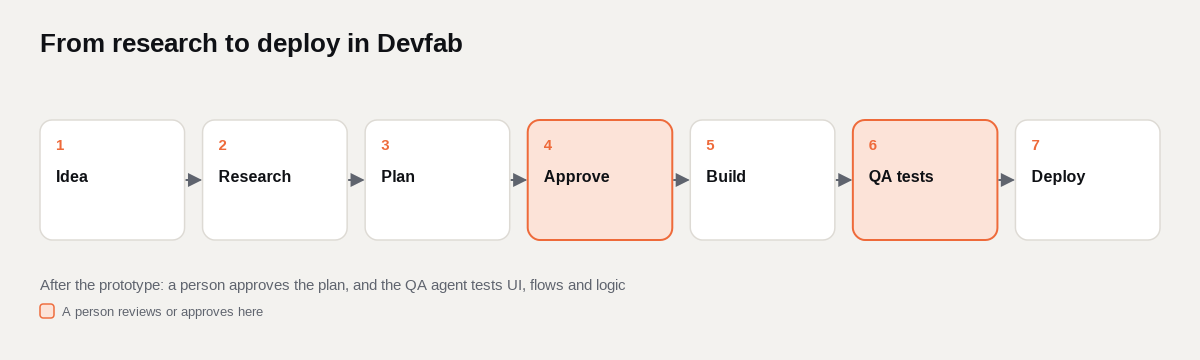
App builders automate the first version. Devfab automates the development lifecycle. Rocket's Solve and Devfab's Researcher look alike at first: both study the market before building. The difference comes after. Devfab's research maps key terms, best practices and competitors, then suggests a prototype, and the Planner writes a plan that a person approves. The Coordinator splits it into tickets for dev agents. ChainFlow maps which functions and APIs call each other, so a change to quote pricing shows its effect on discounts, PDFs and approval emails. The QA agent runs UI and flow tests that click screens, buttons and user journeys, plus logic tests. Code sits in your own GitHub account, and Deploy ships to your own server.
FlutterFlow
Verdict: best if mobile is the main product. Best for: native iOS and Android apps with store release built in. Trade-off: the new agent-based FlutterFlow is iPhone and Android only; web needs FlutterFlow Studio. Pricing: Free USD 0; Basic USD 39 per month; Pro USD 80 per month; Max USD 150 per month, as of November 2026 (FlutterFlow pricing).
- In November 2026 the classic builder became "FlutterFlow Studio" and "FlutterFlow" now names a new AI-agent mobile builder; one subscription covers both (FlutterFlow community).
- A Proposal card "waits for your approval before the agent builds it" (FlutterFlow docs).
- Code download on Basic and above; push to GitHub on Pro and Max (FlutterFlow pricing).
- Rocket also builds mobile in Flutter, so the framework stays the same (Rocket docs).
Bolt.new
Verdict: best for zero-setup building in a browser tab. Best for: solo builders who start from Figma or want Expo mobile prototypes. Trade-off: the project stays on main and cannot switch branches. Pricing: Free USD 0; Pro USD 25 per month; Teams USD 30 per member per month, billed monthly, as of November 2026 (Bolt pricing).
- Start from an idea, a Figma frame, Google Stitch designs, a GitHub repo or a Lovable project (Bolt support).
- Bolt auto-commits each non-breaking change to GitHub (Bolt docs: Git).
- Bolt Cloud bundles hosting, databases, auth, storage and Stripe payments (Bolt Cloud).
- When hosting usage runs out, the site "stops displaying publicly until your usage resets" (Bolt Cloud).
Where Rocket.new is still the better choice
- You want research and the app from one tool. Solve validates ideas, runs market research and writes PRDs before Build starts.
- You watch competitors. Intelligence tracks pricing changes and site updates next to the builder.
- You build many landing pages. Rocket added 25,000+ landing page templates in March 2026, with SEO checks in Polish.
- Your team is large but your budget is fixed. Paid plans include unlimited team members.
- You need web and mobile from one place. Next.js for web and Flutter for iOS and Android, with app-store release.
How to choose
- If your trigger is repo import, choose a tool that works in your existing repo. Devfab's "Work on an existing project" connects your GitHub repo; Bolt.new also imports repos.
- If your trigger is testing, choose a tool with a named test step: Replit App Testing, or Devfab's QA agent.
- If your trigger is mobile, go to FlutterFlow.
- If you only want a cheaper or simpler builder, compare Lovable and Bolt.new on their pricing pages.
- If the client will audit the work, prefer a plan someone approves and code in the client's own GitHub organization.
FAQ
What is the closest alternative to Rocket.new?
Lovable is the closest match for web apps: a hosted prompt-to-app builder with Plan mode, publishing, a built-in backend and Git sync. Bolt.new is close too, with Figma import and Expo mobile apps. Neither bundles Rocket's market research (Solve) or competitor monitoring (Intelligence).
Can I take my code out of Rocket.new?
Yes, on paid plans. Rocket pushes changes to a rocket-update branch and opens a pull request to main, and ZIP download of the source needs Pro or above in a web browser. On the Free plan you cannot download code.
Which Rocket.new alternative is best for mobile apps?
FlutterFlow. Its new agent builds native iOS and Android apps and handles store submission, and FlutterFlow Studio exports clean Flutter code. Rocket also builds Flutter mobile apps, so moving between them keeps you in the same framework.
Is Rocket.new priced per user?
No. As of November 2026, Rocket's paid plans are priced per plan with unlimited team members: Pro USD 25, Rocket USD 50 and Booster USD 250 per month, each with monthly credits shared across Build, Solve and Intelligence.
When should a team move from an app builder to a software factory?
When the app must pass real tests, survive changes to connected features and run on your own server. A factory like Devfab adds research before the plan, plan approval by a person, UI, flow and logic tests, and deploy, with code in your own GitHub account.
Read next
- What is an AI software factory?
- Devfab vs Rocket.new
- Lovable vs Rocket.new
- Bolt.new vs Rocket.new
- Bolt.new alternatives
Ready to take the prototype to production? Try Beta
Sources (checked November 2026): Rocket; Rocket docs: Introduction; Rocket docs: Build overview; Rocket docs: Pricing plans; Rocket docs: From GitHub; Rocket docs: Code editor; Rocket changelog: February 2026; Rocket changelog: March 2026; Lovable pricing; Lovable FAQ; Lovable docs: GitHub; Replit pricing; Replit Agent overview; Replit App Testing; Replit: Publish your app; Replit Enterprise; FlutterFlow pricing; FlutterFlow docs: The agent; FlutterFlow community: Two ways to build (Nov 2026); Bolt pricing; Bolt support: Intro; Bolt docs: Git; Bolt Cloud.
Frequently asked questions
What is the closest alternative to Rocket.new?
Lovable is the closest match for web apps: a hosted prompt-to-app builder with Plan mode, publishing, a built-in backend and Git sync. Bolt.new is close too, with Figma import and Expo mobile apps. Neither bundles Rocket's market research (Solve) or competitor monitoring (Intelligence).
Can I take my code out of Rocket.new?
Yes, on paid plans. Rocket pushes changes to a rocket-update branch and opens a pull request to main, and ZIP download of the source needs Pro or above in a web browser. On the Free plan you cannot download code.
Which Rocket.new alternative is best for mobile apps?
FlutterFlow. Its new agent builds native iOS and Android apps and handles store submission, and FlutterFlow Studio exports clean Flutter code. Rocket also builds Flutter mobile apps, so moving between them keeps you in the same framework.
Is Rocket.new priced per user?
No. As of November 2026, Rocket's paid plans are priced per plan with unlimited team members: Pro USD 25, Rocket USD 50 and Booster USD 250 per month, each with monthly credits shared across Build, Solve and Intelligence.
When should a team move from an app builder to a software factory?
When the app must pass real tests, survive changes to connected features and run on your own server. A factory like Devfab adds research before the plan, plan approval by a person, UI, flow and logic tests, and deploy, with code in your own GitHub account.