Short answer: Choose Rocket.new when a founder or product team wants market research, a PRD, competitor monitoring and a first web or mobile app from one tool and one credit pool. Choose Devfab when you deliver client software: the research feeds a plan a person approves, agents build and test, and the app deploys to your server.
Most AI builders start typing code the moment you hit enter. Rocket.new and Devfab don't: both research before they build. That makes this a closer match than most comparisons, and a fair one needs care. The real difference is what happens after the research. Rocket turns it into a PRD and a generated app. Devfab turns it into an approved plan, tickets, tests and a deploy.
In this comparison:
- What each tool is built for
- Switching triggers
- Moving from Rocket.new to Devfab
- Where Rocket.new is the better choice
Here is how they compare.
What each tool is built for
Rocket.new
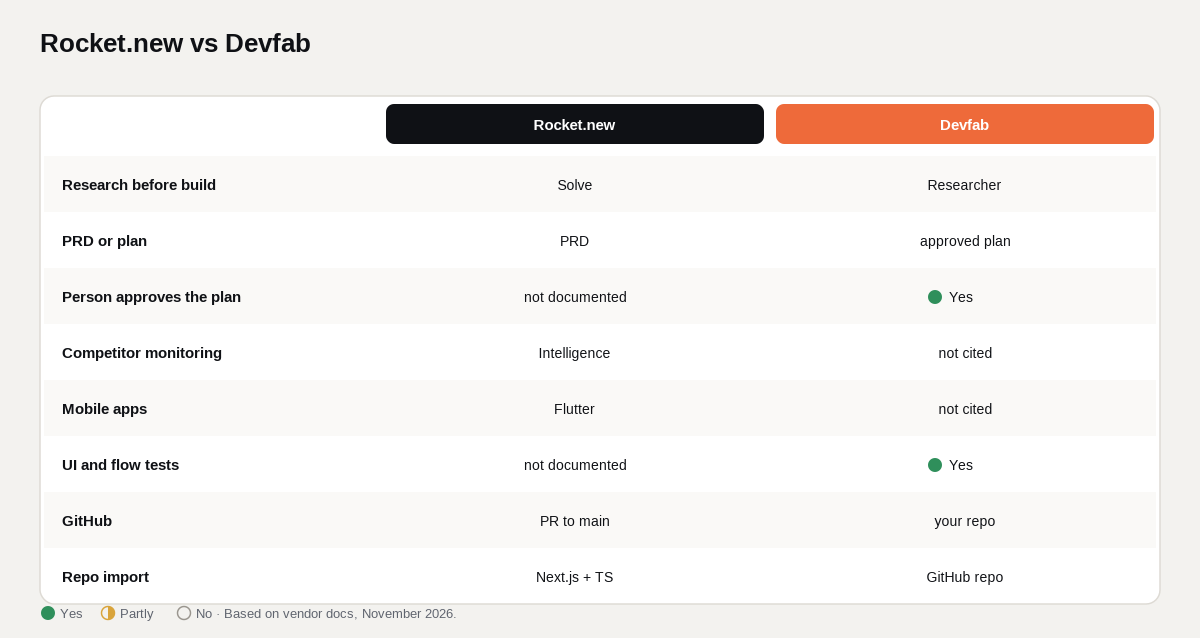
Rocket.new, from Rocket USA Inc., is a prompt-to-app builder with two extra modes. It lists "Solo founders. Product teams. Engineering teams. Sales leaders. Consultants." as users, and claims 1.5 million people have tried it across 180 countries.
- Solve validates ideas, runs market research and creates PRDs and structured reports.
- Build "plans the architecture, writes the code" and shows a live preview. Web apps use Next.js; iOS and Android apps use Flutter. You refine by Chat, Visual edit or the Code editor, and can start from an idea, a URL to redesign, a screenshot or wireframe, a template or a GitHub repo.
- Intelligence monitors competitors, such as pricing changes and site updates.
- Launch: one-click web launch with custom domains; mobile through a web preview, an Android APK, Google Play and the Apple App Store.
- Editor extras: connectors for payments, databases, AI models, email, analytics and CRM; versions, environment variables, an Advisor Agent, and a Polish section for SEO, accessibility and compliance.
- Team: paid plans include unlimited team members; SSO and data localization go through sales. The homepage cites SOC 2, ISO 27001 and GDPR.
2026 changes: on February 10, 2026, landing pages and websites moved to Next.js and HTML was discontinued for new projects. On March 11–12, 2026, Rocket launched GitHub Sync for Next.js projects, deprecated React for new web apps and added more than 25,000 landing page templates.
Devfab
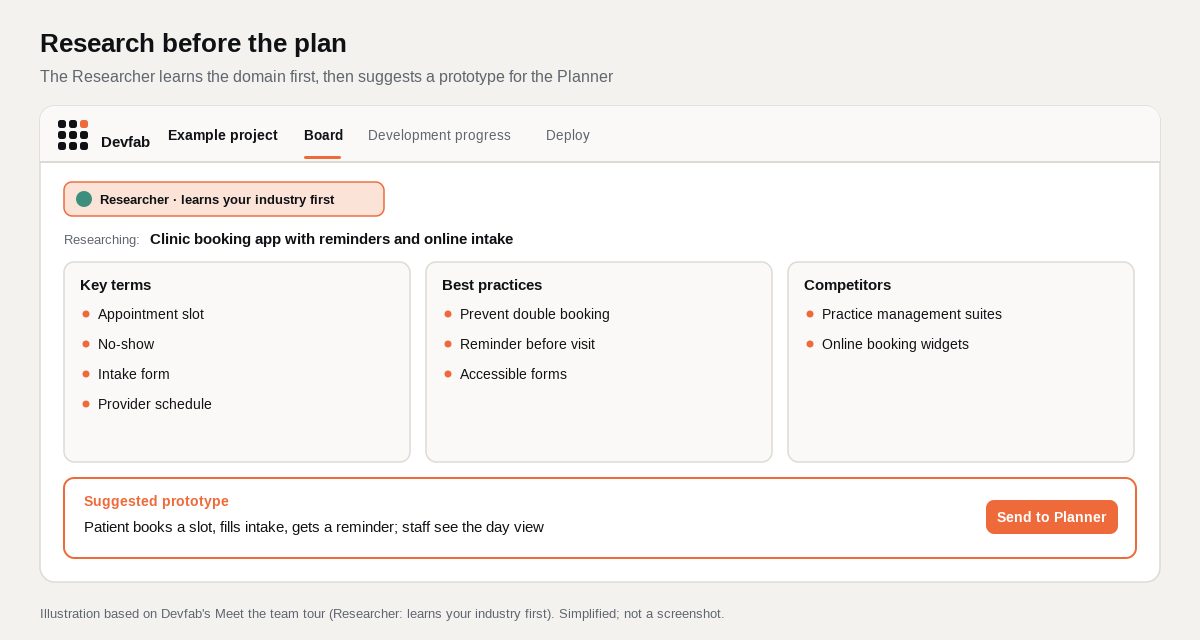
Devfab is an AI software factory run by seven agents. The Researcher maps the domain first: key terms, best practices for that kind of app and competitors, then suggests a prototype. The Planner turns that into a plan, and a person approves it before the Coordinator creates tickets for the Developers. They work with ChainFlow, which maps which functions and APIs call each other so a change doesn't break connected features. Blueprint draws screens, the QA agent runs UI and flow tests plus logic tests, and Deploy ships to your own server.
Code lives in your own GitHub account (or your organization's).
App builders automate the first version. Devfab automates the development lifecycle.
Switching triggers
| Trigger | Rocket.new | Devfab | Source |
|---|---|---|---|
| Your client's repo isn't Next.js | GitHub import is "available for Next.js + TypeScript tasks only" | Connect your GitHub repo; pick languages or let Devfab pick the stack | Rocket docs: From GitHub |
| You need repo history and CI | Import brings the default branch's latest state, without issues, PRs, Actions or git history | Works in your existing repo; ChainFlow maps the code first | Rocket docs: From GitHub |
| Code download is gated | ZIP download needs Pro or above and works only in a web browser | Code lives in your GitHub from the first ticket | Rocket docs: Code editor |
| Research and build share one budget | One credit pool covers Build, Solve and Intelligence; full Solve is on upper tiers | Cost logged after each run, per task and per project | Rocket pricing docs |
| Scope needs a client signature | Build plans the architecture before writing code | A person approves the plan by default, then a Coordinator creates tickets | Rocket docs: Build overview |
| You need a test report | Testing is not covered in the docs we checked | QA agent runs UI, flow and logic tests | Rocket docs: Build overview |
Cost model by team size
| Team size | Rocket.new | Devfab |
|---|---|---|
| 1 person | Free tier with a one-time credit grant; Pro adds monthly credits and code download | Cost logged per task and per project (Beta) |
| 5 people | Paid tiers (Pro, Rocket, Booster) with monthly credits and unlimited team members; add-on credits | Cost logged per task and per project (Beta) |
| 25 people | Upper tiers for full Solve and competitive intelligence; SSO and data localization through sales | Cost logged per task and per project (Beta) |
Annual billing has a discount. Check Rocket's pricing plans page for current amounts.
Moving from Rocket.new to Devfab
- Turn on GitHub Sync. Rocket pushes each batch of edits to a
rocket-updatebranch and opens a pull request tomain, so the code is already in your GitHub. - Merge and check the repo. Review the open pull request and merge it, so
mainhas the latest version. - Connect the repo to Devfab. Choose "Work on an existing project", pick the repo and leave the change box empty. ChainFlow maps the code first and suggests three small first tickets.
- Bring your PRD. Attach the PRD from Solve as a spec, so the Planner starts from what you already decided.
- Approve the plan. Human in the loop is the default; the Coordinator then creates tickets.
- Let the QA agent test UI, user flows and logic, then deploy to your own server.
Where Rocket.new is the better choice
- You are validating an idea and want market research, a PRD and a first app from one tool before committing engineers.
- You need native mobile apps with Flutter, an APK, Google Play and App Store paths.
- You want ongoing competitor monitoring, such as pricing changes and site updates, next to the builder.
- Marketing sites and landing pages from a large template library, with SEO and accessibility checks.
- Unlimited team members on paid plans, which suits a large product or sales team.
Where Devfab is the better choice
- The research must lead to a signed-off plan. A person approves it before agents build anything.
- The client's repo isn't Next.js, or you need its history and CI kept intact.
- You need a QA report from a separate agent that tests screens, user journeys and logic.
- You maintain a live codebase. ChainFlow shows what a change touches, such as checkout affecting payments, inventory and notifications.
- The app runs on the client's server, with the code in their GitHub.
- You report per project: Kanban and Gantt views, user manuals, a Team Delivery Report and cost per task.
Devfab's honest limits: it is new and in Beta, with a smaller community and fewer integrations than Rocket.new. This page cites no competitor-monitoring mode or template library for Devfab. It is not an editor for hands-on coding, and it needs a GitHub account.
FAQ
Rocket.new and Devfab both do research. What is the difference?
Rocket's Solve mode validates ideas, runs market research and writes PRDs, and Intelligence monitors competitors. Devfab's Researcher maps the domain's terms, best practices and competitors, and that research feeds a plan a person approves, tickets for dev agents, a QA agent and a deploy to your server.
Does Rocket.new work with GitHub?
Yes. Rocket pushes edits to a rocket-update branch and opens a pull request to main, and can pull main back in. Importing an existing repo works for Next.js and TypeScript projects only, and brings only the default branch's latest state.
Can Rocket.new build mobile apps?
Yes. Rocket builds iOS and Android apps with Flutter and offers a web preview, an Android APK, Google Play and Apple App Store. Web apps use Next.js.
How do Rocket.new and Devfab charge?
Rocket uses one credit pool shared across Build, Solve and Intelligence, with a one-time grant on Free and monthly credits on paid tiers. Devfab is in Beta with predictable cost: cost is logged after each run, per task and per project.
Read next
- What is an AI software factory?
- Spec-driven development vs vibe coding: which ships better software?
- Devfab vs Bolt.new: which fits a team that ships client work?
- Best AI tools for writing software requirements
See research turn into an approved plan. Book a Devfab demo
Sources (checked November 13, 2026): Rocket homepage; Rocket docs: introduction; Rocket docs: Build overview; Rocket docs: pricing plans; Rocket docs: from GitHub; Rocket docs: code editor; Rocket changelog: Feb 2026, week 2; Rocket changelog: Mar 2026, week 2.
Frequently asked questions
Rocket.new and Devfab both do research. What is the difference?
Rocket's Solve mode validates ideas, runs market research and writes PRDs, and Intelligence monitors competitors. Devfab's Researcher maps the domain's terms, best practices and competitors, and that research feeds a plan a person approves, tickets for dev agents, a QA agent and a deploy to your server.
Does Rocket.new work with GitHub?
Yes. Rocket pushes edits to a rocket-update branch and opens a pull request to main, and can pull main back in. Importing an existing repo works for Next.js and TypeScript projects only, and brings only the default branch's latest state.
Can Rocket.new build mobile apps?
Yes. Rocket builds iOS and Android apps with Flutter and offers a web preview, an Android APK, Google Play and Apple App Store. Web apps use Next.js.
How do Rocket.new and Devfab charge?
Rocket uses one credit pool shared across Build, Solve and Intelligence, with a one-time grant on Free and monthly credits on paid tiers. Devfab is in Beta with predictable cost: cost is logged after each run, per task and per project.