Short answer: Bubble wins when non-coders want to keep editing pages, workflows and data visually, and need a web app plus native iOS and Android apps on one backend. Lovable wins when you want React code you can export, two-way GitHub sync and a path to hand the app to developers.
You're a founder who doesn't write code, and you plan to run this app as a business. Bubble's camp says a visual editor is the only way you'll keep control without hiring. Lovable's camp says generated code is the only way you won't be locked in later. Both have published comparisons; Bubble's came out on October 27, 2026. This page checks their claims against the docs and gives each one the wins it earned.
In this comparison:
- Bubble and Lovable at a glance
- Feature comparison
- Cost model by team size
- Where Bubble wins and where Lovable wins
- Where Devfab fits
Here's how the two compare, section by section.
Bubble and Lovable at a glance
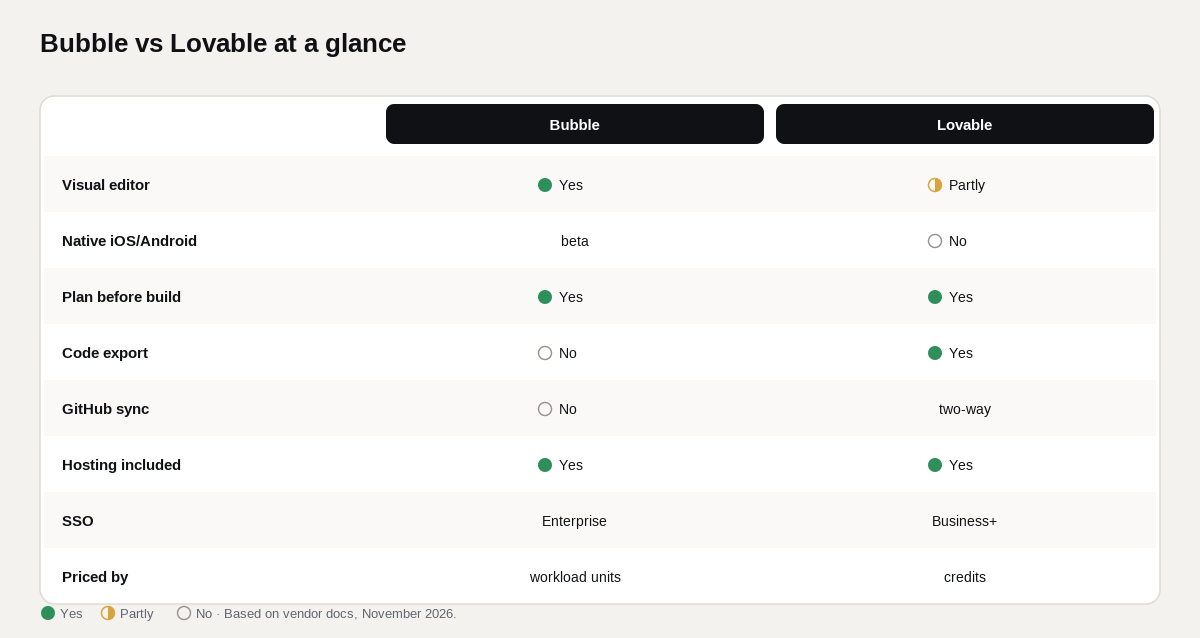
Bubble is a hosted no-code platform. "Every component is visual, including the backend," and hosting, a built-in database, security and auto-scaling are included. Its AI Agent (beta) "plans your app with you," then builds pages, workflows, the database and privacy rules inside the visual editor; you can keep chatting or edit by hand. Bubble also builds iOS and Android apps that share data and workflows with the web app (labeled beta). The key constraint: Bubble apps "can only be run on the Bubble platform; there's no way of exporting your application as code."
Lovable is a browser-based AI app builder founded in 2023 as GPT Engineer. You describe the app in a chat; Lovable generates the code, which you can read and edit, and hosts the result. 2026 changes: new apps use TanStack Start since May 13, 2026, and since September 9, 2026, Free and Pro data may be used for model training unless users opt out.
Put simply: in Bubble, the visual editor is the source of truth. In Lovable, the code is.
Feature comparison
| Aspect | Bubble | Lovable | Source |
|---|---|---|---|
| Where it runs | Browser visual editor; hosting, database and scaling included | Browser chat, code editor and preview; iOS and Android app for building | Bubble · Lovable FAQ |
| Output | Web apps plus native iOS and Android (beta) on one backend | Web apps only; no React Native projects | Bubble · Lovable FAQ |
| Planning / spec | AI Agent plans the app with you, then builds | Plan mode writes a plan for approval before changes | Bubble AI guide · Lovable FAQ |
| Editing after the first draft | Chat with the Agent or edit pages, workflows and data visually | Changes beyond text go through prompts (which use credits) or the code editor | Bubble AI builder · Bubble vs Lovable (Bubble) |
| Testing / security | Built-in privacy rules; SOC 2 Type II platform | Browser and frontend tests when asked; security scan on every publish | Bubble · Lovable FAQ |
| Code ownership / export | No code export; data as CSV or via the Bubble API | Two-way GitHub sync; GitLab and Bitbucket; ZIP on paid plans | Bubble manual · Lovable GitHub |
| Team / admin | Team plan with custom branches; Enterprise: SSO, isolated instance in a chosen region | Roles and per-person drafts; SSO from Business; SCIM and audit logs on Enterprise | Bubble compare plans · Lovable Enterprise |
| Bring your own agent | Bubble MCP (beta) connects agents such as Claude or Codex | Not covered in the docs we checked | Bubble AI guide |
| Pricing model | Plans with workload units, AI credits and a set number of editors | Monthly credits, not seats | Bubble compare plans · Lovable plans |
Cost model by team size
| Team size | Bubble | Lovable | Devfab |
|---|---|---|---|
| 1 person | Free plan to build and test, but no live app or custom domain; a paid plan is required to go live | Free plan can build and publish with daily build credits; Pro adds monthly credits | Cost logged per task and per project (Beta) |
| 5 people | Each plan includes a set number of app editors; Team adds custom branches | Credits, not seats; collaborators spend the owner workspace's credits | Cost logged per task and per project (Beta) |
| 25 people | Enterprise: SSO, isolated instance, restricted contributor access, account provisioning | Business for SSO; Enterprise for SCIM, audit logs and publish approval gates | Cost logged per task and per project (Beta) |
Bubble's bill grows with server activity: each plan meters workload units, with paid overages. Lovable's grows with AI use and hosting, from one shared credit balance. Each vendor calls its own model the more predictable one, so model your traffic on Bubble's plan comparison and Lovable's plans page.
Where Bubble wins
- Editing forever without code. Pages, workflows, data and privacy rules stay visual, so a non-coder can keep changing the app after launch.
- Web and native mobile on one backend. iOS and Android apps share data and workflows with the web app, with direct store submission (beta).
- Everything hosted in one place. Hosting, database, security and auto-scaling are part of every live plan.
- Enterprise isolation. An isolated instance on a Bubble-managed AWS server in a chosen region, encryption at rest and point-in-time recovery.
Where Lovable wins
- Code you can take with you. Two-way GitHub sync and a full ZIP download on paid plans; Bubble's own comparison concedes the download.
- Polished first drafts. Bubble's post says "Lovable's first drafts are especially polished visually."
- Quick MVPs and demos. Bubble calls Lovable "a good pick for spinning up a quick MVP or demo."
- Developer handoff. A developer can open the repo, review changes and work in their own tools.
Switching from one to the other
Bubble to Lovable. There is no code to export. Export your data as CSV or through the Bubble API, then rebuild the app in Lovable by describing it. Bubble's guide says its MCP (beta) can help rebuild an app in code you own, but "can't deploy your app yet."
Lovable to Bubble. Keep the code in GitHub. Bubble's docs we checked don't describe importing code, so describe the app to the Bubble AI Agent, rebuild workflows visually and move the data.
Where Devfab fits
Bubble and Lovable both help a non-coder get a first version. When the app starts to matter, teams ask for things neither centers on: research into how similar apps work, a plan someone approves, journey tests and an app on their own server.
App builders automate the first version. Devfab automates the development lifecycle.
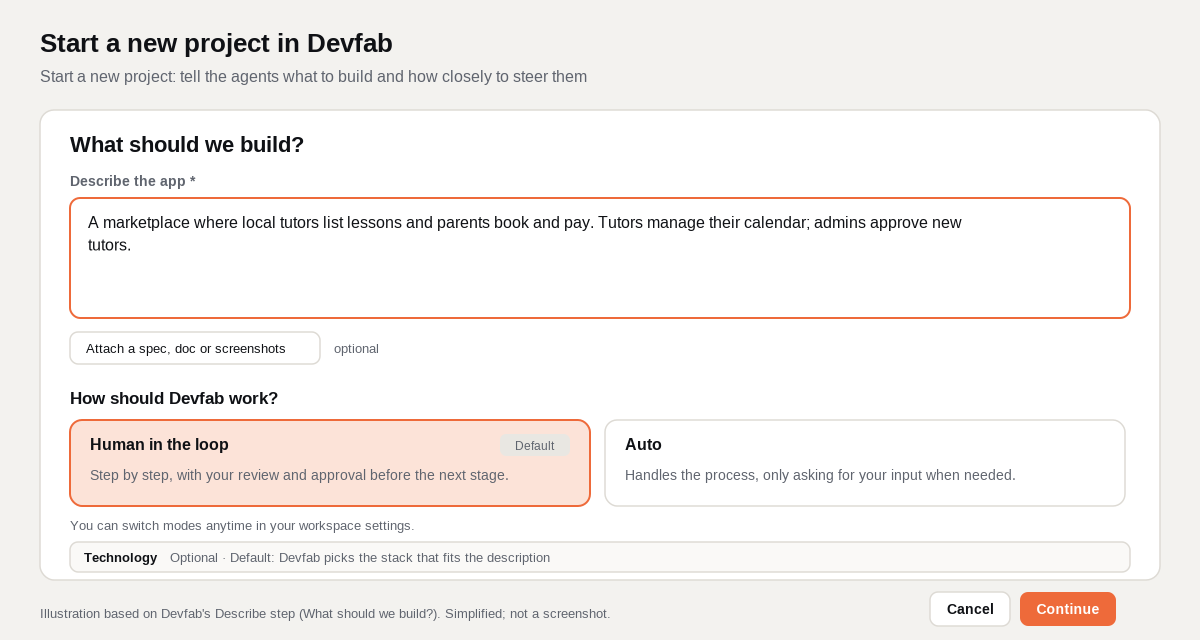
Devfab is an AI software factory. Choose "Start a new project" and describe what to build. The research step maps the domain first: key terms, best practices for that kind of app and competitors, then suggests a prototype. A person approves the plan; the QA agent runs UI and flow tests plus logic tests; Deploy ships to your own server. The code lives in your own GitHub account (or your organization's), which is the opposite of Bubble's run-only-on-Bubble model.
Devfab's honest limits: it is new and in Beta, with a smaller community and fewer integrations. It has no visual editor like Bubble's and is not an editor for hands-on coding. It needs a GitHub account and deploys to your own server rather than hosting the app for you.
FAQ
Can I export my Bubble app as code?
No. Bubble's manual says apps can only run on the Bubble platform and there is no way to export the application as code. You can export your data as CSV or through the Bubble API. Bubble says its MCP, in beta, can help rebuild an app in code you own.
Is Lovable or Bubble better for a non-technical founder?
Both are built for non-coders. Choose Bubble if you want to keep editing the app visually for years and need native mobile apps. Choose Lovable if you want polished first drafts and code a developer can take over later.
Which has more predictable costs?
Each vendor says its own. Bubble meters workload units for server usage plus AI credits, with a fixed number of editors per plan. Lovable uses one monthly credit balance for building, hosting and backend. Model your expected traffic and edits on both pricing pages.
Does Bubble or Lovable build native mobile apps?
Bubble does: iOS and Android apps that share data and workflows with the web app, labeled beta. Lovable's FAQ says it builds web apps only, with no React Native projects.
Read next
- What is an AI software factory?
- Bubble alternatives
- No-code vs AI app builder
- What is vibe coding, and when does it stop working?
Want the app in your own repo, tested and deployed? Try Devfab Beta
Sources (checked November 13, 2026): Bubble homepage; Bubble pricing: compare plans; Bubble AI app builder; Bubble for Enterprise; Bubble manual: application and data ownership; What is Bubble AI? (Bubble, Aug 19, 2026); Bubble vs Lovable (Bubble, Oct 27, 2026); Lovable FAQ; Lovable for Enterprise; Lovable GitHub Git sync; Lovable plans and credits; Lovable subscription plans; Lovable collaboration.
Frequently asked questions
Can I export my Bubble app as code?
No. Bubble's manual says apps can only run on the Bubble platform and there is no way to export the application as code. You can export your data as CSV or through the Bubble API. Bubble says its MCP, in beta, can help rebuild an app in code you own.
Is Lovable or Bubble better for a non-technical founder?
Both are built for non-coders. Choose Bubble if you want to keep editing the app visually for years and need native mobile apps. Choose Lovable if you want polished first drafts and code a developer can take over later.
Which has more predictable costs?
Each vendor says its own. Bubble meters workload units for server usage plus AI credits, with a fixed number of editors per plan. Lovable uses one monthly credit balance for building, hosting and backend. Model your expected traffic and edits on both pricing pages.
Does Bubble or Lovable build native mobile apps?
Bubble does: iOS and Android apps that share data and workflows with the web app, labeled beta. Lovable's FAQ says it builds web apps only, with no React Native projects.