Short answer: UI Bakery wins when developers want an AI agent to scaffold admin panels on existing SQL databases, then export readable React code, with air-gapped installs available on Enterprise. ToolJet wins when developers already use coding agents and want an open-source, self-hosted platform they drive over MCP, priced per builder.
The support team at an online furniture store handles returns, refunds and damaged-delivery claims in raw database queries. The developers who know the Postgres schema are tired of running them by hand. They want an admin panel, and they want to stay in control of the code.
UI Bakery and ToolJet both promise that, with different meanings of "control." One lets you export the code. The other lets you read and host the whole platform. This page compares them on vendor pages checked in November 2026.
In this comparison:
- UI Bakery and ToolJet at a glance
- Feature comparison
- Cost model by team size
- Where UI Bakery wins
- Where ToolJet wins
Decide what "control" means for you first.
UI Bakery and ToolJet at a glance
UI Bakery is active, and its homepage shows an undated "UI Bakery Self-Hosted 2.0" banner (UI Bakery). It is a low-code platform for internal tools, admin panels and portals on existing data. Its AI Development Agent builds apps from chat prompts, and you can export readable React code to continue in your own IDE. It targets internal tool builders, operations and finance teams, and developers. It connects to 45+ sources, including PostgreSQL, MySQL, MongoDB, SQL Server, Snowflake, Oracle, GraphQL, OpenAPI, MCP and HTTP APIs.
The "new ToolJet" arrived on September 2, 2026. It lets teams "Build apps from your own coding agents (Claude Code, Codex, Grok Build, Cursor, etc)" through ToolJet MCP, and its AI Builder "can create complete business applications" that stay editable in the visual builder (ToolJet blog). The Community Edition is AGPL-3.0, and ToolJet positions itself as "Designed for self-hosted, security-sensitive environments" (ToolJet 2026 post).
Feature comparison
| Aspect | UI Bakery | ToolJet | Source |
|---|---|---|---|
| Where it runs | Cloud, or self-hosted in a private network, on-prem, air-gapped or Docker | ToolJet Cloud, VPC, or self-hosted on Docker, Kubernetes, major clouds or on-prem | UI Bakery; ToolJet vs Superblocks (ToolJet) |
| AI building | AI Development Agent builds apps from chat | AI Builder creates complete apps; assistant reads API specs | UI Bakery; ToolJet 2026 post |
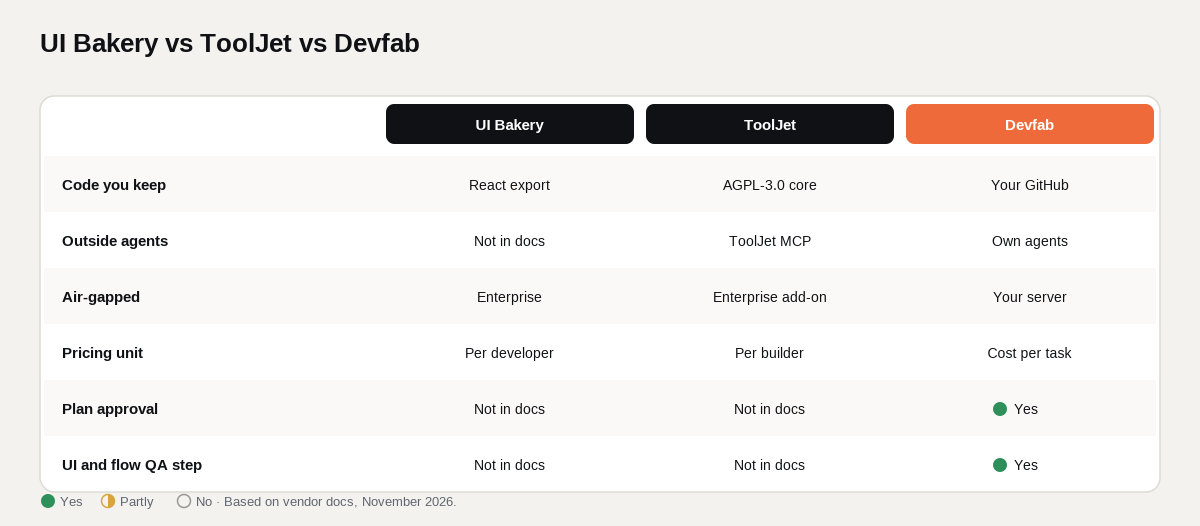
| Outside coding agents | Not covered in the pages we checked | ToolJet MCP for Claude Code, Codex, Cursor; Governance MCP for permissions | ToolJet blog |
| Testing | Not covered in the pages we checked | Assistant auto-fixes component errors; testing not covered | ToolJet 2026 post |
| Code | Export readable React code; use any React component | AGPL-3.0 core; Git-based workflows, dev and prod environments | UI Bakery; ToolJet blog |
| Data | 45+ connectors incl. SQL databases, GraphQL, OpenAPI, MCP | 100+ integrations; ToolJet database for AI-built apps | UI Bakery; ToolJet blog |
| Admin and compliance | Git version control, RBAC, audit logs, MFA, SOC 2 Type 2; custom SSO on Enterprise | SSO with SCIM, fine-grained RBAC, OpenTelemetry; SOC 2 Type II, ISO 27001 | UI Bakery pricing; ToolJet 2026 post |
| Model choice | Custom AI provider keys; bring your own key is Enterprise on self-hosted | Several model families on paid plans; bring your own key on Enterprise | UI Bakery pricing; ToolJet vs Superblocks (ToolJet) |
| Pricing model | Per developer seat, AI credits per plan, metered automation runs | Per builder, end-user caps, AI credits per builder | UI Bakery pricing; ToolJet pricing |
Cost model by team size
| Team size | UI Bakery | ToolJet |
|---|---|---|
| 1 person | Cloud Free USD 0; or Builder USD 25 per developer per month (USD 20 billed annually) | Free USD 0: 1 builder, 10 end users, 3 apps, 100 AI credits per month |
| 5 people | Team USD 40 per developer per month (USD 35 billed annually) | Pro USD 79 per month (annual): 5 builders, 50 end users, unlimited apps |
| 25 people | Team per developer, or Enterprise custom (custom SSO, air-gapped) | Team USD 199 per builder per month billed annually (USD 249 monthly), 100 end users; or Enterprise custom |
Prices as of November 2026 from UI Bakery pricing and ToolJet pricing. Both price the people who build, not the people who use the app. UI Bakery charges USD 50 per extra 5,000 automation runs; ToolJet sells extra AI credits at USD 1 per 100 (minimum 2,000). UI Bakery's pricing page is inconsistent on self-hosted Free seats, so confirm before you plan on it.
Where UI Bakery wins
- You want an exit with code. Export readable React code and keep working in your own IDE.
- SQL-heavy admin panels. Direct connectors for Postgres, MySQL, SQL Server, Oracle and Snowflake suit the refund panel.
- Low cost for a few developers. Builder starts at USD 20 per developer per month billed annually.
- Air-gapped installs are listed on Enterprise, next to on-prem and Docker options.
Where ToolJet wins
- Your developers already use coding agents. ToolJet MCP turns Claude Code or Cursor sessions into governed apps, without using ToolJet credits.
- Open source you can inspect. AGPL-3.0 core and an MIT-licensed MCP server.
- Fine-grained governance. RBAC down to queries, components and pages, promote and release permissions, and OpenTelemetry.
- Workflows with NPM libraries. Scheduled and event-driven workflows can pull in external packages.
Trade-offs on ToolJet: workflows and AI agents are listed as self-hosted only, and a competitor review warns that AI-built apps may lack input validation and need developer review (Jet Admin).
Switching from one to the other
There is no direct import between the two in the pages we checked. Both connect to the same SQL databases, so point the new platform at the existing database first. Moving to ToolJet, a coding agent can rebuild screens through ToolJet MCP. Moving to UI Bakery, describe the panel to its AI Development Agent, then reconnect queries; if you exported React code from UI Bakery earlier, that code stays yours either way.
Where Devfab fits
Both platforms are good at internal admin panels. Neither is built to run the whole delivery of a customer-facing returns portal, where shoppers file claims, upload photos and track refunds.
Coding agents automate the developer. Devfab automates the development lifecycle. A person approves the plan before tickets exist. ChainFlow maps which functions and APIs call each other and what is deployed, so a change to refund rules shows its effect on payments, inventory, order confirmation and customer emails before it ships. The QA agent then runs UI and flow tests plus logic tests. Devfab is in Beta, with fewer connectors than either platform, and it is not an editor for hands-on coding. See Devfab vs UI Bakery and Devfab vs ToolJet.
FAQ
Can I export code from UI Bakery or ToolJet?
UI Bakery says you can export readable React code and continue in your own IDE. ToolJet's Community Edition is open source under AGPL-3.0, and it offers Git-based workflows; exporting an app as a standalone React project is not covered in the ToolJet pages we checked.
Which is cheaper for a few developers?
As of November 2026, UI Bakery Builder is USD 20 per developer per month billed annually (USD 25 monthly). ToolJet Basic is USD 23 per builder per month billed annually, and Pro is USD 79 per month for 5 builders and 50 end users. Both have free tiers.
Which can run air-gapped?
Both, on enterprise terms. UI Bakery lists air-gapped deployment on its Enterprise plan. ToolJet needs a Self-hosted Enterprise add-on for air-gapped operation, per its own comparison page.
Can my coding agent build apps on either platform?
ToolJet is built for it: ToolJet MCP lets Claude Code, Codex, Cursor and others create and modify apps, and that uses no ToolJet AI credits. UI Bakery lists MCP among its data connectors and has its own AI Development Agent; outside agents building UI Bakery apps is not covered in the pages we checked.
Read next
Building the customer-facing side too? Try Beta
Sources (checked November 2026): UI Bakery homepage; UI Bakery pricing; Meet the new ToolJet (Sep 2, 2026); ToolJet at the start of 2026 (Jan 8, 2026); ToolJet vs Superblocks (ToolJet's own page); ToolJet pricing; Jet Admin: ToolJet vs Retool 2026 (competitor, Jul 27, 2026).
Frequently asked questions
Can I export code from UI Bakery or ToolJet?
UI Bakery says you can export readable React code and continue in your own IDE. ToolJet's Community Edition is open source under AGPL-3.0, and it offers Git-based workflows; exporting an app as a standalone React project is not covered in the ToolJet pages we checked.
Which is cheaper for a few developers?
As of November 2026, UI Bakery Builder is USD 20 per developer per month billed annually (USD 25 monthly). ToolJet Basic is USD 23 per builder per month billed annually, and Pro is USD 79 per month for 5 builders and 50 end users. Both have free tiers.
Which can run air-gapped?
Both, on enterprise terms. UI Bakery lists air-gapped deployment on its Enterprise plan. ToolJet needs a Self-hosted Enterprise add-on for air-gapped operation, per its own comparison page.
Can my coding agent build apps on either platform?
ToolJet is built for it: ToolJet MCP lets Claude Code, Codex, Cursor and others create and modify apps, and that uses no ToolJet AI credits. UI Bakery lists MCP among its data connectors and has its own AI Development Agent; outside agents building UI Bakery apps is not covered in the pages we checked.