Short answer: Caspio wins when a healthcare, education or government team needs many outside users, such as patients or applicants, on a flat plan with a signed BAA and forms embedded in its website. Power Apps wins when the users are staff in a Microsoft 365 tenant and IT wants Dataverse, per-user licensing and central policy.
A network of community health clinics wants online intake and referral forms on its public website, with records staff can search afterward. Patients number in the thousands. Compliance asks first: will the vendor sign a BAA? Finance asks second: do we pay per user?
Caspio and Power Apps answer those two questions very differently. This page puts the answers side by side, using vendor pages checked in November 2026.
In this comparison:
- Caspio and Power Apps at a glance
- Feature comparison
- Cost model by team size
- Where Caspio wins
- Where Power Apps wins
Bring the user count; it decides most of this.
Caspio and Power Apps at a glance
Caspio is active and repositioned. Its homepage, last modified November 9, 2026, calls it "the Compliant AI App Builder," led by the Caspi AI builder (Caspio). Caspio is a low-code platform for database-backed business apps on a SQL Server core. It targets regulated industries (healthcare, government, financial services, education, nonprofits), IT teams and non-IT builders. Apps run hosted by Caspio or embedded in websites, intranets and portals, built in a visual builder called Flex.
Power Apps is Microsoft's low-code platform for business apps on Dataverse and Microsoft 365, for business users, developers and IT working in one workspace (Power Apps). The September 2026 update made the app-builder skill generally available, letting AI coding tools build model-driven apps after the user approves a build plan, though Microsoft's post labels it both GA and preview (September 2026 update). From November 15, 2026, new unmanaged developer environments and new Dataverse for Teams environments can't be created (Licensing FAQ).
Feature comparison
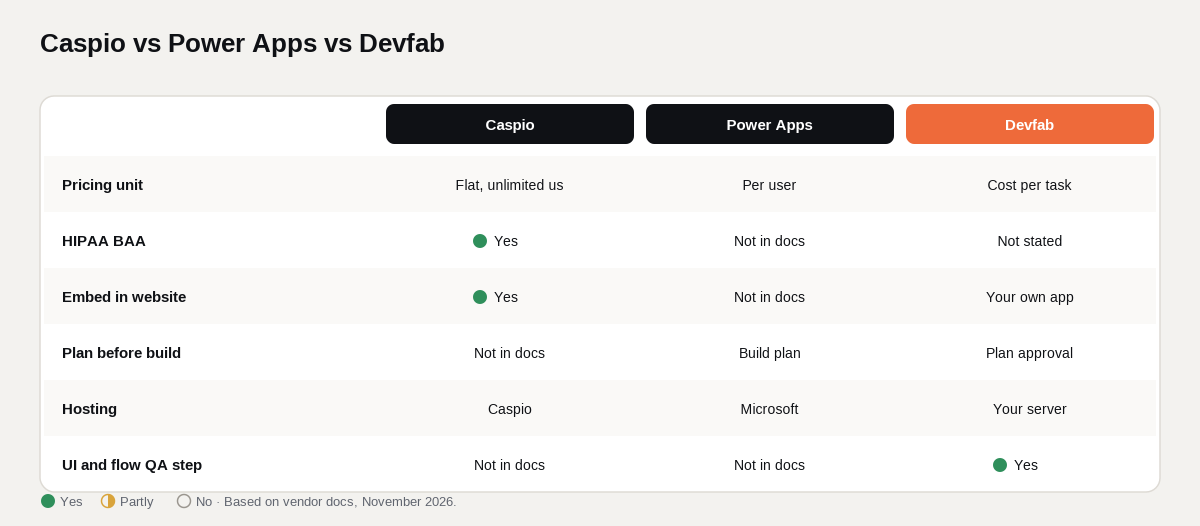
| Aspect | Caspio | Power Apps | Source |
|---|---|---|---|
| Where it runs | Hosted by Caspio, or embedded in websites, intranets and portals | Maker studio in the browser; also from AI coding tools | Caspio; Sept 2026 update |
| AI building | Caspi builds data model, interface and roles from a description | Natural-language app generation; Plans workspace with AI agents | Caspio; The New Stack |
| Approval before build | Result stays editable; approval step not covered | App-builder skill creates nothing until the build plan is approved | Sept 2026 update |
| Testing | Not covered in the pages we checked | Not covered in the pages we checked | |
| Data | SQL Server core; REST API, webhooks, Zapier, Make, n8n | Dataverse; premium and custom connectors need a standalone license | Caspio; Licensing FAQ |
| AI in apps | Chat AI Agent respects roles and field-level security; MCP Server | Agent feed; Microsoft 365 Copilot embeddable in apps | Caspio; Power Apps |
| Compliance | HIPAA, SOC 2 Type II, GDPR certified annually; FERPA and WCAG supported | Central policies for environments, data loss prevention, access and auditing | Caspio; Power Apps |
| Model choice | Bring your own AI license on Enterprise only | AI features draw on AI Builder or Copilot Credits capacity | Caspio pricing; Licensing FAQ |
| Pricing model | Flat monthly plans, unlimited app users; caps on authors, records, task runs | Per user, per user per app, or pay-as-you-go via Azure | Caspio pricing; Licensing FAQ |
Cost model by team size
| Team size (builders) | Caspio | Power Apps |
|---|---|---|
| 1 person | Free trial, no permanent free plan; Team USD 300 per month (USD 270 billed annually) | Developer Plan free for non-production; Premium USD 20 per user per month, paid yearly |
| 5 people | Team covers up to 5 app authors, with unlimited app users | Premium USD 20 per user per month for builders and every user of the app |
| 25 people | Business USD 600 per month (USD 540 billed annually), or Enterprise custom; HIPAA/Compliance Edition USD 500 per month on an annual term | Premium USD 20 per user per month; USD 12 per user per month only at a 2,000-seat minimum |
Prices as of November 2026 from Caspio pricing and Power Apps pricing. The real driver is users, not builders: Caspio does not charge per app user, while Power Apps licenses each user. Caspio Team caps records at 250K and task runs at 500 per month. Microsoft notes prices vary by region and Dataverse capacity is a paid add-on.
Where Caspio wins
- Thousands of outside users. Patients, students or applicants don't add seat costs on a flat plan.
- A signed BAA. HIPAA-eligible AI features operate under signed BAAs, with a dedicated Compliance Edition.
- Forms on your existing website. Embedding into sites, intranets and portals is a core use.
- Education and accessibility rules. FERPA and WCAG are supported.
- Your team doesn't run Microsoft 365. Caspio stands alone, with Zapier, Make and n8n for glue.
Where Power Apps wins
- Staff apps inside your tenant. Identity, data loss prevention and auditing come from Microsoft's central policies.
- A few users, low cost. At USD 20 per user per month, a short list of staff costs less than Caspio's entry plan.
- Microsoft data. SharePoint, Teams and Dynamics 365 sit next door, though premium connectors need a standalone license.
- Plan before build. The Plans workspace and app-builder skill put requirements and a data model first.
- Developers can add code. Generative pages produce native React code.
Switching from one to the other
Neither vendor documents a direct converter in the pages we checked. Caspio to Power Apps: export the tables, load them into Dataverse, then regenerate screens with the Plans workspace or the app-builder skill. Power Apps to Caspio: export the Dataverse tables, import them into Caspio, and let Caspi rebuild the data model, interface and roles from a description. In both directions, re-check roles and field-level rules before patients or staff log in.
Where Devfab fits
Caspio and Power Apps both keep your app on their platform. Some clinic networks eventually want a patient app as their own codebase, on their own servers, with test evidence for every release.
Coding agents automate the developer. Devfab automates the development lifecycle. Its Researcher maps the domain first (intake, referrals, consent, how other patient portals work) and suggests a prototype. A person approves the plan. The QA agent runs UI and flow tests (screens, buttons and user journeys clicked end to end) plus logic tests, and Deploy ships to your own server. Devfab is in Beta, and its compliance certifications are not stated, so Caspio remains the safer pick when a BAA is the first requirement. See Devfab vs Caspio and Devfab vs Power Apps.
FAQ
Is Caspio cheaper than Power Apps?
It depends on how many people use the app. As of November 2026, Caspio Team is USD 300 per month (USD 270 billed annually) with unlimited app users. Power Apps Premium is USD 20 per user per month, paid yearly, so it costs less for a few users and more for large audiences.
Which one supports HIPAA?
Caspio states HIPAA, SOC 2 Type II and GDPR certification, renewed annually, and runs HIPAA-eligible AI features under signed BAAs. It sells a HIPAA/Compliance Edition at USD 500 per month on an annual term, as of November 2026. HIPAA terms for Power Apps are not covered in the pages we checked.
Can I embed a Caspio or Power Apps form on my public website?
Caspio is built for it: apps run hosted by Caspio or embedded into websites, intranets and customer portals. Embedding Power Apps on a public website is not covered in the Power Apps pages we checked.
Do both have AI app builders?
Yes. Caspio's Caspi builds the data model, interface and roles from a description. Power Apps generates apps from natural language, plans them with AI agents in the Plans workspace, and lets AI coding tools build model-driven apps after you approve a build plan.
Read next
Planning a patient app you own as code? Try Beta
Sources (checked November 2026): Caspio homepage; Caspio pricing; Microsoft Power Apps; Power Apps pricing; Power Platform licensing FAQ; What's new in Power Platform: September 2026; The New Stack: Power Apps Plans (May 19, 2025).
Frequently asked questions
Is Caspio cheaper than Power Apps?
It depends on how many people use the app. As of November 2026, Caspio Team is USD 300 per month (USD 270 billed annually) with unlimited app users. Power Apps Premium is USD 20 per user per month, paid yearly, so it costs less for a few users and more for large audiences.
Which one supports HIPAA?
Caspio states HIPAA, SOC 2 Type II and GDPR certification, renewed annually, and runs HIPAA-eligible AI features under signed BAAs. It sells a HIPAA/Compliance Edition at USD 500 per month on an annual term, as of November 2026. HIPAA terms for Power Apps are not covered in the pages we checked.
Can I embed a Caspio or Power Apps form on my public website?
Caspio is built for it: apps run hosted by Caspio or embedded into websites, intranets and customer portals. Embedding Power Apps on a public website is not covered in the Power Apps pages we checked.
Do both have AI app builders?
Yes. Caspio's Caspi builds the data model, interface and roles from a description. Power Apps generates apps from natural language, plans them with AI agents in the Plans workspace, and lets AI coding tools build model-driven apps after you approve a build plan.