Short answer: Appian wins for regulated, long-running processes that need case management, RPA, audited agents and air-gapped AI. Power Apps wins when your company already runs on Microsoft 365 and Dataverse, and you want many internal apps at a published per-user price, inside the tenant's existing governance and data loss prevention rules.
You run vendor onboarding for a hospital network. Every supplier needs checks, documents and sign-offs, and auditors read the trail.
One side of the room says Power Apps is already in the Microsoft agreement. The other says onboarding is a process, and Appian is a process platform. This page referees with facts from vendor pages checked on November 20, 2026.
In this comparison:
- Appian and Power Apps at a glance
- Feature comparison
- Cost model by team size
- Where Appian wins
- Where Power Apps wins
Each section ends with the fact that should move your decision.
Appian and Power Apps at a glance
Power Apps changed its environment rules this month. From November 15, 2026, new unmanaged developer environments and new Dataverse for Teams environments can't be created, and included AI Builder credits on attended RPA licenses were removed November 1 (Power Platform licensing FAQ). In September, Microsoft made the "app-builder skill" for building model-driven apps from AI coding tools generally available (Power Platform blog).
Power Apps is Microsoft's low-code platform for business users, developers and IT, with data in Dataverse and Microsoft 365 Copilot embeddable in custom apps (Power Apps).
Appian focused its 2026 releases on agents. Release 26.3 added multi-agent communication and an audit view; the July 1 update added an MCP Server, Snowflake support and bulk agent evaluations; release 26.6 added agent cost controls (Appian Q1 2026; Appian Q2 2026; Appian What's New).
Appian is an enterprise low-code platform for process automation, case management and data fabric, with Agent Studio, Composer and DocCenter.
Feature comparison
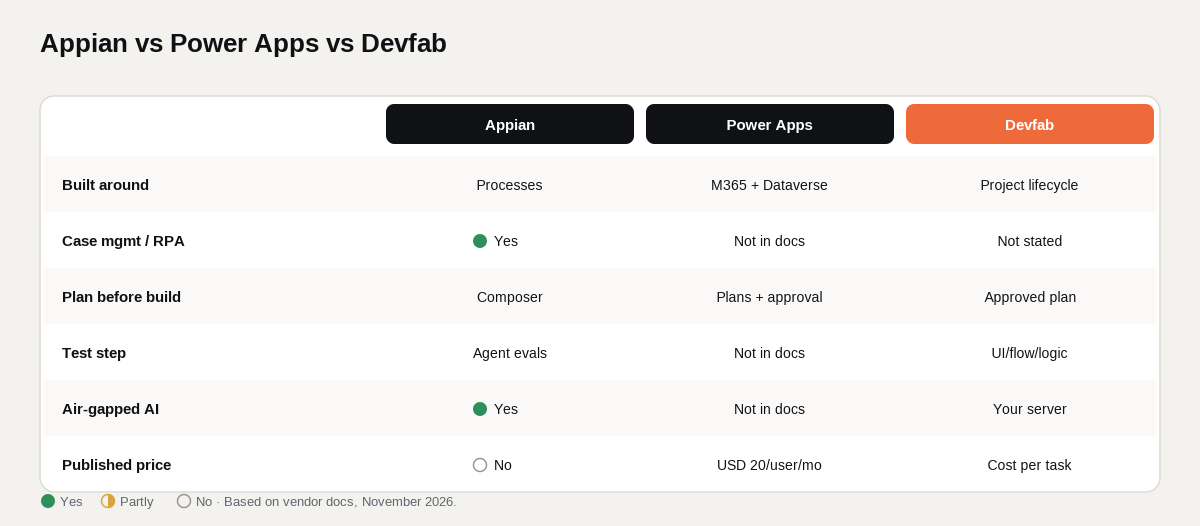
| Aspect | Appian | Power Apps | Source |
|---|---|---|---|
| Where it runs | Appian cloud (SLA 99.8–99.99%) or self-managed, including air-gapped AI | Maker studio in the browser; also AI coding tools such as GitHub Copilot CLI and Claude Code | Appian pricing; Appian What's New; Power Platform blog |
| Planning and spec | Composer turns requirements into a visual app plan (preview) | "Plans" uses agents as requirements analyst, data modeler and solution architect | Appian What's New; The New Stack |
| Agent autonomy | Agent Studio agents call other agents; audit view of every step | App-builder skill creates nothing until you approve the build plan; agent feed to oversee agents in apps | Appian Q1 2026; Power Platform blog; Power Apps |
| Testing | Central evaluations run agent test cases in bulk | Not covered in the pages we checked | Appian Q2 2026 |
| Process tools | Process HQ, Case Management Studio, RPA bots | Not covered in the Power Apps pages we checked | Appian pricing |
| Code | Platform apps; external assistants through a CLI | Generative pages produce native React code | Appian Q2 2026; The New Stack |
| Governance | AI Guardrails for prompt injection, toxic content and PII; disable model families per environment | Central policies for environments, DLP, access and auditing | Appian Q2 2026; Power Apps |
| Model choice | Own Azure OpenAI account; custom LLM gateway | AI features draw on AI Builder or Copilot Credits | Appian Q2 2026; Licensing FAQ |
| Pricing model | Per user, per month, per app; AI Action quotas | Per user, per user per app, or pay-as-you-go via Azure | Appian pricing; Licensing FAQ |
Cost model by team size
| Team size | Appian | Power Apps | Devfab |
|---|---|---|---|
| 1 person | Free Community Edition instance | Developer Plan, free for non-production use | Cost logged per task and per project (Beta) |
| 5 people | Standard: per user, per month, per app; 200K AI Actions; no AI Agents or Composer | Premium, USD 20 per user per month paid yearly (unlimited apps) | Cost logged per task and per project (Beta) |
| 25 people | Advanced (500K AI Actions) or Premium (1M AI Actions, no row limits) | Premium, USD 20 per user per month paid yearly; Dataverse capacity add-on USD 40 per GB per month | Cost logged per task and per project (Beta) |
As of November 2026 from Appian pricing and Power Apps pricing. Appian shows no dollar amounts. Power Apps prices may vary by country or region; a USD 12 rate applies at a 2,000-seat minimum. Devfab is in Beta and offers predictable cost: cost is logged after each run, per task and per project.
Where Appian wins
- Auditors read every step. Agent Studio records the exact steps an agent took.
- Case work is the core. Case Management Studio and RPA bots are part of the plans.
- You test agents before release. Central evaluations run agent test cases in bulk.
- AI can't touch the public internet. AI capabilities can run self-managed on air-gapped infrastructure.
- Documents drive decisions. DocCenter adds compliance-check agents in 26.6.
Where Power Apps wins
- You already pay Microsoft. Some Microsoft 365 licenses include limited Power Apps use.
- Many apps, one price. Premium covers unlimited apps per user at a published rate.
- Microsoft connectors matter. SharePoint, Teams and Dynamics 365 sit next to your data.
- Developers want React. Generative pages emit native React code, and a "convert a vibe app to a code app" guide exists.
- Copilot inside the app. Microsoft 365 Copilot can be embedded in custom apps.
Watch the fine print. Power Apps premium, on-premises and custom connectors need a standalone license, and several AI pieces are still preview (Licensing FAQ). A competitor review of Appian cites high per-user pricing for smaller businesses and a steep learning curve (Blaze, February 2026).
Switching from one to the other
There is no direct converter between the platforms in the pages we checked. To move to Power Apps, model your tables in Dataverse, then describe the app or use the app-builder skill from GitHub Copilot CLI or Claude Code and approve the build plan before anything is created. To move to Appian, start from your user stories in Composer (preview) and rebuild the process in process models. In both directions, export data yourself and run the old and new apps side by side until sign-off.
Where Devfab fits
Appian and Power Apps both keep your app on a vendor platform. That suits internal work. It fits less well when the onboarding portal faces suppliers, needs custom logic, and must run on servers you control as code you own.
Coding agents automate the developer. Devfab automates the development lifecycle. Its Researcher maps supplier-onboarding terms, best practices and similar products before the Planner writes a plan, and a person approves it. The QA agent runs UI and flow tests that click through the supplier journey, plus logic tests. Code lives in your own GitHub account. Devfab is in Beta, with a smaller community, fewer integrations, and no Microsoft 365 connectors of its own. See Devfab vs Appian and Devfab vs Power Apps.
FAQ
Is Appian more expensive than Power Apps?
You can only tell with an Appian quote. As of November 2026, Power Apps Premium is USD 20 per user per month, paid yearly, with unlimited apps. Appian shows no prices; plans are per user, per month, per app. A competitor review cites Appian's high per-user pricing for smaller businesses.
Can Power Apps handle complex workflows like Appian?
Power Apps handles app screens and data on Dataverse, and its Plans workspace uses agents to analyze requirements and model data. Appian is built around process models, case management, RPA and audited agents. For long-running regulated processes, Appian has more process tooling in the pages we checked.
Can I build Power Apps or Appian apps with Claude Code?
Yes. Microsoft's app-builder skill lets AI coding tools such as GitHub Copilot CLI and Claude Code build whole model-driven apps, creating nothing until you approve the plan. Appian says developers can use external assistants such as Claude through a CLI, and its MCP Server serves outside agents.
What changed in Power Apps in November 2026?
From November 15, 2026, new unmanaged developer environments and new Dataverse for Teams environments can't be created. On November 1, 2026, included AI Builder credits were removed from attended RPA licenses. Both changes are in Microsoft's licensing FAQ.
Read next
Supplier-facing app, your servers, your code? Try Beta
Sources (checked November 2026): Appian pricing; Appian What's New; Appian Q1 2026 release highlights; Appian Q2 2026 product highlights; Blaze: Appian reviews (competitor, Feb 2026); Microsoft Power Apps; Power Apps pricing; Power Platform licensing FAQ; What's new in Power Platform: September 2026; The New Stack: Power Apps Plans (May 2025).
Frequently asked questions
Is Appian more expensive than Power Apps?
You can only tell with an Appian quote. As of November 2026, Power Apps Premium is USD 20 per user per month, paid yearly, with unlimited apps. Appian shows no prices; plans are per user, per month, per app. A competitor review cites Appian's high per-user pricing for smaller businesses.
Can Power Apps handle complex workflows like Appian?
Power Apps handles app screens and data on Dataverse, and its Plans workspace uses agents to analyze requirements and model data. Appian is built around process models, case management, RPA and audited agents. For long-running regulated processes, Appian has more process tooling in the pages we checked.
Can I build Power Apps or Appian apps with Claude Code?
Yes. Microsoft's app-builder skill lets AI coding tools such as GitHub Copilot CLI and Claude Code build whole model-driven apps, creating nothing until you approve the plan. Appian says developers can use external assistants such as Claude through a CLI, and its MCP Server serves outside agents.
What changed in Power Apps in November 2026?
From November 15, 2026, new unmanaged developer environments and new Dataverse for Teams environments can't be created. On November 1, 2026, included AI Builder credits were removed from attended RPA licenses. Both changes are in Microsoft's licensing FAQ.