Short answer: Power Apps wins for Microsoft 365 organizations that want many small apps per user, on Dataverse, at a published per-user price. Mendix wins when a few important apps must reach large or public audiences without per-user fees for developers or anonymous users, and must deploy to SAP BTP, Kubernetes, sovereign clouds or your own servers.
A manufacturer wants a maintenance app for its plants: technicians log faults on tablets, planners schedule repairs, and suppliers see open orders. The licensing question arrives before the design question. Counting users or counting apps gives very different totals.
That is the real fork between these two. One prices people, the other prices apps. This page compares both on pricing, AI building and deployment, with vendor pages checked in November 2026.
In this comparison:
- Power Apps and Mendix at a glance
- Feature comparison
- Cost model by team size
- Where Power Apps wins
- Where Mendix wins
The cost section is where most decisions are made.
Power Apps and Mendix at a glance
Power Apps: AI building went GA in September 2026. The app-builder skill for vibe-coding model-driven apps is generally available. It lets AI code tools such as GitHub Copilot CLI and Claude Code build whole model-driven apps, and it creates nothing until the user approves the build plan (Power Platform blog). Microsoft also added guidance to "Convert a vibe app to a code app." On the licensing side, new unmanaged developer environments can't be created from November 15, 2026 (licensing FAQ).
Mendix: a Siemens company, now on an LTS release. Mendix 11.12, released June 30, 2026, is the first long-term support release since 10.24. It added Agents Kit 2.0 and Mendix Cloud MCP, which connects assistants such as Claude Code and GitHub Copilot to Mendix Cloud environments (Mendix 11.12). Siemens positions Mendix as a core part of its Intelligence Center X platform (Verdantix).
Power Apps serves business users, developers and IT in one Microsoft workspace. Mendix serves enterprises that build governed app portfolios in its Studio Pro desktop IDE.
Feature comparison
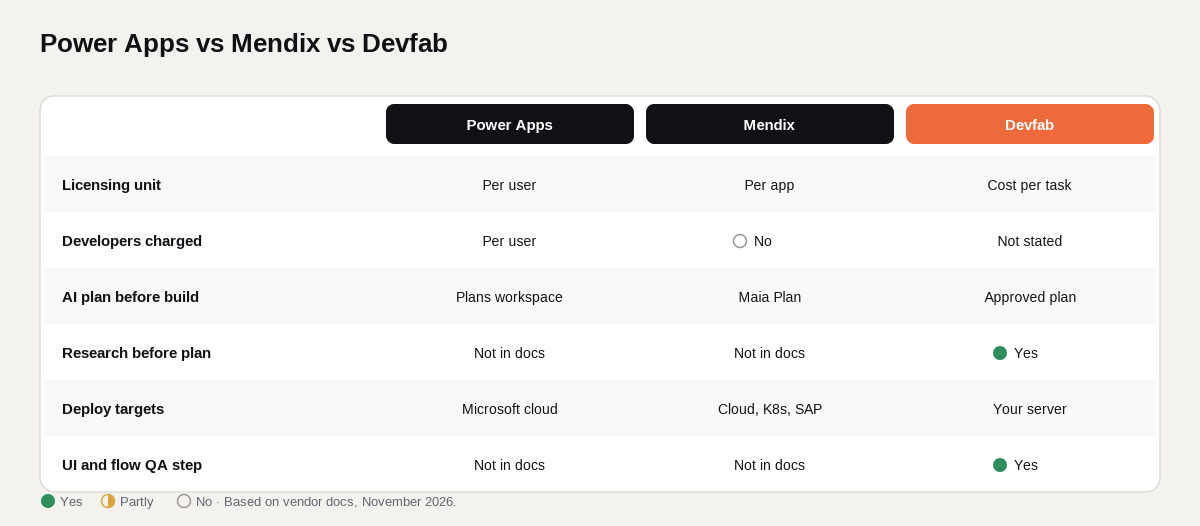
| Aspect | Power Apps | Mendix | Source |
|---|---|---|---|
| Where you build | Maker studio in the browser; AI coding tools via the app-builder skill | Studio Pro desktop IDE plus Mendix Portal | Power Platform blog; Mendix pricing |
| Planning | "Plans" workspace with AI agents as requirements analyst, data modeler and solution architect | Maia Plan turns ideas and user stories into structured app plans | The New Stack; Mendix 11.10 |
| AI building | Natural-language apps; generative pages produce React code | Maia generates domain models, pages, workflows and OQL; Maia Make adds constants and JavaScript actions | Power Apps; Mendix 11.0 |
| External agents | App-builder skill (GA) and MCP for canvas apps | Studio Pro MCP Server; AGENTS.md and Agent Skills; the 11.10 MCP Server cannot generate pages | Power Platform blog; Mendix docs |
| Testing | Not covered in the pages we checked | Not covered in the pages we checked | — |
| Deploy and hosting | Microsoft cloud with Dataverse | Mendix Cloud, Azure, Kubernetes, SAP BTP, StackIT, own servers, Cloud Dedicated | Power Apps; Mendix pricing |
| Governance | Central policies for environments, DLP, access and auditing | Approved-domain invites and roles; agent policies "bring visibility, but no enforcement" | Power Apps; Mendix 11.12 |
| Model choice | AI draws on AI Builder or Copilot Credits capacity | Claude models via one resource; Maia Make can use any OpenAI-compatible model (beta) | Licensing FAQ; Mendix docs |
| Pricing model | Per user (Premium) or per user per app; pay-as-you-go via Azure (preview) | Per app (One App or Unlimited Apps) and users; developers and anonymous users free; cloud compute billed separately | Licensing FAQ; Mendix pricing |
Cost model by team size
| Team size | Power Apps | Mendix |
|---|---|---|
| 1 person | Developer Plan free (non-production) | Free plan on Mendix Cloud, no uptime guarantee or support |
| 5 people | Premium USD 20 per user per month, paid yearly | Standard One App "starting at" USD 1,090 per month |
| 25 people | Premium USD 20 per user per month; USD 12 per user only at a 2,000-seat minimum | Standard Unlimited Apps "starting at" USD 2,725 per month, or Premium by quote |
Prices as of November 2026 from Power Apps pricing and Mendix pricing. Power Apps' Dataverse capacity add-on is USD 40 per GB per month, paid yearly, and premium, on-premises and custom connectors need a standalone license. Mendix shows no per-user figures, bills cloud compute separately, and external-agent usage is billed by your own LLM provider (Mendix docs).
Where Power Apps wins
- Your users already live in Microsoft 365. Some licenses include limited Power Apps rights, and identity, DLP and auditing are already in place.
- You want many small apps per person. Premium covers unlimited apps per licensed user.
- Your data is in SharePoint, Dynamics 365 or Dataverse, and Microsoft connectors cover the rest.
- You want a low first step. A free Developer Plan and published per-user prices make budgeting simple.
Where Mendix wins
- Large or public audiences. Developers and anonymous users are not charged, so a supplier portal does not multiply license costs.
- Deployment choice. SAP BTP, Kubernetes, StackIT, your own servers or a dedicated cloud, under one license.
- Industrial and Siemens environments, where Mendix is part of Siemens' own platform strategy.
- Reuse at scale. Maia Plan can recommend Marketplace components, limited to company-approved ones if you set that (Mendix 11.10).
Switching from one to the other
The pages we checked describe no direct import between the two, so expect a rebuild. Moving to Mendix, start in Maia Plan with the user stories behind the existing Power App, then let Maia generate the domain model and pages. Moving to Power Apps, model the data in Dataverse, then use the Plans workspace or natural-language generation for screens. One Mendix-side detail: the React client is now the default for new projects, and the older Dojo client will be removed in Mendix 12 (Mendix 11.0), so build new screens on React.
Where Devfab fits
Both are platforms you license for as long as the app runs. For the plant maintenance app, that may be right. It is less right when the app should be plain code with no platform license behind it.
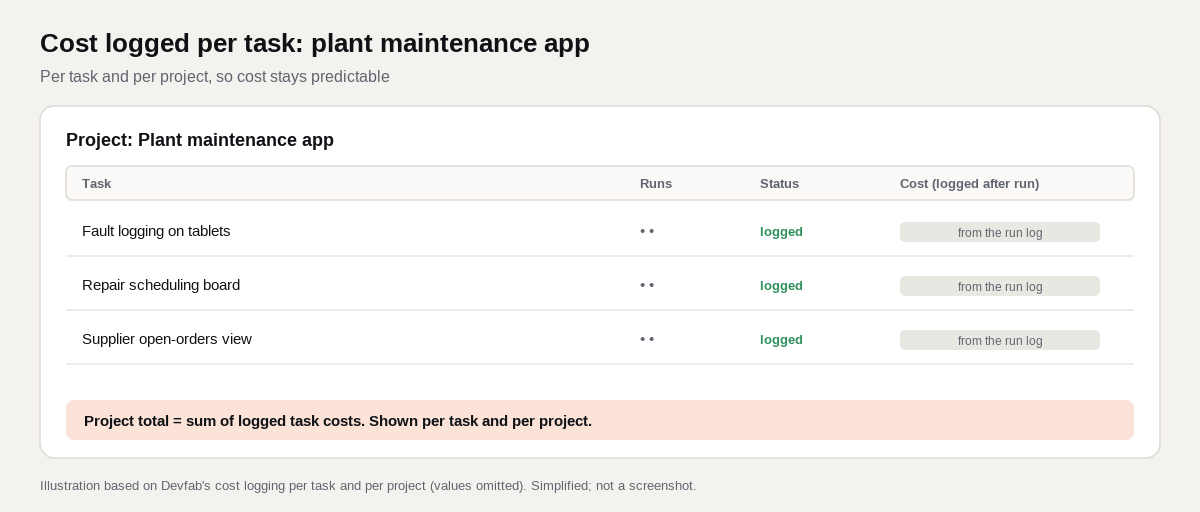
Coding agents automate the developer. Devfab automates the development lifecycle. Devfab's Researcher maps maintenance terms, best practices and competitors before the Planner writes a plan, and a person approves it. The QA agent runs UI and flow tests (screens, buttons and user journeys clicked end to end) plus logic tests, Deploy ships to your own server, and cost is logged after each run, per task and per project. Devfab is in Beta, with a smaller community and fewer integrations than either platform. See Devfab vs Power Apps and Mendix alternatives.
FAQ
Is Mendix more expensive than Power Apps?
For one app with few users, usually yes. As of November 2026, Mendix Standard starts at USD 1,090 per month for one app, while Power Apps Premium is USD 20 per user per month, paid yearly. Mendix does not charge for developers or anonymous users, so the gap narrows for large or public audiences.
Where can Mendix apps be deployed compared with Power Apps?
Mendix lists Mendix Cloud, Mendix on Azure, Kubernetes, SAP BTP, StackIT, your own servers, and Mendix Cloud Dedicated on Premium. Power Apps runs in Microsoft's cloud, with data in Dataverse.
Which has better AI for building apps?
Both added a lot in 2026. Mendix's Maia plans apps from user stories and generates domain models, pages and workflows, and Studio Pro now works with external agents through MCP. Power Apps generates apps from natural language, and its app-builder skill lets GitHub Copilot CLI or Claude Code build model-driven apps.
Who owns Mendix?
Mendix is a Siemens company. Siemens positions it as a core part of its Intelligence Center X platform, according to a July 2026 Verdantix analysis. Mendix 11.12, released June 30, 2026, is its first long-term support release since 10.24.
Read next
- What is an AI software factory?
- OutSystems vs Mendix
- Power Apps vs OutSystems: which should your team pick?
Want the app as plain code with no platform license? Try Beta
Sources (checked November 2026): Microsoft Power Apps; Power Apps pricing; Power Platform licensing FAQ (updated Oct 8, 2026); What's new in Power Platform: September 2026; The New Stack: Power Apps Plans (May 19, 2025); Mendix pricing; Mendix 11.0 release (Jun 26, 2025); Mendix 11.10 release (Apr 28, 2026); Mendix 11.12 release (Jun 30, 2026); Mendix docs: Maia with external AI agents; Verdantix: Siemens Realize LIVE Europe 2026 (Jul 22, 2026).
Frequently asked questions
Is Mendix more expensive than Power Apps?
For one app with few users, usually yes. As of November 2026, Mendix Standard starts at USD 1,090 per month for one app, while Power Apps Premium is USD 20 per user per month, paid yearly. Mendix does not charge for developers or anonymous users, so the gap narrows for large or public audiences.
Where can Mendix apps be deployed compared with Power Apps?
Mendix lists Mendix Cloud, Mendix on Azure, Kubernetes, SAP BTP, StackIT, your own servers, and Mendix Cloud Dedicated on Premium. Power Apps runs in Microsoft's cloud, with data in Dataverse.
Which has better AI for building apps?
Both added a lot in 2026. Mendix's Maia plans apps from user stories and generates domain models, pages and workflows, and Studio Pro now works with external agents through MCP. Power Apps generates apps from natural language, and its app-builder skill lets GitHub Copilot CLI or Claude Code build model-driven apps.
Who owns Mendix?
Mendix is a Siemens company. Siemens positions it as a core part of its Intelligence Center X platform, according to a July 2026 Verdantix analysis. Mendix 11.12, released June 30, 2026, is its first long-term support release since 10.24.