Short answer: Zoho Creator wins for small and mid-size businesses that want low per-user prices, native iOS and Android apps and AI agents that plan, build and test, especially if they already use Zoho CRM. Power Apps wins for companies standardized on Microsoft 365, where apps must live in Dataverse under the tenant's governance and connectors.
You manage a field-service business. Technicians fill paper job sheets in vans, and the office retypes them.
One adviser says Zoho Creator: cheap seats and a phone app for every technician. Another says Power Apps: you already live in Outlook and Teams. Both pitches leave things out. This page fills the gaps with facts checked on November 20, 2026.
In this comparison:
- Zoho Creator and Power Apps at a glance
- Feature comparison
- Cost model by team size
- Where Zoho Creator wins
- Where Power Apps wins
Read it before either vendor's demo.
Zoho Creator and Power Apps at a glance
Power Apps changed several rules in late 2026. In September, Microsoft made its "app-builder skill" generally available, so AI coding tools can build whole model-driven apps (Power Platform blog). From November 15, 2026, new unmanaged developer environments and new Dataverse for Teams environments can't be created (Power Platform licensing FAQ).
Power Apps is Microsoft's low-code platform for business users, developers and IT, with data in Dataverse (Power Apps).
Zoho Creator is active, with no ownership change. It is Zoho's low-code platform for business apps, workflows and AI agents, built with prompts, visual tools or code. Zoho claims 6M+ users and 7M+ apps (Zoho Creator). Its CoCreator AI features, announced in May 2025, came at no extra fee to subscribers (IT Brief).
Feature comparison
| Aspect | Zoho Creator | Power Apps | Source |
|---|---|---|---|
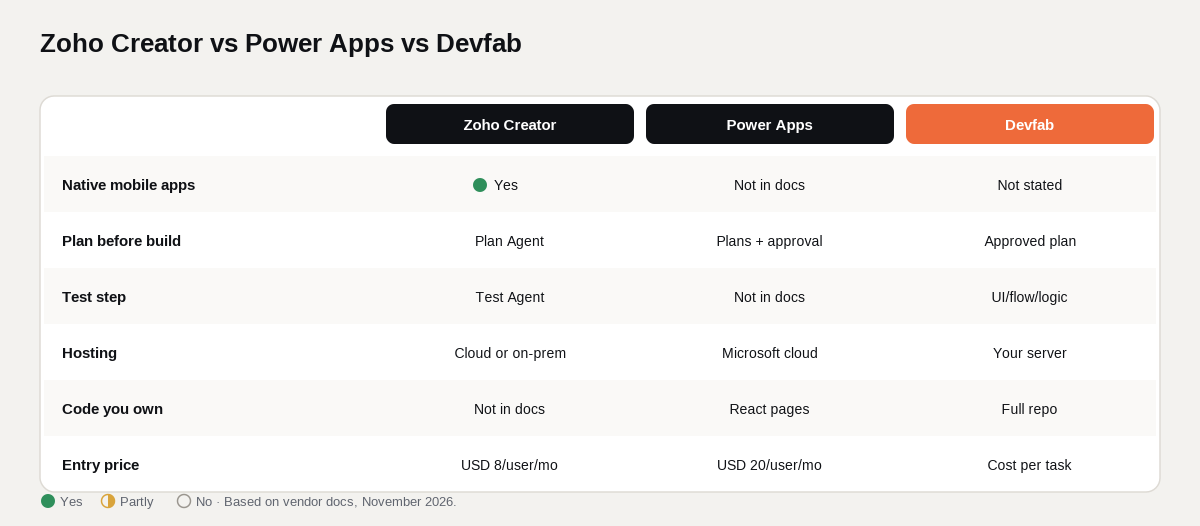
| Where it runs | Browser builder; apps on Zoho Cloud, AWS, Azure, GCP, on-premise or hybrid | Maker studio in the browser; Microsoft cloud on Dataverse | Zoho Creator; Power Apps |
| Mobile | Native iOS and Android versions of every app | Not covered in the pages we checked | Zoho Creator |
| Planning and spec | Plan Agent writes a business requirement document | "Plans" uses agents as requirements analyst, data modeler and solution architect | Zoho Creator; The New Stack |
| Agent autonomy | Build Agent adds modules and workflows, with review of each change | App-builder skill creates nothing until you approve the build plan | Zoho Creator; Power Platform blog |
| Testing | Test Agent generates and runs test cases; described as self-healing | Not covered in the pages we checked | Zoho Creator |
| Code | Deluge scripting and code options | Generative pages produce native React code | Capterra; The New Stack |
| Team and admin | Roles, MFA, encryption, audit trail; SAML SSO is an add-on | Central policies for environments, DLP, access and auditing | Zoho pricing; Power Apps |
| Model choice | Zoho's own GenAI, or your own key for OpenAI, Google or Anthropic; MCP access | AI features draw on AI Builder or Copilot Credits | Zoho Creator; Licensing FAQ |
| Pricing model | Per user per month, three tiers plus Free Edition and custom Flex | Per user, per user per app, or pay-as-you-go via Azure | Zoho pricing; Licensing FAQ |
Cost model by team size
| Team size | Zoho Creator | Power Apps | Devfab |
|---|---|---|---|
| 1 person | Free Edition, or Standard USD 8 per user per month billed annually (USD 12 monthly), one app | Developer Plan, free for non-production use | Cost logged per task and per project (Beta) |
| 5 people | Professional, USD 20 per user per month billed annually (USD 30 monthly), unlimited apps | Premium, USD 20 per user per month paid yearly | Cost logged per task and per project (Beta) |
| 25 people | Enterprise, USD 25 per user per month billed annually (USD 37 monthly), or custom Flex | Premium, USD 20 per user per month paid yearly; Dataverse capacity add-on USD 40 per GB per month | Cost logged per task and per project (Beta) |
Prices as of November 2026 from Zoho Creator pricing and Power Apps pricing. Power Apps prices may vary by region. Zoho's SAML SSO is a paid add-on. Devfab is in Beta and offers predictable cost: cost is logged after each run, per task and per project.
Where Zoho Creator wins
- Field staff need a phone app. Every app gets native iOS and Android versions.
- Budget is per seat. Standard starts at USD 8 per user per month billed annually.
- You want a test step. The Test Agent generates and runs test cases.
- You run on Zoho already. Creator sits next to Zoho CRM and Zoho Books.
- You want hosting choice. Zoho lists Zoho Cloud, AWS, Azure, GCP, on-premise and hybrid.
Where Power Apps wins
- Your staff live in Microsoft 365. Apps sit inside your tenant's DLP, environments and auditing.
- You need Microsoft connectors for SharePoint, Teams and Dynamics 365.
- IT wants governance first. Policies for environments, data loss prevention, access and auditing are central.
- Developers want plain React for custom screens. Generative pages emit native React code.
- Some seats are already paid. Some Microsoft 365 licenses include limited Power Apps use.
Both have limits worth reading. Capterra reviewers in 2026 cite a steeper learning curve beyond simple apps, slow-to-learn Deluge scripting and uneven support for Zoho Creator (Capterra). For Power Apps, premium, on-premises and custom connectors need a standalone license, and several AI pieces are still in preview (Licensing FAQ).
Switching from one to the other
Neither vendor documents a direct importer from the other in the pages we checked. To move to Power Apps, recreate tables in Dataverse, import records, then describe the app or use the app-builder skill and approve the plan. To move to Zoho Creator, export your Dataverse data, import it, and give the Plan Agent your requirements so it drafts a requirement document before the Build Agent starts. Rebuild Deluge scripts or Power Fx logic by hand, and test both apps on the same job list before cutover.
Where Devfab fits
Zoho Creator and Power Apps keep the app on their platforms. That's fine for internal job sheets. It is a harder fit when the field-service app grows into a customer portal with custom dispatch rules that must run on your own server.
Coding agents automate the developer. Devfab automates the development lifecycle. Its Researcher maps field-service terms, best practices and competing products before the Planner writes a plan, and a person approves it. ChainFlow maps which functions and APIs call each other, so a change to job status shows its effect on invoicing, parts stock and customer notifications. The QA agent runs UI and flow tests plus logic tests, and the code lives in your own GitHub account. Devfab is in Beta, with a smaller community and fewer integrations, and it is not a visual builder. See Devfab vs Zoho Creator and Devfab vs Power Apps.
FAQ
Is Zoho Creator cheaper than Power Apps?
At list price, yes for most plans. As of November 2026, Zoho Creator is USD 8, 20 or 25 per user per month billed annually, and Power Apps Premium is USD 20 per user per month paid yearly. Zoho's Standard plan allows only one app, so compare like for like.
Which is better for field staff on phones?
Zoho Creator says every app gets native iOS and Android versions. That suits a field-service app where technicians log jobs on site. The Power Apps pages we checked don't cover mobile apps; they focus on Dataverse, Microsoft connectors and tenant governance.
Does Zoho Creator have AI agents like Power Apps?
Yes. Zoho lists a Plan Agent that writes a business requirement document, a Build Agent that adds modules and workflows with review of each change, and a Test Agent that generates and runs test cases. Power Apps has a Plans workspace and an app-builder skill for AI coding tools.
Can Zoho Creator apps run on-premises?
Zoho says apps can run on Zoho Cloud, AWS, Azure, GCP, on-premise or hybrid. Power Apps runs in Microsoft's cloud on Dataverse.
Read next
- What is an AI software factory?
- Zoho Creator alternatives
- Power Apps alternatives
- Build page: field service work order app
Job sheets growing into a customer portal? Try Beta
Sources (checked November 2026): Zoho Creator; Zoho Creator pricing; IT Brief: Zoho unveils advanced AI for Creator (May 2025); Capterra: Zoho Creator reviews; Microsoft Power Apps; Power Apps pricing; Power Platform licensing FAQ; What's new in Power Platform: September 2026; The New Stack: Power Apps Plans (May 2025).
Frequently asked questions
Is Zoho Creator cheaper than Power Apps?
At list price, yes for most plans. As of November 2026, Zoho Creator is USD 8, 20 or 25 per user per month billed annually, and Power Apps Premium is USD 20 per user per month paid yearly. Zoho's Standard plan allows only one app, so compare like for like.
Which is better for field staff on phones?
Zoho Creator says every app gets native iOS and Android versions. That suits a field-service app where technicians log jobs on site. The Power Apps pages we checked don't cover mobile apps; they focus on Dataverse, Microsoft connectors and tenant governance.
Does Zoho Creator have AI agents like Power Apps?
Yes. Zoho lists a Plan Agent that writes a business requirement document, a Build Agent that adds modules and workflows with review of each change, and a Test Agent that generates and runs test cases. Power Apps has a Plans workspace and an app-builder skill for AI coding tools.
Can Zoho Creator apps run on-premises?
Zoho says apps can run on Zoho Cloud, AWS, Azure, GCP, on-premise or hybrid. Power Apps runs in Microsoft's cloud on Dataverse.