Short answer: Caspio wins when one app holds sensitive records, such as patient or student data, and you need BAAs, annual HIPAA and SOC 2 audits, or forms embedded in an existing website. Quickbase wins when operations teams need many governed apps and automations on one flat platform price, or a quick prompt-built app with Pave.
A home-care agency needs caregiver schedules, visit notes and a family portal. Its operations manager also wants apps for vehicle checks, training records and supply orders. Two different needs hide in one request. One is a single app full of health data. The other is a dozen small operations apps.
Caspio and Quickbase each lean toward one of those. This page sets out both, from their own pages checked in November 2026.
In this comparison:
- Caspio and Quickbase at a glance
- Feature comparison
- Cost model by team size
- Where Caspio wins
- Where Quickbase wins
Here's how each vendor describes itself now.
Caspio and Quickbase at a glance
Caspio, November 2026: active, now "the Compliant AI App Builder". Its homepage leads with Caspi, an AI builder that creates the data model, interface and roles from a description (Caspio). Under the hood, Caspio is a low-code platform on a SQL Server core. Apps run fully hosted or embedded into websites, intranets and portals. Its stated audience is regulated industries: healthcare, government, financial services, education and nonprofits (Caspio).
Quickbase, November 2026: active, with a new product. On April 28, 2026, Quickbase launched Pave, a full-stack AI app builder that builds from plain language and then refines in a no-code interface (Quickbase press release). The core platform remains a low-code tool for operational business apps and automations, aimed at business teams with IT oversight (Quickbase pricing).
The split: Caspio is built around trust in one dataset. Quickbase is built around many apps run by operations teams.
Feature comparison
| Aspect | Caspio | Quickbase | Source |
|---|---|---|---|
| Where apps run | Hosted by Caspio or embedded in websites and portals | Browser platform with mobile-ready apps; Pave hosts with draft and publish | Caspio; Quickbase pricing; Pave |
| AI building | Caspi builds data model, UI and roles; stays editable | Pave builds data model, roles, workflows and hosting from a prompt | Caspio; Pave |
| AI inside apps | Chat AI Agent respects roles and field-level security; AI Workflows; MCP Server | Agentic workflows; custom agents "coming soon" | Caspio pricing; Pave pricing |
| Compliance | HIPAA, SOC 2 Type II, GDPR certified annually; FERPA, WCAG; BAAs | Not covered in the pages we checked; Pave: "Your data never trains the AI" | Caspio; Pave |
| Identity | SAML SSO on eligible plans | Okta, OneLogin, LDAP or SAML, two-step auth; Pave SSO Enterprise-only | Caspio; Quickbase pricing |
| Number of apps | Capped by plan resources (authors, records, task runs) | Up to 50 custom apps on the entry tier | Caspio pricing; Quickbase pricing |
| Integrations | REST API, webhooks, Zapier, Make, n8n | API, Sync, Automations; Pave lists 350+ connectors | Caspio; Pave |
| Governance | Field-level security, also applied to the Chat AI Agent | Developer sandbox, IP filtering, versioning rollback in Pave; audit logs a paid add-on | Caspio; Quickbase pricing |
| Pricing model | Flat plans, unlimited app users, caps on resources | Platform price, no user limit; Pave by credits | Caspio pricing; Quickbase pricing |
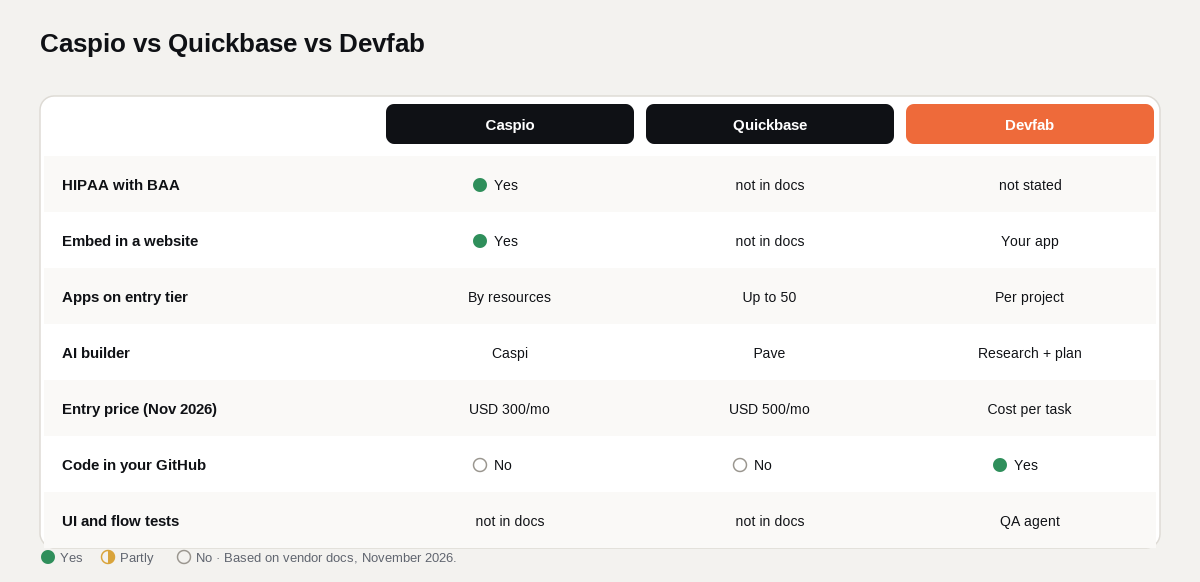
Limits to know. Caspio Team allows 5 app authors, 250K records and 500 task runs a month; bring-your-own AI licensing is Enterprise-only (Caspio pricing). For Quickbase, a competitor review updated September 10, 2026 cites a platform minimum that raises starting cost and specialized integrations such as Procore and Salesforce on higher plans (Blaze review). Pave API access and white labeling are still "coming soon" (Pave pricing).
Cost model by team size
| Team size | Caspio | Quickbase | Devfab |
|---|---|---|---|
| 1 person | Team USD 300 per month (USD 270 billed annually); 14-day trial | Pave Free (1 app) or Pave Launch USD 20 per month for 120 credits | Cost logged per task and per project (Beta) |
| 5 people | Team covers 5 app authors; Business USD 600 per month (USD 540 billed annually) | Core entry tier USD 500 per month billed annually, no user limit | Cost logged per task and per project (Beta) |
| 25 people | Business or Enterprise (custom); HIPAA/Compliance Edition USD 500 per month on a one-year term | Same platform price, or Enterprise (custom) | Cost logged per task and per project (Beta) |
Prices as of November 2026 from Caspio pricing, Quickbase pricing and Pave pricing. Pave's higher credit tiers run up to USD 200 per month. Caspio Team and above include 100 Caspio Credits a month. Devfab is in Beta and offers predictable cost: cost is logged after each run, per task and per project.
Where Caspio wins
- The app holds health or student data. BAAs, annual HIPAA and SOC 2 Type II certification, and FERPA support are stated on the homepage.
- You want forms inside an existing site. Caspio embeds into websites, intranets and customer portals.
- The AI assistant must respect data rules. The Chat AI Agent follows roles and field-level security.
- You want a lower entry price for one serious app: Caspio Team costs less per month than Quickbase's core entry tier.
- You automate with common tools. Zapier, Make and n8n are listed alongside a REST API and webhooks.
Where Quickbase wins
- Operations runs on many small apps. Up to 50 custom apps on the entry tier suits field, construction and manufacturing teams.
- Business users own the apps, with IT watching. Roles, sandbox and IP filtering support that split.
- You want a prompt-to-hosted app without a contract. Pave Free covers one app, and Launch is credit-based.
- Identity is already in Okta or OneLogin. Quickbase lists both, plus LDAP and SAML.
- Many connectors matter. Pave lists 350+ connectors.
Switching from one to the other
Neither vendor offers an export to source code in the pages we checked. A move is a rebuild:
- Inventory each app: tables, roles, forms, automations and reports.
- Move data through the APIs. Caspio lists a REST API and webhooks; Quickbase's core platform includes an API (Caspio; Quickbase pricing).
- Rebuild with the AI builder on the destination (Caspi or Pave), then review every role and permission by hand.
- For regulated data, put the destination's compliance paperwork in place before any record moves.
Where Devfab fits
Both platforms keep apps on their own engine. The home-care agency may later want its family portal as code on its own server, or logic a platform builder can't express. Neither tool covers that.
App builders automate the first version. Devfab automates the development lifecycle. The Researcher maps the domain before planning: visit types, care plans, scheduling rules and what family portals usually offer. A person approves the plan. ChainFlow shows dev agents that changing a visit schedule also touches caregiver pay, family notices and mileage. The QA agent runs UI, flow and logic tests, and Deploy ships to your own server, with code in your GitHub.
Devfab is in Beta, with a smaller community and fewer integrations than either platform. It is not a drag-and-drop tool for staff, and its compliance certifications are not stated. See Devfab vs Caspio and Devfab vs Quickbase.
FAQ
Is Caspio or Quickbase better for healthcare apps?
Caspio states its case clearly: HIPAA, SOC 2 Type II and GDPR certified annually, HIPAA-eligible AI features under signed BAAs, and a HIPAA/Compliance Edition at USD 500 per month on a one-year term, as of November 2026. HIPAA was not covered on the Quickbase pages we checked, so ask Quickbase directly.
What is Quickbase Pave?
Pave is a prompt-first AI app builder Quickbase launched on April 28, 2026. It builds a data model, roles, workflows and hosting from a description. It has its own pricing: Free, Launch at USD 20 per month for 120 credits, and custom Enterprise, as of November 2026.
Do Caspio and Quickbase charge per user?
No. Caspio's flat plans include unlimited app users and cap app authors, records and task runs. Quickbase's core platform has an entry tier priced per platform, not per user, with no limit on users.
Which is cheaper to start?
Caspio Team is USD 300 per month (USD 270 billed annually) as of November 2026. Quickbase's core entry tier is USD 500 per month billed annually. Quickbase Pave starts free for one app, but it is a separate product with credit-based pricing.
Read next
Need the portal as code on your own server? Try Beta
Sources (checked November 2026): Caspio homepage; Caspio pricing; Quickbase pricing; Quickbase Pave; Quickbase Pave pricing; Quickbase introduces Pave (press release, Apr 28, 2026); Blaze: Quickbase review (competitor, updated Sep 10, 2026).
Frequently asked questions
Is Caspio or Quickbase better for healthcare apps?
Caspio states its case clearly: HIPAA, SOC 2 Type II and GDPR certified annually, HIPAA-eligible AI features under signed BAAs, and a HIPAA/Compliance Edition at USD 500 per month on a one-year term, as of November 2026. HIPAA was not covered on the Quickbase pages we checked, so ask Quickbase directly.
What is Quickbase Pave?
Pave is a prompt-first AI app builder Quickbase launched on April 28, 2026. It builds a data model, roles, workflows and hosting from a description. It has its own pricing: Free, Launch at USD 20 per month for 120 credits, and custom Enterprise, as of November 2026.
Do Caspio and Quickbase charge per user?
No. Caspio's flat plans include unlimited app users and cap app authors, records and task runs. Quickbase's core platform has an entry tier priced per platform, not per user, with no limit on users.
Which is cheaper to start?
Caspio Team is USD 300 per month (USD 270 billed annually) as of November 2026. Quickbase's core entry tier is USD 500 per month billed annually. Quickbase Pave starts free for one app, but it is a separate product with credit-based pricing.