Short answer: Quickbase wins for operations-heavy companies that want many governed apps for many users on one flat platform price, or a prompt-built app with Pave. Airtable wins for teams that want to build data apps themselves with the Omni assistant, start small at a per-seat price, and already run work in bases.
You run operations for a growing company, and the spreadsheets are breaking. One camp says Airtable: easy, flexible, AI-built. The other says Quickbase: governed, built for field and plant work. Both platforms changed a lot in 2026, and most comparisons online predate those changes. This page sets out what each one is now.
In this comparison:
- Quickbase and Airtable at a glance
- Feature comparison
- Cost model by team size
- Where Quickbase wins
- Where Airtable wins
Start with the ownership and product news below.
Quickbase and Airtable at a glance
Airtable changed owners. Bending Spoons' acquisition of Airtable closed in early September 2026. On October 12, 2026, Airtable announced layoffs of much of the pre-acquisition team and said plans and pricing would stay the same (Airtable newsroom: Back to bases; Airtable community update). Product work continued: the October 21 Fall Release brought Omni 2.0, an Airtable Canvas open beta, a bigger MCP server and agent audit logs (Airtable Fall Release).
Airtable is a no-code database and app platform. Omni, its AI assistant, creates tables, fields, records, automations, dashboards and interface pages from plain language (Airtable support). It suits business teams who want to build their own data apps.
Quickbase added Pave. On April 28, 2026, Quickbase launched Pave, a prompt-first AI app builder that includes data, permissions and hosting (Quickbase press release). The core Quickbase platform remains a low-code tool for operational business apps and automations, with customizable roles, a developer sandbox and IP filtering (Quickbase pricing). Quickbase pitches Pave as taking teams "from A to Z" beyond prototypes, with IT oversight from one interface.
Feature comparison
| Aspect | Quickbase | Airtable | Source |
|---|---|---|---|
| Where it runs | Browser platform, mobile-ready apps; Pave builds from a prompt, then refine without code | Web, Mac and Windows apps; Omni chat; MCP for outside AI assistants | Quickbase pricing; Airtable elements |
| AI building | Pave: data model, roles, workflows, hosting; custom agents "coming soon" | Omni builds bases, interfaces and automations; Omni 2.0 builds data models from spreadsheets, PDFs and images | Pave; Pave pricing; Airtable Fall Release |
| Human checks | Pave hosting has draft and publish, plus version rollback | Omni asks before deletions; publishing and turning on automations stay with the user | Pave; Airtable support |
| Workflows | Quickbase Automations; Pave assignments, escalations, reminders | Automations; Field Agents set up by Omni | Quickbase pricing; Airtable Fall Release |
| Integrations | Pave lists 350+ connectors; Sync and API on the core platform | MCP server for Claude, ChatGPT, Gemini and Cursor | Pave; Airtable Fall Release |
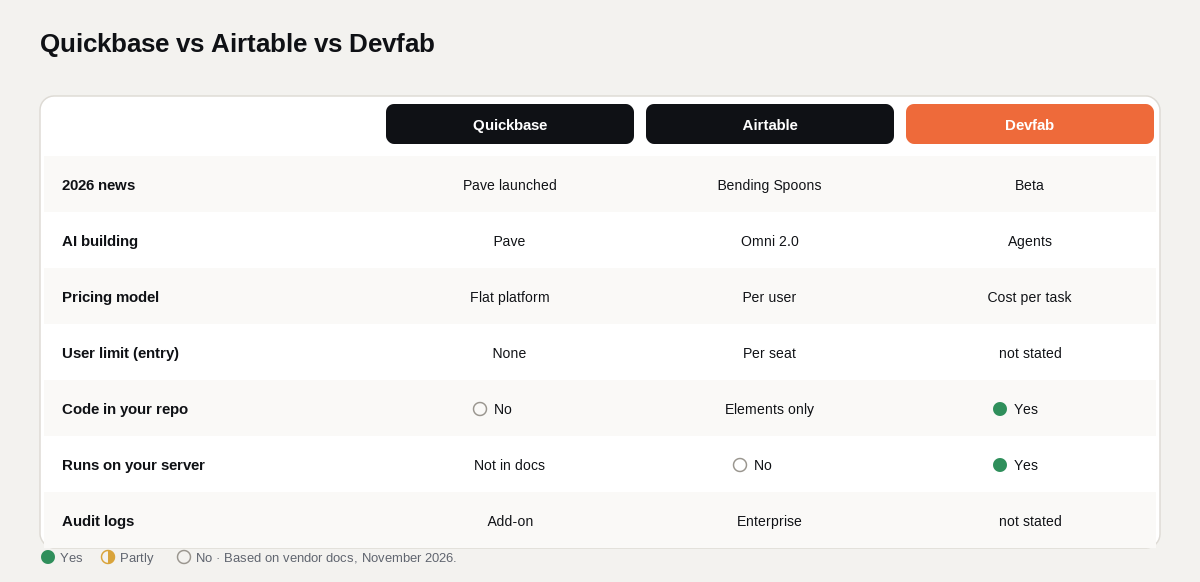
| Code ownership | Apps run on Quickbase | Custom element source can be edited or downloaded; bases stay in Airtable | Airtable elements |
| Team and admin | Okta and OneLogin, LDAP or SAML, two-step login; audit logs are an add-on; Pave SSO on Enterprise | Org-wide MCP controls; agent audit logs on Enterprise; agent permissions "coming soon" | Quickbase pricing; Airtable Fall Release |
| AI models | "Your data never trains the AI" (Pave) | Only Anthropic and OpenAI models for custom elements | Pave; Airtable elements |
| Pricing model | Flat platform price, no user limit; Pave by credits | Per billable collaborator, with pooled AI credits | Quickbase pricing; Airtable plans |
Cost model by team size
| Team size | Quickbase | Airtable | Devfab |
|---|---|---|---|
| 1 person | Pave Free (1 app, no credits included) or Pave Launch USD 20 per month for 120 credits | Free plan, or Team USD 20 per user per month billed annually | Cost logged per task and per project (Beta) |
| 5 people | Core platform entry tier USD 500 per month billed annually (platform price, not per user); or Pave credit tiers up to USD 200 per month | Team USD 20 per user per month, or Business USD 45 per user per month, billed annually | Cost logged per task and per project (Beta) |
| 25 people | Same entry tier, no limit on users, up to 50 apps; Enterprise custom | Team or Business per user; Enterprise Scale custom | Cost logged per task and per project (Beta) |
Prices as of November 2026 from Quickbase pricing, Pave pricing and Airtable pricing. Airtable bills per billable collaborator; building with Omni does not use AI credits, but Omni Q&A does (Airtable AI billing). Devfab is in Beta and offers predictable cost: cost is logged after each run, per task and per project.
The headline: Airtable is cheaper for a handful of builders, and Quickbase's flat price gets more attractive as headcount grows. A competitor's review notes Quickbase's platform minimum raises the starting cost and that some specialized integrations sit on higher plans (Blaze).
Where Quickbase wins
- Many users on one bill. The entry tier has no limit on users, so a plant or field crew doesn't add seats.
- Operations apps with structure. Customizable roles, a developer sandbox, IP filtering and directory login fit IT-run deployments.
- A hosted AI app in one step. Pave includes the data model, permissions, workflows and hosting, so there is no separate database or deploy.
- Draft, publish and roll back. Pave keeps versions, so you can undo a bad change.
Where Airtable wins
- Starting small. A free plan and a per-seat Team plan cost less for a few builders.
- Business users building alone. Omni 2.0 turns spreadsheets, PDFs and images into a data model in a conversation.
- Custom screens on live data. Canvas (open beta) builds apps and dashboards on base data and asks before adding tables or fields.
- Your outside AI tools. The MCP server lets Claude, ChatGPT, Gemini and Cursor work with your bases, with admin controls.
Know the limits too. Omni can't create new views, set up syncs or export data, and Canvas is unavailable for HIPAA-compliant or non-US-data organizations (Airtable support; Airtable Fall Release).
Switching from one to the other
There is no one-click move in the docs we checked. Treat it as a rebuild with a data migration. Export your Airtable tables as files, recreate the tables and relationships in Quickbase or let Pave draft the model from a description, then rebuild automations and permissions by hand. Going the other way, Omni 2.0 can build a data model from exported spreadsheets. In both directions, list every automation and role first, because those are what break quietly.
Where Devfab fits
Both products keep your app on their platform. That is fine for trackers and team tools. It is a problem when the app grows into something customers use, needs its own rules and tests, or must run on your own server.
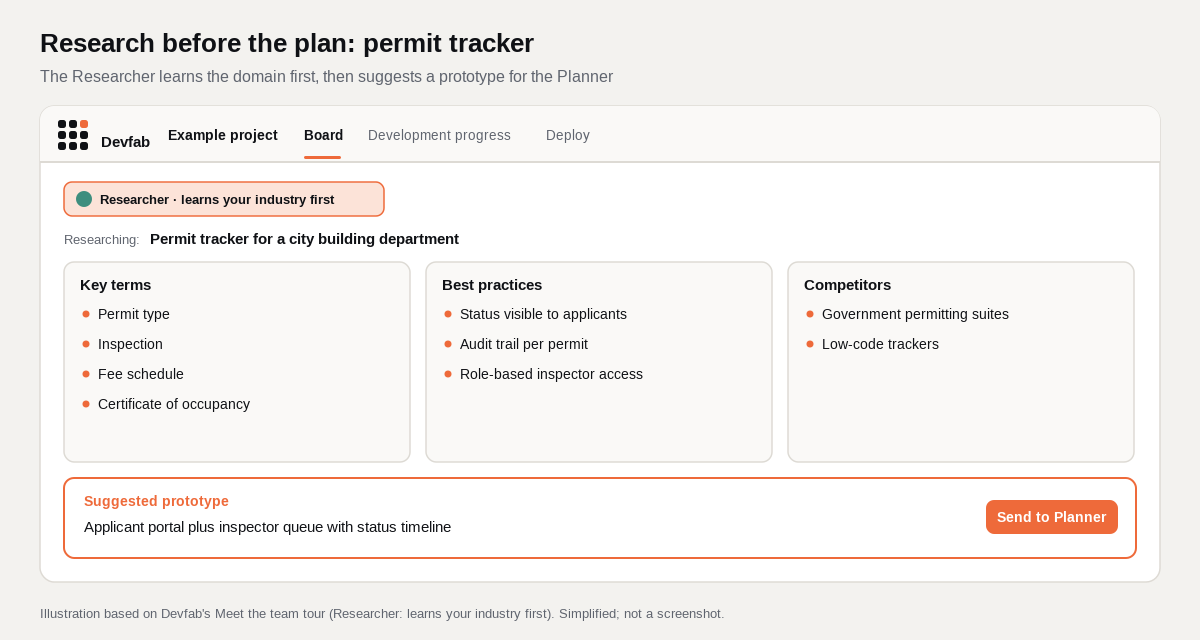
Coding agents automate the developer. Devfab automates the development lifecycle. Devfab builds a normal codebase in your own GitHub account and deploys it to your own server. Before the plan, its Researcher maps the domain; for a permit tracker that means permit types, inspection steps and fee rules are on the table first. A person approves the plan, and the QA agent runs UI and flow tests (screens and user journeys clicked end to end) plus logic tests. Devfab is in Beta, has fewer integrations than either platform, and has no drag-and-drop editor. Compare it directly in Devfab vs Quickbase and Devfab vs Airtable.
FAQ
Who owns Airtable now?
Bending Spoons. Its acquisition of Airtable closed in early September 2026. On October 12, 2026, Airtable announced layoffs of much of the pre-acquisition team and said plans and pricing were unchanged. The product kept shipping: Omni 2.0 and the Canvas beta came out on October 21.
Is Quickbase cheaper than Airtable for a big team?
It can be. As of November 2026, Quickbase's entry tier is USD 500 per month billed annually as a platform price with no limit on users. Airtable Team is USD 20 per user per month billed annually, so at 25 billable collaborators the two list prices meet.
What is Quickbase Pave?
Pave is a prompt-first AI app builder Quickbase launched on April 28, 2026. It builds the data model, roles, permissions, workflows and hosting from a plain-language description. It has its own credit-based pricing, starting with a free plan for one app.
Can I export my app code from Airtable or Quickbase?
Mostly no. Both are platforms: apps run on the vendor's service. Airtable lets you view or download the source of AI-generated custom elements, but the base itself stays in Airtable. If you need code in your own repository, consider a different kind of tool.
Read next
- What is an AI software factory?
- Airtable alternatives
- Low-code vs AI software factory
- Devfab vs Quickbase
- Devfab vs Airtable
Outgrowing the platform and want the code in your own repo? Try Beta
Sources (checked November 2026): Quickbase pricing; Quickbase Pave; Quickbase Pave pricing; Quickbase: Introducing Pave (Apr 28, 2026); Blaze: Quickbase review (competitor, updated Sep 10, 2026); Airtable pricing; Airtable newsroom: Back to bases (Oct 12, 2026); Airtable: An update on Airtable's team (Oct 12, 2026); Airtable Fall Release (Oct 21, 2026); Airtable: AI-generated custom elements out of beta (Apr 14, 2026); Airtable support: Using Omni; Airtable support: AI billing; Airtable support: Plans overview.
Frequently asked questions
Who owns Airtable now?
Bending Spoons. Its acquisition of Airtable closed in early September 2026. On October 12, 2026, Airtable announced layoffs of much of the pre-acquisition team and said plans and pricing were unchanged. The product kept shipping: Omni 2.0 and the Canvas beta came out on October 21.
Is Quickbase cheaper than Airtable for a big team?
It can be. As of November 2026, Quickbase's entry tier is USD 500 per month billed annually as a platform price with no limit on users. Airtable Team is USD 20 per user per month billed annually, so at 25 billable collaborators the two list prices meet.
What is Quickbase Pave?
Pave is a prompt-first AI app builder Quickbase launched on April 28, 2026. It builds the data model, roles, permissions, workflows and hosting from a plain-language description. It has its own credit-based pricing, starting with a free plan for one app.
Can I export my app code from Airtable or Quickbase?
Mostly no. Both are platforms: apps run on the vendor's service. Airtable lets you view or download the source of AI-generated custom elements, but the base itself stays in Airtable. If you need code in your own repository, consider a different kind of tool.