Short answer: For low per-user prices and native mobile apps, pick Zoho Creator. On Microsoft 365, pick Power Apps. For cheap portals with unlimited users, Knack; for HIPAA work, Caspio; for client portals on existing data, Softr. Choose Devfab when the app needs custom rules and code you own.
You run a mid-size general contractor. Quickbase holds your punch lists, inspections and change orders. It works, but the renewal quote landed, and the field crews still call the office to ask what's open.
People leave Quickbase for three common reasons: the platform minimum before a single user logs in, integrations that sit on higher plans, and an interface some users find cluttered. This page compares six alternatives against those reasons, with vendor pages checked on November 23, 2026.
In this guide, you'll learn:
- Why teams leave Quickbase
- Quick comparison
- The alternatives
- Where Quickbase is still the better choice
- How to choose
Match your own reason to the list, then read only the tools that solve it.
Why teams leave Quickbase
Quickbase is active and added an AI builder this year: Pave, launched April 28, 2026, builds apps from plain-language descriptions with data, permissions and hosting included (Quickbase press release). The core platform still drives most switching decisions:
- Platform minimum. The entry tier is USD 500 per month, billed annually, as of November 2026. It is a platform price with no user limit, which is great at scale and steep for a handful of users (Quickbase pricing).
- Integrations by tier. A competitor review (Blaze, updated September 10, 2026) says specialised integrations such as Procore, Salesforce and Asana are reserved for higher plans, and API setup is technical (Blaze).
- Interface. The same review cites a January 2026 user review calling the interface cluttered.
- Paid add-ons. Audit logs are an add-on on the core platform.
- Pave is still filling in. Custom agents, API access, white labeling and corporate-grade integrations are "coming soon," and Pave SSO is Enterprise-only (Pave pricing).
Quick comparison
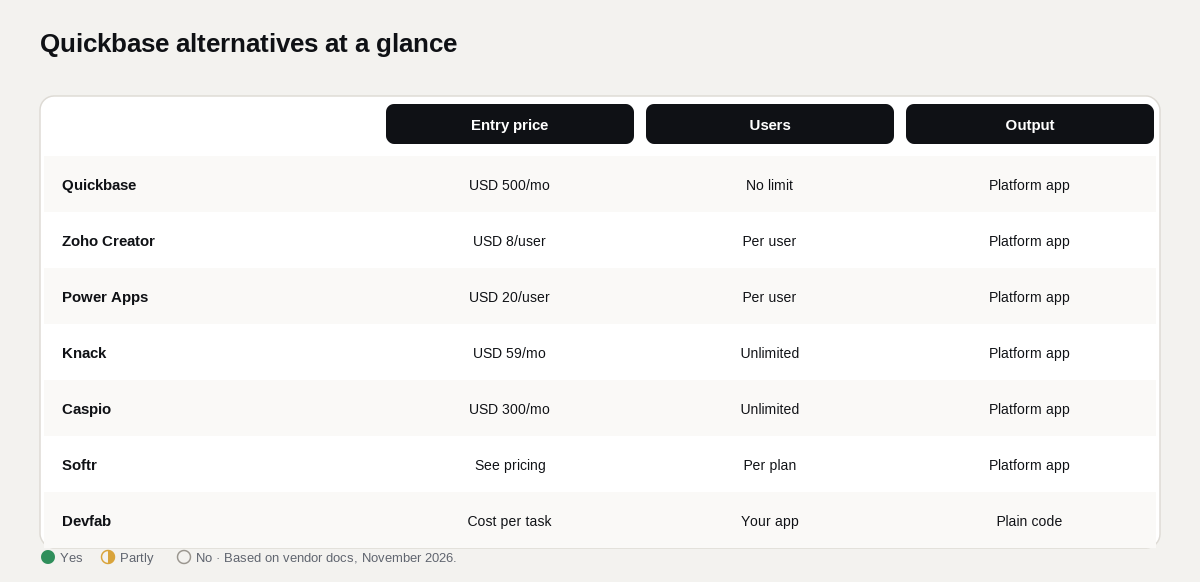
| Tool | Type | AI building | Users | Compliance noted | Starting paid price (Nov 2026) |
|---|---|---|---|---|---|
| Quickbase (baseline) | Operations low-code + Pave | Pave from a prompt | No user limit | Pave: data never trains the AI | USD 500 per month, billed annually |
| Zoho Creator | Low-code with native mobile | Zia; Plan, Build and Test agents | Per user | Audit trail; SAML SSO add-on | Standard USD 8 per user per month, annual |
| Microsoft Power Apps | Low-code on Microsoft 365 | Natural language; Plans agents | Per user or per app | Tenant DLP and auditing | Premium USD 20 per user per month, paid yearly |
| Knack | No-code database apps and portals | AI app builder on all plans | Unlimited | HIPAA, GDPR, SOC 2 Type II cited | Starter USD 59 per month (USD 49 annual) |
| Caspio | Compliant database app builder | Caspi | Unlimited app users | HIPAA, SOC 2 Type II, GDPR; BAAs | Team USD 300 per month (USD 270 annual) |
| Softr | No-code portals and internal apps | New Softr builds the whole app | Builders plus app users per plan | SOC 2 Type II, GDPR | See pricing page |
| Devfab | AI software factory | Agents research, plan, build, test, deploy | Your app | Not stated | Beta; cost logged per task |
The alternatives
Zoho Creator
Verdict: the lowest per-user entry for internal apps, with phone apps included. Best for: small and mid-size firms, especially on Zoho CRM or Books. Trade-off: per-user pricing grows with headcount, unlike Quickbase's flat price. Pricing: Standard USD 8, Professional USD 20, Enterprise USD 25 per user per month billed annually, as of November 2026 (Zoho Creator pricing).
Every Creator app gets native iOS and Android versions, which matters for field crews (Zoho Creator). A Plan Agent writes a business requirements document, a Build Agent adds modules with review of each change, and a Test Agent generates and runs test cases. Apps can run on Zoho Cloud, AWS, Azure, GCP, on-premise or hybrid. Standard allows only one app. See Zoho Creator vs Quickbase.
Microsoft Power Apps
Verdict: the default for organizations standardized on Microsoft 365. Best for: apps on Dataverse, SharePoint or Dynamics 365 under existing tenant governance. Trade-off: premium connectors, Dataverse capacity and AI credits add cost beyond the seat. Pricing: Developer Plan free; Premium USD 20 per user per month, paid yearly, as of November 2026 (Power Apps pricing).
Users describe apps in natural language, and the Plans workspace uses agents as requirements analyst, data modeler and solution architect (The New Stack). IT can centralize policies for environments, data loss prevention, access and auditing (Power Apps). Since September 2026, outside AI coding tools can build model-driven apps after a person approves the build plan (Power Platform blog). From November 15, 2026, new unmanaged developer environments can't be created (Microsoft licensing FAQ).
Knack
Verdict: the budget pick when many outside users need a portal. Best for: nonprofits, small firms and agencies building portals with logins and payments. Trade-off: record and API caps on lower plans. Pricing: Starter USD 59 per month (USD 49 billed annually); Pro USD 130 (USD 110 annually); Corporate from USD 300, as of November 2026, with unlimited users (Knack pricing).
Knack keeps Quickbase's best pricing trait, no per-seat charge, at a much lower entry price. Its relational database supports one-to-many and many-to-many links (Knack). Branded portals include secure login and Stripe and PayPal payments. The AI app builder is on every plan, and a Knack MCP Server lets AI tools connect to the backend. Starter caps 20,000 records and 1,000 API calls a day. See Knack vs Quickbase.
Caspio
Verdict: the compliance-first alternative. Best for: healthcare, education and government teams that need signed BAAs. Trade-off: Team allows only 5 app authors. Pricing: Team USD 300 per month (USD 270 billed annually); Business USD 600 (USD 540 annually); HIPAA Compliance Edition USD 500 per month on a one-year term, as of November 2026 (Caspio pricing).
Caspio runs on a SQL Server core and says it is certified annually for HIPAA, SOC 2 Type II and GDPR, with FERPA and WCAG support (Caspio). The Caspi builder creates data model, interface and roles from a description. Flat plans include unlimited app users, like Quickbase. Apps can be embedded into existing websites and portals. Integrations include a REST API, webhooks, Zapier, Make and n8n.
Softr
Verdict: the pick when the Quickbase app is really a client portal. Best for: operations teams building portals on Softr's database or on Airtable, Google Sheets or Notion. Trade-off: no native App Store or Google Play publishing, per a competitor's review. Pricing: workspace plans (Free, Basic, Pro, Business, Enterprise) with set numbers of builders and app users; prices did not load when checked, so see Softr pricing.
Softr relaunched as "the new Softr" on November 9, 2026: from a description, AI creates the database, roles, workflows and a fully custom front end (Softr blog). Workflows trigger on buttons, forms, schedules or record changes, and AI agents can wait for human approval (Softr). Softr lists SOC 2 Type II and GDPR, with EU or US hosting. A competitor review (Jet Admin, September 2026) notes metered records and workflow actions (Jet Admin).
Devfab
Verdict: for the operations app that has become a product of its own. Best for: companies and agencies that want a custom app as code they own, on their own server. Trade-off: in Beta; no visual builder. Pricing: predictable cost; cost is logged after each run, per task and per project.
See Where Devfab fits below, and the head-to-head in Devfab vs Quickbase.
Where Quickbase is still the better choice
- Many users on one flat price. No user limit on the entry tier, which beats per-seat tools at scale.
- Many connected operational apps. Up to 50 custom apps on the entry tier, with Automations, Sync and API.
- IT oversight. A developer sandbox, IP filtering and identity through Okta, OneLogin, LDAP or SAML.
- Prompt to hosted app with versioning. Pave adds draft and publish, version rollback and 350+ connectors (Pave).
- Business users own the app. For field, construction and manufacturing teams that don't want a codebase.
Where Devfab fits
Every alternative above is another platform. Some teams leave Quickbase because they want to stop renting the app.
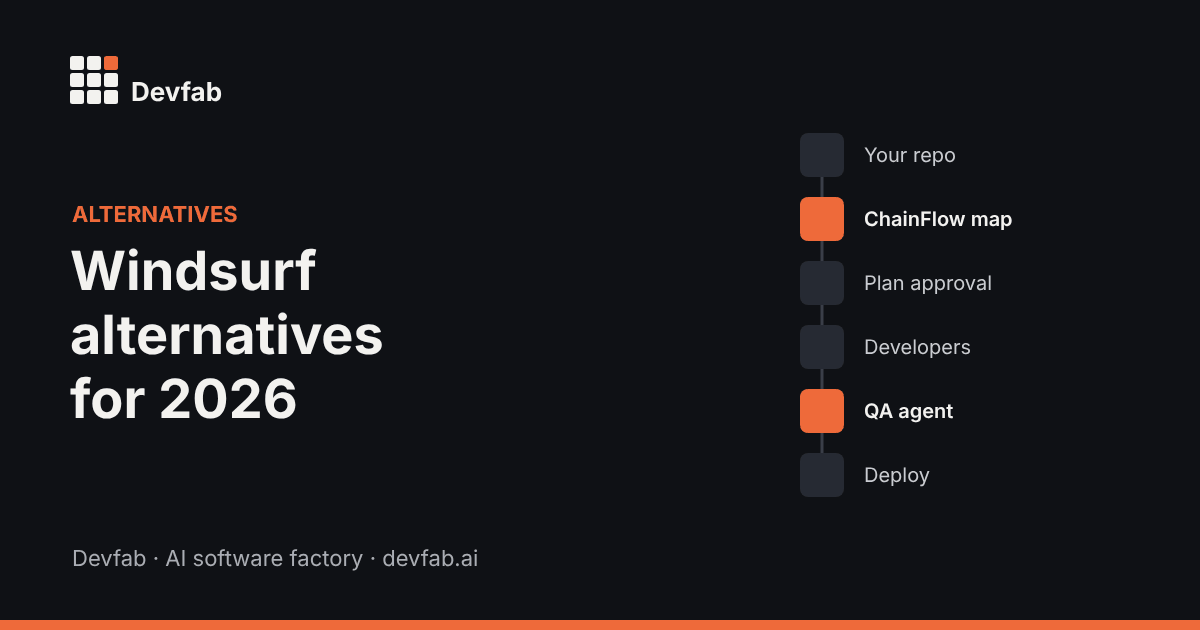
Coding agents automate the developer. Devfab automates the development lifecycle. For the contractor's punch-list and inspection app, you describe the app or attach your current Quickbase screenshots. The Researcher maps the domain first: punch items, trade assignments, inspection checklists, photo evidence, sign-off and competing construction tools. It suggests a prototype, the Planner writes a plan, and a person approves it.
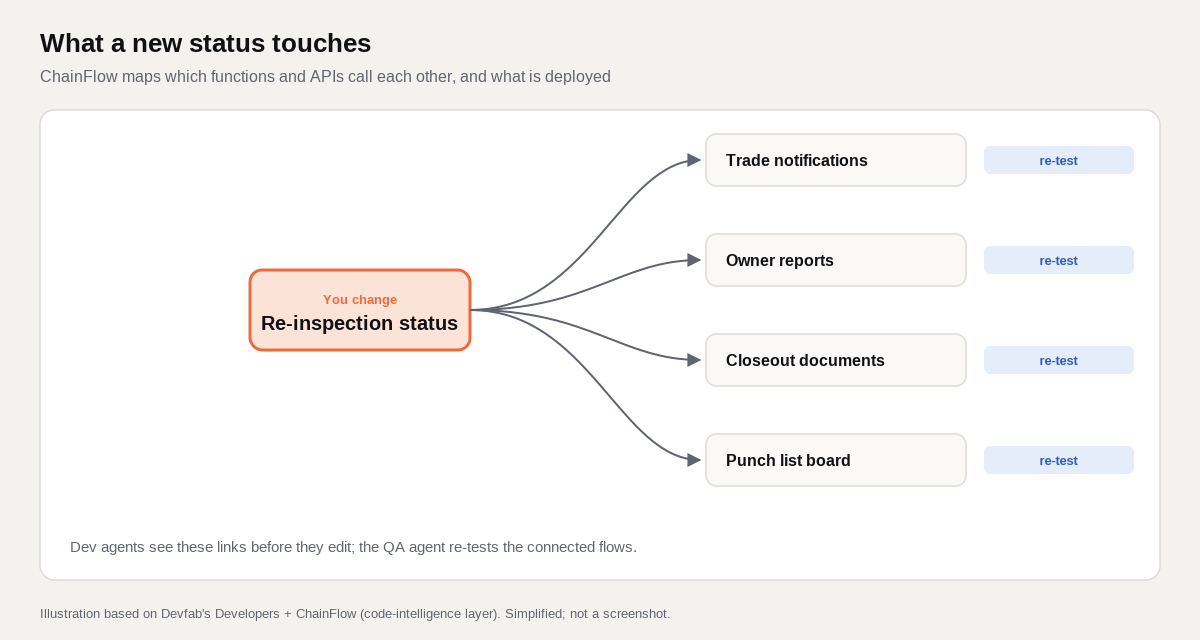
The Coordinator splits the plan into tickets for developer agents. ChainFlow maps which functions and APIs call each other, so adding a "re-inspection" status shows its impact on trade notifications, owner reports and closeout documents before anyone changes code. The QA agent runs UI and flow tests, a superintendent logging a defect with a photo and a trade closing it, plus logic tests. Code lives in your own GitHub account, and Deploy ships to your own server.
Honest limits: Devfab is in Beta, with a smaller community and fewer integrations than Quickbase's 350+ Pave connectors. It has no drag-and-drop builder, is not an editor for hands-on coding, and needs a GitHub account. You also run the server.
How to choose
- Few users, many internal apps, field crews on phones: Zoho Creator.
- Microsoft 365 company: Power Apps.
- Many outside users on a small budget: Knack.
- HIPAA, FERPA or a signed BAA: Caspio.
- A client portal on data you already keep elsewhere: Softr.
- Custom rules and code you own: Devfab.
- Hundreds of users across many operational apps: stay on Quickbase.
FAQ
Why do teams look for Quickbase alternatives?
Mostly cost and complexity. As of November 2026, Quickbase's core platform starts at USD 500 per month billed annually, which is steep when only a few people use it. A competitor review from September 2026 also cites specialised integrations reserved for higher plans, technical API setup and a cluttered interface. Audit logs are a paid add-on.
What is the cheapest Quickbase alternative?
For a few users, Zoho Creator Standard is USD 8 per user per month billed annually, and Knack Starter is USD 59 per month with unlimited users, as of November 2026. Quickbase's own Pave builder also has a free plan and a Launch plan at USD 20 per month for 120 credits.
Is Pave a replacement for Quickbase?
Pave is Quickbase's prompt-first AI app builder, launched April 28, 2026. It builds the data model, roles, workflows and hosting from a description, with its own credit-based pricing. Some features, such as custom agents, API access and white labeling, are still listed as coming soon.
Which Quickbase alternative is best for regulated data?
Caspio is the closest fit for healthcare and education: it says it is HIPAA, SOC 2 Type II and GDPR certified annually and signs BAAs for HIPAA-eligible AI features. Power Apps fits organizations that need Microsoft tenant governance and data loss prevention policies.
Read next
- What is an AI software factory?
- Devfab vs Quickbase
- Knack vs Quickbase
- Zoho Creator vs Quickbase
- Low-code vs an AI software factory
Ready to own the app instead of renting it? Try Beta
Sources (checked November 2026): Quickbase pricing; Quickbase Pave; Quickbase Pave pricing; Quickbase introduces Pave (Apr 28, 2026); Blaze: Quickbase review (competitor, Sep 2026); Zoho Creator; Zoho Creator pricing; Power Apps; Power Apps pricing; The New Stack: Power Apps Plans; Power Platform September 2026 update; Power Platform licensing FAQ; Knack; Knack pricing; Caspio; Caspio pricing; Softr; Softr pricing; Softr blog: Beyond building blocks (Nov 9, 2026); Jet Admin: Softr review (competitor, Sep 2026).
Frequently asked questions
Why do teams look for Quickbase alternatives?
Mostly cost and complexity. As of November 2026, Quickbase's core platform starts at USD 500 per month billed annually, which is steep when only a few people use it. A competitor review from September 2026 also cites specialised integrations reserved for higher plans, technical API setup and a cluttered interface. Audit logs are a paid add-on.
What is the cheapest Quickbase alternative?
For a few users, Zoho Creator Standard is USD 8 per user per month billed annually, and Knack Starter is USD 59 per month with unlimited users, as of November 2026. Quickbase's own Pave builder also has a free plan and a Launch plan at USD 20 per month for 120 credits.
Is Pave a replacement for Quickbase?
Pave is Quickbase's prompt-first AI app builder, launched April 28, 2026. It builds the data model, roles, workflows and hosting from a description, with its own credit-based pricing. Some features, such as custom agents, API access and white labeling, are still listed as coming soon.
Which Quickbase alternative is best for regulated data?
Caspio is the closest fit for healthcare and education: it says it is HIPAA, SOC 2 Type II and GDPR certified annually and signs BAAs for HIPAA-eligible AI features. Power Apps fits organizations that need Microsoft tenant governance and data loss prevention policies.