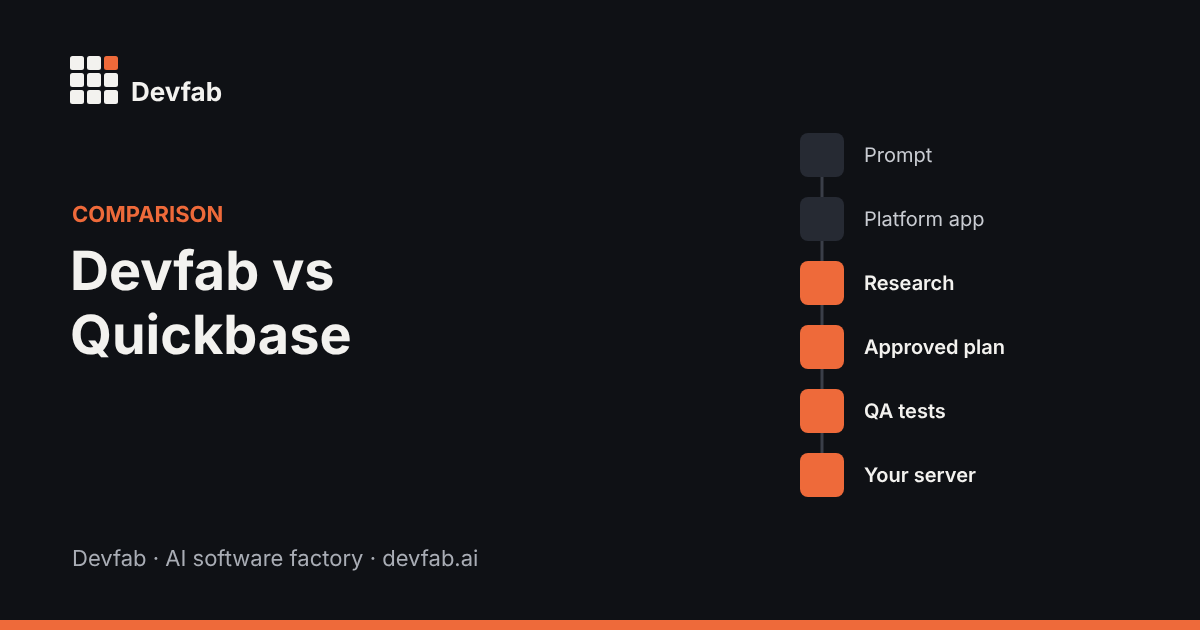
Short answer: Quickbase wins when business teams want governed operations apps and automations they run themselves on one hosted platform, now with Pave to start from a prompt. Devfab wins when an agency or IT team ships a client app as code in its own GitHub, with research, an approved plan, QA tests and deployment to its own server.
A city client asks your agency for a permit tracker. Their operations team already likes Quickbase. Their IT lead wants the code in their own repository. Both requests are reasonable, and they point to different tools.
The choice decides who owns the app after launch: the business users on a platform, or a codebase your team maintains. This page weighs both, using Quickbase's own pages checked in November 2026.
In this comparison:
- What each tool is built for
- Switching triggers
- Cost model by team size
- Where Quickbase is the better choice
- Where Devfab is the better choice
Start with what changed at Quickbase this year.
What each tool is built for
Quickbase
Status, November 2026: active, with a new product. On April 28, 2026, Quickbase announced Pave, a full-stack AI app builder that turns a plain-language description into an app, then lets you refine it in a no-code interface (Quickbase press release). Quickbase pitches Pave as a way to take teams "from A to Z" past the prototype, with IT oversight from one interface.
What matters for a delivery team:
- The core platform is for operational business apps. The entry tier includes up to 50 custom apps, Quickbase Automations, Sync, an API, customizable roles, a developer sandbox and IP filtering. Audit logs are a paid add-on (Quickbase pricing).
- Pave includes the plumbing. A data model, roles and permissions, workflows with assignments, escalations and reminders, hosting with draft and publish, version rollback and 350+ connectors. Quickbase states, "Your data never trains the AI" (Pave).
- Identity. The platform integrates with Okta and OneLogin, supports LDAP or SAML directories and two-step authentication. Pave SSO is Enterprise-only (Quickbase pricing; Pave pricing).
- Still coming. Custom agents, Pave API access, white labeling and corporate-grade integrations are listed as "coming soon" (Pave pricing).
Quickbase's main user is a business or operations team that builds and runs its own apps, with IT watching from above.
Devfab
Devfab is an AI software factory. Its unit of work is a project, and seven agents run it: Researcher, Planner, Coordinator, Developers, Blueprint, QA agent and Deploy.
- The Researcher maps the domain before any plan. For a permit tracker, that means key terms (permit types, inspections, fee schedules), best practices for that kind of app and competitors. Then it suggests a prototype.
- The Planner publishes the plan, and a person approves it. The Coordinator turns it into tickets for dev agents.
- Developers work with ChainFlow, which maps which functions and APIs call each other and what is deployed, so a change to permit fees doesn't quietly break payments or applicant notices.
- The QA agent runs UI and flow tests (screens, buttons and user journeys clicked end to end) plus logic tests. Deploy ships to your own server.
App builders automate the first version. Devfab automates the development lifecycle.
Switching triggers
| Trigger | Quickbase | Devfab | Source |
|---|---|---|---|
| Starting cost for a small client | Core platform has a monthly minimum; a 2026 competitor review says it raises the starting cost | Cost logged per task and per project (Beta) | Quickbase pricing; Blaze review |
| Client wants code in its own repo | Apps run on Quickbase; code export is not covered in the pages we checked | Code lives in your GitHub account or your organization's | Pave |
| Client wants its own branding or API | Pave white labeling and API access are "coming soon" | Plain code, so branding and APIs are part of the build | Pave pricing |
| Specialist integrations | Procore, Salesforce and Asana integrations sit on higher plans, per the same review | Built as part of the plan; fewer ready integrations than mature platforms | Blaze review |
| Audit and SSO needs | Audit logs are a paid add-on; Pave SSO is Enterprise-only | Roles, workspace permissions, Team Delivery Report | Quickbase pricing; Pave pricing |
| Proof of testing for the client | Not covered in the pages we checked | QA agent runs UI, flow and logic tests | Pave |
Cost model by team size
| Team size | Quickbase | Devfab |
|---|---|---|
| 1 person | Pave Free (1 app, no credits included) or Pave Launch at USD 20 per month for 120 credits, as of November 2026 | Cost logged per task and per project (Beta) |
| 5 people | Core platform entry tier at USD 500 per month, billed annually, with no limit on users, as of November 2026 | Cost logged per task and per project (Beta) |
| 25 people | Same platform price (not per user), or Enterprise on custom terms | Cost logged per task and per project (Beta) |
Prices from Quickbase pricing and Pave pricing. Pave credits pay for building, workflows, agent tasks and integrations, and higher credit tiers run up to USD 200 per month. Devfab is in Beta and offers predictable cost: cost is logged after each run, per task and per project.
Moving from Quickbase to Devfab
A Quickbase app is not a Git repository, so the move is a rebuild from a clear spec, not an export.
- Write down what the app does today. List tables, roles, automations and the screens people use most. Take screenshots.
- Pull the data out through Quickbase's API, which is part of the core platform (Quickbase pricing).
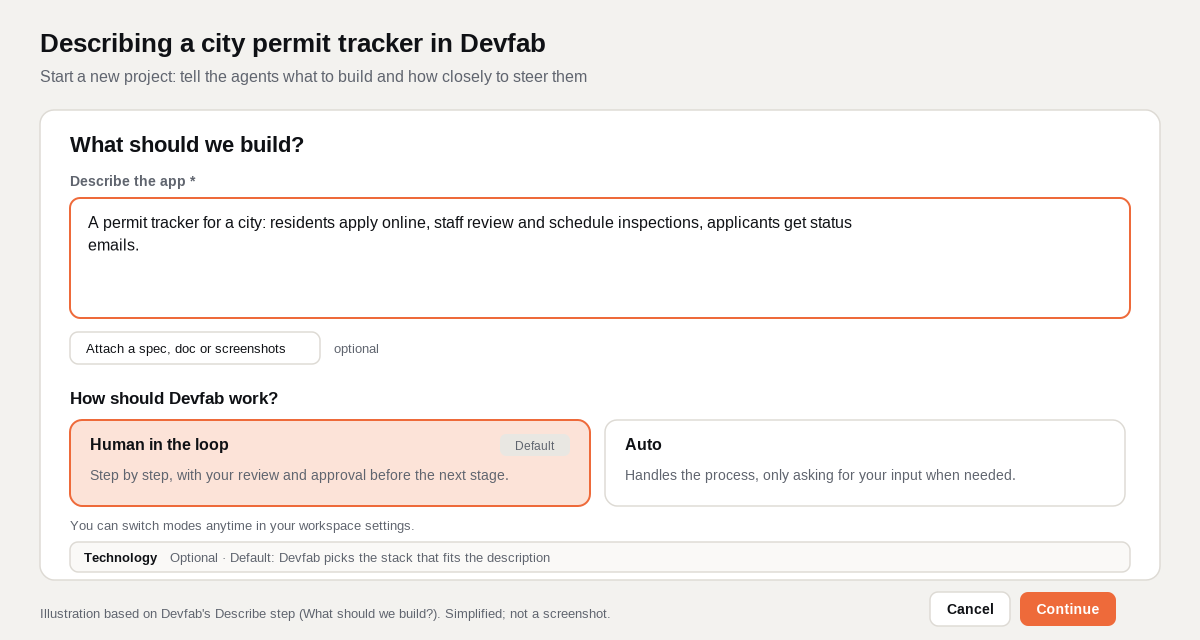
- In Devfab, choose "Start a new project". Describe the app under "What should we build?" and attach the spec and screenshots.
- Let the Researcher map the domain, then review the suggested prototype.
- Approve the plan. The Coordinator creates tickets only after a person approves.
- Turn on "QA agent · review before Done" so each ticket gets UI, flow and logic tests, then deploy to the client's server.
Once the code is in GitHub, later changes use "Work on an existing project". Leave the change box empty, and ChainFlow maps the code and suggests three small first tickets.
Where Quickbase is the better choice
- Business users should own the app. Operations staff in field work, construction or manufacturing build and change apps themselves.
- Many users, flat price. The core platform has no limit on users, which suits a large internal audience.
- You want one prompt-to-hosted step. Pave includes data, permissions, workflows and hosting, with no separate database or deploy step.
- The client already runs on Quickbase and its IT team governs apps there.
- You need many small apps fast, up to 50 on the entry tier, rather than one custom product.
Where Devfab is the better choice
- Research before the plan. The Researcher learns the client's domain first, so the plan starts from the right terms and rules.
- A plan the client can approve. A person approves the plan before tickets exist.
- Changes don't break connected features. ChainFlow shows the impact of a change across functions, APIs and deployed code.
- Proof of testing. The QA agent clicks through screens and user journeys and runs logic tests.
- Ownership. Code in your GitHub (or your client's), deployed to your own server, with docs such as blueprints and user manuals.
- Cost per project. Cost is logged after each run, per task and per project.
Devfab's honest limits: it is new and in Beta, with a smaller community and fewer integrations than Quickbase. It is not an editor for hands-on coding, and it is not a tool for staff to edit apps by drag and drop. It needs a GitHub account.
FAQ
Is Quickbase Pave the same as Quickbase?
No. Pave is a separate prompt-first AI app builder that Quickbase announced on April 28, 2026. It has its own pricing page and credit plans. The core Quickbase platform is still sold on its own plans, with an entry tier priced per platform, not per user.
Can an agency build client apps on Quickbase?
Yes, if the client is happy to run the app on Quickbase and pay for the platform. The app, data and automations live in Quickbase. If the client wants code in its own GitHub account and the app on its own server, Devfab fits better.
Does Devfab replace a low-code platform for business users?
No. Devfab is not a drag-and-drop builder for staff to change apps themselves. Its agents research, plan, build, test and deploy a normal codebase. Business users approve the plan and use the app; developers or Devfab's agents change it later.
How does pricing compare?
As of November 2026, Quickbase's entry tier is USD 500 per month billed annually, with no limit on users, and Pave's Launch plan is USD 20 per month for 120 credits. Devfab is in Beta with predictable cost: cost is logged after each run, per task and per project.
Read next
- What is an AI software factory?
- Low-code vs AI software factory: what's the difference?
- Quickbase vs Airtable: which should your team pick?
- Build: a field-service work order app
Want to see a client project go from research to deploy? Book a Devfab demo
Sources (checked November 2026): Quickbase pricing; Quickbase Pave; Quickbase Pave pricing; Quickbase introduces Pave (press release, Apr 28, 2026); Blaze: Quickbase review (competitor, updated Sep 10, 2026).
Frequently asked questions
Is Quickbase Pave the same as Quickbase?
No. Pave is a separate prompt-first AI app builder that Quickbase announced on April 28, 2026. It has its own pricing page and credit plans. The core Quickbase platform is still sold on its own plans, with an entry tier priced per platform, not per user.
Can an agency build client apps on Quickbase?
Yes, if the client is happy to run the app on Quickbase and pay for the platform. The app, data and automations live in Quickbase. If the client wants code in its own GitHub account and the app on its own server, Devfab fits better.
Does Devfab replace a low-code platform for business users?
No. Devfab is not a drag-and-drop builder for staff to change apps themselves. Its agents research, plan, build, test and deploy a normal codebase. Business users approve the plan and use the app; developers or Devfab's agents change it later.
How does pricing compare?
As of November 2026, Quickbase's entry tier is USD 500 per month billed annually, with no limit on users, and Pave's Launch plan is USD 20 per month for 120 credits. Devfab is in Beta with predictable cost: cost is logged after each run, per task and per project.