Short answer: Bubble wins when you are building a custom product, such as a SaaS app or marketplace, that needs its own database, complex workflows and a native mobile app. Softr wins when you need a client portal or internal tool on data you already keep in Airtable, Google Sheets or Notion, with user groups and record-level permissions.
Your clients keep emailing for status updates, and you want them to log in and see it themselves. Half the advice says Bubble, because it can build any logic you can describe. The other half says Softr, because a portal on your existing data is what you actually need. Softr's relaunch on November 9, 2026 shifts this debate. We read both vendors' pages to settle it fairly.
In this comparison:
- Bubble and Softr at a glance
- Feature comparison
- Cost model by team size
- Where Bubble wins
- Where Softr wins
Start with what changed this month.
Bubble and Softr at a glance
Softr relaunched on November 9, 2026. The "new Softr" builds the whole app with AI from a description: database, user roles and permissions, workflows, integrations, and a custom frontend that is no longer limited to blocks. Softr's line is "We vibe code your frontend. We don't vibe code your backend." Existing apps keep working, block-based building stays available, and no pricing changes were described (Softr blog).
Softr is aimed at business, operations and IT teams building apps without engineers; it calls client portals "the most common starting point" and claims 1M+ builders and 7,000 organizations (Softr). Claude, ChatGPT, Cursor and Codex can also build and manage Softr apps through Softr MCP, which is included on every plan, including Free (Softr MCP).
Bubble is a hosted no-code platform where "every component is visual, including the backend." Hosting, database, security and auto-scaling are included (Bubble). Its AI Agent (beta) plans an app with you and builds pages, workflows, database and privacy rules in the visual editor (Bubble blog). Bubble apps run only on Bubble, with no code export (Bubble manual).
Think of a small accounting firm. A portal where each client sees only their own documents and deadlines, on records already in Airtable, is Softr's home ground. A new tax-filing product sold to the public, with its own pricing logic and a mobile app, points to Bubble.
Feature comparison
| Aspect | Bubble | Softr | Source |
|---|---|---|---|
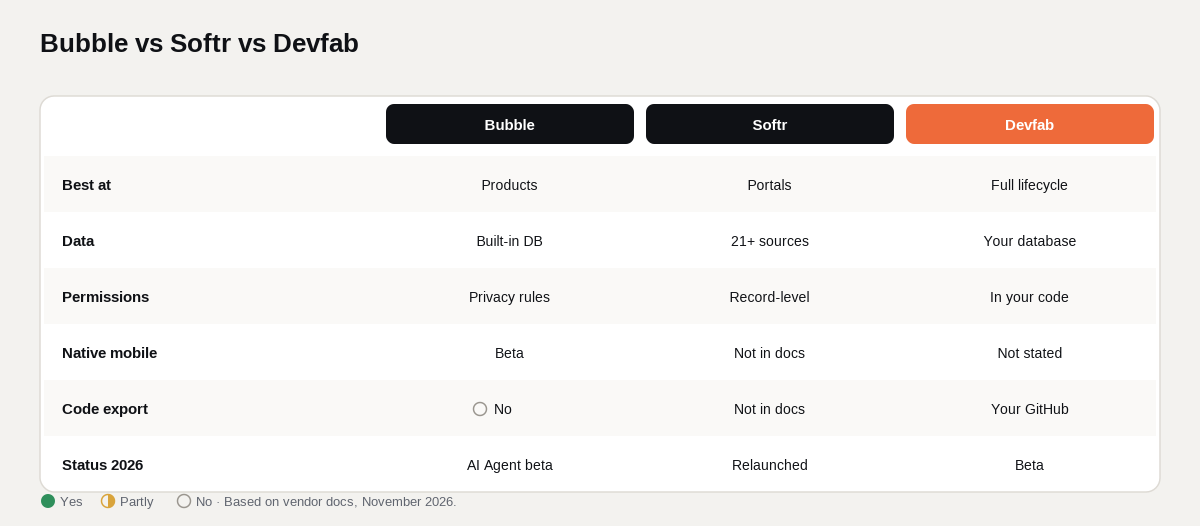
| What AI builds | Full app via the AI Agent (beta), then visual editing | Pages, database, permissions, workflows and a custom frontend | Bubble AI; Softr blog |
| Data | Built-in database | Softr Databases plus 21+ external sources (Airtable, Sheets, Notion, Xano, REST API; Salesforce, Snowflake, SQL on higher tiers) | Bubble; Softr |
| Permissions | Built-in privacy rules | User groups, record-level data restrictions, preview as any user | Bubble; Softr |
| Workflows and agents | Visual workflows | Workflows on buttons, forms, schedules or record changes; AI agents can wait for human approval | Softr |
| Mobile | Native iOS and Android (beta) with store submission | No native App Store or Google Play publishing, per a competitor's review | Bubble; Jet Admin review |
| Outside agents | Bubble MCP (beta); can't deploy yet | Softr MCP on every plan, no AI credits used | Bubble blog; Softr MCP |
| Code ownership | No code export | Source export not covered in the pages we checked | Bubble manual |
| Compliance and admin | SOC 2 Type II; Enterprise SSO and isolated instance | SOC 2 Type II, GDPR, EU or US hosting; Enterprise SAML/OpenID SSO and SCIM | Bubble; Softr |
| Pricing model | Plans plus workload units and AI credits | Workspace plans with set builders and app users, workflow limits, AI credits | Bubble pricing; Softr docs |
Cost model by team size
| Team size | Bubble | Softr | Devfab |
|---|---|---|---|
| 1 person | Free (no live app); Starter USD 32 per month | Free plan; paid plans add a custom domain (see pricing page) | Cost logged per task and per project (Beta) |
| 5 people | Growth USD 119 per month or Team USD 349 per month, by editors needed | Basic, Pro or Business, by builders and app users needed | Cost logged per task and per project (Beta) |
| 25 people | Team or Enterprise (contact sales) | Business or custom Enterprise; add-on users and builders on higher tiers | Cost logged per task and per project (Beta) |
Bubble prices as of November 2026 from Bubble pricing (web plans, billed annually), plus workload units. Softr plan prices did not load in our capture of Softr pricing, so we describe the model from Softr docs; Softr offers a trial and a 50% nonprofit and education discount. Devfab is in Beta and offers predictable cost: cost is logged after each run, per task and per project.
Where Bubble wins
- Your app is the product. Marketplaces, SaaS and AI SaaS are Bubble's listed use cases.
- You need a native mobile app on the same data and workflows as the web app.
- Your logic is complex and custom. Every part, including the backend, is editable visually.
- You want one bundled stack. Hosting, database, security and auto-scaling come with the plan.
Where Softr wins
- The data already exists. Airtable, Google Sheets, Notion and more connect on every plan.
- You need a client portal fast, with user groups and record-level permissions, and no engineers.
- Your AI tools should do the building. Softr MCP lets Claude, ChatGPT, Cursor or Codex build and manage apps, without using Softr AI credits.
- You need EU hosting or SCIM. Softr offers EU or US hosting and SCIM on Enterprise.
- AI agents must ask first. Softr agents can wait for human approval before acting.
Softr limits to check: a competitor's review (Jet Admin, Sep 30, 2026) says app users are capped per plan, builders are billable, records and workflow actions are metered, and very large Airtable bases can slow apps (Jet Admin).
Switching from one to the other
From Bubble to Softr. Export your data as CSV or via the Bubble API, import it into Softr Databases or Airtable, and describe the app to Softr's AI. Recreate roles as user groups. Custom Bubble logic will need rebuilding as Softr workflows.
From Softr to Bubble. Keep your data where it is or export it, model the data types in Bubble, and describe the app to the Bubble AI Agent. Portal permissions become Bubble privacy rules.
Where Devfab fits
Bubble and Softr host what they build. When a client contract says the source code must be handed over, or the portal must run on the client's own server, you need a codebase instead.
App builders automate the first version. Devfab automates the development lifecycle. The Researcher learns the domain, such as client-portal practices and competitors, before the Planner writes a plan, and a person approves it. ChainFlow maps which functions and APIs call each other, so a change to document upload doesn't quietly break notifications. Code lives in your own GitHub account and deploys to your own server. Devfab is in Beta, has fewer integrations than mature platforms, and is not a visual editor. See Devfab vs Softr.
FAQ
What changed with the new Softr?
On November 9, 2026, Softr relaunched as the new Softr. From a description, its AI now creates the database, user roles, permissions, workflows, integrations and a fully custom frontend on Softr's backend. Existing apps keep working, block-based building remains, and Softr described no pricing changes.
Is Softr easier than Bubble?
For portals and internal tools on existing data, usually yes. Softr generates pages, database, permissions and workflows from a prompt and connects to Airtable, Google Sheets, Notion and more. Bubble gives more control over custom logic, but its own guide says its terms, such as workflows and data types, take learning.
Can I use Airtable with Bubble or Softr?
Softr lists Airtable as a data source on every plan, along with Google Sheets, Notion, Coda, SmartSuite, Xano, Zoho CRM and REST API. Bubble connects to outside tools through its integrations and API, but its own database is the default.
Which one lets me own the code?
Neither gives you a codebase to run elsewhere in the pages we checked. Bubble says apps only run on Bubble and can't be exported as code. Softr hosts the apps it builds; a source-code export is not covered in its pages.
Read next
Want the portal as code you own? Try Beta
Sources (checked November 2026): Bubble homepage; Bubble pricing: compare plans; Bubble AI app builder; Bubble blog: What is Bubble AI (Aug 19, 2026); Bubble manual: Application and data ownership; Softr homepage; Softr blog: Beyond building blocks (Nov 9, 2026); Softr MCP; Softr pricing; Softr docs: Pricing and plans; Jet Admin: Softr review (Sep 30, 2026).
Frequently asked questions
What changed with the new Softr?
On November 9, 2026, Softr relaunched as the new Softr. From a description, its AI now creates the database, user roles, permissions, workflows, integrations and a fully custom frontend on Softr's backend. Existing apps keep working, block-based building remains, and Softr described no pricing changes.
Is Softr easier than Bubble?
For portals and internal tools on existing data, usually yes. Softr generates pages, database, permissions and workflows from a prompt and connects to Airtable, Google Sheets, Notion and more. Bubble gives more control over custom logic, but its own guide says its terms, such as workflows and data types, take learning.
Can I use Airtable with Bubble or Softr?
Softr lists Airtable as a data source on every plan, along with Google Sheets, Notion, Coda, SmartSuite, Xano, Zoho CRM and REST API. Bubble connects to outside tools through its integrations and API, but its own database is the default.
Which one lets me own the code?
Neither gives you a codebase to run elsewhere in the pages we checked. Bubble says apps only run on Bubble and can't be exported as code. Softr hosts the apps it builds; a source-code export is not covered in its pages.