Short answer: Claude Code wins when you want one strong coding agent across terminal, IDE, desktop and web, with plan mode and managed PR review. Warp wins when you want an AI terminal, or an orchestration layer (Warp Factories) that runs agents, including Claude Code itself, through triage, spec, build, review and verification stages.
This comparison is odd, because the two are not the same kind of product. Claude Code is an agent. Warp is a terminal, an agent CLI and, since August, a factory that can run Claude Code inside it. So the question is less "which is better" and more which layer you want to buy.
Warp argues its control plane beats a single agent. Claude Code fans argue one well-tuned agent is enough. This page referees using docs and pricing checked on November 20, 2026, and it says when each claim is the vendor's own.
In this comparison:
- Claude Code and Warp at a glance
- Feature comparison
- Cost model by team size
- Where Claude Code wins
- Where Warp wins
The layers are explained first.
Claude Code and Warp at a glance
Warp added a second product in 2026. Warp launched Warp Factories on August 18, 2026, as a new product alongside the Warp Terminal, not a rename (TechCrunch). In April 2026 it open-sourced the Warp Terminal client under the AGPL (Warp). Warp now has three pieces:
- Warp Terminal, an open-source terminal built for AI-assisted development.
- Agent CLI, which works in any terminal on Mac, Linux and Windows.
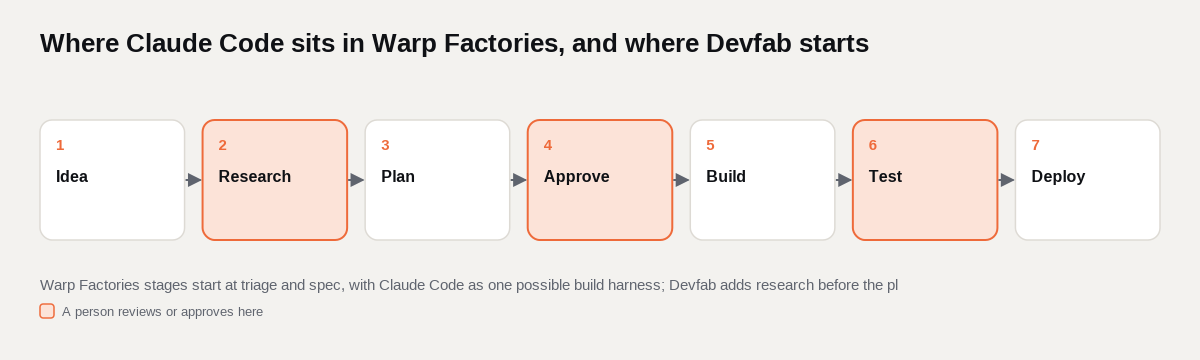
- Warp Factories, a hosted control plane where a "foreman" agent splits work across triage, spec, implementation and review subagents, defined in a version-controlled
factory.yaml(Warp).
Factories is still in early access: on November 20 the homepage's main call to action was "request early access," although the pricing page lists public Factories tiers (Warp pricing).
Claude Code is Anthropic's agentic coding tool. It reads a codebase, edits files, runs commands and opens pull requests from the terminal, IDEs, a desktop app, the web and mobile (Claude Code docs).
The link between them. Warp says Factories is "the control plane that can run any model or harness, including Claude Code," and that "Claude Code is a component you run inside it" (Warp article, Aug 19, 2026). That is Warp's framing, not an independent test.
Feature comparison
| Aspect | Claude Code | Warp (Terminal, Agent CLI, Factories) | Source |
|---|---|---|---|
| What it is | Coding agent | AI terminal, agent CLI and agent orchestration platform | Claude Code docs; Warp |
| Where it runs | Terminal, VS Code, JetBrains, desktop, web, mobile | Warp Terminal; Agent CLI in any terminal; Factories watched from web, mobile, terminal or IDE | Claude Code docs; Warp |
| Planning and stages | Plan mode proposes an approach for approval | Factory stages: triage, spec, implementation, review, verification | Claude Code costs; TechCrunch |
| Work intake | Slack, GitHub Actions, GitLab CI/CD, scheduled tasks | GitHub, GitLab, Linear, Jira, Slack, Teams, or a local agent via Factory MCP | Claude Code docs; Warp |
| Quality checks | Managed Code Review on GitHub PRs | Evals and scorers per factory; compare metrics across agent setups | Code Review; Warp |
| Model choice | Claude models only | Warp's agent, Claude Code or Codex as harnesses; frontier or open-weight models per stage | Claude Code costs; Warp |
| Self-hosting | Cloud sessions can run on self-hosted environments | Compute on Warp's cloud or your own VPC (Enterprise) | Enterprise deployment; Warp pricing |
| Team and admin | SSO, managed settings, spend limits, analytics | SSO on Business; spend controls and Analytics API on Enterprise; SOC 2 | Enterprise deployment; Warp pricing |
| Pricing model | Included in paid Claude plans | Terminal plans plus a separate Factories price list with usage billing | Claude pricing; Warp pricing |
Cost model by team size
| Team size | Claude Code | Warp |
|---|---|---|
| 1 person | Pro USD 20 per month (USD 17 billed annually); Max USD 100; Ultra USD 200 | Terminal: Free; Build USD 20 per month (USD 18 annual); Max USD 200 per month (USD 180 annual) |
| 5 people | Team Standard USD 25 per user per month (USD 20 annual) | Terminal Business USD 50 per user per month (USD 45 annual); Factories Start USD 0 per month plus usage |
| 25 people | Team, or Enterprise at USD 20 per seat per month billed annually (20-seat minimum) plus API-rate usage | Business (up to 25 seats) or Enterprise; Factories Scale USD 250 per team per month plus usage (USD 150 of usage included) |
Prices as of November 2026 from Claude pricing and Warp pricing. Warp's paid terminal tiers include agent usage billed at API rates; Factories usage is billed by agent runtime. If a factory runs Claude Code as its harness, you may pay for both products.
Where Claude Code wins
- You want one agent, not a platform. Claude Code works on its own in your terminal, editor or browser.
- You want planning before edits on each task. Plan mode has Claude explore and propose an approach first.
- You need managed PR review on GitHub, with several agents per PR and false-positive filtering.
- Inference must stay in your cloud account, via Bedrock, Google Cloud or Microsoft Foundry.
- You want fewer bills. Claude Code is part of a Claude plan; a factory on top adds a second price list.
Where Warp wins
- You want a better terminal. Warp Terminal is open source (AGPL) and built for AI-assisted work.
- You want several harnesses or models per stage. Factories runs Warp's agent, Claude Code or Codex, with open-weight models where you choose.
- You want the pipeline as code. A version-controlled
factory.yamldefines stages and triggers. - You want metrics across setups. Evals and scorers let managers compare agent configurations and track token spend.
- Work arrives from Jira or Teams. Factories takes intake from Jira, Linear, Slack and Microsoft Teams as well as GitHub and GitLab.
Switching from one to the other
Adding Warp to Claude Code. You don't need to drop Claude Code. Warp says a factory calls Claude Code through its non-interactive mode, and CLAUDE.md files keep working unmodified (Warp article). Start with Factories Start (no monthly fee) and one stage.
From Warp's agent to Claude Code. Install Claude Code, move your project rules into CLAUDE.md or AGENTS.md, and recreate recurring work as cloud scheduled tasks triggered by GitHub events or API calls (Claude Code docs).
Where Devfab fits
Warp Factories is the closest thing here to a software factory, and Warp uses that name. Its stages start at triage of an incoming issue. Devfab starts one step earlier, with the domain.
Coding agents automate the developer. Devfab automates the development lifecycle. For a B2B quote tool, Devfab's Researcher maps terms such as price lists, discounts and approval limits, common practices and competing tools, then suggests a prototype before the Planner writes a plan. A person approves the plan. ChainFlow maps which functions and APIs call each other, so a change to discount rules shows its effect on quotes, invoices and notifications. The QA agent runs UI, flow and logic tests, and Deploy ships to your own server.
Devfab is in Beta, with a smaller community and fewer integrations; it is not an editor and needs a GitHub account. See Devfab vs Warp and Warp vs Factory.
FAQ
Can Warp run Claude Code?
Yes. Warp says Warp Factories can run Claude Code as a harness alongside Warp's own agent and Codex, calling it through Claude Code's non-interactive mode. Warp also says CLAUDE.md files keep working unmodified when Claude Code is the harness.
What is Warp Factories?
Warp Factories, launched on August 18, 2026, is a hosted control plane that runs coding agents across triage, specification, implementation, review and verification. Factories are defined as version-controlled code in a factory.yaml file and can be triggered by issues, Slack messages or schedules.
Is Warp open source?
The Warp Terminal client was open-sourced in April 2026 under the AGPL. Warp's page does not say whether Warp Factories is open source.
Do I need to choose between Claude Code and Warp?
Not always. Claude Code is a terminal tool, so it can run inside the Warp terminal, and Warp Factories can use Claude Code as one of its harnesses. The real choice is whether you also want Warp's orchestration layer and its pricing on top.
Read next
Want a factory that starts with research and ends on your server? Try Beta
Sources (checked November 2026): Claude Code docs: Overview; Claude Code docs: Manage costs; Claude Code docs: Code Review; Claude Code docs: Enterprise deployment; Claude pricing; Warp homepage; Warp pricing; How did Warp Terminal's history shape Warp Factories? (warp.dev); What's the better platform for software factories: Warp or Claude Code? (warp.dev, Aug 19, 2026); TechCrunch: Warp's new system is an out-of-the-box software factory (Aug 18, 2026).
Frequently asked questions
Can Warp run Claude Code?
Yes. Warp says Warp Factories can run Claude Code as a harness alongside Warp's own agent and Codex, calling it through Claude Code's non-interactive mode. Warp also says CLAUDE.md files keep working unmodified when Claude Code is the harness.
What is Warp Factories?
Warp Factories, launched on August 18, 2026, is a hosted control plane that runs coding agents across triage, specification, implementation, review and verification. Factories are defined as version-controlled code in a factory.yaml file and can be triggered by issues, Slack messages or schedules.
Is Warp open source?
The Warp Terminal client was open-sourced in April 2026 under the AGPL. Warp's page does not say whether Warp Factories is open source.
Do I need to choose between Claude Code and Warp?
Not always. Claude Code is a terminal tool, so it can run inside the Warp terminal, and Warp Factories can use Claude Code as one of its harnesses. The real choice is whether you also want Warp's orchestration layer and its pricing on top.