Short answer: Warp wins when you want a factory defined as code in your own repo, the freedom to run Claude Code or Codex as the agent, and an AI terminal with a built-in editor for local work. Factory wins when you want a packaged, generally available platform with its own Droid agent, planned Missions with QA, and on-premises or air-gapped deployment.
Two vendors now sell you a software factory, and they use nearly the same words. Factory renamed its pitch around factories in June. Warp launched Warp Factories in August. Both run agents from triage to review. So the useful question is not which is a factory, but where the factory lives and who controls it. Devfab uses the word too, so we stay strict: every claim has a source.
In this comparison:
- Warp and Factory at a glance
- Feature comparison
- Cost model by team size
- Where Warp wins and where Factory wins
- Where Devfab fits
Use the sections below as your playbook.
Warp and Factory at a glance
Status changes in 2026. Factory announced Factory 2.0 on June 15, 2026, repositioning from coding agents to "software factories" with Droid Computers, Missions, Automations, Skills and a model Router (Factory). Its main domain is now factory.com; factory.ai redirects there (Factory). Warp open-sourced its Terminal client under AGPL in April 2026 and launched Warp Factories on August 18, 2026 as a new product next to the Terminal (Warp; TechCrunch). Factories is in early access.
Warp has three parts. Warp Terminal is an open-source terminal with a built-in code editor, file tree, language server support and a Code Review panel for diffs (Warp docs). The Agent CLI runs in any terminal on Mac, Linux and Windows. Warp Factories is a control plane for fleets of agents across triage, spec, implementation, review and verification. A factory is a factory.yaml plus agent files checked into your repo, and a "foreman" agent splits work across subagents (Warp). Warp's CEO says the main market is smaller companies that can't build such a system themselves (TechCrunch).
Factory sells autonomous coding agents called Droids to startups and enterprises; named customers include RBC, T-Mobile and DoorDash (Factory). Droids run in the Droid CLI (with headless droid exec for CI), the Factory App desktop workspace and IDEs such as VS Code, JetBrains and Zed. Work can be delegated from Slack, Linear, Jira, Microsoft Teams and Google Chat (Factory docs).
A note on sources. Warp has published its own article comparing Warp Factories with Factory (Warp). It is a vendor page, so we used it only for what Warp says about Warp.
Feature comparison
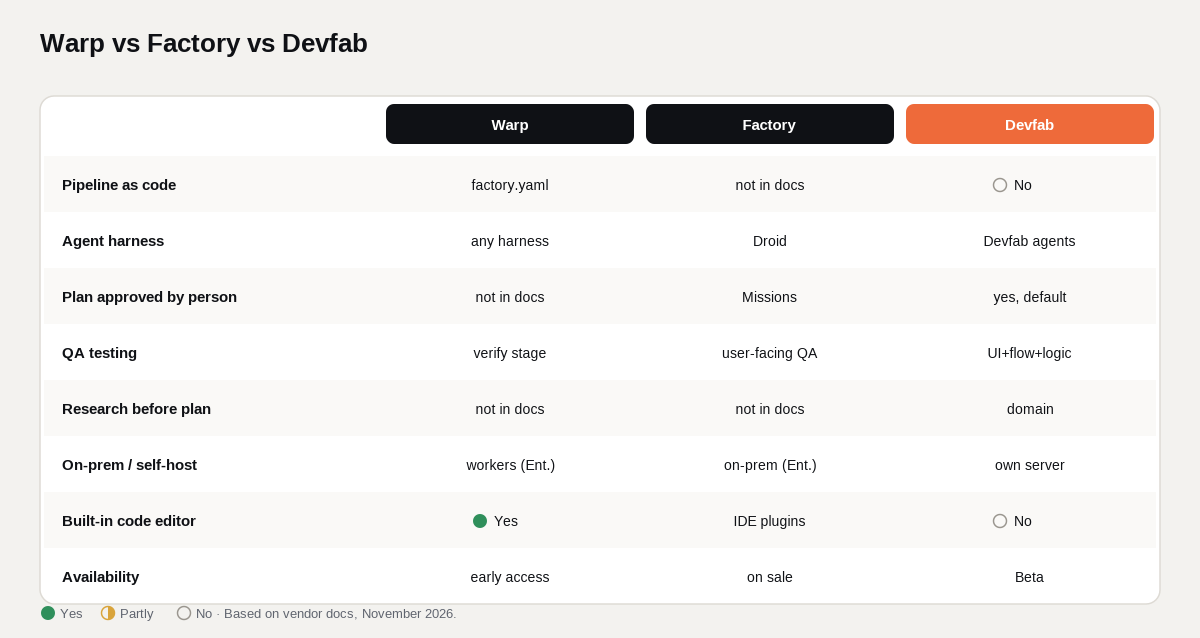
| Aspect | Warp | Factory | Source |
|---|---|---|---|
| Where it runs | Warp Terminal with built-in editor, Agent CLI, Factories via web, mobile, terminal or IDE; API, SDK, MCP | Droid CLI, Factory App, IDE integrations, Remote Control on the web; Slack, Linear, Jira, Teams, Google Chat | Warp; Factory docs |
| How a factory is defined | factory.yaml and agent files in your repo, version-controlled | Missions, Automations, autonomy levels and permission rules in Factory's CLI and app | Warp; Factory docs |
| Planning and approval | Spec is a pipeline stage; the foreman splits work | Normal, Spec and Mission modes; a Mission runs only after you approve its plan | Warp; Factory Missions |
| Testing and review | Review and verification stages; evals and scorers compare agent setups | Missions run user-facing QA against your app per feature; PR review; Droid Shield secret detection | Warp article; Factory Missions |
| Agent and model choice | Warp agent, Claude Code or Codex as harness; any model per stage | Droid agent; Router picks a model per task; BYOK | Warp article; Factory |
| Hosting | Warp's cloud, or self-hosted workers and data on Enterprise | SaaS; on-premises, data residency and dedicated compute on Enterprise; air-gapped docs | Warp pricing; Factory pricing |
| Team and admin | SAML SSO and BYO keys on Business; spend controls on Enterprise; SOC 2 | SSO, SAML/SCIM, audit logs and zero data retention on Business | Warp pricing; Factory pricing |
| Availability | Factories in early access | Published plans from Free to Enterprise | Warp article; Factory pricing |
| Pricing model | Separate Terminal and Factories price lists; usage for inference, compute and agents | Individual tiers by usage level; Teams base fee plus seats; Business and Enterprise by quote | Warp pricing; Factory pricing |
Cost model by team size
| Team size | Warp | Factory | Devfab |
|---|---|---|---|
| 1 person | Terminal Free, or Build USD 20 (includes USD 20 of agent usage); Factories pay-as-you-go at 20% above API rates, or Factories Build USD 20 | Free if you bring your own inference; Pro USD 20; Plus USD 100 (about 5x Pro usage); Max USD 200 | Cost logged per task and per project (Beta) |
| 5 people | Terminal Business USD 50 per user (USD 45 annually); Factories Business USD 50 per user | Teams USD 60 a month plus USD 40 per seat, up to 10 seats: USD 260 for five | Cost logged per task and per project (Beta) |
| 25 people | Terminal Business (capped at 25 seats) or Enterprise; Factories Enterprise for self-hosted workers | Business or Enterprise, by quote | Cost logged per task and per project (Beta) |
Prices per month as of November 2026 from Warp pricing and Factory pricing; the five-seat Factory total is our arithmetic. Warp bills factory usage separately for inference, compute and agents. Devfab is in Beta and offers predictable cost: cost is logged after each run, per task and per project.
Where Warp wins
- The factory should live in your repo. A
factory.yamlis versioned and reviewed like any other code. - You already use Claude Code or Codex. Factories can run either as the harness, so you don't re-platform when you change agents.
- You want a model per stage. Pick frontier or open-weight models for triage, spec, implementation and review separately.
- Developers want a better local tool too. Warp Terminal has an open-source client, a built-in editor and an Agent CLI.
- You want to measure agent setups. Evals and scorers compare configurations and track token spend.
Where Factory wins
- You need it in production now. Factory sells published plans from Free to Enterprise today; Warp Factories is in early access.
- Plans need sign-off. A Mission works out a plan of milestones with you and starts only after you approve it.
- Each feature should be tested like a user would. Missions run user-facing QA testing, given a script that starts or mocks your app's dependencies.
- Your network is closed. On-premises, data residency and air-gapped setups are documented, as are self-hosted GitHub Enterprise Server and GitLab.
- Work starts in many chat tools. Slack, Teams, Google Chat, Linear and Jira can all hand work to Droids.
Switching from one to the other
From Factory to Warp. Droid reads AGENTS.md and CLAUDE.md (Factory docs), and Warp uses AGENTS.md as its default rules file (Warp docs), so project guidance carries over. Request early access, write a factory.yaml for one workflow, such as issue triage to pull request, and run it next to your Droid Automations first.
From Warp to Factory. Keep AGENTS.md. Recreate each factory stage as a Mission or Automation, and set autonomy levels and command permissions per team. If you relied on Claude Code or Codex as the harness, plan for Droid as the agent.
Where Devfab fits
Devfab also calls itself a software factory. The honest difference: Warp and Factory serve engineering teams running agents on their repos; Devfab serves delivery teams, such as agencies and internal IT, taking an app from an idea or an existing repo to a tested deploy.
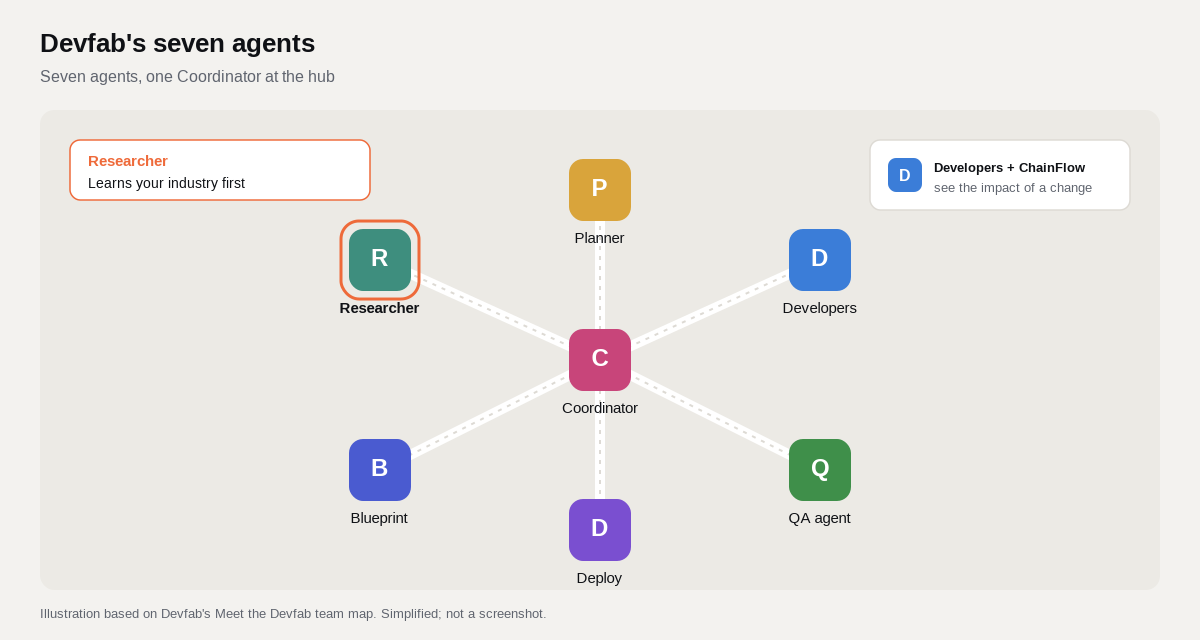
Coding agents automate the developer. Devfab automates the development lifecycle. Before any plan, its Researcher maps the domain: key terms, best practices for that kind of app, and competitors. A person approves the plan by default. ChainFlow maps which functions and APIs call each other, so dev agents see the impact of a change. The QA agent runs UI, flow and logic tests, and Deploy ships to your own server. Cost is logged per task and per project.
Honest limits: Devfab is newer than both, in Beta, with a smaller community and fewer integrations. You can't define its pipeline as code, it is not a terminal or an editor, and it needs a GitHub account. Read Devfab vs Warp and AI software factory vs AI coding tools.
FAQ
Are Warp Factories and Factory the same kind of product?
They overlap. Both run agents across the lifecycle, from triage and spec to review, testing and shipping, and both take work from Slack, Linear, Jira and GitHub. The difference is shape: Warp Factories is defined as code in a factory.yaml and can use Claude Code or Codex as the harness; Factory is a packaged platform built around its own Droid agent.
Is Warp Factories generally available?
Not yet. Warp says Factories is in early access, with sign-up on its site, and some features are labeled beta or Research Preview on the pricing page. Warp's own comparison says Factory has been generally available since mid-2025.
Is Warp just a terminal?
No. Warp's docs describe a built-in code editor with syntax highlighting, tabs, find and replace, Vim keybindings, a file tree and language server support, plus a Code Review panel for diffs. Warp also has an Agent CLI that works in any terminal and, separately, Warp Factories.
Which one can run fully on-premises?
Factory lists on-premises deployment on Enterprise, and its docs cover air-gapped setups. Warp's Enterprise tier lists self-hosted workers and data storage for Factories and your own AI provider. Ask both vendors which parts still run in their cloud.
Read next
Want a factory that starts with research and ends with a deploy to your server? Try Beta
Sources (checked November 13, 2026): Warp homepage; Warp pricing; Warp: Warp Terminal history and Warp Factories; Warp: Warp Factories vs Factory.ai (vendor article, Sep 17, 2026); Warp docs: Code overview; Warp docs: Rules; TechCrunch: Warp's new system is an out-of-the-box software factory (Aug 18, 2026); Factory homepage; Factory pricing; Factory 2.0 announcement (Jun 15, 2026); Factory docs index; Factory docs: Missions; Factory docs: AGENTS.md.
Frequently asked questions
Are Warp Factories and Factory the same kind of product?
They overlap. Both run agents across the lifecycle, from triage and spec to review, testing and shipping, and both take work from Slack, Linear, Jira and GitHub. The difference is shape: Warp Factories is defined as code in a factory.yaml and can use Claude Code or Codex as the harness; Factory is a packaged platform built around its own Droid agent.
Is Warp Factories generally available?
Not yet. Warp says Factories is in early access, with sign-up on its site, and some features are labeled beta or Research Preview on the pricing page. Warp's own comparison says Factory has been generally available since mid-2025.
Is Warp just a terminal?
No. Warp's docs describe a built-in code editor with syntax highlighting, tabs, find and replace, Vim keybindings, a file tree and language server support, plus a Code Review panel for diffs. Warp also has an Agent CLI that works in any terminal and, separately, Warp Factories.
Which one can run fully on-premises?
Factory lists on-premises deployment on Enterprise, and its docs cover air-gapped setups. Warp's Enterprise tier lists self-hosted workers and data storage for Factories and your own AI provider. Ask both vendors which parts still run in their cloud.