Short answer: Choose Warp if you want an open-source AI terminal and, through Warp Factories, a pipeline of agents for triage, spec, implementation and review that can use Claude Code or Codex and run in your own VPC. Choose Cursor if your developers want an AI editor where planning, coding, cloud agents and pull request review sit in one product.
The old question was terminal or editor. That one was easy: most developers used both. In 2026 the question changed. Warp launched Warp Factories, which runs teams of agents through a pipeline. Cursor runs cloud agents from its editor, one agent per VM. Now you are choosing how background work gets done, not where you type. This page compares both, with sources checked on November 13, 2026.
In this comparison:
- Warp and Cursor at a glance
- Feature comparison
- Cost model by team size
- Where Warp wins and where Cursor wins
- Where Devfab fits
Here's how each one compares.
Warp and Cursor at a glance
Status changes. Warp open-sourced its Terminal client under AGPL in April 2026. On August 18, 2026, it launched Warp Factories as a new product next to the Terminal, not a rename. Factories is in early access. Cursor's parent, Anysphere, was acquired by SpaceX; Cursor's August 14 post says the deal has closed.
Warp has three parts. The Warp Terminal is an open-source terminal built for AI-assisted development; its docs also list a built-in code editor, file tree and Code Review panel. The Agent CLI works in any terminal on Mac, Linux and Windows. Warp Factories is a control plane for fleets of coding agents. A "foreman" agent splits work across triage, spec, implementation and review subagents. Work enters from GitHub, GitLab, Linear, Jira, Slack or Teams. Factories include evals and scorers, so managers can compare agent setups and track token spend. Warp's CEO says the main market is smaller companies that cannot build such a system themselves.
Cursor is an AI editor and coding agent, also available as a CLI and SDKs. Plan Mode drafts an editable plan before code. Cloud agents run in isolated VMs, each on its own branch, and can start from Slack, GitHub, Linear or the API. Bugbot reviews pull requests.
A note on sources. Warp has published its own article comparing Factories with Cursor cloud agents. It is useful, but it is a vendor page. We used it only for what Warp says about Warp.
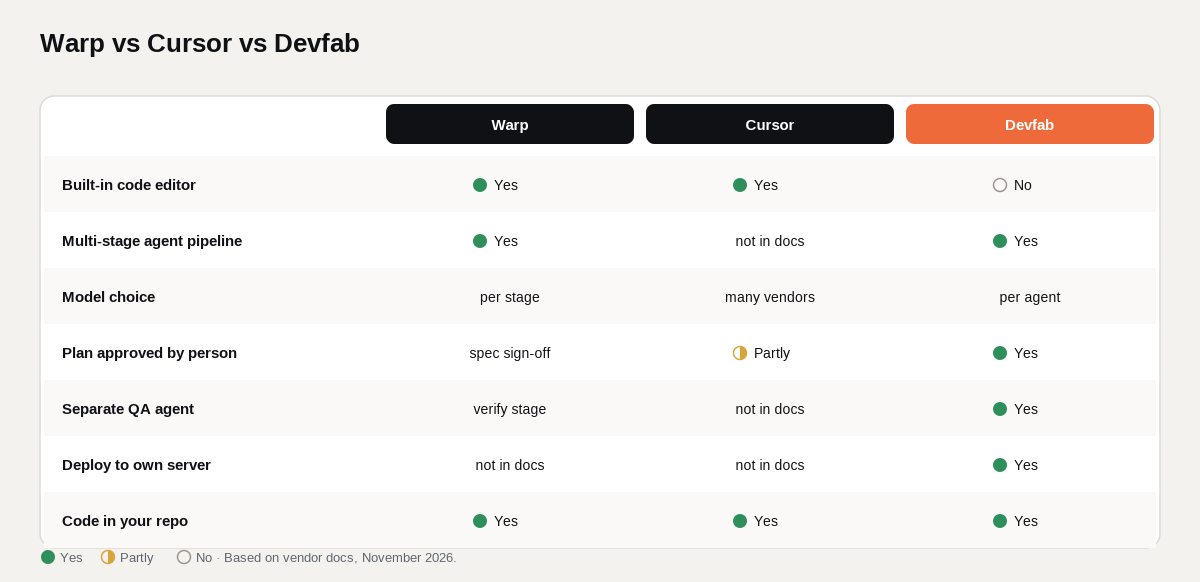
Feature comparison
| Aspect | Warp | Cursor | Source |
|---|---|---|---|
| Where it runs | Warp Terminal, Agent CLI in any terminal, Factories via web, mobile, terminal or IDE; API, SDK, MCP | Desktop editor, CLI, cloud agents, mobile, SDKs | Warp; Cursor docs |
| Planning and spec | Spec is a pipeline stage; the foreman splits work across subagents | Plan Mode with clarifying questions and an editable plan | Warp article; Cursor Plan Mode |
| Agent autonomy | Factories triggered by issues, Slack messages or schedules; any stage can be automated | Parallel cloud agents, one branch each | TechCrunch; Cursor cloud agents |
| Testing and review | Review and verification stages; evals and scorers | Bugbot PR review; Autofix | TechCrunch; Bugbot |
| Hosting | Warp's cloud or self-hosted in your VPC (Enterprise) | Cursor's cloud; Self-Hosted Machines for agent tools | Warp pricing; Cursor cloud agents |
| Open source | Terminal client open source under AGPL | Not covered in the docs we checked | Warp article |
| Team and admin | SAML SSO, usage metrics, BYO API keys on Business; spend controls on Enterprise; SOC 2 | SSO on Teams; SCIM, audit logs on Enterprise | Warp pricing; Cursor Enterprise |
| Model choice | Warp agent, Claude Code or Codex harnesses; frontier or open-weight model per stage | Claude, Gemini, GPT, Grok, Composer | Warp article; Cursor docs |
| Pricing model | Separate price lists for Terminal and Factories; usage billed for inference, compute and agents | Tiers with a usage pool; Teams per seat; Enterprise custom | Warp pricing; Cursor pricing |
Cost model by team size
| Team size | Warp | Cursor | Devfab |
|---|---|---|---|
| 1 person | Terminal Free, or Build and Max tiers with agent usage at API rates; Factories pay-as-you-go with no monthly fee | Free tier, or an individual tier with a usage pool | Cost logged per task and per project (Beta) |
| 5 people | Terminal Business per seat with SSO; Factories Build or per-user Business | Teams, per seat, with SSO | Cost logged per task and per project (Beta) |
| 25 people | Business or Enterprise (self-hosted workers, spend controls, Analytics API) | Teams or custom Enterprise with group spend limits | Cost logged per task and per project (Beta) |
Pricing models as of November 13, 2026, from Warp's pricing page and Cursor's pricing page. Warp's pay-as-you-go Factories usage is billed above API rates, so heavy use can favor a plan.
Where Warp wins
- Multi-stage pipelines. Triage, spec, implementation, review and verification can each be automated, with a foreman agent splitting the work.
- Keep your current agent. Factories can run Claude Code or Codex as harnesses, so teams do not have to switch agents.
- Self-hosted workers. Enterprise lists self-hosted workers and data for Factories in your own VPC.
- Factory as code. Pipelines live in a version-controlled
factory.yaml. - Open-source terminal. The Terminal client is AGPL-licensed and inspectable.
Where Cursor wins
- Editing code by hand. Cursor is an editor first. Warp's docs list a built-in code editor, file tree and LSP support, but its center is the terminal and agents.
- A shipping product today. Cursor's cloud agents come with Premium and higher plans; Warp Factories is in early access, with some features labeled research preview or beta.
- Pull request review. Bugbot flags bugs and security issues, and Autofix pushes fixes.
- Git host coverage. Cloud agents support GitHub, GitLab, Bitbucket and Azure DevOps.
Switching from one to the other
Both tools work on your own repositories. Most of the work is rules and pipelines.
- Use AGENTS.md for rules. Warp's project rules default to AGENTS.md (WARP.md still works). Cursor reads AGENTS.md in the root and subdirectories.
- Link existing rule files. Warp's
/initcommand can link an existing file such as CLAUDE.md or.cursorrulesto AGENTS.md. Cursor's own rules live in.cursor/rulesas.mdcfiles. - Map your pipeline. Moving to Factories means writing a
factory.yamland choosing a harness and model per stage. Sign up for early access at warp.dev/factories. - Run both on one ticket and compare the pull requests and spend.
Where Devfab fits
Warp Factories also calls itself a software factory. It is built for engineering teams that want to design their own agent pipeline as code. Devfab takes a different route: a fixed, approved lifecycle for teams delivering whole apps, often for clients who never see the code.
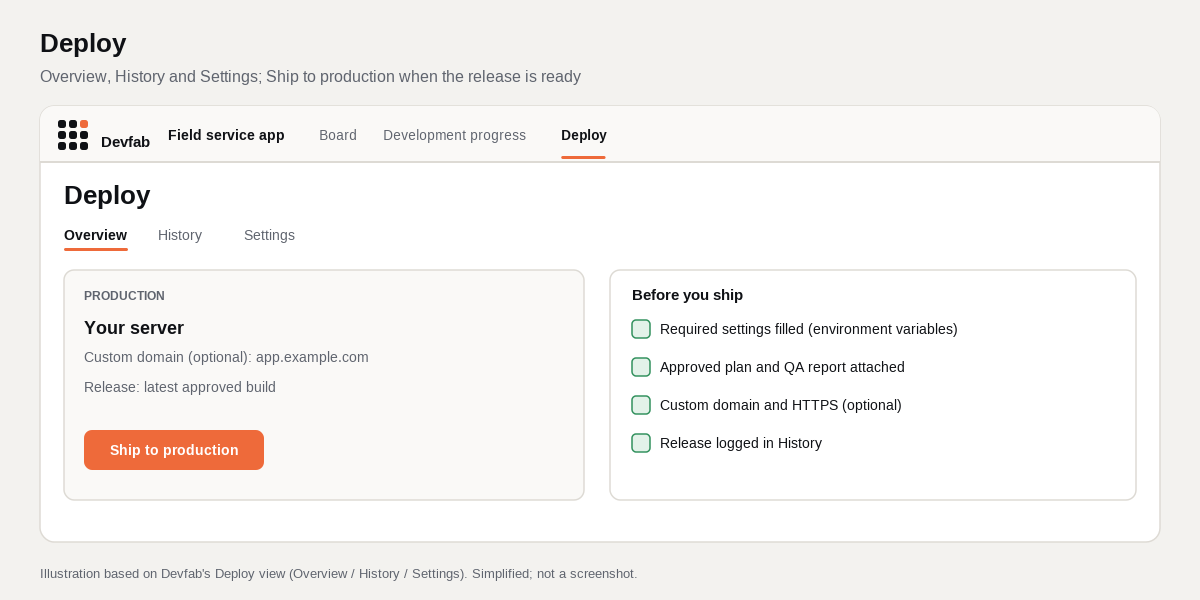
Coding agents automate the developer. Devfab automates the development lifecycle. Devfab researches the domain before planning, and a person approves the plan. The QA agent runs UI and flow tests that click through screens and journeys, plus logic tests. Then Deploy ships to production on your own server, with an optional custom domain, deploy history and settings.
Honest limits: Devfab is new and in Beta, with a smaller community and fewer integrations than Warp or Cursor. It is not an editor or a terminal, and it needs a GitHub account. See Devfab vs Warp and Devfab vs Cursor.
FAQ
What is Warp Factories?
Warp Factories, launched on August 18, 2026, is a hosted control plane that runs coding agents across triage, specification, implementation, review and verification. Factories are defined as version-controlled code in a factory.yaml file. It is a separate product next to the Warp Terminal and is in early access.
Can Warp Factories use Claude Code or Codex?
Yes. Warp says Factories works with its own agent, Claude Code and Codex as harnesses, including open-weight models, and you can choose a model per pipeline stage. The Cursor docs we checked do not list other harnesses for its cloud agents.
Is Warp open source?
The Warp Terminal client was open-sourced in April 2026 under the AGPL license. Warp's article does not say whether Warp Factories is open source. Cursor is a commercial product.
Should I replace my editor with Warp?
It depends on how you work. Warp's docs list a built-in code editor, a file tree, LSP support and a Code Review panel, but Warp is built around the terminal and agents. Developers who edit by hand all day often keep a dedicated editor such as Cursor next to Warp. The bigger choice is whether Warp Factories or Cursor's cloud agents run your background work.
Read next
- What is an AI software factory?
- AI software factory vs AI coding tools: what's the difference?
- Warp alternatives for teams that ship to production (2026)
- Devfab vs Warp: which fits a team that ships client work?
- Devfab vs Cursor: which fits a team that ships client work?
Want a factory that ends with a deploy to your own server? Try Devfab Beta
Sources (checked November 13, 2026): TechCrunch: Warp's new system is an out-of-the-box software factory (Aug 18, 2026); Warp: Warp Terminal history and Warp Factories; Warp: Warp vs Cursor Cloud Agents (vendor article, Aug 19, 2026); Warp homepage; Warp Pricing; Warp Docs: Rules; Warp Docs: Coding in Warp; Cursor Docs; Cursor Plan Mode; Cursor Cloud Agents; Cursor Bugbot; Cursor Enterprise; Cursor Rules; Cursor Pricing; Cursor: Joining SpaceX.
Frequently asked questions
What is Warp Factories?
Warp Factories, launched on August 18, 2026, is a hosted control plane that runs coding agents across triage, specification, implementation, review and verification. Factories are defined as version-controlled code in a factory.yaml file. It is a separate product next to the Warp Terminal and is in early access.
Can Warp Factories use Claude Code or Codex?
Yes. Warp says Factories works with its own agent, Claude Code and Codex as harnesses, including open-weight models, and you can choose a model per pipeline stage. The Cursor docs we checked do not list other harnesses for its cloud agents.
Is Warp open source?
The Warp Terminal client was open-sourced in April 2026 under the AGPL license. Warp's article does not say whether Warp Factories is open source. Cursor is a commercial product.
Should I replace my editor with Warp?
It depends on how you work. Warp's docs list a built-in code editor, a file tree, LSP support and a Code Review panel, but Warp is built around the terminal and agents. Developers who edit by hand all day often keep a dedicated editor such as Cursor next to Warp. The bigger choice is whether Warp Factories or Cursor's cloud agents run your background work.