Short answer: If you are replacing Warp's terminal agent, choose Claude Code for a polished agent or OpenCode for a free, open-source one. If you are replacing Warp Factories, choose Factory for enterprise agent fleets, Devfab for a ready-made lifecycle with plan approval, UI tests and deploy, or OpenHands to self-host.
"Warp" now means two different products. One is an AI terminal you type in every day. The other, since August 2026, is a factory that runs fleets of agents from a YAML file. People searching for alternatives usually want to replace one, not both. Mixing them up leads to the wrong shortlist. So this page splits the field in two.
In this guide, you'll learn:
- Why teams leave Warp, terminal and Factories
- The quick comparison across both halves
- Where Warp is still the better choice
- How to choose once you know which Warp you're replacing
Here's how each one compares.
Why teams leave Warp
What Warp is in November 2026. The Warp Terminal is an AI terminal, and its client was open-sourced in April 2026 under the AGPL. An Agent CLI works in any terminal on Mac, Linux and Windows (Warp). On August 18, 2026 Warp launched Warp Factories as a separate product (TechCrunch). A factory is version-controlled code (factory.yaml) triggered by issues, Slack messages or schedules. A "foreman" agent splits work across triage, spec, implementation and review subagents. Work can come from GitHub, GitLab, Linear, Jira, Slack or Teams, and harnesses include Warp's own agent, Claude Code and Codex (Warp article). Compute runs on Warp's cloud or self-hosted in your VPC.
Switching triggers, as documented:
- Factories is early access. Sign-up is through warp.dev/factories, and some features are labeled Research Preview (cross-harness agent memory) or beta (cloud use of any harness) (Warp pricing).
- Two price lists to manage. Terminal has Free, Build and Max individual tiers that bill agent usage at API rates, plus per-seat Business. Factories has pay-as-you-go (no monthly fee, usage billed above API rates), Build, per-user Business and Enterprise, with inference, compute and agent usage billed separately.
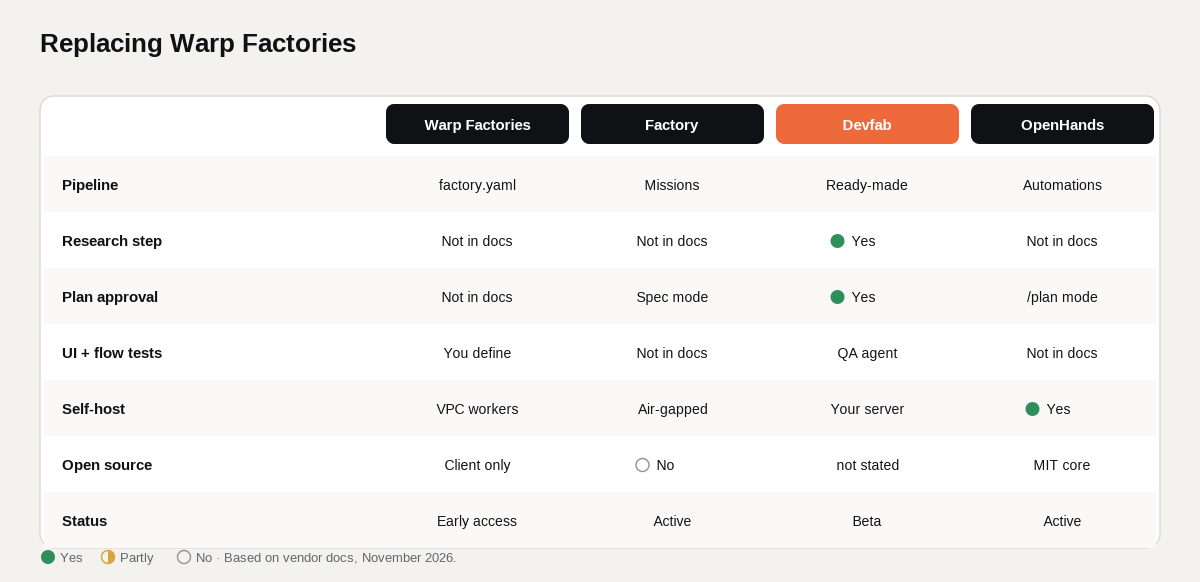
- You build the factory. Warp's model is factory-as-code. That suits platform teams. Smaller teams may want the stages pre-built.
- License fit. The open-source client is AGPL. Some legal teams prefer MIT or Apache-2.0 tools.
- Expectations. CEO Zach Lloyd told TechCrunch that Factories does not replace engineers and that many tasks still need a human.
Quick comparison
| Tool | Replaces which Warp | What it is | Open source | Pricing model |
|---|---|---|---|---|
| Warp (baseline) | Both | AI terminal + Agent CLI; Factories | Terminal client (AGPL) | Two lists: Terminal and Factories |
| Claude Code | Terminal agent | Agentic coding tool | No | Paid Claude plans or API |
| OpenCode | Terminal agent | Terminal UI, desktop and mobile agent | Yes (MIT) | Free; BYOK or subscriptions |
| OpenAI Codex | Terminal agent | CLI, IDE, cloud tasks | CLI yes (Apache-2.0) | Included in ChatGPT plans |
| Factory | Factories | Enterprise agents, Missions | No | Usage tiers; Teams; Enterprise |
| Devfab | Factories | AI software factory, ready-made stages | No | Cost logged per task and per project (Beta) |
| OpenHands | Factories (self-hosted) | Agent platform, Agent Canvas | Yes (MIT core) | Free to self-host; Teams plan |
The alternatives
1. Claude Code
Verdict: the best replacement for Warp's terminal agent if you want depth over model choice. Best for: developers who live in the terminal and script their agents. Trade-off: Claude models only; it is not a terminal emulator, so you keep your own. Pricing: included in paid Claude plans or billed per token through the API (Claude pricing).
- Runs in the terminal, VS Code, JetBrains, a desktop app, the web and mobile (Claude Code overview).
- Subagents, background agents and cloud scheduled tasks handle parallel and recurring work.
- Warp Factories can already use Claude Code as a harness, so you can keep it if you move off Warp later.
2. OpenCode
Verdict: the best free, open-source swap for Warp's agent. Best for: developers who want any model and an MIT license. Trade-off: a 2026 review notes heavy memory use, frequent releases that sometimes break features and immature enterprise compliance (rywalker.com). Pricing: free agent; free models, your own keys, or existing ChatGPT or GitHub Copilot subscriptions (OpenCode).
- Terminal UI, desktop app and mobile client, with 200+ providers through Models.dev, including local models.
- Built-in "build" and read-only "plan" agents (GitHub).
- MIT license with 225.7k GitHub stars.
3. OpenAI Codex
Verdict: the pick for ChatGPT teams that want terminal and cloud in one plan. Best for: delegating parallel, well-defined tasks. Trade-off: OpenAI models only. Pricing: included in ChatGPT plans, with credits beyond limits (Codex pricing).
- The Codex CLI is open source under Apache-2.0 and installs via npm, Homebrew or binaries (GitHub).
- Cloud tasks keep running after you close your laptop (OpenAI Codex).
- Codex is one of the harnesses Warp Factories supports.
4. Factory
Verdict: the closest match to Warp Factories for large engineering organizations. Best for: enterprises that need on-prem or air-gapped agents. Trade-off: its pricing page gives usage multiples, not credit amounts (Factory pricing). Pricing: free tier with your own inference; usage-based individual tiers; Teams; Business and Enterprise via sales.
- Factory 2.0 (June 15, 2026) repositioned it as a software factory, with Missions, Automations and a model Router (Factory).
- Modes include Normal, Spec and Mission, with autonomy levels and rules to allow, require approval for or block shell commands (Factory docs).
- Droid CLI runs headless in CI with
droid exec.
5. Devfab
Verdict: the pick if you want a factory without writing one. Best for: agencies and product teams delivering whole apps. Trade-off: new and in Beta; you don't swap harnesses per stage the way Warp allows. Pricing: predictable cost: cost is logged after each run, per task and per project.
See Where Devfab fits and the full Devfab vs Warp comparison.
6. OpenHands
Verdict: the self-hosted, open-source way to orchestrate several agent harnesses. Best for: platform teams that must run everything in their own VPC. Trade-off: you run and govern the models, keys and sandboxes yourself. Pricing: free to self-host; Teams plan at USD 500 per month for up to 10 users, as of November 2026; Enterprise custom (OpenHands pricing).
- Agent Canvas (June 16, 2026) runs third-party harnesses such as Claude Code and Codex through the Agent Client Protocol (OpenHands blog).
- Scheduled and event-triggered automations cover PR reviews, issue triage and issue-to-PR, and
/planand/codemodes arrived in September 2026 (OpenHands blog). - MIT license; backends include Docker, Kubernetes and enterprise VPCs.
Where Devfab fits
Warp Factories gives you the parts to build a pipeline. Devfab is the pipeline, already assembled. Coding agents automate the developer. Devfab automates the development lifecycle.
- Research before the plan. Warp's stages start at triage and spec. Devfab's research step first maps the domain: key terms, best practices for that kind of app, and competitors. Then it suggests a prototype.
- A plan a person approves. "Your turn: the Planner published the plan. Approve it so the Coordinator can create the tickets." The Coordinator then assigns developer agents.
- ChainFlow. Devfab maps which functions and APIs call each other and what is deployed, so developer agents see the impact of a change. A checkout change can affect payments, inventory, order confirmation and notifications.
- QA agent. Warp's verification stage is yours to define. Devfab's QA agent runs UI and flow tests (screens, buttons and user journeys clicked end to end) plus logic tests.
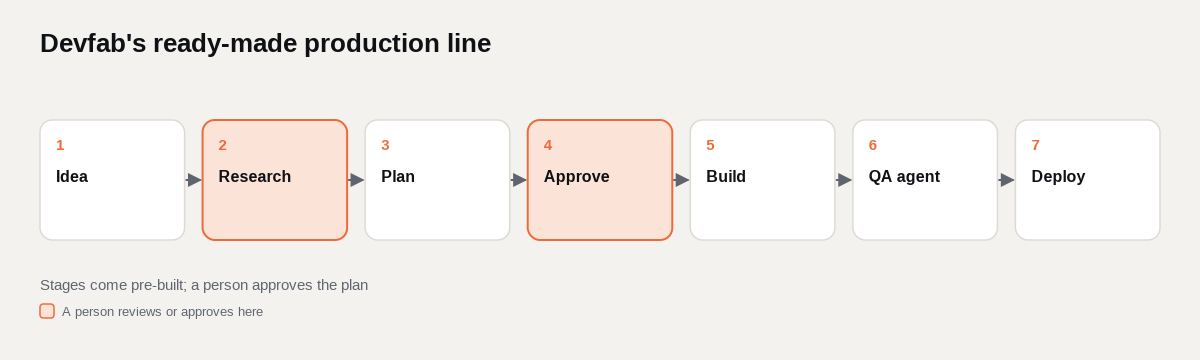
Then Deploy ships to your own server. Code stays in your own GitHub account (or your organization's). You can choose the model for each agent or keep Devfab's default. Cost is predictable: it's logged after each run, per task and per project.
Devfab's honest limits:
- It's new and in Beta, with a much smaller community than Warp.
- It has fewer integrations; Warp takes work from GitHub, GitLab, Linear, Jira, Slack and Teams.
- It isn't a terminal or an editor for hands-on coding. Keep your terminal.
- It needs a GitHub account.
Where Warp is still the better choice
- You want a better terminal, not a pipeline. Warp is a terminal first, with an agent built in.
- You already use Claude Code or Codex. Factories keeps those harnesses and adds orchestration.
- Self-hosted workers in your VPC with your own model provider. Enterprise lists self-hosted workers and data.
- You want to inspect the client. The Terminal client is open source under the AGPL.
- Factory-as-code. Platform teams that want pipelines in version control, with evals and per-stage model choice, get exactly that.
How to choose
- Replacing the terminal agent, want the strongest agent? Claude Code.
- Replacing the terminal agent, want free and open source? OpenCode, or the Codex CLI if you're on ChatGPT.
- Replacing Factories at enterprise scale? Factory.
- Replacing Factories, need full self-hosting? OpenHands.
- Want a factory without building one, with research, an approved plan, UI and flow tests and deploy to your own server? Devfab.
Still deciding between an editor and a terminal? Read AI IDE vs CLI coding agent.
FAQ
What is Warp Factories?
Warp Factories launched on August 18, 2026 as a new product next to the Warp Terminal. It runs fleets of coding agents across triage, spec, implementation, review and verification, defined in a version-controlled factory.yaml file. It is in early access.
Is Warp open source?
The Warp Terminal client was open-sourced in April 2026 under the AGPL license. Warp's own article does not say whether Factories is open source.
What is the best open-source alternative to Warp's AI agent?
OpenCode is a strong pick: an MIT-licensed agent with a terminal UI, desktop app and 200+ model providers. OpenAI's Codex CLI is also open source, under Apache-2.0. For orchestration you can self-host, OpenHands has an MIT-licensed core.
How is Devfab different from Warp Factories?
With Warp Factories you define the pipeline as code and choose the harness for each stage. Devfab ships the pipeline ready to use: research, a plan a person approves, developer agents with ChainFlow, a QA agent running UI, flow and logic tests, and deploy to your own server. Devfab is in Beta.
Read next
Want the factory without writing the YAML? Try the Devfab Beta
Sources (checked November 13, 2026): Warp homepage; Warp pricing; Warp: Terminal history and Warp Factories; TechCrunch: Warp's software factory (Aug 18, 2026); Claude Code overview; Claude pricing; OpenCode; anomalyco/opencode on GitHub; rywalker.com: OpenCode research note (Jun 2026); openai/codex on GitHub; OpenAI Codex; Codex pricing; Factory: The software factory; Factory pricing; Factory docs; OpenHands pricing; OpenHands: Introducing Agent Canvas; OpenHands: New in September 2026; OpenHands homepage.
Frequently asked questions
What is Warp Factories?
Warp Factories launched on August 18, 2026 as a new product next to the Warp Terminal. It runs fleets of coding agents across triage, spec, implementation, review and verification, defined in a version-controlled factory.yaml file. It is in early access.
Is Warp open source?
The Warp Terminal client was open-sourced in April 2026 under the AGPL license. Warp's own article does not say whether Factories is open source.
What is the best open-source alternative to Warp's AI agent?
OpenCode is a strong pick: an MIT-licensed agent with a terminal UI, desktop app and 200+ model providers. OpenAI's Codex CLI is also open source, under Apache-2.0. For orchestration you can self-host, OpenHands has an MIT-licensed core.
How is Devfab different from Warp Factories?
With Warp Factories you define the pipeline as code and choose the harness for each stage. Devfab ships the pipeline ready to use: research, a plan a person approves, developer agents with ChainFlow, a QA agent running UI, flow and logic tests, and deploy to your own server. Devfab is in Beta.