Short answer: Cline wins for any new or ongoing work, because Roo Code, which began as a fork of Cline, shut down on May 15, 2026 and its repo is archived. Roo Code wins only for a team frozen on its last release, using custom modes it built, while it plans a move to Cline, Zoo Code or Kilo Code.
You picked Roo Code because it gave you more modes than Cline. Architect for planning, Debug for bugs, custom modes for everything else. Then, in April 2026, the team announced the shutdown.
So the old debate, the original or the fork, has a new frame. One tool keeps shipping. The other is a read-only repo. This page is the referee for teams deciding where to go next, using sources checked in November 2026.
In this comparison:
- Cline and Roo Code at a glance
- Feature comparison
- Where Cline wins
- Where Roo Code wins
- Switching from one to the other
The status section comes first because it changes the answer.
Cline and Roo Code at a glance
Roo Code is discontinued. Its README says "The Roo Code Extension was shut down on May 15th," and the GitHub repo is archived and read-only (GitHub). The shutdown was announced on April 21, 2026, when Roo had reached 3 million installs; the team is focusing on Roomote, its cloud agent (Kilo blog, Apr 21, 2026). As of May 2026, Roomote had no public release, per a competitor page (kilo.ai).
Roo Code was an open-source VS Code agent, forked from Cline, with Code, Architect, Ask, Debug and custom modes (GitHub). It was Apache-2.0 and the archived repo shows 24.3k stars (same source). The extension stays on the VS Code Marketplace in its final state (kilo.ai), but it gets no fixes for new VS Code versions, new model APIs or security issues (Morph, Oct 2026). The README itself recommends Zoo Code, a community fork, and Cline (GitHub).
Cline is active. It is an open-source agent for VS Code, JetBrains, the terminal and desktop, and every action needs your approval (Cline docs). Its blog has posts through November 19, 2026, including a new harness rolled out to all users in August (Cline blog archive). That harness migration deprecated "some less-used features" (Cline blog, Sep 2026).
Feature comparison
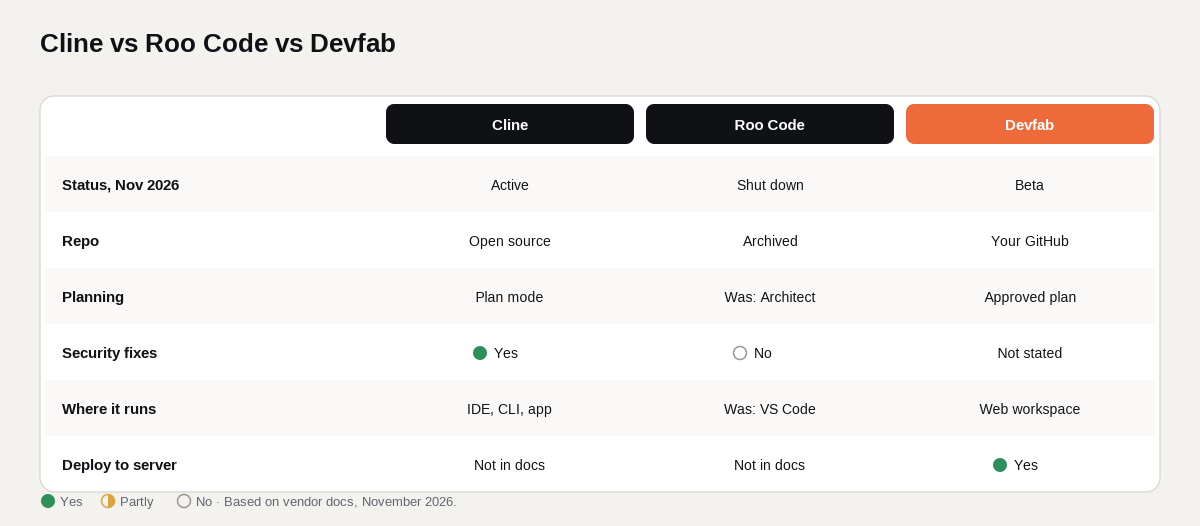
| Aspect | Cline | Roo Code | Source |
|---|---|---|---|
| Status, November 2026 | Active | Shut down May 15, 2026; repo archived | Cline blog; GitHub |
| Where it runs | VS Code, JetBrains, CLI, desktop, SDK, Kanban | Was: VS Code extension only | Cline docs; GitHub |
| Planning | Plan mode and Act mode, /deep-planning, Checkpoints | Was: Architect mode for planning, specs and migrations | Plan & Act; GitHub |
| Modes | Plan and Act, with a different model per mode | Was: Code, Architect, Ask, Debug, custom modes | Plan & Act; GitHub |
| Agent autonomy | Approves every action; Kanban runs agents in parallel | Not covered in the pages we checked | Cline docs |
| Deploy and hosting | Not covered in the docs we checked | Not covered in the pages we checked | — |
| Maintenance | Releases through 2026 | No fixes for new VS Code versions, model APIs or security issues | Cline blog; Morph |
| Team and admin | Enterprise: SSO, RBAC, SLA, central billing | Not applicable | Cline pricing |
| Model choice | Cline billing, ClinePass, or your own key incl. local runtimes | Not applicable for new setups | Cline docs |
| Pricing model | Free; pay inference; Enterprise custom | Not applicable; billing questions go to Roo's billing email | Cline pricing; GitHub |
Cost model by team size
| Team size | Cline | Roo Code |
|---|---|---|
| 1 person | Free extension; pay inference through Cline billing, ClinePass or your own key | Not sold; the last release is free but unmaintained |
| 5 people | Same per developer; no seat fee in the docs we checked | Not sold |
| 25 people | Enterprise, custom pricing (SSO, RBAC, SLA, central billing) | Not sold |
As of November 2026, Cline's pricing page lists Free (inference billed separately) and custom Enterprise, with no plan prices. Roo Code has no paid product.
Where Cline wins
- You need a maintained tool. Cline shipped steadily through 2026; Roo gets no further fixes.
- You want the agent beyond VS Code: JetBrains, a CLI that runs headless in CI, and a desktop app (Cline docs).
- You want a planning step with rollback. Plan mode discusses without edits, and Checkpoints undo work (Plan & Act).
- Security reviews matter. A tool with no security fixes is hard to approve for client repos.
- The vendor endorses it. Roo's own README lists Cline as a recommended path.
Where Roo Code wins
- You built many custom modes and need time to rebuild them; the last release still installs from the Marketplace.
- You want the Roo mode set (Code, Architect, Ask, Debug) and prefer a community fork, Zoo Code, that keeps it going.
- You plan to fork and maintain the Apache-2.0 code yourself.
For most teams, these are reasons to plan a careful exit, not reasons to stay.
Switching from one to the other
From Roo Code to Cline. Both run in your own repo, so code stays where it is. Install Cline, connect a model route, and recreate your Architect habits with Plan mode, where you can set a different model than in Act mode (Plan & Act). Custom Roo modes don't map one to one in the docs we checked; list what each did and rebuild the important ones as instructions. If you want to keep Roo's mode set, look at Zoo Code, or Kilo Code, which published a Roo-to-Kilo migration guide (Kilo blog).
From Cline to Roo Code. Not advised for new work, since the extension is shut down.
Where Devfab fits
Roo Code's shutdown is a reminder that one editor tool is a single point of failure. Neither Cline nor Roo Code, in the pages we checked, covers research before planning, QA on user flows or deployment.
Coding agents automate the developer. Devfab automates the development lifecycle. Devfab keeps the code in your own GitHub account and deploys to your own server, so the app does not depend on any one agent. On an existing repo, leave the change box empty and ChainFlow maps the code first, then suggests three small first tickets. A person approves the plan, and the QA agent runs UI, flow and logic tests.
Devfab is in Beta, with a smaller community and fewer integrations, and it is not an editor. See Devfab vs Cline.
FAQ
Is Roo Code shut down?
Yes. Roo Code's README says the extension was shut down on May 15, 2026, and the GitHub repo is archived and read-only. The shutdown was announced on April 21, 2026, so the team could focus on a cloud agent called Roomote.
Can I keep using Roo Code?
The extension stays on the VS Code Marketplace in its final state, so it may still install. It gets no fixes for new VS Code versions, new model APIs or security issues. For client or production work, that is a real risk.
What does Roo Code recommend instead?
The archived README recommends Zoo Code, a community fork by former Roo contributors, and Cline. Kilo Code, which also began as a Roo fork, published a Roo-to-Kilo migration guide.
Is Roomote a replacement for Roo Code?
Not yet. As of May 2026, Roomote was in early development with no public release, according to a competitor page. Check Roo's own channels before you plan around it.
Read next
- What is an AI software factory?
- Roo Code alternatives for teams that ship to production (2026)
- Kilo Code vs Roo Code: which should your team pick?
Don't tie your app to one editor tool. Try a factory that keeps code in your GitHub. Try Beta
Sources (checked November 2026): RooCodeInc/Roo-Code on GitHub (archived); Thank you, Roo (Kilo blog, Apr 21, 2026); Roo Code shutdown and Roomote (kilo.ai); Roo Code (2026): Shut Down May 15 (Morph, Oct 25, 2026); Cline docs overview; Cline Plan & Act; Cline pricing; Cline blog archive; How We Migrated 11 Million Users (Cline blog, Sep 2, 2026).
Frequently asked questions
Is Roo Code shut down?
Yes. Roo Code's README says the extension was shut down on May 15, 2026, and the GitHub repo is archived and read-only. The shutdown was announced on April 21, 2026, so the team could focus on a cloud agent called Roomote.
Can I keep using Roo Code?
The extension stays on the VS Code Marketplace in its final state, so it may still install. It gets no fixes for new VS Code versions, new model APIs or security issues. For client or production work, that is a real risk.
What does Roo Code recommend instead?
The archived README recommends Zoo Code, a community fork by former Roo contributors, and Cline. Kilo Code, which also began as a Roo fork, published a Roo-to-Kilo migration guide.
Is Roomote a replacement for Roo Code?
Not yet. As of May 2026, Roomote was in early development with no public release, according to a competitor page. Check Roo's own channels before you plan around it.