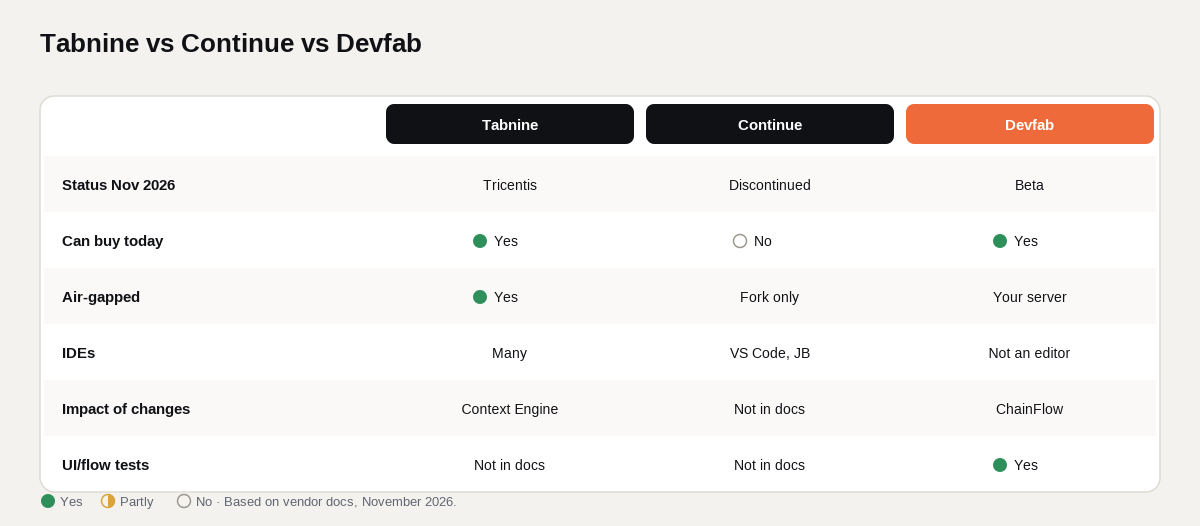
Short answer: Tabnine wins for any team buying today: it is still sold, runs in VS Code, JetBrains, Eclipse and Visual Studio, and deploys on-premises or air-gapped, though Tricentis now owns it. Continue only wins if you will fork its Apache-2.0 code and maintain an assistant yourself, because Cursor bought it and discontinued the product in June 2026.
Last year this was a real debate. Open source and bring-your-own-model on one side, private deployment with a vendor behind it on the other. Many security teams shortlisted both.
Then both companies were bought in the same summer. One product kept selling. The other became a GitHub repository with a goodbye note. If your team still runs either, the question is no longer which is better. It is what you can safely keep running, and what replaces the gap.
In this comparison:
- Tabnine and Continue at a glance
- Feature comparison
- Where Tabnine wins
- Where Continue wins
- Switching from one to the other
The status news is the most useful part, so it comes first.
Tabnine and Continue at a glance
Continue: acquired by Cursor and discontinued. Continue's homepage now says "Continue has joined Cursor" and "Continue was acquired by Cursor" (continue.dev). The New Stack reports the purchase around June 16, 2026, with terms undisclosed. The product was discontinued, recurring billing was disabled, and users had until July 15, 2026 to export data before deletion (The New Stack). A final 2.0.0 release removed telemetry, and the Apache-2.0 code stays public for forking.
Before the shutdown, Continue was an open-source assistant for VS Code and JetBrains, with a CLI (cn) for terminal and CI use and a cloud dashboard called Mission Control. Mission Control ran cloud agents in parallel and ran "AI Checks" on every pull request (Continue blog, Feb 17, 2026). It had about 34,300 GitHub stars at the time of the deal (The New Stack).
Tabnine: acquired by Tricentis, still on sale. Tricentis announced the acquisition on July 30, 2026, with no terms disclosed. Tabnine's Enterprise Context Engine will be built into the Tricentis Agentic Quality Engineering Platform (Tricentis). The stated customer commitment is that existing customers "will continue to receive support for the products they use today." An analyst flags roadmap risk for the standalone assistant, noting Tricentis shut down an earlier acquisition, Flood.io, in 2024 (beri.net, Aug 2026).
Tabnine is a privacy-focused assistant and agent platform for organizations whose IT blocks SaaS AI, such as defense, finance, healthcare and government (DEV Community, Jun 2026).
Feature comparison
| Aspect | Tabnine (Nov 2026) | Continue (before shutdown) | Source |
|---|---|---|---|
| Status | Active; owned by Tricentis | Discontinued; code public under Apache-2.0 | Tricentis; The New Stack |
| Where it runs | VS Code, JetBrains, Android Studio, Eclipse, Visual Studio, Tabnine CLI | VS Code, JetBrains (community-maintained), CLI | DEV review; Continue blog |
| Deployment | SaaS, VPC, on-premises or air-gapped | Local extension; Mission Control in the cloud | SD Times; Continue blog |
| Agents | Agentic tier; agents implement Jira issues and check code against requirements | Cloud agents in parallel via Mission Control | Tabnine pricing; Continue blog |
| Planning | Plan mode in the Tabnine CLI | Not covered in the pages we checked | DEV review |
| Codebase context | Enterprise Context Engine: graph of code, docs, tickets and APIs for impact analysis | Not covered in the pages we checked | SD Times |
| PR checks | Agent output checked against standards | AI Checks posted GitHub status checks with suggested diffs | Tricentis; Continue blog |
| Model choice | Self-managed models (bring your own) on the agentic tier since April 2026 | Open source; you wire your own models in a fork | DEV review |
| Pricing model | Per-user seats billed annually; no prices on the official page | None: billing disabled | Tabnine pricing; The New Stack |
Cost model by team size
| Team size | Tabnine | Continue | Devfab |
|---|---|---|---|
| 1 person | No free tier in a June 2026 review, only a trial; per-seat subscription | No product to buy; a fork costs your time plus model usage | Cost logged per task and per project (Beta) |
| 5 people | Code Assistant or Agentic tier, per seat, billed annually | Same: self-maintained fork | Cost logged per task and per project (Beta) |
| 25 people | Enterprise (custom), including private deployment | Same, plus the work of running it for a whole team | Cost logged per task and per project (Beta) |
Tabnine's pricing page showed no plan prices when we checked in November 2026, so only the model is listed; ask for a quote. Continue's billing was disabled at shutdown (The New Stack). Devfab is in Beta and offers predictable cost: cost is logged after each run, per task and per project.
Where Tabnine wins
- You need a vendor-supported product. Tabnine is still sold and supported; Continue is not.
- No SaaS AI is allowed. VPC, on-premises and fully air-gapped deployment are available.
- Your developers use many IDEs. JetBrains, Eclipse, Visual Studio and Android Studio are covered, not just VS Code.
- You need organization-wide context. The Context Engine maps code, docs, tickets and APIs for dependency and impact analysis.
- You already buy from Tricentis and want coding context next to your testing platform.
Where Continue wins
- You must own every line of the assistant. The Apache-2.0 code is public, and the final release removed telemetry.
- You have engineers to maintain a fork, including the JetBrains plugin, which was already community-maintained in February 2026.
- You want no vendor roadmap risk. A fork can't be acquired again; it changes only when you change it.
Be realistic about the third point: a fork has no roadmap at all unless your team writes one.
Switching from one to the other
From Continue to Tabnine. The export deadline passed on July 15, 2026, so any data left in Continue's cloud is gone. Your code was always in your own repository. Install the Tabnine plugin in each IDE your team uses, or the Tabnine CLI, and ask sales about deployment options and the post-acquisition roadmap before a multi-year contract.
From Tabnine to a Continue fork. Clone the public repository, pin the 2.0.0 release, and decide who reviews upstream changes and security fixes. Budget for the JetBrains plugin separately.
Many former Continue users also moved to Cursor, its buyer, or to other open-source agents; see Continue alternatives.
Where Devfab fits
Say your team maintains a clinic booking app. A coding assistant, forked or bought, helps a developer write the next change. In the pages we checked, neither tool researches the clinic domain before planning, sends a plan for approval, clicks through a patient's booking journey as a test step, or deploys the app.
Coding agents automate the developer. Devfab automates the development lifecycle. The Researcher maps the domain, a person approves the plan, and ChainFlow maps which functions and APIs call each other and what is deployed, so changing appointment slots doesn't break reminders or billing. The QA agent runs UI, flow and logic tests, and Deploy ships to your own server. Devfab is in Beta, has a smaller community and fewer integrations, and is not an in-IDE assistant. See Devfab vs Continue.
FAQ
Is Continue still available?
No. Continue was acquired by Cursor around June 16, 2026, and the product was discontinued. Recurring billing was disabled and users had until July 15, 2026 to export data. The continue.dev homepage now reads 'Continue has joined Cursor'. The Apache-2.0 code remains public for forking.
Will Tabnine keep working after the Tricentis deal?
It is still sold today. Tricentis announced the acquisition on July 30, 2026 and said Tabnine's Enterprise Context Engine will be built into its quality-engineering platform. The only stated commitment is that existing customers will keep getting support for the products they use. No roadmap for the standalone assistant was given.
Can I self-host a Continue fork instead of buying Tabnine?
You can, if your team will maintain it. The final 2.0.0 release removed telemetry, and the Apache-2.0 code is public. You take on updates, security fixes and the JetBrains plugin, which was already community-maintained in February 2026. Tabnine sells on-prem and air-gapped deployment with vendor support.
Which is cheaper?
Continue has no price because it is discontinued; a fork costs only your engineers' time and model usage. Tabnine sells per-user seats billed annually, but its official pricing page showed no plan prices when we checked in November 2026, so you need a quote.
Read next
Looking past the editor to the whole release? Try Beta
Sources (checked November 2026): continue.dev homepage; The New Stack: Cursor acquires Continue (Jun 22, 2026); Continue blog: From Extension to Mission Control (Feb 17, 2026); Tricentis acquires Tabnine (Jul 30, 2026); beri.net: Tricentis bought Tabnine's Context Engine (Aug 2026); SD Times: Tabnine Enterprise Context Engine (Mar 4, 2026); DEV Community: Tabnine review 2026 (Jun 2026); Tabnine pricing.
Frequently asked questions
Is Continue still available?
No. Continue was acquired by Cursor around June 16, 2026, and the product was discontinued. Recurring billing was disabled and users had until July 15, 2026 to export data. The continue.dev homepage now reads 'Continue has joined Cursor'. The Apache-2.0 code remains public for forking.
Will Tabnine keep working after the Tricentis deal?
It is still sold today. Tricentis announced the acquisition on July 30, 2026 and said Tabnine's Enterprise Context Engine will be built into its quality-engineering platform. The only stated commitment is that existing customers will keep getting support for the products they use. No roadmap for the standalone assistant was given.
Can I self-host a Continue fork instead of buying Tabnine?
You can, if your team will maintain it. The final 2.0.0 release removed telemetry, and the Apache-2.0 code is public. You take on updates, security fixes and the JetBrains plugin, which was already community-maintained in February 2026. Tabnine sells on-prem and air-gapped deployment with vendor support.
Which is cheaper?
Continue has no price because it is discontinued; a fork costs only your engineers' time and model usage. Tabnine sells per-user seats billed annually, but its official pricing page showed no plan prices when we checked in November 2026, so you need a quote.