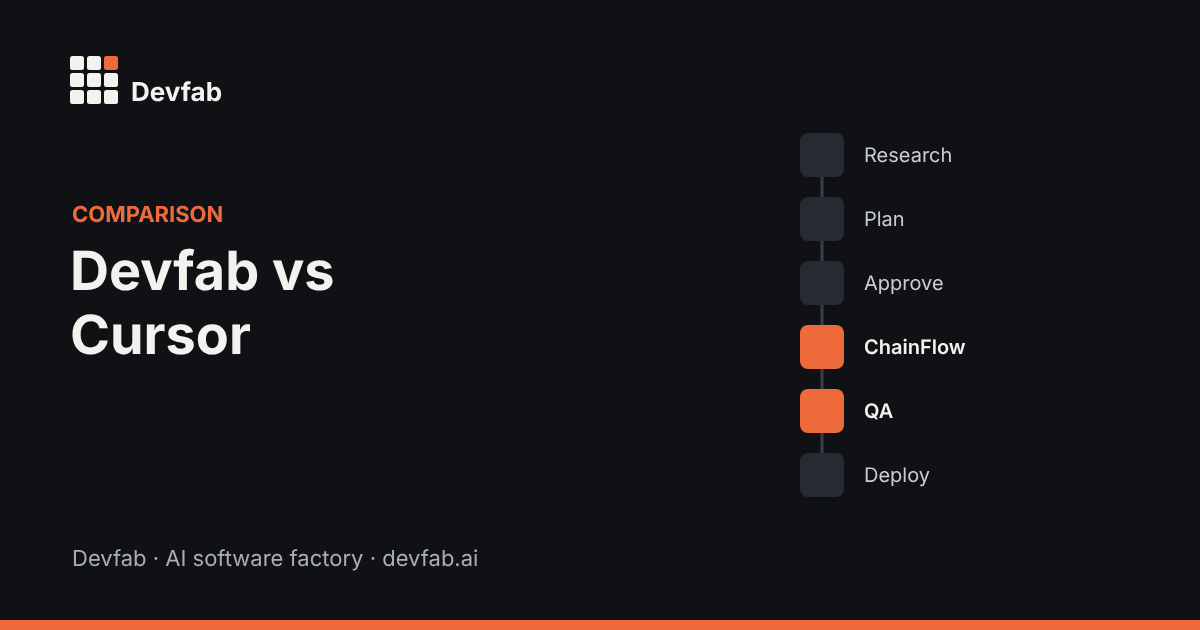
Short answer: Cursor is an AI editor and coding agent: developers plan, write and review code in the editor, the CLI or cloud agents that open pull requests. Devfab is a software factory: it researches the domain, a person approves the plan, agents build and test, and the app deploys to your server. Choose Cursor for hands-on coding; Devfab for repeatable delivery.
Your developers already write code faster with Cursor in the editor. But client projects can still slip at planning, testing and handover. One camp says a better editor is all a team needs. The other says the process around the code needs its own system. This page referees both, using sourced facts and an honest look at each.
In this comparison:
- What each tool is built for
- Same-task test: what each produced
- Comparison table
- When to choose Cursor
- When to choose Devfab
Read it in order, or jump to your use case.
What each tool is built for
Cursor
Cursor describes itself as "a coding agent for building ambitious software". It combines an AI editor with an agent that can understand a codebase, plan and build features, fix bugs and review changes.
A few parts matter most for a team comparison:
- Plan Mode "creates detailed implementation plans before writing any code". The agent asks clarifying questions, researches your codebase and writes a plan you can edit before you click to build.
- Cloud agents each run on a dedicated virtual machine with your repository and dependencies. They can build features, fix bugs and write tests, then open pull requests. Cursor says the agent tests its changes and attaches videos, screenshots and logs to the PR, so you can review without checking out the branch. You can start them from the editor, the web, mobile, or by mentioning @Cursor in Slack, GitHub or Linear.
- Bugbot "reviews pull requests and identifies bugs, security issues, and code quality problems". It uses usage-based billing.
- Customisation through rules, skills, plugins and MCP servers, plus a CLI for the terminal and CI.
Cursor lists models from several providers alongside its own. Pricing combines subscription tiers with an included usage pool, and usage beyond the pool is billed per model by tokens. Teams is priced per seat and adds centralized billing, usage analytics, SSO and a team spending cap.
Cursor also changed owners in 2026: its August 14 blog post says it "has officially been acquired by SpaceX".
Cursor's main user is a developer who wants AI inside the editor.
Devfab
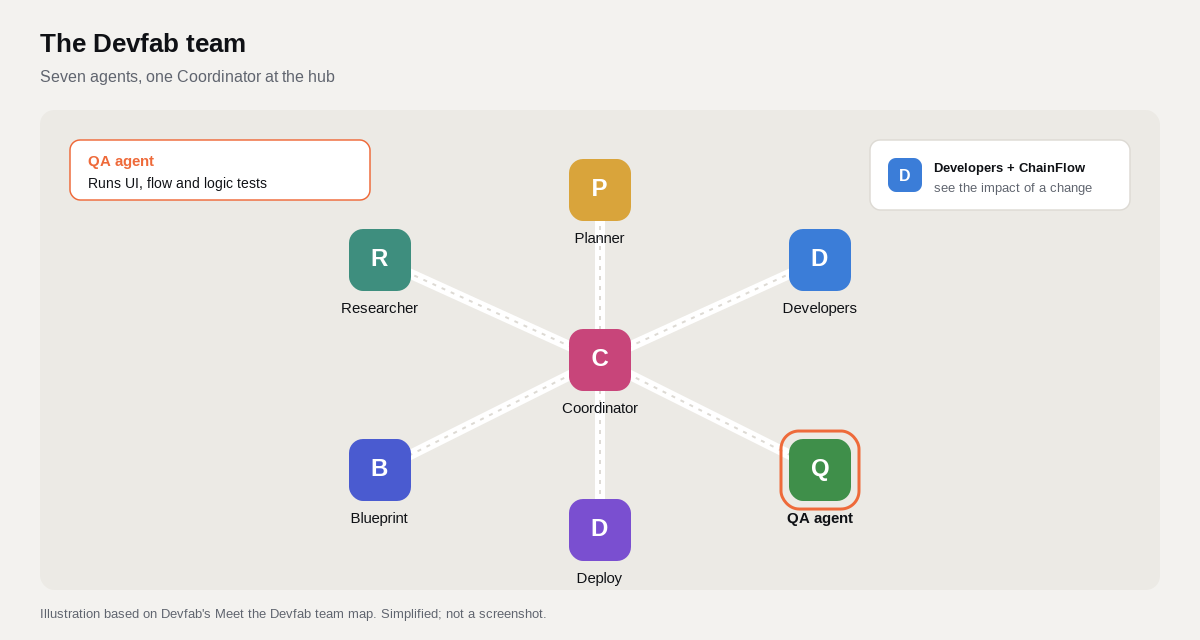
Devfab is an AI software factory. Its unit of work is a project, run by seven agents:
- The Researcher maps the domain first: key terms, best practices for that kind of app and competitors, then suggests a prototype.
- The Planner writes the plan, and a person approves it before the Coordinator creates tickets and assigns dev agents.
- Developers work with ChainFlow, Devfab's code-intelligence layer. It maps which functions and APIs call each other and what is deployed, so a change to checkout doesn't break payments, inventory, order confirmation or notifications.
- Blueprint produces screens, the QA agent runs UI and flow tests plus logic tests, and Deploy ships to production on your own server.
Its main users are teams: product owners, project managers, developers and agency clients.
Coding agents automate the developer. Devfab automates the development lifecycle.
Same-task test: what each produced
Take one client brief, on an existing codebase this time: "Our client already has a client portal for their accounting firm. Add document requests: staff ask a client for a document, the client gets an email, uploads the file, and the request closes."
[TEST DATA TODO: run the same spec through Cursor and Devfab; add what each produced]
With Cursor, a developer opens the repository in the editor and switches to Plan Mode. The agent asks a few questions, researches the codebase and writes a plan the developer edits. The developer builds it locally with the agent, or hands parts to cloud agents that open pull requests with screenshots and logs. Bugbot reviews each PR. The developer decides how the work is split, how it's tracked, which end-to-end tests to add, how it deploys and what the client is told.
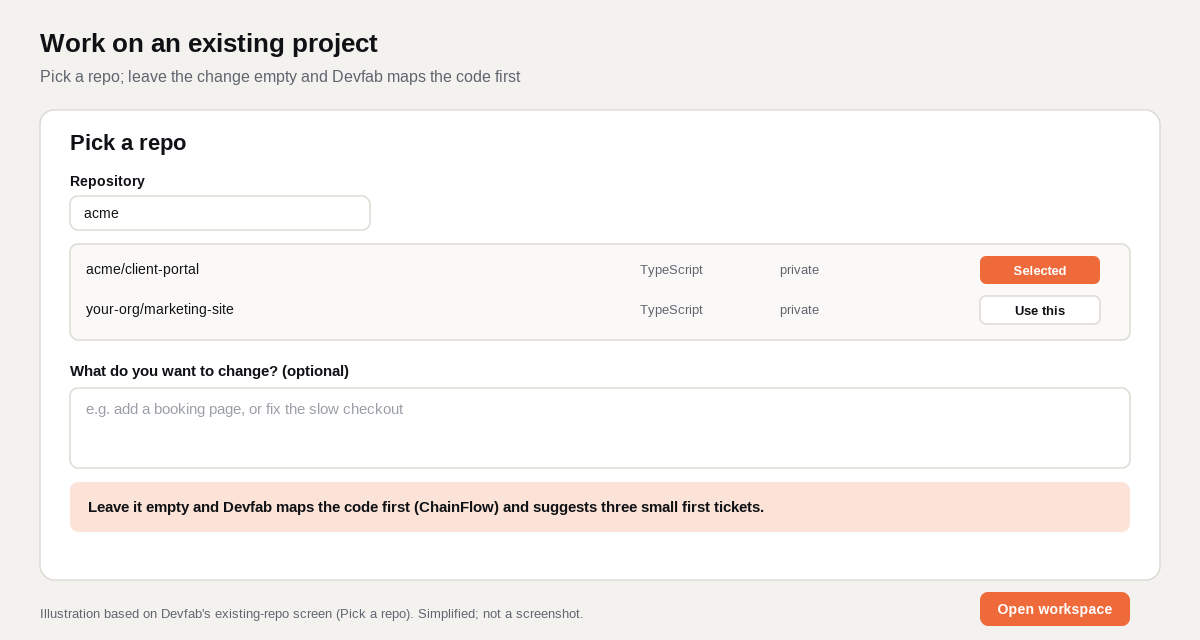
With Devfab, the project manager connects the client's GitHub repo. ChainFlow maps the code first, so the plan shows which existing parts the change touches: upload, notifications, the client dashboard. The Planner writes the plan and the project manager approves it. The Coordinator creates tickets for the dev agents, and the QA agent clicks through "staff requests a document, client gets an email, uploads it, request closes". The team reviews the QA report, deploys to the client's server and updates the user manual.
Both can end with good code. The difference is who runs the process and how much of it is built in.
Comparison table
| Aspect | Cursor | Devfab |
|---|---|---|
| Planning | Plan Mode writes a plan per task; you edit it, then build | Planner writes the project plan as epics; Coordinator creates tickets |
| Research before planning | Researches your codebase and asks clarifying questions | Research step maps the domain, best practices and competitors first |
| Human approval | You choose when to build a plan and review each PR | A person approves the plan by default; optional QA review before Done |
| Code | Strong: AI editor, agent, CLI and cloud agents | Dev agents work tickets in your repo |
| UI and flow tests | Cloud agents test changes and attach videos and screenshots; you own the test suite | Separate QA agent runs UI and flow tests end to end, plus logic tests |
| Deploy | Up to your CI and hosting | Ship to production on your own server; custom domain optional |
| Docs | Writes docs when asked | Blueprints, hi-fi designs, sequence flows, prototypes, user manuals |
| Team management | Teams seats, centralized billing, usage analytics, SSO | Roles, workspace permissions, Kanban and Gantt, Team Delivery Report |
| Model choice | Models from several providers plus Cursor's own | Choose the model for each agent or keep Devfab's default |
| Code ownership | Works in your repository | Code in your own GitHub account (or your organization's) |
| Cost visibility | Subscription with a usage pool; extra usage billed per model; team spending cap | Predictable cost: logged after each run, per task and per project |
| Existing codebases and impact of changes | Strong: codebase research, Bugbot reviews on each PR | ChainFlow maps calls and deployed code; empty change box gives three small first tickets |
When to choose Cursor
Cursor is the better choice when:
- Your developers code by hand every day and want AI in the editor, not a separate project tool.
- The work is code-level: features, refactors, bug fixes and reviews in a codebase the developer knows.
- You want deep control: rules, skills, MCP servers, a CLI for CI, and a choice of models per task.
- You already have a delivery process (tracker, CI/CD, QA, release routine) and want the coding stage faster.
- You want background work with proof: cloud agents that open PRs with screenshots and logs, plus Bugbot reviews.
When to choose Devfab
Devfab is the better choice when:
- You deliver projects for clients and want the same steps every time: research, approved plan, tickets, QA, deploy, docs.
- Non-developers need to take part: a client approving the plan, a project manager reading the QA report.
- You need a record for each delivery: the approved plan, the QA report and a user manual.
- The app must run on the client's server, with the code in your own GitHub account or theirs.
- You quote fixed scopes and need predictable cost, with cost logged per task and per project.
- You change existing client apps and want to see what a change affects before it ships.
Where Devfab is weaker: it is new and in Beta, with a smaller community and fewer integrations than Cursor. It is not an editor for hands-on coding, so a developer who wants to type alongside an agent should use Cursor. It needs a GitHub account. And for a quick fix, a full project with a plan is more process than the job needs.
Using both is common: developers keep Cursor for hands-on work on the same repository, while projects run through Devfab.
FAQ
Is Devfab a replacement for Cursor?
Not for developers who code by hand every day. Cursor is an editor and coding agent. Devfab runs the project around the code: research, an approved plan, tickets, a separate QA agent, deployment and docs. A developer can keep Cursor open on the same GitHub repository Devfab works in.
Cursor has Plan Mode. How is Devfab's planning different?
Cursor's Plan Mode asks clarifying questions, researches your codebase and writes a plan you edit before building. That suits one task. Devfab researches the domain first, writes a project plan that a person approves, and a Coordinator turns it into tickets for several dev agents.
Do Cursor's cloud agents test their work?
Yes. Cursor's docs say cloud agents test their changes and attach videos, screenshots and logs to the pull request. Devfab adds a separate QA agent that runs UI and flow tests plus logic tests, and an option to require QA review before a ticket is marked Done.
Which is better for a software agency?
If the agency mainly needs developers to code faster, Cursor is a strong choice. If it needs client-approved plans, QA reports, deployment to client servers, user manuals and cost per project, Devfab is built for that.
Read next
- What is an AI software factory?
- Cursor alternatives for teams that ship to production (2026)
- AI software factory vs AI coding tools: what's the difference?
- Build a client portal with AI agents: plan, prototype and test report
- Cursor vs GitHub Copilot in 2026
- Cursor vs Claude Code in 2026
See it on one of your client projects. Book a Devfab demo
Sources (checked November 2026): Cursor documentation; Cursor Plan Mode; Cursor cloud agents; Cursor Bugbot; Cursor plans and pricing; Cursor blog: Joining SpaceX (Aug 14, 2026).
Frequently asked questions
Is Devfab a replacement for Cursor?
Not for developers who code by hand every day. Cursor is an editor and coding agent. Devfab runs the project around the code: research, an approved plan, tickets, a separate QA agent, deployment and docs. A developer can keep Cursor open on the same GitHub repository Devfab works in.
Cursor has Plan Mode. How is Devfab's planning different?
Cursor's Plan Mode asks clarifying questions, researches your codebase and writes a plan you edit before building. That suits one task. Devfab researches the domain first, writes a project plan that a person approves, and a Coordinator turns it into tickets for several dev agents.
Do Cursor's cloud agents test their work?
Yes. Cursor's docs say cloud agents test their changes and attach videos, screenshots and logs to the pull request. Devfab adds a separate QA agent that runs UI and flow tests plus logic tests, and an option to require QA review before a ticket is marked Done.
Which is better for a software agency?
If the agency mainly needs developers to code faster, Cursor is a strong choice. If it needs client-approved plans, QA reports, deployment to client servers, user manuals and cost per project, Devfab is built for that.