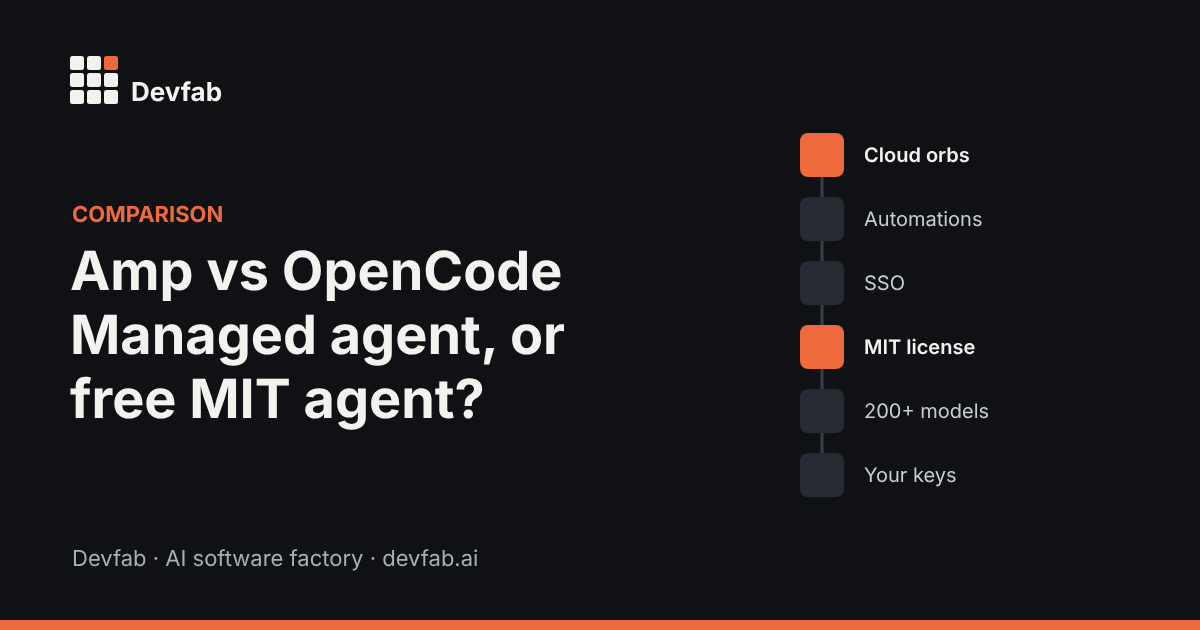
Short answer: Cursor wins when your developers want AI inside an editor, with Plan Mode, Bugbot pull-request reviews and cloud agents on GitHub, GitLab, Bitbucket or Azure DevOps. Amp wins when you want to drive agents from a terminal, web or phone app, run them unsupervised in cloud sandboxes, and pay model providers' rates with no markup.
You lead developers who already use AI every day. The question now is where the work happens. One camp says the editor is still home base. The other says agents should run on their own, in the cloud, while people review. Cursor and Amp sit on either side of that line. This page acts as referee, using each vendor's docs and pricing pages as of November 2026.
In this comparison:
Both companies changed hands or shape in the past year, so start there.
Cursor and Amp at a glance
Amp is now its own company. Sourcegraph and Amp announced on December 2, 2025 that they were becoming "two separate companies." Amp Inc. is led by co-founder Quinn Slack as CEO (Sourcegraph blog). Amp added monthly subscriptions in beta on July 18, 2026; before that it was pay-as-you-go only (Amp news).
Amp calls itself a frontier coding agent. You use it on the web with no install, in apps for Mac, Windows, Linux, iPhone, iPad and Android, or as a CLI in a terminal or script (Amp manual). Its "orbs" are cloud sandboxes where agents run unsupervised and keep going after you close your laptop (Amp).
Cursor now belongs to SpaceX. The purchase of Anysphere, Cursor's maker, was confirmed on June 16, 2026 (The Next Web). Cursor's August 14 post says the acquisition "officially" closed (Cursor blog). Cursor is an AI code editor plus an agent that also runs in a CLI, as cloud agents, on mobile and through SDKs (Cursor docs).
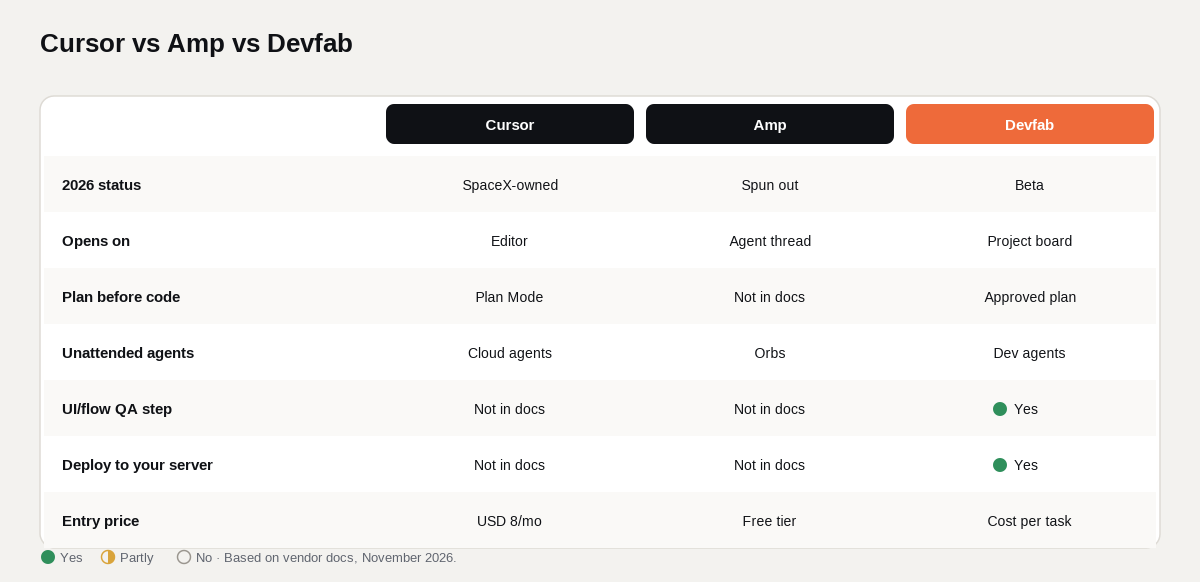
In short: Cursor opens on an editor. Amp opens on an agent thread.
Feature comparison
| Aspect | Cursor | Amp | Source |
|---|---|---|---|
| Where it runs | Desktop editor, CLI, cloud agents, mobile, SDKs | Web, desktop and mobile apps, CLI, cloud sandboxes (orbs) | Cursor docs; Amp manual |
| Planning | Plan Mode asks questions, researches the codebase and drafts an editable plan before code | A planning mode is not covered in the docs we checked | Cursor Plan Mode |
| Unattended agents | Cloud agents in isolated VMs, each on its own branch | Orbs run unsupervised; amp sync mirrors an orb's changes to your checkout | Cursor cloud agents; Amp |
| Review and preview | Bugbot reviews PRs; Autofix pushes fixes | Portals preview the agent's changes live in the browser | Bugbot; Amp |
| Collaboration | Rules, skills, subagents, hooks, plugins | Multiplayer shares one agent, code and running app; Spaces for many agents and teammates | Cursor docs; Amp |
| Automation | Cloud agents start from Slack, PR comments, Linear or the API | Automations wake agents on a schedule or on events such as failing CI | Cursor cloud agents; Amp |
| Model choice | You pick from Claude, Gemini, GPT, Grok, Composer and others | Amp picks models "for what each model is best at"; OpenAI models can use a linked ChatGPT plan | Cursor docs; Amp manual |
| Team and admin | SSO on Teams; SCIM, audit logs on Enterprise | Teams: SSO, permissions, self-hosted orbs; Enterprise: SCIM, audit logs, IP allowlisting | Cursor Enterprise; Amp pricing |
| Deploy and hosting | Not covered in the docs we checked | Not covered in the docs we checked | — |
| Pricing model | Subscription with a weekly usage pool; third-party models at API list price | Free tier, monthly tiers with included usage, credits at provider prices with no markup; orbs billed by the minute | Cursor pricing; Amp pricing |
Cost model by team size
| Team size | Cursor | Amp | Devfab |
|---|---|---|---|
| 1 person | Free; Plus USD 8 per month (Grok models only); Premium USD 30 per month, which includes cloud agents | Hobby free (bring your own key); Individual USD 20 per month | Cost logged per task and per project (Beta) |
| 5 people | Teams from USD 30 per user per month | Teams workspace at no extra charge; each member stays on their own tier, with pooled credits | Cost logged per task and per project (Beta) |
| 25 people | Teams, or Enterprise (custom) with SCIM and audit logs | Enterprise (custom) with SCIM, spend limits and audit logs | Cost logged per task and per project (Beta) |
Prices as of November 2026 from Cursor pricing and Amp pricing. Cursor's page says subscriptions are sold through X Subscription Corp. Amp bills extra model usage at provider API prices. Devfab is in Beta and offers predictable cost: cost is logged after each run, per task and per project.
Two notes on value. Amp said that before subscriptions, pure pay-as-you-go made it "more expensive than agents on monthly plans" (Amp news). A dated Cursor review called its credit pricing "opaque" (DEV Community, Apr 2026). Run your own trial month before you commit a team.
Where Cursor wins
- Your developers want an editor first. Tab completion, chat and Plan Mode all live in one IDE.
- You want reviews that fix things. Bugbot finds bugs and security issues in pull requests, and Autofix can push fixes to a branch.
- Your code isn't only on GitHub. Cloud agents support GitHub, GitLab, Bitbucket Cloud and Azure DevOps.
- You want to pick the model yourself for each task, from several vendors.
- You need a low entry price and are fine with Grok-only models on Plus.
Where Amp wins
- You want agents to run without you. Orbs keep working after the laptop closes, and Automations wake agents on new Linear issues or failing CI.
- You pair on agent work. Multiplayer lets teammates share control of the same agent, code and running app.
- You want pass-through pricing. Paid credits are billed at provider API prices with no markup for individuals and non-enterprise workspaces.
- You already pay for ChatGPT Plus or Pro. Amp can run OpenAI models on that linked subscription.
- You work from a phone or tablet as often as from a desk.
Switching from one to the other
Both tools work on your own Git repository, so there is no code to export.
From Cursor to Amp. Install the CLI or open Amp on the web, point it at the repo, and move project rules into AGENTS.md, which Amp reads (Amp manual). Re-add MCP servers in Amp's settings. If you relied on Bugbot, plan another review step.
From Amp to Cursor. Cursor also reads AGENTS.md in the project root and subfolders (Cursor rules). For unattended work, note that cloud agents need Premium or higher, Teams or Enterprise; "Free and Plus don't include them" (Cursor cloud agents).
Where Devfab fits
Picture a warehouse picking app for a client. Pickers scan bins, supervisors reassign orders, and the stock count must stay right. Cursor or Amp can write that code quickly. Neither, in the docs we checked, researches the domain first, sends a whole project plan to a person for approval, runs a separate QA step on user journeys, or deploys the app.
Coding agents automate the developer. Devfab automates the development lifecycle. Its Researcher maps the domain before the Planner writes a plan: key terms such as pick lists and short picks, best practices, and competitors. A person approves the plan. ChainFlow maps which functions and APIs call each other, so a change to picking doesn't quietly break stock counts or order confirmation. The QA agent then runs UI, flow and logic tests, and Deploy ships to your own server.
Devfab is in Beta, has a smaller community and fewer integrations, and is not an editor for hands-on coding. See Devfab vs Cursor and Devfab vs Amp.
FAQ
Is Amp still part of Sourcegraph?
No. Sourcegraph and Amp announced on December 2, 2025 that they were becoming two separate companies. Amp Inc. is led by co-founder Quinn Slack as CEO, and Sourcegraph is led by Dan Adler.
Is Amp cheaper than Cursor?
It depends on how you work. As of November 2026, Amp has a free Hobby tier and an Individual tier at USD 20 per month, with model usage at provider API prices and no markup for individuals. Cursor has a free tier, Plus at USD 8 per month (Grok models only) and Teams from USD 30 per user per month.
Can I run Amp agents while my laptop is closed?
Yes. Amp's orbs are cloud sandboxes where agents run unsupervised and keep working after you close your laptop. Cursor's cloud agents also run in isolated cloud VMs, but they need the Premium plan or higher, Teams or Enterprise.
Does Cursor still work now that SpaceX owns it?
Yes. SpaceX's purchase of Anysphere, Cursor's maker, was confirmed on June 16, 2026, and Cursor says the deal closed in its August 14 post. Cursor continues as a wholly owned subsidiary, and its plans now bundle Grok products.
Read next
- What is an AI software factory?
- Amp alternatives for teams that ship to production
- Cursor alternatives for teams that ship to production
Want the plan, the tests and the deploy handled too? Try Beta
Sources (checked November 2026): Cursor docs; Cursor pricing; Cursor Plan Mode; Cursor cloud agents; Cursor Bugbot; Cursor Enterprise; Cursor rules; Cursor blog: Joining SpaceX; The Next Web: SpaceX makes its Cursor takeover official; DEV Community: Cursor 3 review (Apr 2026); Amp; Amp manual; Amp pricing; Amp news: Subscriptions, at last (Jul 18, 2026); Sourcegraph blog: Why Sourcegraph and Amp are becoming independent companies.
Frequently asked questions
Is Amp still part of Sourcegraph?
No. Sourcegraph and Amp announced on December 2, 2025 that they were becoming two separate companies. Amp Inc. is led by co-founder Quinn Slack as CEO, and Sourcegraph is led by Dan Adler.
Is Amp cheaper than Cursor?
It depends on how you work. As of November 2026, Amp has a free Hobby tier and an Individual tier at USD 20 per month, with model usage at provider API prices and no markup for individuals. Cursor has a free tier, Plus at USD 8 per month (Grok models only) and Teams from USD 30 per user per month.
Can I run Amp agents while my laptop is closed?
Yes. Amp's orbs are cloud sandboxes where agents run unsupervised and keep working after you close your laptop. Cursor's cloud agents also run in isolated cloud VMs, but they need the Premium plan or higher, Teams or Enterprise.
Does Cursor still work now that SpaceX owns it?
Yes. SpaceX's purchase of Anysphere, Cursor's maker, was confirmed on June 16, 2026, and Cursor says the deal closed in its August 14 post. Cursor continues as a wholly owned subsidiary, and its plans now bundle Grok products.