Short answer: Amazon Q Developer wins only for teams that already hold Pro seats and need AWS-aware help or Java upgrades before support ends on April 30, 2027. Cursor wins for nearly everyone choosing today: it is an active AI editor with Plan Mode, cloud agents and Bugbot, while AWS itself points Q users to Kiro.
Your team builds on AWS, and Q Developer came with the account. Now AWS has set an end date. You could follow AWS to Kiro, or use the deadline to look wider, and Cursor is the name most developers bring up. This page treats it as a fair fight, but it starts with the date, because that date shapes every other answer.
In this comparison:
- Cursor and Amazon Q Developer at a glance
- Feature comparison
- Cost model by team size
- Where Cursor wins
- Where Amazon Q Developer wins
- Switching from one to the other
Read the status section first if you hold Q seats today.
Cursor and Amazon Q Developer at a glance
Amazon Q Developer is being sunset. AWS says the IDE plugins and paid subscriptions reach end of support on April 30, 2027, with Kiro as the migration target. New Free Tier accounts and new subscriptions were blocked from May 15, 2026. Java upgrade and .NET porting transformations also stop on April 30, 2027 (AWS DevOps blog). On November 5, 2026, Q Developer in the AWS console was renamed "AWS assistant" (AWS What's New). Kiro's docs say "Kiro CLI is the next update of the Q CLI," and it still accepts the q command (Kiro docs).
Q Developer is AWS's AI coding assistant for developers building on AWS. It runs as plugins for VS Code, JetBrains, Visual Studio and Eclipse (preview), as a CLI agent, and on GitHub and GitLab (AWS).
Cursor is active and now owned by SpaceX. The deal for Anysphere, Cursor's maker, was confirmed on June 16, 2026 (The Next Web), and Cursor says it closed in August (Cursor blog). Cursor is an AI code editor plus a coding agent that also runs in a CLI, as cloud agents, on mobile and through SDKs (Cursor docs).
Feature comparison
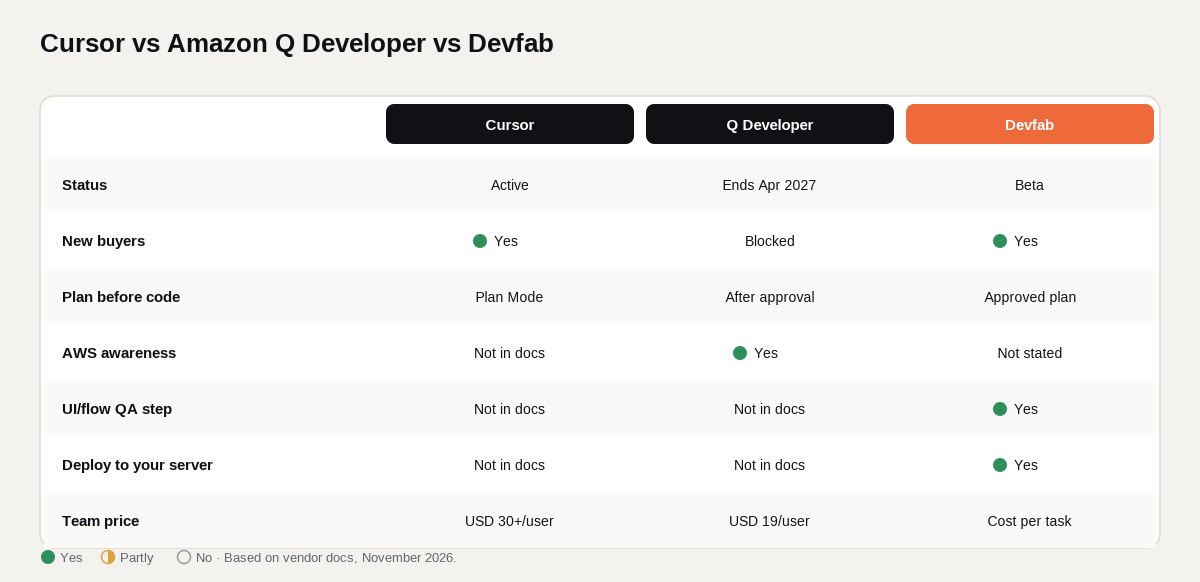
| Aspect | Cursor | Amazon Q Developer | Source |
|---|---|---|---|
| Status | Active | IDE plugins and paid plans end April 30, 2027 | AWS DevOps blog |
| Where it runs | Own editor, CLI, cloud agents, mobile, SDKs | Plugins for VS Code, JetBrains, Visual Studio, Eclipse; CLI; GitHub and GitLab | Cursor docs; AWS |
| Planning | Plan Mode drafts an editable plan before code | Agent plans multi-file features and makes changes after approval | Cursor Plan Mode; AWS |
| Background agents | Cloud agents in isolated VMs, many in parallel | Assign GitHub issues to Q to implement features | Cursor cloud agents; AWS |
| Review and security | Bugbot reviews PRs; Autofix pushes fixes | Security scans and automated PR reviews, including IaC misconfigurations | Bugbot; AWS |
| Cloud awareness | Not covered in the docs we checked | Queries your AWS resources; CLI agent calls AWS APIs | AWS |
| Legacy upgrades | Not covered in the docs we checked | Java upgrade transformation (ends April 30, 2027) | AWS pricing |
| Model choice | Claude, Gemini, GPT, Grok, Composer and others | AWS says the newest coding models ship only in Kiro | Cursor docs; AWS DevOps blog |
| Team and admin | SSO on Teams; SCIM, audit logs on Enterprise | Pro: admin dashboard, Identity Center, IP indemnity | Cursor Enterprise; AWS pricing |
| Pricing model | Free tier, monthly tiers with a usage pool, Teams per seat | Free Tier and per-user Pro Tier; closed to new buyers | Cursor pricing; AWS pricing |
Cost model by team size
| Team size | Cursor | Amazon Q Developer | Devfab |
|---|---|---|---|
| 1 person | Free; Plus USD 8 per month (Grok models only); Premium USD 30 per month | Free Tier USD 0 (closed to new accounts) | Cost logged per task and per project (Beta) |
| 5 people | Teams from USD 30 per user per month | Pro Tier USD 19 per user per month (existing subscriptions only) | Cost logged per task and per project (Beta) |
| 25 people | Teams, or Enterprise (custom) | Pro Tier, existing subscriptions can add users until end of support | Cost logged per task and per project (Beta) |
Prices as of November 2026 from Cursor pricing and Amazon Q Developer pricing. The Q pricing page carries no end-of-support notice; the AWS announcement does. Devfab is in Beta and offers predictable cost: cost is logged after each run, per task and per project.
Where Cursor wins
- You need a tool with a future. Q's coding side has an end date; Cursor is shipping new features.
- Your repos live outside GitHub. Cursor's cloud agents support GitHub, GitLab, Bitbucket Cloud and Azure DevOps.
- You want parallel background work. Cloud agents run in isolated VMs, each on its own branch.
- You want model choice. Cursor lists models from several vendors; AWS says its newest models go to Kiro, not Q.
- You want plan-then-build in the editor, with Plan Mode asking clarifying questions first.
Where Amazon Q Developer wins
- You already hold Pro seats and want to use them until April 2027 without a new purchase.
- You need AWS-aware help. Q can query your AWS resources and call AWS APIs from the CLI.
- You have Java upgrades in flight. The transformation feature still runs until end of support.
- Your developers use Visual Studio or Eclipse. Q has plugins there; AWS notes Kiro does not.
- You want IP indemnity and Identity Center bundled in the Pro Tier.
Switching from one to the other
From Q Developer to Cursor. Your code already sits in your own repos, so nothing needs exporting. Install Cursor and open the repo. Set up MCP servers for any AWS tools you relied on. Plan for Java upgrades to finish before April 30, 2027.
From Q Developer to Kiro (AWS's path). Kiro CLI is backward compatible with the q command, and new features ship only there. Spec-driven development is only in the Kiro IDE. Visual Studio and Eclipse users must switch to the Kiro IDE or run Kiro CLI next to their editor (Kiro migration guide).
Where Devfab fits
Think of a county permit tracker. Residents apply, staff review, inspectors log visits and fees post. A coding assistant helps write each part. In the docs we checked, neither Cursor nor Q researches the domain before planning, sends a project plan to a person for approval, runs a QA step on resident journeys, or deploys the app.
Coding agents automate the developer. Devfab automates the development lifecycle. Devfab's Researcher maps permit terms and best practices first. A person approves the plan. ChainFlow maps which functions and APIs call each other, so a change to fee rules shows its effect on receipts and inspection scheduling. The QA agent runs UI, flow and logic tests, and Deploy ships to your own server.
Devfab is in Beta, with a smaller community and fewer integrations, and it is not an editor. See Devfab vs Amazon Q Developer and Devfab vs Cursor.
FAQ
Is Amazon Q Developer being discontinued?
Yes, for coding. AWS says the Q Developer IDE plugins and paid subscriptions reach end of support on April 30, 2027, and it points users to Kiro. New subscriptions and new Free Tier accounts have been blocked since May 15, 2026. The console assistant was renamed AWS assistant on November 5, 2026.
Should I move from Amazon Q Developer to Kiro or to Cursor?
Kiro is AWS's own successor: Kiro CLI is the next update of the Q CLI and accepts the q command. Choose Kiro if you want to stay with AWS. Choose Cursor if you want an AI editor with cloud agents across GitHub, GitLab, Bitbucket and Azure DevOps.
Can I still buy Amazon Q Developer Pro?
Not as a new customer. New subscriptions have been blocked since May 15, 2026, though existing Pro subscriptions can still add users. The official pricing page still lists the Pro Tier at USD 19 per user per month, as of November 2026.
Does Cursor work with AWS like Q Developer does?
Not in the same way. Q Developer can query information about your AWS resources and call AWS APIs from its CLI agent. Cursor's docs we checked do not describe built-in AWS account awareness, though you can add tools through MCP servers.
Read next
- What is an AI software factory?
- Amazon Q Developer alternatives for teams that ship to production
- Kiro vs Cursor
Replacing Q before the deadline? Try a factory, not just another editor. Try Beta
Sources (checked November 2026): AWS DevOps blog: Amazon Q Developer end of support announcement; AWS What's New: Q Developer in the console renamed AWS assistant (Nov 5, 2026); Amazon Q Developer pricing; Amazon Q Developer agentic coding; Kiro: Migrating from Q Developer; Kiro: Upgrading from Q CLI; Cursor docs; Cursor pricing; Cursor Plan Mode; Cursor cloud agents; Cursor Bugbot; Cursor Enterprise; Cursor blog: Joining SpaceX; The Next Web: SpaceX makes its Cursor takeover official.
Frequently asked questions
Is Amazon Q Developer being discontinued?
Yes, for coding. AWS says the Q Developer IDE plugins and paid subscriptions reach end of support on April 30, 2027, and it points users to Kiro. New subscriptions and new Free Tier accounts have been blocked since May 15, 2026. The console assistant was renamed AWS assistant on November 5, 2026.
Should I move from Amazon Q Developer to Kiro or to Cursor?
Kiro is AWS's own successor: Kiro CLI is the next update of the Q CLI and accepts the q command. Choose Kiro if you want to stay with AWS. Choose Cursor if you want an AI editor with cloud agents across GitHub, GitLab, Bitbucket and Azure DevOps.
Can I still buy Amazon Q Developer Pro?
Not as a new customer. New subscriptions have been blocked since May 15, 2026, though existing Pro subscriptions can still add users. The official pricing page still lists the Pro Tier at USD 19 per user per month, as of November 2026.
Does Cursor work with AWS like Q Developer does?
Not in the same way. Q Developer can query information about your AWS resources and call AWS APIs from its CLI agent. Cursor's docs we checked do not describe built-in AWS account awareness, though you can add tools through MCP servers.