Short answer: Cypress wins when your developers want to own and write browser tests in a free, open-source framework, with Cypress Cloud for replay and flake data. QA Wolf wins when you want AI agents, and optionally QA Wolf engineers, to write, run and maintain end-to-end tests for web, mobile and desktop for you.
Your warehouse picking app broke again in a release. A picker scanned a bin, the screen froze, and nobody's test touched that path. One camp on your team says: write better Cypress tests. The other says: stop writing tests ourselves and pay QA Wolf to own coverage. This page is the referee. It sets out what each product is in November 2026, from their own pages.
In this comparison:
- Cypress and QA Wolf at a glance
- Feature comparison
- Cost model by team size
- Where Cypress wins
- Where QA Wolf wins
The core question is who writes and maintains the tests.
Cypress and QA Wolf at a glance
Cypress, November 2026: active, with AI test writing now in beta. The cy.prompt command, which turns plain-English steps into Cypress commands, moved to beta in Cypress 15.13.0, and the experimental flag was removed (cy.prompt docs). Cypress has two parts. The Cypress App runs end-to-end and component tests in a real browser, locally or in CI. Cypress Cloud records runs and adds Test Replay, Smart Orchestration, Flake Detection, Branch Review, UI Coverage and Accessibility (Cypress). The App is MIT-licensed and free (Cypress pricing).
Cypress is for developers and QA engineers who write their own tests. Its newer pieces aim at coding agents too: Cloud MCP and a Cloud CLI let agents read CI failures, flake history and accessibility violations, and cypress tap lets agents run specs from the terminal (Cypress).
QA Wolf, November 2026: active. It calls itself an "AI Testing Platform" that combines agents, infrastructure and human experts (QA Wolf). Its agents plan coverage, write tests, pick the tests each pull request needs, investigate failures and file bugs to Linear or Jira. Broken tests "are fixed automatically as your app changes" (QA Wolf pricing).
QA Wolf is for teams that would rather not staff test writing. Its pitch targets teams whose coding agents "ship faster than anyone can review" (QA Wolf). Tests are exported as open-source Playwright and Appium code (QA Wolf pricing), so it does not use Cypress under the hood. QA Wolf says it picked Playwright for multi-tab flows, speed and fewer dependencies (a vendor claim, QA Wolf blog, Jan 29, 2026).
Feature comparison
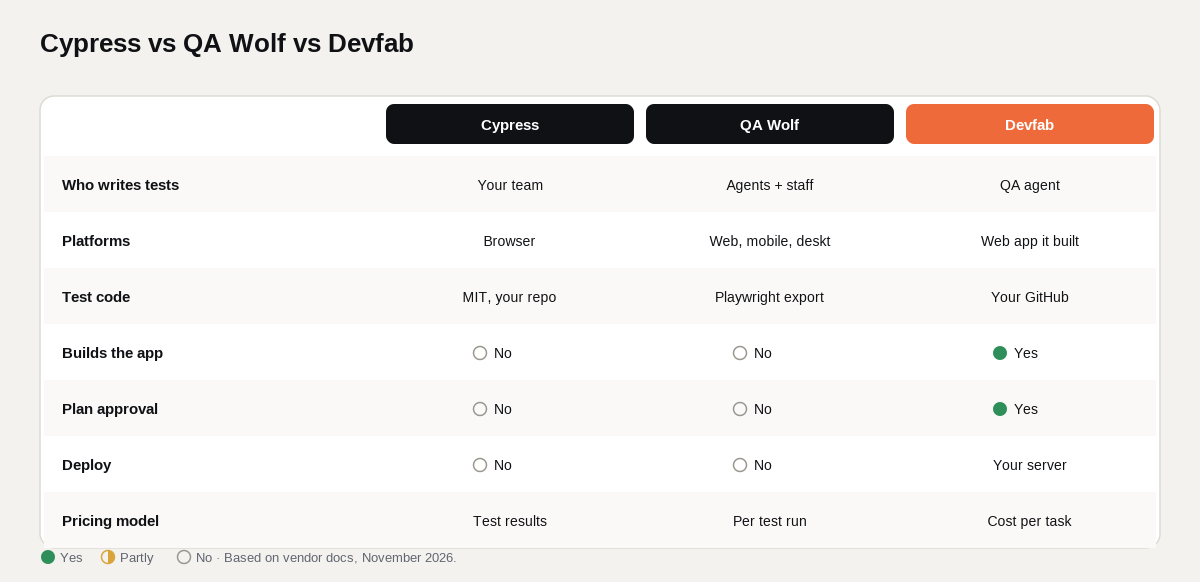
| Aspect | Cypress | QA Wolf | Source |
|---|---|---|---|
| What you get | Open-source framework plus a paid test cloud | AI agents plus infrastructure, with optional managed service | Cypress; QA Wolf |
| Who writes tests | Your team, with Studio AI recording and cy.prompt | QA Wolf agents; QA Wolf engineers on managed tiers | Cypress; QA Wolf pricing |
| Platforms | Browser tests; cy.prompt is Chromium-only (Chrome, Edge) | Web, iOS, Android, Windows; real iPhone and iPad devices | cy.prompt docs; QA Wolf |
| Test maintenance | Your team; Flake Detection and AI failure summaries help | Agents fix broken tests; flakes retried up to 3 attempts | Cypress pricing; QA Wolf pricing |
| Coding-agent link | Cloud MCP, Cloud CLI, cypress tap | MCP server for Claude Code, Codex, Cursor and other clients | Cypress; QA Wolf |
| Code ownership | Tests live in your repo, MIT-licensed runner | Tests exportable as Playwright and Appium code | Cypress pricing; QA Wolf pricing |
| Visual checks | UI Coverage and Accessibility as premium add-ons | Screenshot diffing against a baseline, web only | Cypress pricing; QA Wolf docs |
| Integrations | GitHub, GitLab, Bitbucket, Jira, Slack, Teams, webhooks | GitHub, Slack, Jira, Linear, coding agents | Cypress; QA Wolf |
| Pricing model | Free App; Cloud billed by test results and cy.prompt runs | Per test run, no per-seat fees; managed tiers by quote | Cypress pricing; QA Wolf pricing |
Known limits. cy.prompt can't handle multi-element assertions, clearing cookies or sessions, cy.request(), canvas or iframes, and every execution counts toward your plan quota (cy.prompt docs). On QA Wolf, flakes are retried rather than removed, and the "80%+ automated coverage" guarantee only applies to the sales-quoted managed tiers (QA Wolf pricing).
Cost model by team size
The two bill on different units. Cypress counts recorded test results. QA Wolf counts test runs. Neither charges per seat in the way a code editor does.
| Team size | Cypress | QA Wolf | Devfab |
|---|---|---|---|
| 1 person | Free App; Cloud Starter USD 0 with 500 test results and 100 cy.prompt runs a month | USD 1 per web run, USD 2 per mobile or desktop run; free runs to start | Cost logged per task and per project (Beta) |
| 5 people | Starter covers up to 10 users; Team from USD 67 per month billed annually | Same per-run price; no seat fees | Cost logged per task and per project (Beta) |
| 25 people | Business from USD 267 per month billed annually, or Enterprise (custom) | Per-run billing, or Jump Start and Coverage-as-a-Service by quote | Cost logged per task and per project (Beta) |
Prices as of November 2026 from Cypress pricing and QA Wolf pricing. Cypress overage is USD 6 per 1,000 results on Team and USD 5 on Business. QA Wolf's own example puts 50 web tests run daily at about USD 1,083 a month. Devfab is in Beta and offers predictable cost: cost is logged after each run, per task and per project.
Where Cypress wins
- You want to own the test code and the runner. The App is MIT-licensed and free, and tests sit in your repo.
- Debugging across many CI runs matters most. Test Replay, Flake Detection and Smart Orchestration show why a run failed and run failures first.
- Your coding agents should read real CI failures. Cloud MCP gives them flake history, UI Coverage and accessibility data without a new platform.
- You have a small budget and a small suite. The Starter plan is free for up to 10 users.
- Your team already knows Cypress and has a working suite to build on.
Where QA Wolf wins
- Nobody on the team has time to write tests. Agents plan coverage, write tests and fix them as the app changes.
- You ship mobile or desktop apps. QA Wolf covers iOS, Android and Windows, including real iPhone and iPad devices.
- You want people to own coverage. Coverage-as-a-Service has QA Wolf engineers write, run and maintain the suite, with a coverage guarantee.
- Bugs should land in your tracker. Agents investigate failures and file bugs to Linear or Jira.
- You fear lock-in. Tests export as Playwright and Appium code, and QA Wolf says it doesn't train models on customer data.
Switching from one to the other
From Cypress to QA Wolf. There is no Cypress import in the pages we checked. In practice, QA Wolf's agents map your app and write new Playwright tests; keep your Cypress suite running in CI until the new coverage matches it. Connect GitHub and your tracker so failures turn into tickets.
From QA Wolf to Cypress. Export your tests; they arrive as Playwright and Appium code (QA Wolf pricing). Cypress uses a different API, so the flows need rewriting. Studio AI can record clicks into editable Cypress tests, and cy.prompt can draft steps from plain English (Cypress). Many teams keep the exported Playwright tests instead and run them in their own CI.
Where Devfab fits
Both tools test an app that already exists. Neither writes the app, plans it with you or deploys it. If your real problem is that releases go out without a clear plan or proof of testing, a test tool alone won't fix that.
Coding agents automate the developer. Devfab automates the development lifecycle. It researches the domain, writes a plan that a person approves, splits it into tickets for dev agents, and deploys to your own server. Its QA agent is one step of that flow: it runs UI and flow tests (screens, buttons and user journeys clicked end to end) plus logic tests on what the agents built. ChainFlow maps which functions and APIs call each other, so a change to bin scanning shows its impact on stock counts and pick lists before it ships.
Devfab is in Beta, with a smaller community and fewer integrations than either tool. It is not an editor, and it needs a GitHub account. For a mature app with a large suite, Cypress or QA Wolf is the more direct fit. See Devfab vs QA Wolf.
FAQ
Is QA Wolf built on Cypress?
No. QA Wolf says its tests are open-source Playwright and Appium code you can export anytime. In a January 2026 blog post, QA Wolf explained it chose Playwright over Cypress for multi-tab flows, speed and fewer dependencies. Those are the vendor's own claims.
Is Cypress free?
The Cypress App is MIT-licensed and free. Cypress Cloud has a free Starter plan with 500 test results and 100 cy.prompt runs a month for up to 10 users, as of November 2026. Paid Cloud plans are priced by recorded test results.
Can QA Wolf test mobile apps?
Yes. QA Wolf lists web, iOS, Android and Windows, plus real-device iPhone and iPad testing. Cypress runs browser tests, and its AI command cy.prompt works only for end-to-end tests in Chromium browsers such as Chrome and Edge.
Which is cheaper, Cypress or QA Wolf?
It depends on suite size and run frequency. Cypress Cloud bills by recorded test results, from a free tier. QA Wolf bills per test run, USD 1 per web run as of November 2026, and its own example of 50 web tests run daily comes to about USD 1,083 a month.
Read next
Want testing to be one step of a planned build, not a separate project? Try Beta
Sources (checked November 2026): Cypress homepage; Cypress pricing; cy.prompt docs; QA Wolf homepage; QA Wolf pricing; QA Wolf docs: visual diffing; Why QA Wolf chose Playwright over Cypress (QA Wolf blog, Jan 29, 2026).
Frequently asked questions
Is QA Wolf built on Cypress?
No. QA Wolf says its tests are open-source Playwright and Appium code you can export anytime. In a January 2026 blog post, QA Wolf explained it chose Playwright over Cypress for multi-tab flows, speed and fewer dependencies. Those are the vendor's own claims.
Is Cypress free?
The Cypress App is MIT-licensed and free. Cypress Cloud has a free Starter plan with 500 test results and 100 cy.prompt runs a month for up to 10 users, as of November 2026. Paid Cloud plans are priced by recorded test results.
Can QA Wolf test mobile apps?
Yes. QA Wolf lists web, iOS, Android and Windows, plus real-device iPhone and iPad testing. Cypress runs browser tests, and its AI command cy.prompt works only for end-to-end tests in Chromium browsers such as Chrome and Edge.
Which is cheaper, Cypress or QA Wolf?
It depends on suite size and run frequency. Cypress Cloud bills by recorded test results, from a free tier. QA Wolf bills per test run, USD 1 per web run as of November 2026, and its own example of 50 web tests run daily comes to about USD 1,083 a month.