Short answer: For tests as files in your own repo with usage-based billing, pick Momentic. For a QA platform your own team drives across web, mobile and API, pick mabl. To stop paying per run, export to free Playwright. If the real gap is building and shipping the app, not testing it, look at Devfab.
You bought QA Wolf so nobody on your team had to babysit tests. It worked. Then the suite grew, the release schedule tightened, and the invoice followed both.
That's the first reason people look around: per-run billing scales with tests times runs. The second is flaky tests that get retried rather than fixed. The third is control: some teams want the tests in their own repo, on their own runners. This page covers six options and when QA Wolf is still the right call.
In this guide, you'll learn:
- Why teams leave QA Wolf
- Quick comparison
- The alternatives
- Where QA Wolf is still the better choice
- How to choose
Start with the triggers; they point to the right pick.
Why teams leave QA Wolf
QA Wolf is active and well regarded. It markets an "AI Testing Platform" of agents, infrastructure and human experts (QA Wolf). Teams that switch usually name one of these documented points:
- Cost follows volume. USD 1 per web or Linux Electron run and USD 2 per mobile or desktop run, as of November 2026. QA Wolf's own example is about USD 1,083 a month for 50 web tests run daily (QA Wolf pricing).
- Flakes are retried, not removed. Up to 3 retries per run are included (same source).
- The guarantee costs extra. "80%+ automated coverage" applies only to the sales-quoted Coverage-as-a-Service tier (same source).
- Some teams want ownership. QA Wolf tests already export as Playwright and Appium code, which makes leaving straightforward (same source).
None of these are flaws for every buyer. They matter when the suite is large, runs often, or the team wants the tests in-house.
Quick comparison
| Tool | What it is | Who writes the tests | Tests live where | Pricing (as of November 2026) |
|---|---|---|---|---|
| QA Wolf | AI testing platform plus managed service | QA Wolf agents or engineers | Exportable Playwright/Appium code | USD 1 per web run, USD 2 per mobile/desktop run |
| Momentic | AI QA platform with agent "Mo" | Mo and your developers | YAML files in your repo | Free (USD 50 usage); Scale USD 500/month |
| mabl | Agentic test platform | Your QA team with mabl agents | mabl platform | Quote-based annual credits |
| Playwright | Open-source framework with Test Agents | Your team or your coding agent | Test files in your repo | Free |
| Cypress | Open-source framework plus Cypress Cloud | Your team, cy.prompt, Studio AI | Test files in your repo | App free; Cloud Starter USD 0, Team from USD 67/month billed annually |
| Applitools | Visual AI plus AI test authoring | Your team with Autonomous | Applitools; SDKs in your code | Per page; no public prices |
| Devfab | AI software factory | QA agent, as one lifecycle step | Your GitHub account | Cost logged per task and per project (Beta) |
The alternatives
1. Momentic
Verdict: the closest swap for developer teams that want QA Wolf's agent-driven coverage without per-run pricing. Best for: product engineering teams who want tests reviewed like code and run on PR preview deployments. Trade-off: no managed service with human engineers; you still own the suite. Pricing: usage-based with no seat fees. Free is USD 0/month with USD 50 of usage; Scale is USD 500/month with USD 500 of usage, as of November 2026 (Momentic pricing).
- Its agent Mo explores web, iOS and Android apps to find bugs, then turns an approved flow "into a Momentic YAML test and opens a pull request in your repo" (Momentic).
- Mo can be triggered from PR comments or labels, test the preview deployment, and post a review with a commit check (same source).
- It is built on Playwright, per its own docs index, and offers an MCP server and a Claude Code plugin (Momentic docs index).
- Watch for: usage doesn't roll over, and results are kept only for a limited period on Free and Scale (Momentic pricing).
2. mabl
Verdict: the pick when you have a QA team and want a platform, not a service. Best for: QA groups covering web, mobile and API in one suite, with test-case management tools. Trade-off: no public prices, and no code export described in the pages we checked. Pricing: quote-based; cloud runs consume credits from an annual allocation, while local and CI Runner runs don't (mabl pricing).
- Agents author tests from inputs such as Jira requirements, investigate failures and heal broken steps (mabl).
- On October 22, 2026 it announced an agentic testing harness with a knowledge graph mapping changes to tests (SD Times).
- SOC 2 Type II, SSO/SAML and RBAC are listed (mabl platform).
3. Playwright
Verdict: the zero-license exit, and where your exported QA Wolf tests already fit. Best for: engineering teams that want full control of end-to-end tests as code. Trade-off: a framework, not a service. You run CI, infrastructure and maintenance. Pricing: free and open source; no paid tier on playwright.dev (Playwright).
- One API for Chromium, Firefox and WebKit, in TypeScript, Python, .NET and Java (same source).
- Test Agents: Planner writes a Markdown test plan, Generator writes test files, Healer repairs failing tests (Playwright Test Agents).
- Playwright MCP lets coding agents drive a browser through accessibility snapshots (Playwright MCP).
4. Cypress
Verdict: a free framework with a paid cloud for teams that debug a lot of CI failures. Best for: web teams that want Test Replay and flake detection across many runs. Trade-off: cy.prompt works in Chromium browsers only and needs a Cypress Cloud account (cy.prompt docs). Pricing: the app is MIT-licensed and free. Cloud Starter is USD 0; Team is from USD 67 per month billed annually; Business from USD 267 per month billed annually, as of November 2026 (Cypress pricing).
- cy.prompt turns natural-language steps into Cypress commands and moved to beta in 15.13.0 (same docs).
- Cloud MCP gives coding agents CI failures, flake history and accessibility violations (Cypress).
- Each cy.prompt execution counts toward the plan quota (Cypress pricing).
5. Applitools
Verdict: add it when visual bugs are what reach production. Best for: teams whose risk is layout and rendering across browsers, and regulated teams needing on-prem. Trade-off: no public prices, and contracts run a year (Applitools pricing). Pricing: per page ("a unique validation"); a free account includes 1 user and 100 checkpoints a month (same source).
- Eyes does Visual AI checks; Autonomous creates functional, visual and API tests (Applitools).
- Works with Selenium, Playwright, Appium and Cypress, so it can sit on top of tests you export from QA Wolf (Applitools FAQ).
- Runs as SaaS, a dedicated cloud on AWS, Azure or GCP, or on-prem (Applitools).
6. Devfab
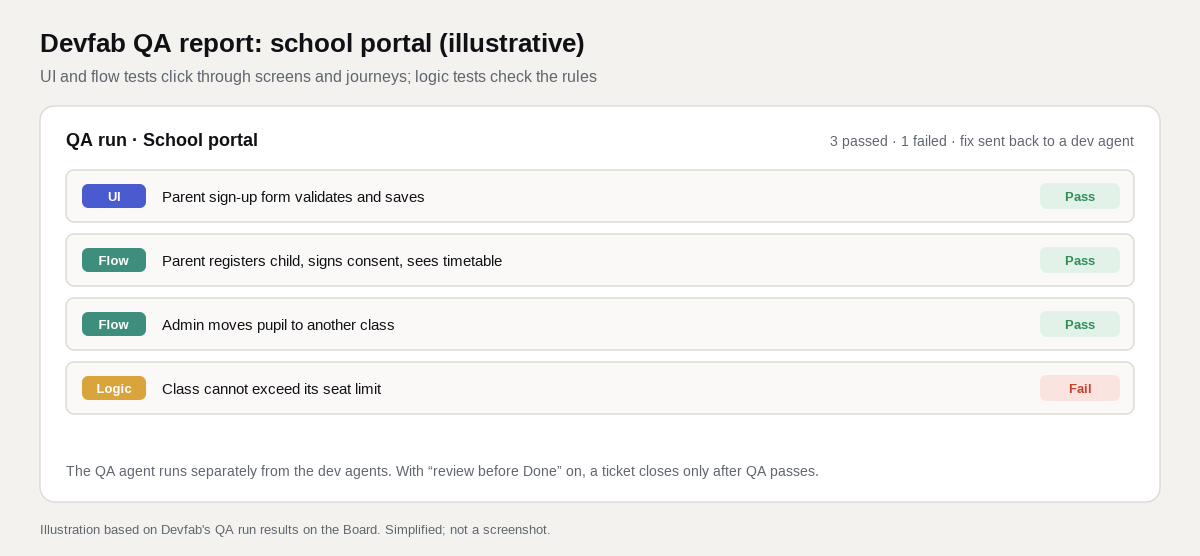
Verdict: not a QA Wolf swap; the pick when you need the app built and shipped, with testing as one step. Best for: agencies and IT teams delivering client apps, such as a school portal where parents register, sign forms and see timetables. Trade-off: in Beta, with a smaller community and fewer integrations; it won't test apps built elsewhere the way QA Wolf does. Pricing: predictable cost; cost is logged after each run, per task and per project.
- The Researcher maps the domain (enrollment rules, guardian roles, school portals on the market) before the Planner writes a plan, and a person approves it.
- ChainFlow maps which functions and APIs call each other, so a change to class enrollment shows its impact on timetables, fee notices and parent emails.
- The QA agent runs UI and flow tests (screens, buttons and user journeys clicked end to end) plus logic tests. Code stays in your GitHub; Deploy ships to your own server.
Coding agents automate the developer. Devfab automates the development lifecycle.
Where QA Wolf is still the better choice
- You want people, not just tools. Jump Start and Coverage-as-a-Service put QA Wolf engineers on your suite. None of the alternatives above sell that.
- You test mobile and desktop. Real iPhone and iPad devices and Windows apps are listed (QA Wolf).
- You want a coverage guarantee. "80%+ automated coverage" on the managed tier is rare.
- You want no seat fees and a public price. Per-run prices are on the page.
- You test AI features. QA Wolf lists semantic and non-deterministic assertions.
How to choose
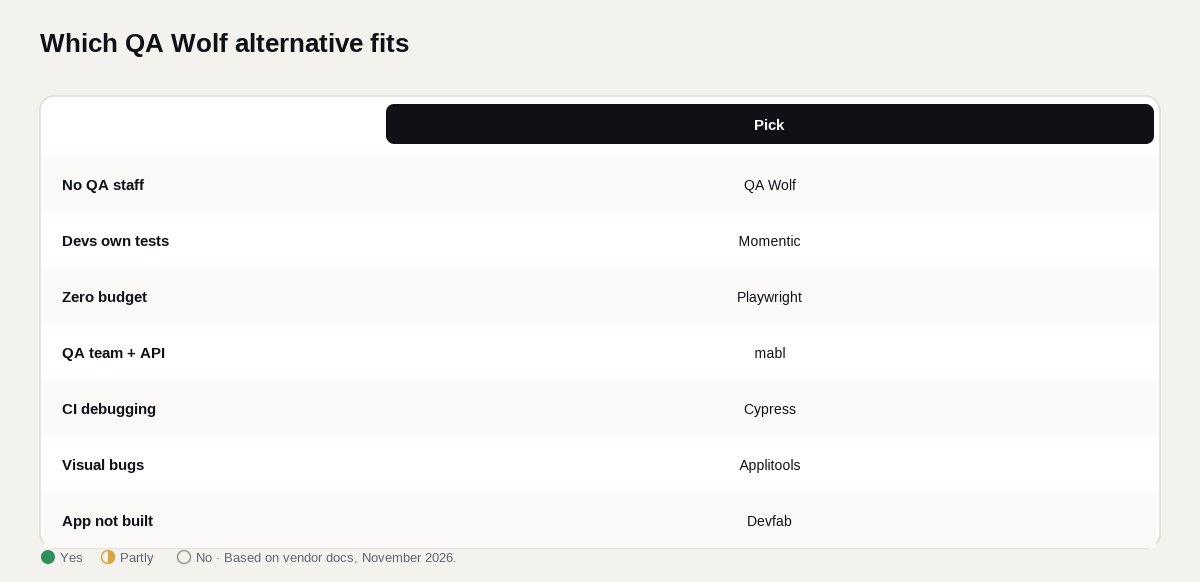
- No QA staff and no wish to hire? Stay with QA Wolf, or move to its managed tier.
- Developers own quality and want tests in the repo? Momentic, or Playwright if budget is zero.
- A QA team with test-case tools and API tests? mabl.
- Lots of CI failures to debug? Cypress with Cypress Cloud.
- Visual regressions are the pain? Add Applitools on top of whatever you run.
- The bottleneck is delivering the app itself? Devfab, and keep any test tool you like on the running app.
FAQ
What is the closest alternative to QA Wolf?
For developer teams, Momentic: its agent explores web and mobile apps, writes tests as YAML files in your repo and is also usage-based with no seat fees. For QA teams that want a platform rather than a service, mabl. Neither offers QA Wolf's managed Coverage-as-a-Service with its engineers.
Is there a free alternative to QA Wolf?
Playwright is free and open source from Microsoft, and its Test Agents can plan, generate and heal tests. Cypress's app is MIT-licensed and free, with a free Cypress Cloud Starter plan. You host runs, CI and maintenance yourself. QA Wolf's own tests export as Playwright code.
Why is QA Wolf's bill growing?
QA Wolf charges per test run: USD 1 per web run and USD 2 per mobile or desktop run, as of November 2026. More tests times more runs means a bigger bill. Its pricing page gives an example of about USD 1,083 a month for 50 web tests run daily.
Can I leave QA Wolf without losing my tests?
Yes. QA Wolf says its tests are open-source Playwright and Appium code you can export anytime. That makes Playwright the lowest-effort move, and tools built on Playwright, such as Momentic, easier to adopt.
Read next
Need the app shipped, with tests as part of the line? Try Beta
Sources (checked November 2026): QA Wolf homepage; QA Wolf pricing; Momentic homepage; Momentic pricing; Momentic llms.txt (docs index); mabl AI test automation; mabl platform; mabl pricing; mabl introduces agentic testing harness (SD Times, Oct 2026); Playwright homepage; Playwright Test Agents docs; microsoft/playwright-mcp (GitHub MCP listing); Cypress homepage; Cypress pricing; cy.prompt docs; Applitools homepage; Applitools pricing; Applitools FAQ.
Frequently asked questions
What is the closest alternative to QA Wolf?
For developer teams, Momentic: its agent explores web and mobile apps, writes tests as YAML files in your repo and is also usage-based with no seat fees. For QA teams that want a platform rather than a service, mabl. Neither offers QA Wolf's managed Coverage-as-a-Service with its engineers.
Is there a free alternative to QA Wolf?
Playwright is free and open source from Microsoft, and its Test Agents can plan, generate and heal tests. Cypress's app is MIT-licensed and free, with a free Cypress Cloud Starter plan. You host runs, CI and maintenance yourself. QA Wolf's own tests export as Playwright code.
Why is QA Wolf's bill growing?
QA Wolf charges per test run: USD 1 per web run and USD 2 per mobile or desktop run, as of November 2026. More tests times more runs means a bigger bill. Its pricing page gives an example of about USD 1,083 a month for 50 web tests run daily.
Can I leave QA Wolf without losing my tests?
Yes. QA Wolf says its tests are open-source Playwright and Appium code you can export anytime. That makes Playwright the lowest-effort move, and tools built on Playwright, such as Momentic, easier to adopt.