Short answer: QA Wolf wins when you want someone else to own end-to-end coverage, with tests you can export as Playwright or Appium code and a bill per run. mabl wins when you have a QA team that wants one platform for web, mobile and API tests, wired into test-case tools and giving a release verdict.
You run QA for a product that ships every week, and coding agents now write a growing share of the pull requests. The test suite can't keep up.
One camp says: hand it to a service and stop thinking about it. The other says: keep testing in-house, just give your testers better tools. QA Wolf and mabl are the clearest example of each side. This page referees, using vendor pages checked in November 2026.
In this comparison:
- QA Wolf and mabl at a glance
- Feature comparison
- Cost model by team size
- Where QA Wolf wins
- Where mabl wins
The answer turns on one question: who should own the tests?
QA Wolf and mabl at a glance
QA Wolf calls itself an "AI Testing Platform" that combines agents, infrastructure and human experts (QA Wolf). Its agents plan coverage, write tests, pick the tests each pull request needs, investigate failures and file bugs to Linear or Jira (QA Wolf pricing). If you don't want to run it yourself, two managed tiers exist: Jump Start, where QA Wolf engineers build your suite, and Coverage-as-a-Service, where they write, run and maintain it with a guarantee of "80%+ automated coverage" (same source).
mabl is an agentic test automation platform. Its agents author tests from inputs such as Jira requirements, investigate every failure and heal broken steps (mabl AI test automation). On October 22, 2026, mabl announced an "agentic testing harness" for checking code written by coding agents. It adds guardrails, a knowledge graph that maps a change to its tests and highlights coverage gaps, and change-impact checks run from the terminal before a PR (SD Times). In April 2026 it launched "Active Coverage", which runs authoring, failure analysis, recovery and execution as one process (mabl blog).
Both are active as of November 2026. Neither builds your app. Both check an app you already have.
Feature comparison
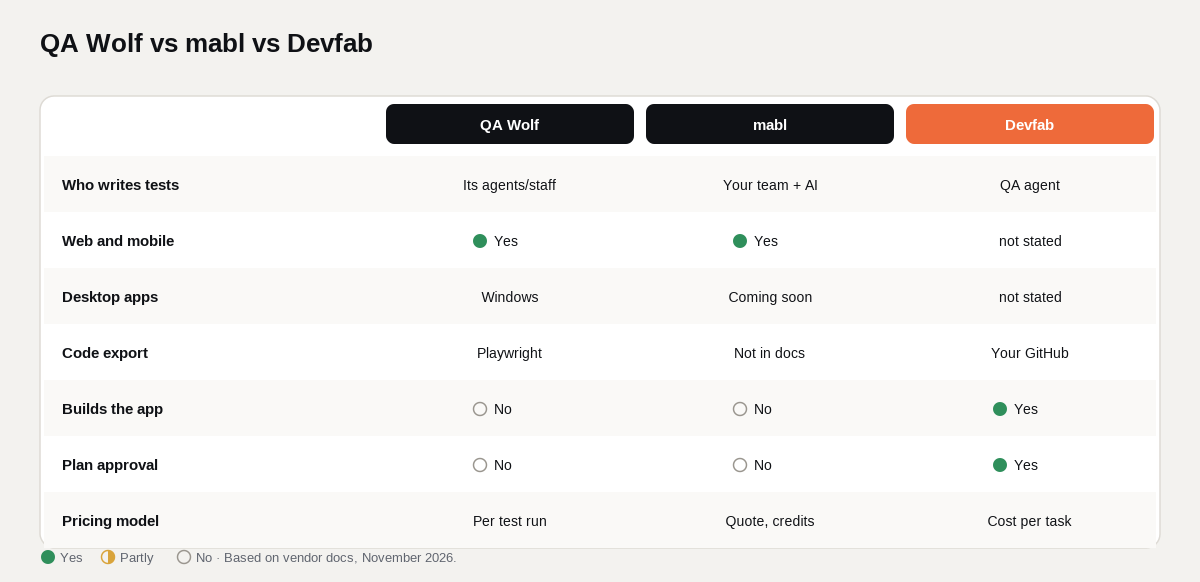
| Aspect | QA Wolf | mabl | Source |
|---|---|---|---|
| Where it runs | Web app plus an MCP server for Claude Code, Codex, Cursor or any MCP client | Cloud platform plus an MCP server for your IDE, Cursor or CLI | QA Wolf; mabl platform |
| Platforms tested | Web, iOS, Android, Windows; real iPhone and iPad devices | Web, iOS, Android, API, AI apps; desktop "coming soon" | QA Wolf; mabl; SD Times |
| Who writes tests | QA Wolf agents, or QA Wolf engineers on managed tiers | Your team with mabl's agents, including from Jira requirements | QA Wolf pricing; mabl |
| Maintenance | Broken tests "fixed automatically as your app changes"; up to 3 retries per run | Adaptive auto-healing of broken steps | QA Wolf pricing; mabl |
| Code export | Open-source Playwright and Appium code, exportable anytime | Not covered in the pages we checked | QA Wolf pricing |
| CI and tracking | GitHub, Slack, Jira, Linear | GitHub PR checks, GitLab, Jenkins, Jira, Slack; Xray, Zephyr, TestRail, Azure DevOps | QA Wolf; mabl platform; SD Times |
| Security and admin | No training or fine-tuning on customer data | SOC 2 Type II, SSO/SAML, RBAC, SLA-backed support | QA Wolf; mabl platform |
| Pricing model | Per test run, no seat fees | Quote-based annual credit allocation; unlimited users | QA Wolf pricing; mabl pricing |
Cost model by team size
| Team size | QA Wolf | mabl | Devfab |
|---|---|---|---|
| 1 person | Free runs to start, then USD 1 per web run and USD 2 per mobile or desktop run | Free trial, then a sales quote | Cost logged per task and per project (Beta) |
| 5 people | Same per-run prices; no per-seat fees, so team size doesn't change the bill | Quote; users are unlimited, cloud runs use credits | Cost logged per task and per project (Beta) |
| 25 people | Per run, or a sales-quoted managed tier (Jump Start, Coverage-as-a-Service) | Quote; local and CI Runner runs don't use credits | Cost logged per task and per project (Beta) |
QA Wolf prices as of November 2026 from QA Wolf pricing; AI and up to 3 retries per run are included, and long runs are billed in extra time blocks. QA Wolf's own example is about USD 1,083 a month for 50 web tests run daily, as of November 2026. mabl lists no public prices (mabl pricing). Devfab is in Beta and offers predictable cost: cost is logged after each run, per task and per project.
The practical difference: with QA Wolf, the bill follows tests times runs. With mabl, it follows the contract, and runs on your own CI runner don't touch it.
Where QA Wolf wins
- You have no QA team and don't want to hire one. Coverage-as-a-Service puts coverage and maintenance on QA Wolf's engineers.
- You want an exit door. Tests export as open-source Playwright and Appium code.
- You ship desktop or real-device mobile apps. Windows and real iPhone and iPad testing are listed today.
- You want a public price. Per-run prices are on the pricing page, with free runs to start.
- Your AI features need testing. QA Wolf lists "semantic and non-deterministic assertions" for AI features (QA Wolf).
Where mabl wins
- You have testers and want to keep control. mabl is a tool for your team, not a service that replaces it.
- API tests belong in the same suite. Web, mobile and API results share one dashboard, with Postman import.
- You live in test-case management. Xray, Zephyr, TestRail and Azure DevOps integrations came with the October 2026 harness.
- Security reviews are strict. SOC 2 Type II, SSO/SAML and RBAC are listed on the platform page.
- You run a lot of tests on your own runners. Local and CI Runner runs don't consume credits.
Both have documented limits. QA Wolf retries flaky tests up to three times rather than removing flakes, and its coverage guarantee applies only to the managed tiers (QA Wolf pricing). mabl has no public pricing, and desktop testing was not yet released at its October 2026 announcement.
Switching from one to the other
From mabl to QA Wolf. List your critical user journeys from the mabl suite. Connect QA Wolf to GitHub and your tracker, and let its agents plan coverage, or buy Jump Start so its engineers rebuild the suite. Keep mabl running in parallel until the new suite covers the same flows.
From QA Wolf to mabl. Export your tests as Playwright code first (QA Wolf pricing); they show exactly which flows you covered. Then author the same journeys in mabl, starting from your Jira requirements, and connect GitHub PR checks so each pull request gets a status.
Where Devfab fits
Picture a warehouse picking app. QA Wolf or mabl can tell you the pick list screen broke after a change. Neither, in the pages we checked, plans the app, writes it, or ships it.
Devfab sits earlier. It is an AI software factory: the Researcher maps the domain (pick paths, bins, short picks, competing warehouse tools) before the Planner writes a plan, a person approves the plan, and dev agents build it. ChainFlow maps which functions and APIs call each other, so a change to stock allocation shows its impact on picking, packing and shipping labels. Its QA agent runs UI, flow and logic tests as one step of that lifecycle. Coding agents automate the developer. Devfab automates the development lifecycle.
If you already have the app and only need tests, a testing tool is the better buy. Devfab is in Beta, has a smaller community and fewer integrations, and needs a GitHub account. See Devfab vs QA Wolf and Devfab vs mabl.
FAQ
What is the main difference between QA Wolf and mabl?
Who does the work. QA Wolf's agents, and optionally its own engineers, write, run and maintain your end-to-end tests, and you pay per test run. mabl is a platform your QA team uses: its agents author, heal and triage tests, and you buy an annual credit allocation through sales.
Can I take my tests with me if I leave QA Wolf or mabl?
QA Wolf says its tests are open-source Playwright and Appium code you can export anytime. The mabl pages we checked describe a single test suite in its platform but do not describe a code export, so plan a rewrite or ask mabl before you sign.
Is QA Wolf or mabl cheaper?
It depends on how often you run tests. QA Wolf lists USD 1 per web test run and USD 2 per mobile or desktop run, as of November 2026, so cost grows with suite size times frequency. mabl is quote-based with an annual credit allocation, and local and CI Runner runs don't use credits.
Which one tests mobile and desktop apps?
Both test web, iOS and Android. QA Wolf also lists Windows desktop and real-device iPhone and iPad testing. mabl said desktop app testing was coming soon in its October 2026 announcement, and adds API tests with Postman import.
Read next
- QA Wolf alternatives
- mabl alternatives
- Best AI testing tools for AI-generated code
- What is an AI software factory?
Testing is one step. See the whole line run. Try Beta
Sources (checked November 2026): QA Wolf homepage; QA Wolf pricing; mabl AI test automation; mabl platform; mabl pricing; Introducing Active Coverage (mabl blog, Apr 23, 2026); mabl introduces agentic testing harness (SD Times, Oct 2026).
Frequently asked questions
What is the main difference between QA Wolf and mabl?
Who does the work. QA Wolf's agents, and optionally its own engineers, write, run and maintain your end-to-end tests, and you pay per test run. mabl is a platform your QA team uses: its agents author, heal and triage tests, and you buy an annual credit allocation through sales.
Can I take my tests with me if I leave QA Wolf or mabl?
QA Wolf says its tests are open-source Playwright and Appium code you can export anytime. The mabl pages we checked describe a single test suite in its platform but do not describe a code export, so plan a rewrite or ask mabl before you sign.
Is QA Wolf or mabl cheaper?
It depends on how often you run tests. QA Wolf lists USD 1 per web test run and USD 2 per mobile or desktop run, as of November 2026, so cost grows with suite size times frequency. mabl is quote-based with an annual credit allocation, and local and CI Runner runs don't use credits.
Which one tests mobile and desktop apps?
Both test web, iOS and Android. QA Wolf also lists Windows desktop and real-device iPhone and iPad testing. mabl said desktop app testing was coming soon in its October 2026 announcement, and adds API tests with Postman import.