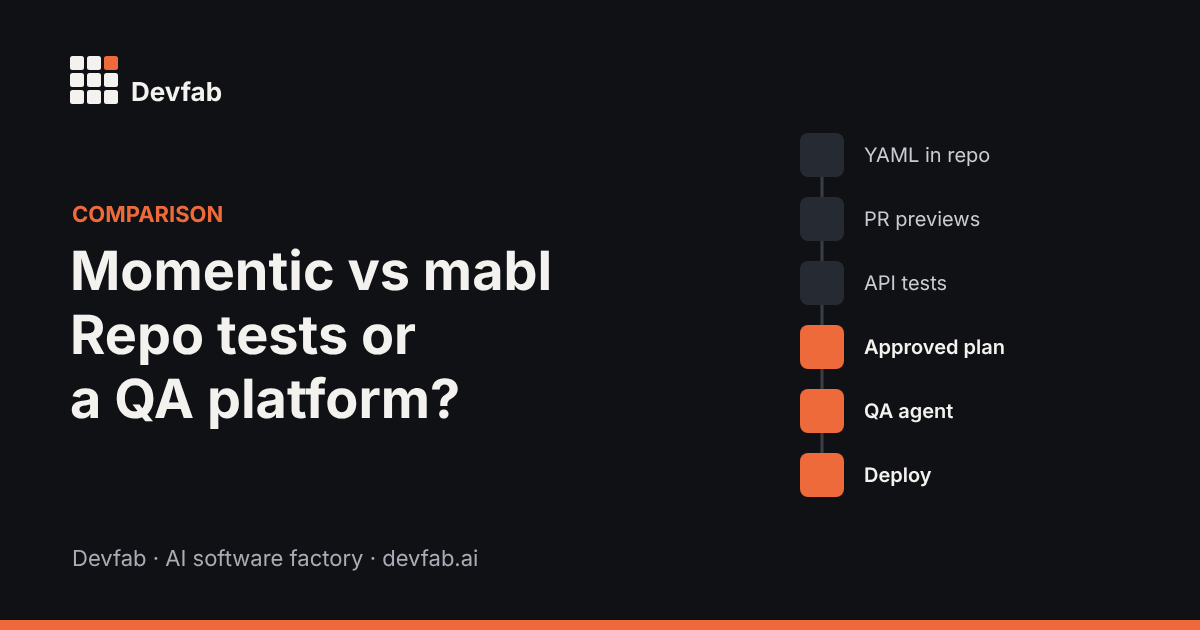
Short answer: Momentic wins when your developers own quality and want an AI agent to write tests as YAML files in the repo, reviewed in pull requests, with usage-based billing. QA Wolf wins when you'd rather not own the suite at all, need mobile and Windows coverage, or want its engineers to guarantee coverage.
You lead engineering, and nobody wants the testing job. Developers ship features. Tests lag a release behind.
Two answers come up. Give developers an agent that writes tests alongside their code: that is Momentic's pitch. Or hand the suite to someone else entirely: that is QA Wolf's. Both build on Playwright, both bill without seats, and both read the same pull requests. The difference is who holds the suite. Here's how they compare from vendor pages opened in November 2026.
In this comparison:
- Momentic and QA Wolf at a glance
- Feature comparison
- Cost model by team size
- Where Momentic wins
- Where QA Wolf wins
The rest of the page goes in that order.
Momentic and QA Wolf at a glance
Momentic is an AI QA platform. Its agent, Mo, explores web, iOS and Android apps to find bugs, then writes, runs and maintains natural-language tests (Momentic). When you approve a flow, Mo turns it "into a Momentic YAML test and opens a pull request in your repo" (same source). A separate agent reproduces each functional bug Mo files. Named customers include Notion, Quora, Webflow, Retool and Runway (same source).
QA Wolf is an "AI Testing Platform" that combines agents, infrastructure and human experts (QA Wolf). Its agents plan coverage, write tests, choose the tests each pull request needs, investigate failures and file bugs (QA Wolf pricing). Two managed tiers add people: Jump Start, where QA Wolf engineers build the suite, and Coverage-as-a-Service, where they own it (same source).
Both are active as of November 2026. Both test apps you already have; neither builds them.
Feature comparison
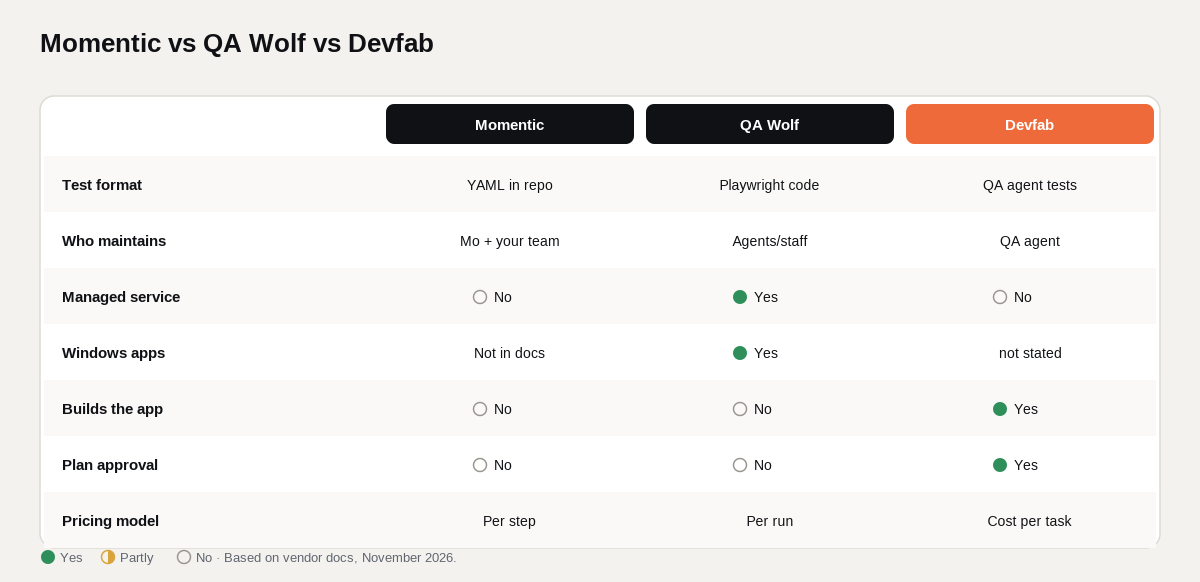
| Aspect | Momentic | QA Wolf | Source |
|---|---|---|---|
| Where it runs | Hosted browsers, iOS simulators, Android emulators, or your own CI | QA Wolf's infrastructure; fully parallel runs | Momentic; QA Wolf |
| Platforms | Web, iOS, Android | Web, iOS, Android, Windows; real iPhone and iPad devices | Momentic; QA Wolf |
| Test format | Plain-English steps stored as Momentic YAML in your repo | Playwright and Appium code, exportable anytime | Momentic; QA Wolf pricing |
| Who maintains | Self-healing AI Action V3 plus your team | Agents fix broken tests; engineers on managed tiers | Momentic; QA Wolf pricing |
| Pull requests | Triggered by PR comments or labels; tests preview deploys; posts a review and commit check | Selects the tests each PR needs | Momentic; QA Wolf pricing |
| Coding-agent access | MCP server (local or hosted) and a Claude Code plugin | MCP server for Claude Code, Codex, Cursor or any MCP client | Momentic docs index; QA Wolf |
| CLI | momentic CLI and qa CLI for Mo | Not covered in the pages we checked | Momentic |
| Security | SOC 2 Type 2, SAML/OIDC SSO, RBAC, audit logs | No training or fine-tuning on customer data | Momentic; QA Wolf |
| Pricing model | Usage in dollars, per step; no seats | Per test run; no seats | Momentic pricing; QA Wolf pricing |
Cost model by team size
| Team size | Momentic | QA Wolf | Devfab |
|---|---|---|---|
| 1 person | Free: USD 0/month with USD 50 of usage; pauses at zero | Free runs to start, then USD 1 per web run, USD 2 per mobile or desktop run | Cost logged per task and per project (Beta) |
| 5 people | Scale: USD 500/month with USD 500 of usage | Same per-run prices; no seat fees | Cost logged per task and per project (Beta) |
| 25 people | Scale, or Enterprise (custom, test-based) | Per run, or sales-quoted managed tiers | Cost logged per task and per project (Beta) |
Prices as of November 2026 from Momentic pricing and QA Wolf pricing. Momentic charges USD 0.0125 per step (USD 0.025 for AI-generated or recovery steps) plus hosted browser time; monthly usage doesn't roll over. QA Wolf includes AI and up to 3 retries per run. Devfab is in Beta and offers predictable cost: cost is logged after each run, per task and per project.
The models feel alike but scale differently. Momentic charges per step, so long tests cost more. QA Wolf charges per run, so frequent runs cost more.
Where Momentic wins
- Developers want tests as code they review. Mo opens a pull request with YAML tests in your repo.
- You test preview deployments. Mo tests a PR's preview build and posts a review with a commit check.
- You want to start free. Free includes USD 50 of usage and pauses at zero rather than billing overages.
- Your coding agent should drive testing. A local or hosted MCP server and a Claude Code plugin are documented.
- Security asks for audit logs and SSO. SOC 2 Type 2, SAML/OIDC SSO, RBAC and audit logs are listed.
Where QA Wolf wins
- Nobody on staff should own the suite. Coverage-as-a-Service hands writing, running and maintenance to QA Wolf engineers.
- You need Windows or real devices. Real iPhone and iPad and Windows desktop testing are listed.
- You want a coverage guarantee. "80%+ automated coverage" on the managed tier.
- You test AI features. Semantic and non-deterministic assertions are listed for AI features.
- You want standard Playwright code out. Exports are plain Playwright and Appium, not a vendor format.
Each has documented limits. Momentic results are kept only for a limited period on Free and Scale, and mobile sessions have a length cap outside Enterprise (Momentic pricing). QA Wolf retries flakes up to three times rather than removing them (QA Wolf pricing).
Switching from one to the other
From QA Wolf to Momentic. Export your QA Wolf tests as Playwright code; they show which flows you covered. Install Momentic, let Mo explore the app, and approve the flows that match your old suite so it opens pull requests with YAML tests. Hook Mo to PR labels so new work gets tested on preview deploys.
From Momentic to QA Wolf. Your Momentic YAML tests read as plain English, so they double as a coverage list. Share them with QA Wolf's agents, or with its engineers on Jump Start, and connect GitHub plus Linear or Jira for bug filing.
Where Devfab fits
Both tools assume the app exists. Say you are building a pharmacy refill app for a client, and nothing is written yet. Neither Momentic nor QA Wolf, in the pages we checked, researches the domain, plans the app or deploys it.
Devfab is an AI software factory. Its Researcher maps key terms (repeat prescriptions, pickup slots, pharmacist checks), best practices and competing apps before the Planner writes a plan, and a person approves it. ChainFlow maps which functions and APIs call each other, so a change to refill rules shows its impact on stock checks, pickup notices and the pharmacist queue. The QA agent runs UI, flow and logic tests as one step of that line. Coding agents automate the developer. Devfab automates the development lifecycle.
Devfab is in Beta, has a smaller community and fewer integrations, and needs a GitHub account. Once your app ships, either tool can still test it. See Devfab vs Momentic and Devfab vs QA Wolf.
FAQ
Do Momentic and QA Wolf both use Playwright?
Yes, in different ways. Momentic's docs index says it is built on Playwright, and its tests are Momentic YAML files in your repo. QA Wolf says its tests are open-source Playwright and Appium code you can export anytime.
Which is cheaper, Momentic or QA Wolf?
It depends on volume. As of November 2026, Momentic Free is USD 0 with USD 50 of usage and Scale is USD 500 per month with USD 500 of usage, billed per step. QA Wolf charges USD 1 per web run and USD 2 per mobile or desktop run. Neither charges per seat.
Can QA Wolf write and maintain tests for us?
Yes. QA Wolf sells Jump Start, where its engineers build your suite, and Coverage-as-a-Service, where they write, run and maintain it with an 80%+ automated coverage guarantee. Both are quoted by sales. Momentic's pages describe agents and tools, not a managed service.
Which tests pull request previews better?
Momentic documents it directly: Mo can be triggered from PR comments or labels, test the PR's preview deployment and post a review with a commit check. QA Wolf's agents select the tests each pull request needs and file bugs to Linear or Jira.
Read next
- Momentic alternatives
- QA Wolf alternatives
- Unit tests vs end-to-end tests for AI-generated code
- What is an AI software factory?
Building the app is the hard part. See how Devfab runs it. Try Beta
Sources (checked November 2026): Momentic homepage; Momentic pricing; Momentic llms.txt (docs index); QA Wolf homepage; QA Wolf pricing.
Frequently asked questions
Do Momentic and QA Wolf both use Playwright?
Yes, in different ways. Momentic's docs index says it is built on Playwright, and its tests are Momentic YAML files in your repo. QA Wolf says its tests are open-source Playwright and Appium code you can export anytime.
Which is cheaper, Momentic or QA Wolf?
It depends on volume. As of November 2026, Momentic Free is USD 0 with USD 50 of usage and Scale is USD 500 per month with USD 500 of usage, billed per step. QA Wolf charges USD 1 per web run and USD 2 per mobile or desktop run. Neither charges per seat.
Can QA Wolf write and maintain tests for us?
Yes. QA Wolf sells Jump Start, where its engineers build your suite, and Coverage-as-a-Service, where they write, run and maintain it with an 80%+ automated coverage guarantee. Both are quoted by sales. Momentic's pages describe agents and tools, not a managed service.
Which tests pull request previews better?
Momentic documents it directly: Mo can be triggered from PR comments or labels, test the PR's preview deployment and post a review with a commit check. QA Wolf's agents select the tests each pull request needs and file bugs to Linear or Jira.