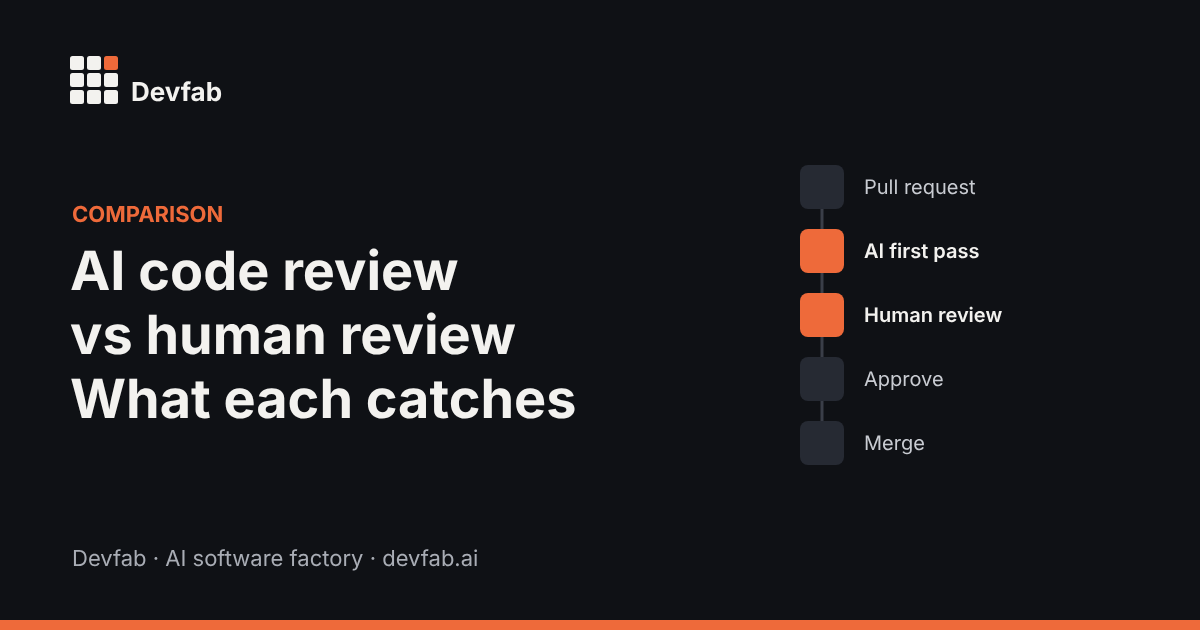
Short answer: AI code review reads the change. It catches logic errors, security issues and rule violations in the diff before merge. A QA agent uses the app. It clicks through screens and user journeys and checks business rules while the app runs. Review finds what's wrong in the code; QA finds what's wrong for the user. Most teams need both.
Your agents now open more pull requests than your team can read. So you added an AI reviewer, and the comments look sharp. Then a customer reports that the booking button does nothing on the last step.
Review vendors say quality starts in the pull request. Testing vendors say a clean diff proves nothing about the running app. Each is right about the other's blind spot. This page sets out what each one checks and which bugs each will miss.
In this comparison:
- Definitions
- What each one catches
- When to choose AI code review
- When to choose a QA agent
- Where an AI software factory fits
Use it to audit your own pipeline.
Definitions
AI code review
An AI code reviewer reads a pull request, compares it with the surrounding code and your rules, and posts comments. It does not need a running app.
- Claude Code Code Review runs several agents on each GitHub pull request, looking for "logic errors, security vulnerabilities, or broken edge cases". A verification step filters false positives, and findings are posted inline by severity. A review "never approves or blocks the pull request", and it works "without building or running your code" (Claude Code docs).
- GitHub Copilot code review produces "feedback comments and suggested changes". GitHub says it "may not identify all of the problems that are present in code, especially where changes are large or complex", can flag problems that don't exist, and "should be supplemented with careful human code review" (GitHub Docs).
- Cursor Bugbot "reviews pull requests and identifies bugs, security issues, and code quality problems", and its Autofix can start a cloud agent to push fixes (Cursor docs).
- Qodo runs multi-agent review that enforces your organization's standards on every pull request. Its Cross Repo Review flags changes that could break downstream repositories (Qodo).
QA agent
A QA agent tests the software by using it. It opens the app, clicks through it like a person would, and checks that the result matches what should happen.
- Playwright test agents come in three parts. The planner "explores the app and produces a Markdown test plan", the generator turns that plan into Playwright test files while checking selectors live, and the healer "executes the test suite and automatically repairs failing tests" (Playwright docs).
- QA.tech runs agents against a live web or mobile app, "exercising it visually like a real user". On each pull request with a preview environment, it runs tests and posts results with screenshots (QA.tech).
- Replit App Testing lets Replit's Agent click through the app in a real browser and fix issues. It supports full-stack JavaScript and Streamlit web apps (Replit docs).
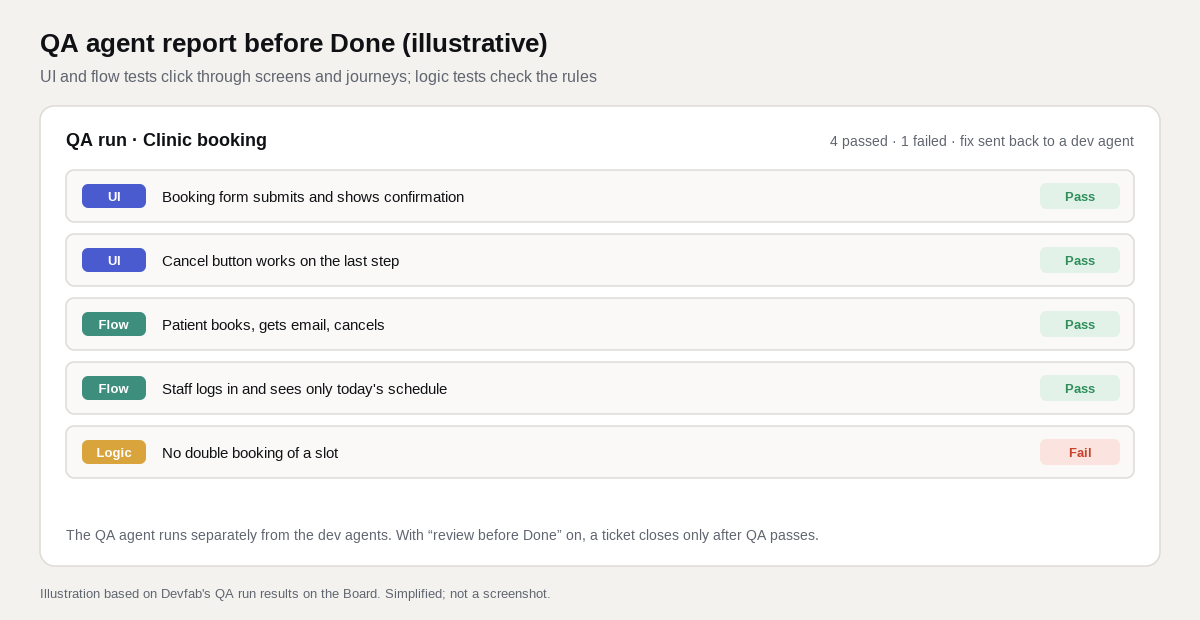
- Devfab's QA agent runs UI and flow tests (screens, buttons and user journeys clicked end to end) plus logic tests, as a separate agent from the developers that wrote the code.
The key difference fits in one line. Anthropic's own docs say it plainly: "A review with no findings doesn't mean your code is error-free or secure" (Claude Code docs). Review reads. QA runs.
What each one catches
| Aspect | AI code review | QA agent |
|---|---|---|
| What it looks at | The diff, nearby code, your rules, sometimes other repos | The running app: screens, journeys, results |
| Needs a running app | No | Yes, or a preview environment |
| When it runs | On each pull request, before merge | On a preview or test build, before release or before Done |
| Output | Inline comments by severity | A pass/fail report per test, often with screenshots |
| Who acts on it | The developer or coding agent | The developer, product owner or client |
| Typical blind spot | Behavior that only appears at runtime | Problems hidden in code that still works today |
Sources: Claude Code Code Review; GitHub Copilot code review; Qodo; Playwright test agents; QA.tech.
By bug type
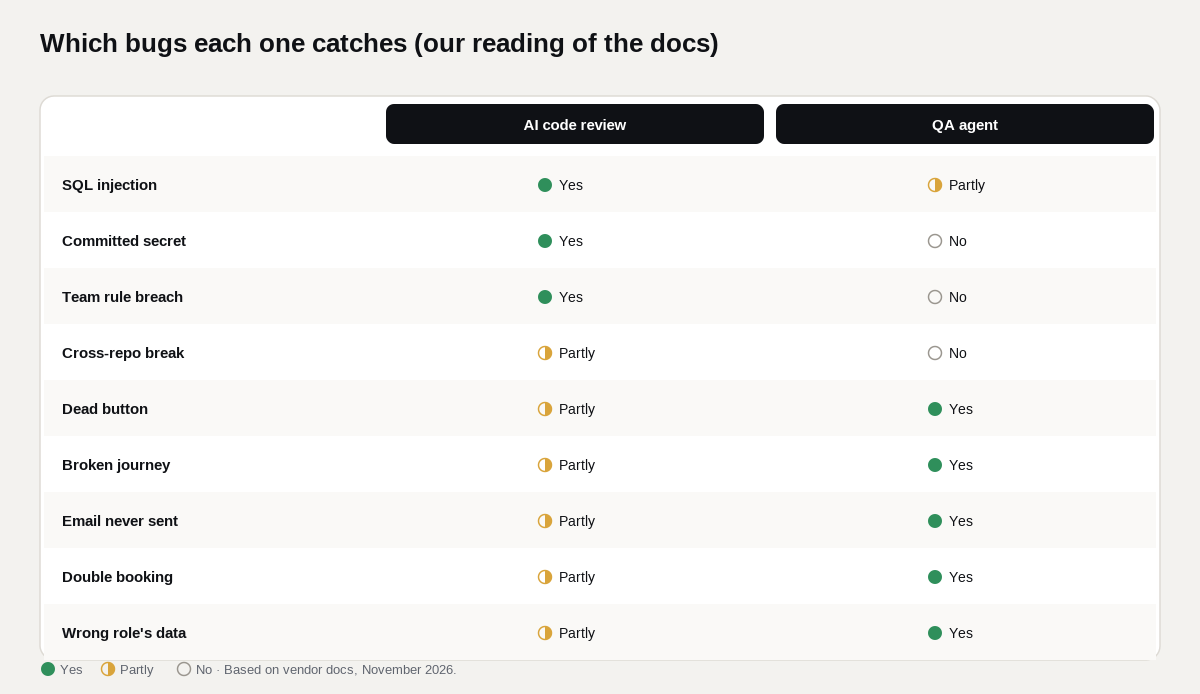
The table below is our reading of the docs above, not a benchmark. "Sometimes" means the tool can catch it only if the problem is visible in its input.
| Bug | AI code review | QA agent |
|---|---|---|
| SQL injection in a new query | Yes: it reads the query | Rarely: the app still works |
| Secret or API key committed to the repo | Yes | No |
| Breach of a team rule or architecture pattern | Yes, if the rule is written down | No |
| Change that breaks another repository | Sometimes (Qodo Cross Repo Review) | No, unless that service is in the test run |
| Button that does nothing on the last step | Sometimes: only if visible in the diff | Yes: it clicks the button |
| Journey that breaks across three screens | Sometimes | Yes: flow tests walk the journey |
| Email or notification never sent | Sometimes | Yes, if the test checks the result |
| Two people booking the same slot | Sometimes: if the race is in the diff | Yes, with a logic test for that rule |
| Screen that shows the wrong role's data | Sometimes | Yes: test logs in as each role |
When to choose AI code review
AI code review is the better choice when the risk lives in the code itself. Pick it when:
- Pull request volume outruns your reviewers. Agents write more code than people can read. Automated review gives every pull request a first pass, and Qodo's headline is exactly that: "Code review for agents. Governance for humans." (Qodo).
- Security and rules matter. Injection, leaked secrets and broken team conventions are visible in the diff and invisible in a click-through. Claude Code's review can be tuned with a
REVIEW.mdfile in the repository (Claude Code docs). - You run many services or repositories. Qodo's Cross Repo Review and Software Map show how repos, services and contracts connect (Qodo).
- There is no UI to test. For libraries, APIs and data pipelines, a QA agent that clicks screens has little to click.
- You need it on-prem. Qodo offers single-tenant, on-prem or air-gapped deployment with zero data retention (Qodo pricing).
When to choose a QA agent
A QA agent is the better choice when the risk lives in what users experience. Pick one when:
- The app has user journeys. Sign-up, checkout, booking, approvals. A journey can fail on step three even when every changed line looks fine in review.
- Nobody read every line. AI-built and vibe-coded apps often have more code than any person has reviewed. Testing the behavior is the direct way to know whether it works.
- A non-developer must accept the work. A client or product owner can read "Patient books, gets email, cancels: pass". Few can read inline review comments.
- Regressions keep coming back. Playwright's healer reruns and repairs failing tests as the UI changes (Playwright docs), and QA.tech re-tests affected journeys on each pull request (QA.tech).
- Business rules matter. No double booking, no self-approval of leave, no order without stock. A logic test checks the rule directly.
Where an AI software factory fits
A review tool and a test tool each sit at one checkpoint. Someone still has to decide what gets built, write the tests that match it, and decide what "done" means. An AI software factory puts both checkpoints into one production line. Devfab is one. Coding agents automate the developer. Devfab automates the development lifecycle.
- QA is a separate agent. Devfab's QA agent runs UI and flow tests plus logic tests. It is not the agent that wrote the code, so the code is not grading its own homework. Turn on "QA agent · review before Done" in the workspace controls, and a ticket only moves to Done after that review.
- Tests come from the approved plan. A person approves the plan before any tickets exist, so the flows the QA agent tests are the flows the team agreed on.
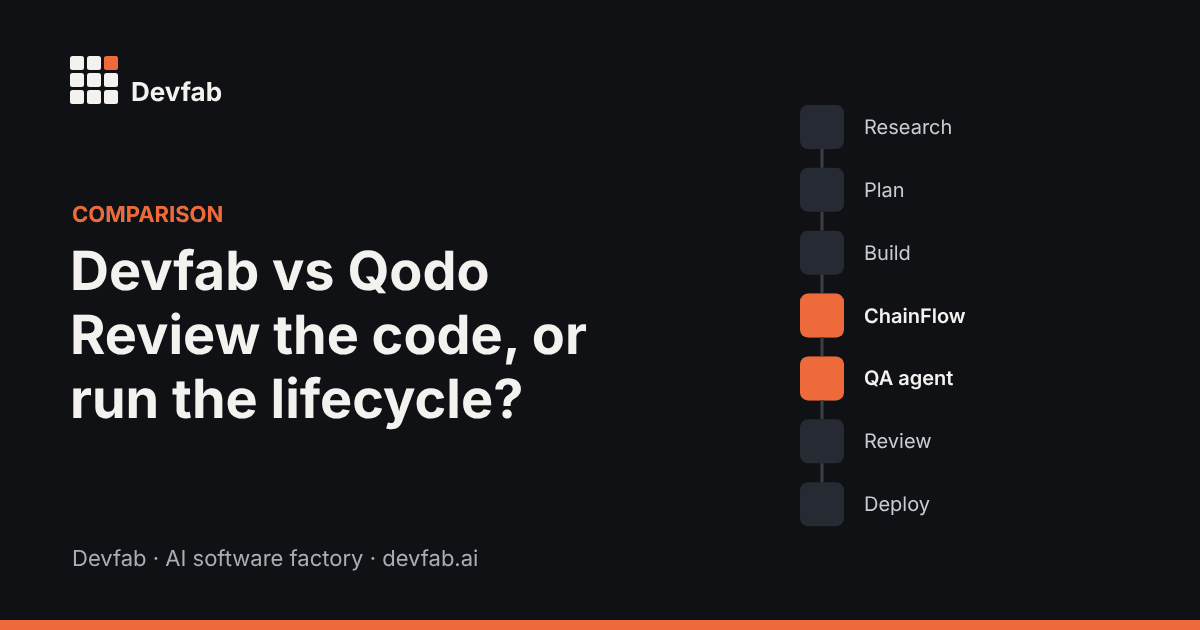
- Impact is checked before the edit. ChainFlow maps which functions and APIs call each other and what is deployed. Dev agents see that a checkout change touches payments, inventory, order confirmation and notifications before they change it, instead of a reviewer finding out afterward.
- Keep your code reviewer. Code lives in your own GitHub account (or your organization's). Qodo, Copilot code review or any other reviewer can read the same pull requests.
Cost is predictable: it is logged after each run, per task and per project. You can choose the model for each agent or keep Devfab's default.
Devfab's honest limits: it is new and in Beta, with a smaller community and fewer integrations than Qodo, Copilot or Playwright. It is not a standalone review or testing service for code built elsewhere, and it is not an editor for hands-on coding. It needs a GitHub account. If you only need review on an existing pipeline, a dedicated review tool is the simpler choice.
FAQ
Can AI code review replace QA testing?
No. AI code review tools read the change and the code around it. Anthropic's Code Review works without building or running your code, and both Anthropic and GitHub say their reviews can miss problems. Bugs that only show up when someone uses the app, such as a broken journey across screens, need tests that run it.
Can a QA agent replace code review?
No. A QA agent tests behavior, so it can pass an app that works today but has a security hole, duplicated logic or a breach of your team's rules. Code review catches those in the diff before merge. The two check different things.
Which should a small team set up first?
If your app has users clicking through screens, start with tests of the main user journeys, because those failures reach customers first. If you mostly ship APIs or libraries, or many agents open pull requests every day, start with AI code review. Most teams add the other soon after.
Can I use Devfab's QA agent with Qodo, Copilot or another code reviewer?
Yes. Devfab keeps the code in your own GitHub account (or your organization's), so any review tool connected to that repository can review the pull requests. Devfab's QA agent tests the app; your review tool reads the code.
Read next
- What is an AI software factory?
- AI software factory vs AI coding tools: what's the difference?
- What is a QA agent?
- Devfab vs Qodo
- Qodo vs GitHub Copilot
- How to stop AI coding agents from breaking existing code
Test the app, not just the diff. Try Beta
Sources (checked November 13, 2026): Claude Code docs: Code Review; Responsible use of GitHub Copilot code review; Cursor docs: Bugbot; Qodo; Qodo pricing; Playwright test agents; QA.tech; Replit docs: App Testing.
Frequently asked questions
Can AI code review replace QA testing?
No. AI code review tools read the change and the code around it. Anthropic's Code Review works without building or running your code, and both Anthropic and GitHub say their reviews can miss problems. Bugs that only show up when someone uses the app, such as a broken journey across screens, need tests that run it.
Can a QA agent replace code review?
No. A QA agent tests behavior, so it can pass an app that works today but has a security hole, duplicated logic or a breach of your team's rules. Code review catches those in the diff before merge. The two check different things.
Which should a small team set up first?
If your app has users clicking through screens, start with tests of the main user journeys, because those failures reach customers first. If you mostly ship APIs or libraries, or many agents open pull requests every day, start with AI code review. Most teams add the other soon after.
Can I use Devfab's QA agent with Qodo, Copilot or another code reviewer?
Yes. Devfab keeps the code in your own GitHub account (or your organization's), so any review tool connected to that repository can review the pull requests. Devfab's QA agent tests the app; your review tool reads the code.