Short answer: Testim wins when you already run web, mobile or Salesforce apps and need stable UI regression tests, with self-healing locators and CI runs. Devfab wins when you deliver new apps or changes for clients and need research, an approved plan, build, UI and flow tests, and deployment in one line.
You run QA at an agency, and the test suite breaks every sprint. A button moves, a locator dies, and someone spends the morning fixing tests instead of finding bugs.
A testing vendor says the fix is smarter tests. A delivery platform says the fix is a process where testing is built in. Both are describing different jobs. This page keeps them apart, with sources checked in November 2026.
In this comparison:
- What each tool is built for
- Switching triggers
- Cost model by team size
- Where Testim is the better choice
- Where Devfab is the better choice
Our running example is a clinic booking app built for a healthcare client.
What each tool is built for
The fair framing first. Testim tests code you already have. Devfab runs the whole lifecycle, and its QA agent is one step of it. They overlap only at the test step.
Testim
Status: a Tricentis product. Tricentis announced its acquisition of Testim on February 9, 2022 (Tricentis blog). Testim is active and sold as part of the Tricentis line (Testim product page).
Testim is a SaaS test automation tool. You record tests or describe them, and add JavaScript where needed:
- Where tests run: "locally, on our grid, or any compatible Selenium grid" (Testim).
- What it tests: cross-browser web apps; native, hybrid, React Native and Flutter mobile apps; and Salesforce, using metadata-based locators for dynamic Lightning elements (same source).
- Stability: "AI-powered locators self-heal to improve test stability and eliminate maintenance," plus element- or page-level visual checks (same source).
- AI features: Agentic Test Automation creates tests from a written description. Testim Copilot writes a JavaScript custom step from a description (Testim Copilot).
- When tests fail: screenshots with highlights, console and network logs, and failure suggestions.
- Integrations: runs from CI, on demand or on a schedule; one-click bug reports to Jira, Trello or GitHub; results to Slack, email or webhooks; test branches sync with code branches (Testim Enterprise).
Testim's main user is a QA engineer or test team that owns regression for apps already in production.
Devfab
Devfab is an AI software factory, in the Autonomous Software Lifecycle category. Its unit of work is a project or a change, run by seven agents: Researcher, Planner, Coordinator, Developers, Blueprint, QA agent and Deploy.
- The Researcher runs before the Planner. For the clinic app it maps terms such as slots, no-shows and intake forms, best practices for booking apps, and competing products, then suggests a prototype.
- The Planner publishes a plan, and a person approves it. The Coordinator turns it into tickets for dev agents.
- Developers use ChainFlow, which maps which functions and APIs call each other and what is deployed. A change to slot rules shows its effect on reminders, cancellations and the staff calendar.
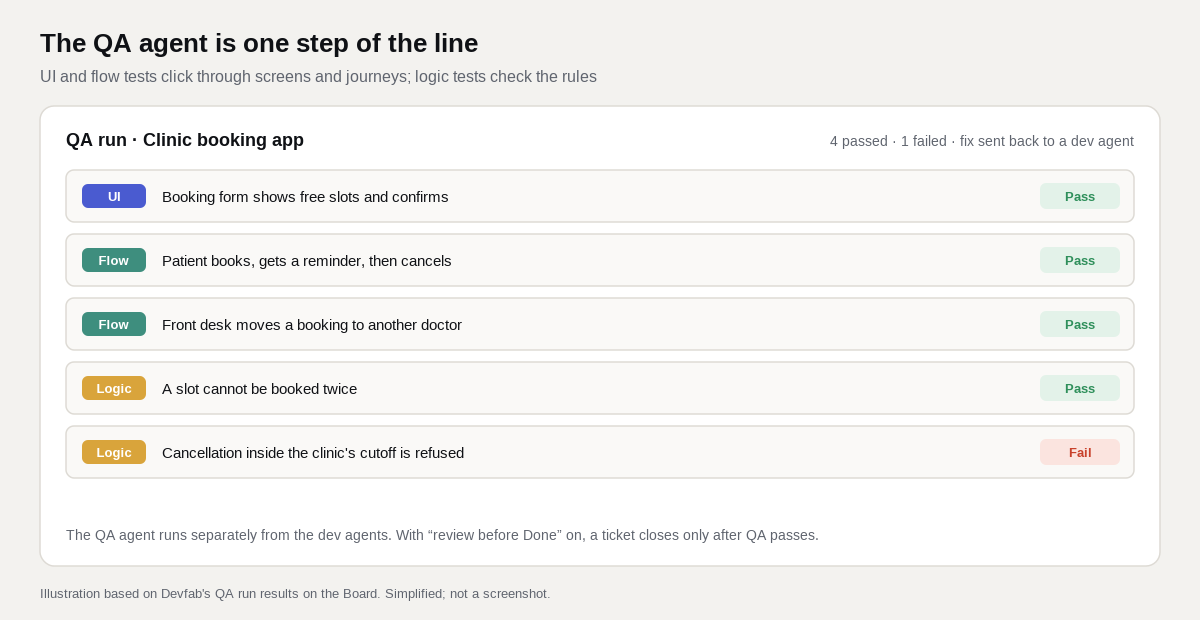
- The QA agent runs UI and flow tests (screens, buttons and user journeys clicked end to end) plus logic tests. With "QA agent · review before Done" switched on, work is checked before it is marked done.
- Deploy ships to your own server.
Coding agents automate the developer. Devfab automates the development lifecycle.
Switching triggers
| Trigger | Testim | Devfab | Source |
|---|---|---|---|
| There is no app yet, only a client brief | Tests need an app to run against | Researcher, Planner and dev agents build it; QA agent tests it | Testim |
| Budget must be known up front | No public prices; trial, demo or Enterprise via sales | Cost logged after each run, per task and per project (Beta) | Testim Enterprise |
| Team wants AI agents to reach the test tool | Tricentis tied its 2025 MCP servers to Tosca, NeoLoad and qTest, not Testim | Agents and QA run inside one workspace | Tricentis news, Jun 2025 |
| A change breaks neighboring features | Catches it after the fact, if a test covers it | ChainFlow shows dev agents the impact before the change | Testim |
| Salesforce Lightning UI keeps moving | Metadata-based locators for dynamic elements | Not stated | Testim |
| Many existing apps need nightly regression | CI, scheduled runs, Selenium grids | Not what Devfab is built for | Testim Enterprise |
Cost model by team size
| Team size | Testim | Devfab |
|---|---|---|
| 1 person | Free trial ("Get started free"); no public plan prices | Cost logged per task and per project (Beta) |
| 5 people | Pricing through Tricentis sales; no edition matrix on the pages we checked | Cost logged per task and per project (Beta) |
| 25 people | Enterprise edition via sales | Cost logged per task and per project (Beta) |
Testim pricing model as of November 2026, from the Testim product page and Testim Enterprise; no prices are shown. Devfab: predictable cost; cost is logged after each run, per task and per project; Devfab is in Beta.
Moving from Testim to Devfab
This is rarely a full move. Your app code already lives in your repository, and Testim tests it from outside. The usual path is to add Devfab for new work and keep Testim for regression.
- Make sure the app's repo is on GitHub. Devfab works with a repository in your own GitHub account or your organization's.
- In Devfab, choose "Work on an existing project". Connect GitHub and pick the repo.
- Leave the change box empty. ChainFlow maps the code first, which functions and APIs call each other and what is deployed, and suggests three small first tickets.
- Approve the plan. The Planner publishes it, and the Coordinator creates tickets only after a person approves.
- Turn on "QA agent · review before Done". The QA agent runs UI, flow and logic tests on each ticket's work.
- Keep Testim on the release branch. Its scheduled runs and test branches can keep guarding the whole app, including Salesforce or mobile parts Devfab doesn't touch.
Where Testim is the better choice
- Regression for apps you already run. Self-healing locators target test maintenance across web, mobile and Salesforce.
- Salesforce orgs. Metadata-based locators handle dynamic Lightning elements that break ordinary selectors.
- You already buy from Tricentis. Testim works with qTest and NeoLoad, so one vendor covers test management and load.
- Mobile apps on many frameworks. Native, hybrid, React Native and Flutter are listed.
- Testers who don't write much code. Record tests, or describe them and let Agentic Test Automation build them.
Where Devfab is the better choice
- You need the app, not only the tests. Research before the plan, an approved plan, tickets, build, QA and deploy run in one workspace.
- Changes that don't break neighbors. ChainFlow shows dev agents the impact of a change across connected functions and APIs, before tests run.
- Tests come with the build. The QA agent clicks screens, buttons and user journeys end to end and runs logic tests on new work.
- Clients want proof and ownership. Code lives in your GitHub, deploys go to your server, and docs include blueprints and user manuals.
- Finance wants cost per job. Cost is logged per task and per project.
Honest limits: Devfab is in Beta, has a smaller community and fewer integrations than Tricentis, is not an editor for hands-on coding, and needs a GitHub account. It is not a test management tool, and it does not run device grids or Salesforce-specific locators.
FAQ
Is Testim a replacement for Devfab, or the other way round?
Neither. Testim tests web, mobile and Salesforce apps you already have, with self-healing locators. Devfab runs the whole lifecycle of a new app or a change to an existing repo, and its QA agent is one step of that. Many teams could use both.
Who owns Testim?
Tricentis. Tricentis announced its acquisition of Testim on February 9, 2022, and Testim is sold today as a Tricentis product for web, mobile and Salesforce test automation.
How much does Testim cost?
The Testim pages we checked in November 2026 show no prices. They offer a free trial, demos and an Enterprise edition through sales. Devfab is in Beta and logs cost after each run, per task and per project.
Does Devfab's QA agent replace a QA team?
No. The QA agent runs UI and flow tests plus logic tests on the work Devfab's dev agents produce, and a person approves the plan. Regression suites for many apps, Salesforce orgs and device grids are jobs where a dedicated testing tool like Testim fits.
Read next
- What is an AI software factory?
- Testim alternatives
- Mabl vs Testim
- What is a QA agent?
- Build page: appointment booking system
Want testing built into delivery, not bolted on after? Try Beta
Sources (checked November 2026): Testim product page (Tricentis); Testim Copilot; Testim Enterprise; Tricentis acquires Testim (Feb 9, 2022); Tricentis leads new era of agentic AI (Jun 24, 2025).
Frequently asked questions
Is Testim a replacement for Devfab, or the other way round?
Neither. Testim tests web, mobile and Salesforce apps you already have, with self-healing locators. Devfab runs the whole lifecycle of a new app or a change to an existing repo, and its QA agent is one step of that. Many teams could use both.
Who owns Testim?
Tricentis. Tricentis announced its acquisition of Testim on February 9, 2022, and Testim is sold today as a Tricentis product for web, mobile and Salesforce test automation.
How much does Testim cost?
The Testim pages we checked in November 2026 show no prices. They offer a free trial, demos and an Enterprise edition through sales. Devfab is in Beta and logs cost after each run, per task and per project.
Does Devfab's QA agent replace a QA team?
No. The QA agent runs UI and flow tests plus logic tests on the work Devfab's dev agents produce, and a person approves the plan. Regression suites for many apps, Salesforce orgs and device grids are jobs where a dedicated testing tool like Testim fits.