Short answer: Momentic wins when you already ship a web or mobile app and want an AI agent to explore it, find bugs and keep end-to-end tests as files in your repo. Devfab wins when you need the app itself planned, built, tested and deployed, with a person approving the plan and a QA agent as one step.
You run delivery for a field-service app that HVAC technicians use on site. Bugs reach them before they reach you. More testing sounds like the fix, and Momentic is a strong way to get it. But if your releases also start without a clear plan, a tester only finds the problem later.
These two products sit at different points in the same pipeline. This page sets out where each one fits, using Momentic's own pages checked in November 2026.
In this comparison:
- What each tool is built for
- Switching triggers
- Cost model by team size
- Where Momentic is the better choice
- Where Devfab is the better choice
The short version: one tests code you have, the other runs the lifecycle that produces it.
What each tool is built for
Momentic
Status, November 2026: active (Momentic). Momentic is an AI QA platform. Its agent, Mo, explores web, iOS and Android apps to find bugs, then writes, runs and maintains tests in plain English.
- Tests live in your repo. Mo turns an approved flow "into a Momentic YAML test and opens a pull request in your repo". A separate agent reproduces each functional bug Mo files (Momentic).
- It plugs into pull requests. Mo can be triggered from PR comments or labels, test the PR's preview deployment and post a review with a commit check (Momentic).
- It heals itself. AI Action V3 "plans the flow up front, caches the resolved steps, and self-heals on failure" (Momentic).
- It talks to coding agents. An MCP server (local or hosted with OAuth) and a Claude Code plugin let your coding agent drive tests (Momentic docs index).
- It runs where you choose. Hosted browsers, iOS simulators, Android emulators or your own CI. Momentic's docs say it is built on Playwright (Momentic docs index).
- It is enterprise-ready. SOC 2 Type 2, SAML/OIDC SSO, RBAC, audit logs and an Enterprise uptime SLA. Named customers include Notion, Webflow and Retool (Momentic).
Momentic's user is a developer or QA team with an app already in production that wants AI-driven coverage.
Devfab
Devfab is an AI software factory. A project moves through seven agents: Researcher, Planner, Coordinator, Developers, Blueprint, QA agent and Deploy.
- The Researcher runs before any plan. For a field-service app it maps key terms (work orders, parts, service windows), best practices and competitors, then suggests a prototype.
- The Planner publishes a plan, and a person approves it. Only then does the Coordinator create tickets for dev agents.
- Developers work with ChainFlow, which maps which functions and APIs call each other and what is deployed. A change to job scheduling shows its impact on technician routes, parts stock and customer notices.
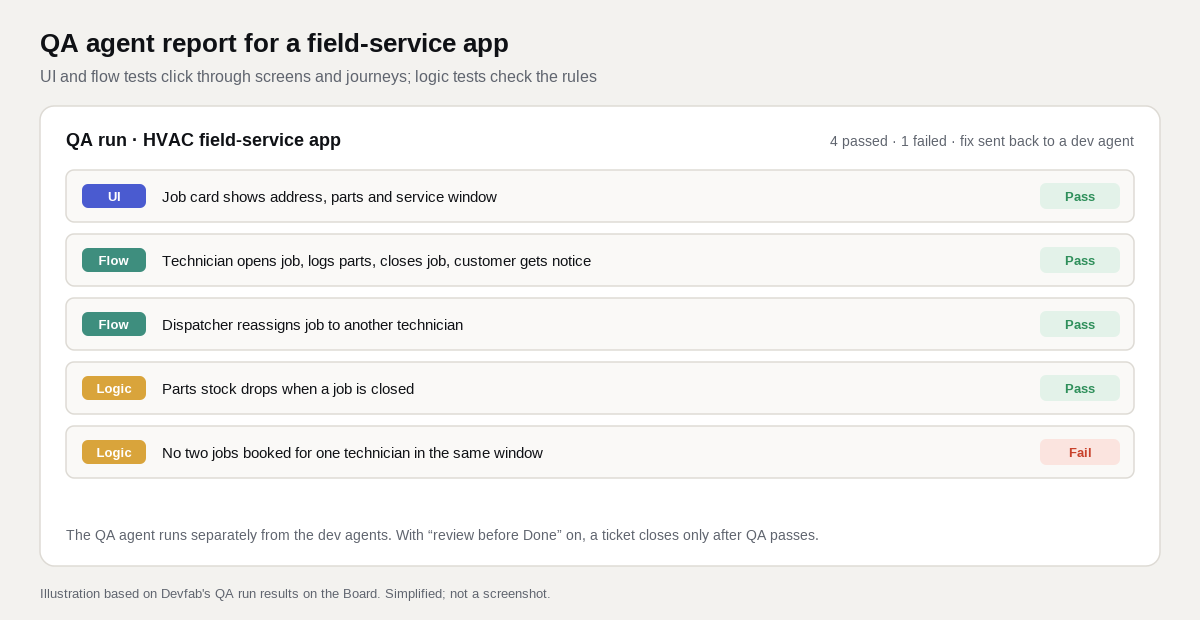
- The QA agent runs UI and flow tests (screens, buttons and user journeys clicked end to end) plus logic tests. Deploy ships to your own server.
Coding agents automate the developer. Devfab automates the development lifecycle. Testing is one stage, not the product.
Switching triggers
These are the documented limits that lead teams to look past a testing tool. None of them means Momentic is weak at testing.
| Trigger | Momentic | Devfab | Source |
|---|---|---|---|
| You need the app built, not only tested | Tests apps built elsewhere, including PR preview deployments | Plans, builds, tests and deploys the app | Momentic |
| You want a plan agreed before work starts | Mo's flows are approved before they become tests; app planning is not covered in the pages we checked | A person approves the plan before tickets exist | Momentic |
| Unused budget is lost | Monthly usage doesn't roll over; Free pauses at zero | Cost logged after each run, per task and per project | Momentic pricing |
| You need history for audits | Results are kept for a limited window on Free and Scale | Team Delivery Report; code and history in your GitHub | Momentic pricing |
| Long mobile journeys | Mobile sessions have a length cap outside Enterprise | QA runs as part of each build; native mobile not stated | Momentic pricing |
| A change keeps breaking other features | Reproduces and reports bugs after the change | ChainFlow shows the impact before the change ships | Momentic |
Cost model by team size
| Team size | Momentic | Devfab |
|---|---|---|
| 1 person | Free: USD 0 a month with USD 50 of usage included | Cost logged per task and per project (Beta) |
| 5 people | Scale: USD 500 a month with USD 500 of usage; no per-seat charges | Cost logged per task and per project (Beta) |
| 25 people | Scale, or Enterprise (custom, test-based) | Cost logged per task and per project (Beta) |
Prices as of November 2026 from Momentic pricing. Steps cost USD 0.0125 each (USD 0.025 for AI-generated or recovery steps) and hosted browsers USD 0.005 a minute. Devfab is in Beta and offers predictable cost: cost is logged after each run, per task and per project.
Moving from Momentic to Devfab
You don't have to leave Momentic to use Devfab. Momentic already works in your repo, so the move is about adding a lifecycle around the code.
- Make sure the app's code is in GitHub, in your own account or your organization's. Momentic's YAML tests stay in the repo.
- In Devfab, choose "Work on an existing project" and pick the repository.
- Leave the change box empty. ChainFlow maps the code first and suggests three small first tickets.
- Review and approve the plan. The Coordinator turns it into tickets for dev agents.
- Turn on "QA agent · review before Done". The QA agent runs UI, flow and logic tests on each ticket's work.
- Deploy to your own server from the Deploy tab when the work is ready.
Where Momentic is the better choice
- Your app is built and live, and coverage is the gap. Mo explores the app, files bugs and writes tests you review as pull requests.
- You test native mobile apps. Momentic runs iOS simulators and Android emulators; native mobile testing in Devfab is not stated.
- Your developers live in a coding agent. The MCP server and Claude Code plugin let them create and run tests without leaving it.
- You want to start free. The Free plan includes USD 50 of usage and no seat fees.
- Compliance teams need a mature vendor today. SOC 2 Type 2, SSO, RBAC and audit logs are listed now.
Where Devfab is the better choice
- Research before the plan. The Researcher maps the domain, terms and competitors, then suggests a prototype.
- A plan a person approves. Tickets exist only after approval, so scope is agreed first.
- Fewer broken neighbours. ChainFlow shows which functions, APIs and deployed parts a change touches.
- QA as part of delivery. UI, flow and logic tests run on what the dev agents built, inside the same workspace.
- Ownership end to end. Code in your GitHub, deploy to your own server, with blueprints and user manuals.
- Cost per task and per project, logged after each run.
Devfab's honest limits: it is in Beta, with a smaller community and fewer integrations than Momentic. It is not an editor for hands-on coding, and it needs a GitHub account. Native mobile testing is not stated.
FAQ
Is Momentic a competitor to Devfab?
Only partly. Momentic tests apps you already build, with its agent Mo exploring web, iOS and Android apps and writing tests as YAML in your repo. Devfab plans, builds, tests and deploys an app. Its QA agent is one step of that lifecycle, so many teams could use both.
Can Momentic test an app that Devfab built?
Momentic tests apps built elsewhere, including PR preview deployments, and Devfab puts code in your own GitHub account. Nothing in Momentic's docs we checked rules out a Devfab-built web app, but we have not tested that pairing.
How does Momentic pricing work?
Momentic is usage-based, with no per-seat charges. As of November 2026, Free is USD 0 with USD 50 of usage, Scale is USD 500 a month with USD 500 of usage, and Enterprise is custom. Monthly usage does not roll over.
Does Devfab write tests into my repo like Momentic?
Devfab's QA agent runs UI and flow tests, clicking screens, buttons and user journeys end to end, plus logic tests on what its dev agents built. The code lives in your GitHub. Momentic's YAML test files are its own format, opened as pull requests by Mo.
Read next
- What is an AI software factory?
- Momentic alternatives
- Momentic vs QA Wolf
- AI code review vs a QA agent
- What is a QA agent?
Need the whole build, with testing as one step? Try Beta
Sources (checked November 2026): Momentic homepage; Momentic pricing; Momentic llms.txt (docs index).
Frequently asked questions
Is Momentic a competitor to Devfab?
Only partly. Momentic tests apps you already build, with its agent Mo exploring web, iOS and Android apps and writing tests as YAML in your repo. Devfab plans, builds, tests and deploys an app. Its QA agent is one step of that lifecycle, so many teams could use both.
Can Momentic test an app that Devfab built?
Momentic tests apps built elsewhere, including PR preview deployments, and Devfab puts code in your own GitHub account. Nothing in Momentic's docs we checked rules out a Devfab-built web app, but we have not tested that pairing.
How does Momentic pricing work?
Momentic is usage-based, with no per-seat charges. As of November 2026, Free is USD 0 with USD 50 of usage, Scale is USD 500 a month with USD 500 of usage, and Enterprise is custom. Monthly usage does not roll over.
Does Devfab write tests into my repo like Momentic?
Devfab's QA agent runs UI and flow tests, clicking screens, buttons and user journeys end to end, plus logic tests on what its dev agents built. The code lives in your GitHub. Momentic's YAML test files are its own format, opened as pull requests by Mo.