Short answer: Devin wins for any new work: it is active, takes tasks from Slack, Teams, Linear, Jira, a CLI or the web, and returns pull requests. Google Jules wins only as the source of your history: it stopped new tasks on November 11, 2026, so use it now to export settings and sessions before December 31.
You handed routine tickets to Jules, and it quietly cleared your backlog. Then the email arrived. Jules stops taking work, and your scheduled tasks stop with it.
Some teams will move straight to Devin, the best-known cloud agent. Others will wait for Google's next tool. This page compares both agents fairly and shows what to save first, using vendor pages checked in November 2026.
In this comparison:
- Devin and Google Jules at a glance
- Feature comparison
- Cost model by team size
- Switching from one to the other
- Where Devfab fits
The export steps come before any buying decision.
Devin and Google Jules at a glance
Google Jules is shutting down. Google announced on October 29, 2026 that Jules winds down on December 31, 2026. New sessions ended November 11, and Jules is read-only until year end (Jules changelog). Users can export settings, environment variables, scheduled tasks, repos, memories and session history with Jules Tools; code, branches and PRs stay in GitHub (same source). Google says lessons from Jules will feed into Antigravity, but has given no date for Jules features to appear there (Times of AI, Oct 30, 2026).
While it ran, Jules was Google's asynchronous coding agent. It ran "in a virtual machine where it clones your code, installs dependencies, and modifies files," and produced a plan you "can review and approve" before code changes (Jules docs).
Devin is active and growing. Cognition describes it as "an autonomous AI software engineer that can write, run and test code" (Devin docs). Since June 2, 2026, the Devin family also includes Devin Desktop, formerly Windsurf (Devin Desktop FAQ). It suits engineering teams working through backlogs.
Feature comparison
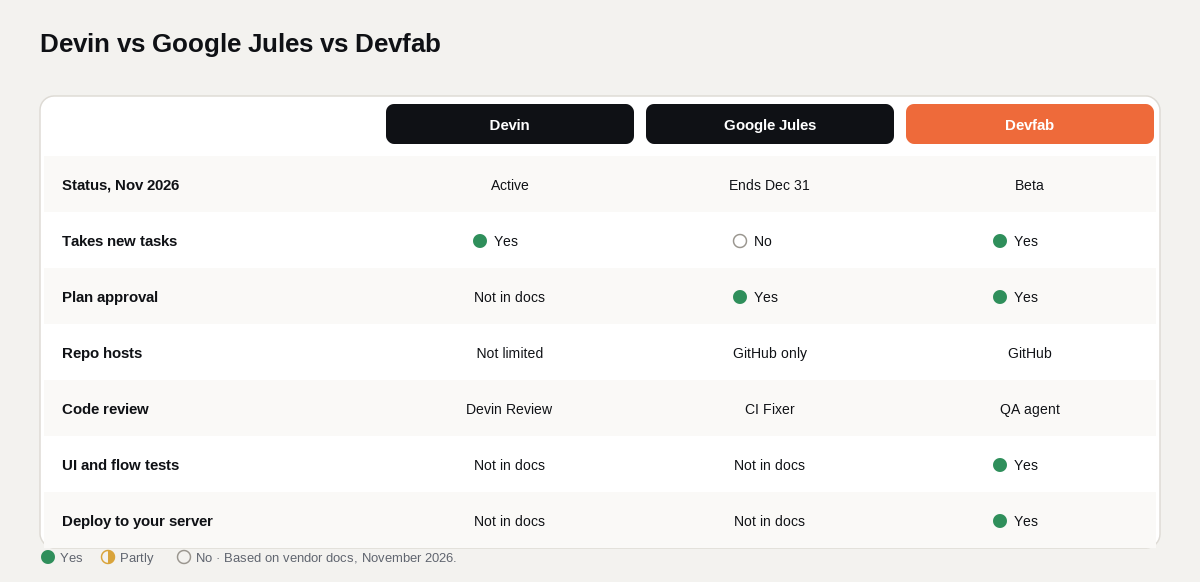
| Aspect | Devin | Google Jules | Source |
|---|---|---|---|
| Status, Nov 2026 | Active | Read-only; shuts down Dec 31, 2026 | Jules changelog |
| Where it runs | Web app, Slack and Teams, Devin for Terminal CLI, API, Devin Desktop | Web app, Jules Tools CLI, REST API, "jules" label on GitHub issues | Devin docs; Jules docs; Jules |
| Workspace | Shell, IDE and browser per session; you can watch and take over | Cloud VM that clones the repo and installs dependencies | Same as above |
| Planning | Not covered as an approval step in the pages we checked | Plan to review and approve before changes; Planning Critic for auto-approved plans | Jules docs; Jules changelog |
| Multi-agent and review | Subagents each open their own PRs; built-in Devin Review | CI Fixer fixed failing CI checks on Jules PRs | Devin Desktop; Jules changelog |
| Repo hosts | Not limited in the pages we checked | GitHub only | Jules docs |
| Team and admin | Teams: SSO, centralized billing, cost controls; Enterprise: SCIM, RBAC, VPC | Tied to Google AI plans | Devin pricing; Jules |
| Model choice | Not covered in the pages we checked | Gemini only (Gemini 3 Flash base, Gemini 3.1 Pro for Pro users) | Jules changelog |
| Pricing model | Free, Pro, Max, Teams (team fee plus seats), Enterprise (ACUs) | Tiers tied to Google AI plans with daily task and concurrency caps | Devin pricing; Jules |
Cost model by team size
| Team size | Devin | Google Jules |
|---|---|---|
| 1 person | Free; Pro USD 20 per month; Max USD 200 per month | No new tasks; was bundled with Google AI plans |
| 5 people | Teams: USD 80 per month team fee plus USD 40 per month per full dev seat | Not available for new work |
| 25 people | Teams (up to 100 users) or Enterprise, custom, measured in Agent Compute Units | Not available for new work |
Devin prices as of November 2026 from Devin pricing; extra usage is billed at API rates, and Enterprise usage is measured in ACUs (Devin usage docs). Jules showed no prices on its own page (Jules).
Where Devin wins
- It is still taking work. That alone decides most cases after November 11, 2026.
- Tasks start where your team talks. Tag Devin in Slack or Teams, or send tickets from Linear and Jira (Devin docs).
- Big jobs split up. Devin can hand long tasks to subagents, each opening its own PRs, and review them with Devin Review (Devin Desktop).
- You need private deployment. Devin offers a single-tenant VPC hosted by Cognition, though its "brain" still runs in Cognition's cloud (Devin enterprise docs).
Where Google Jules wins
Jules can't take new work, so this list is about what it did well and what to look for in its replacement:
- A plan before code. Jules asked you to approve its plan; keep that habit in whatever you pick next.
- GitHub-native triggers. A "jules" label on an issue started a task, with no separate app to open.
- Fixing its own CI. CI Fixer repaired failing checks on Jules PRs.
- Scheduled and suggested tasks ran routine work without a prompt.
Switching from one to the other
- Export from Jules now. Use Jules Tools to export settings, environment variables, scheduled tasks, repos, memories and session history before December 31 (Jules changelog).
- Keep the repo as it is. Your code, branches and PRs are already in GitHub.
- Carry over instructions. Jules read AGENTS.md (Jules docs); keep that file, since other agents read it too.
- Recreate scheduled tasks in your new tool, and write clear completion criteria: Devin's docs say results depend on explicit criteria and easy-to-verify tasks (Devin docs).
More options are in Google Jules alternatives and Devin alternatives.
Where Devfab fits
Jules and Devin both take a ticket and return a pull request. The work around the ticket, deciding what to build, testing user journeys and shipping, stays with your team.
Coding agents automate the developer. Devfab automates the development lifecycle. Devfab's Researcher maps the domain before the Planner writes a plan, and a person approves the plan, much like Jules's approval step but for a whole project. Then dev agents work with ChainFlow, which maps which functions and APIs call each other, and the QA agent runs UI, flow and logic tests. Devfab is in Beta, with a smaller community and fewer integrations than Devin. See Devfab vs Devin.
FAQ
Is Google Jules shutting down?
Yes. Google announced on October 29, 2026 that Jules winds down on December 31, 2026. New sessions ended on November 11, 2026, and Jules is read-only until the end of the year, according to the Jules changelog.
What happens to my code when Jules closes?
Your code, branches and pull requests stay in GitHub. Before the shutdown, you can use Jules Tools to export settings, environment variables, scheduled tasks, repos, memories and session history.
Is Devin a direct replacement for Jules?
Close, for the main job. Both take a task, work in a cloud machine and return a pull request. Devin adds Slack and Teams hand-off, a CLI, a desktop app, subagents and Devin Review. Jules's plan-approval step and GitHub label trigger have no exact match in the Devin pages we checked.
How much does Devin cost compared with Jules?
As of November 2026, Devin's pricing page lists Free, Pro at USD 20 per month, Max at USD 200 per month, Teams at USD 80 per month plus USD 40 per full dev seat, and custom Enterprise. Jules tiers were tied to Google AI plans and showed no prices on the Jules page.
Read next
Moving off Jules? Try a factory that plans, tests and ships the whole app. Try Beta
Sources (checked November 2026): Jules changelog; Jules docs; Jules home; Times of AI: Google to shut down Jules (Oct 30, 2026); Devin docs: Introducing Devin; Devin pricing; Devin docs: Desktop usage and billing; Devin docs: Enterprise deployment overview; Devin Desktop; Devin Desktop FAQ.
Frequently asked questions
Is Google Jules shutting down?
Yes. Google announced on October 29, 2026 that Jules winds down on December 31, 2026. New sessions ended on November 11, 2026, and Jules is read-only until the end of the year, according to the Jules changelog.
What happens to my code when Jules closes?
Your code, branches and pull requests stay in GitHub. Before the shutdown, you can use Jules Tools to export settings, environment variables, scheduled tasks, repos, memories and session history.
Is Devin a direct replacement for Jules?
Close, for the main job. Both take a task, work in a cloud machine and return a pull request. Devin adds Slack and Teams hand-off, a CLI, a desktop app, subagents and Devin Review. Jules's plan-approval step and GitHub label trigger have no exact match in the Devin pages we checked.
How much does Devin cost compared with Jules?
As of November 2026, Devin's pricing page lists Free, Pro at USD 20 per month, Max at USD 200 per month, Teams at USD 80 per month plus USD 40 per full dev seat, and custom Enterprise. Jules tiers were tied to Google AI plans and showed no prices on the Jules page.