Short answer: Google Jules is read-only now and shuts down on December 31, 2026. If you assigned GitHub issues to Jules, move to GitHub Copilot's cloud agent. If you relied on background and scheduled tasks, pick OpenAI Codex or Claude Code. If you valued Jules' plan approval and want testing and deployment too, try Devfab.
Your Jules setup worked. You labeled an issue, approved a plan and reviewed the pull request. Then Google announced the wind-down. New sessions ended on November 11, and Jules goes dark on December 31. The code is safe in GitHub. The habits are not. Scheduled tasks, setup scripts and memories live inside Jules, and they need a new home before the export window closes.
In this guide, you'll learn:
- Why teams leave Google Jules and what to export first
- The quick comparison of six replacements
- Where Google Jules is still the better choice until year end
- How to choose by the Jules feature you used most
Use the sections below as your migration playbook.
Why teams leave Google Jules
This year, the reason is simple: Jules is closing. Here is the timeline from the Jules changelog:
- October 29, 2026: Google announced that Jules will wind down "as part of our work to unify our agentic coding efforts."
- November 11, 2026: last day to finish sessions. Since then, Jules is read-only.
- December 31, 2026: Jules shuts down.
What you can take with you: Google's export runs through Jules Tools (the @google/jules npm package). It saves your settings, environment variables, scheduled tasks, connected repositories, memories, setup scripts and every session, with its prompt, plan, activity log and code patches. The output goes to a local jules-export folder. The changelog warns that env-variables.json holds your real environment variable values, so keep that folder private and out of your repositories. Code, branches and pull requests are not touched; they stay in GitHub.
Google says lessons from Jules feed into Antigravity, its agent platform, but it has not named an official migration path. Times of AI reported no date for Jules' capabilities to appear there.
Before the shutdown, Jules had a clear shape. It cloned your repo into a cloud VM, installed dependencies and proposed a plan you could review and approve before any code changed (Jules docs). You could start a task with a "jules" label on a GitHub issue. In 2026 it added edit, pause and resume for scheduled tasks, a Planning Critic for auto-approved plans, MCP connections (Linear, Supabase, Neon and others) and a CI Fixer that repaired failing checks on its own pull requests. It worked with GitHub repositories only and used Gemini models only. Those are the features to replace.
Quick comparison
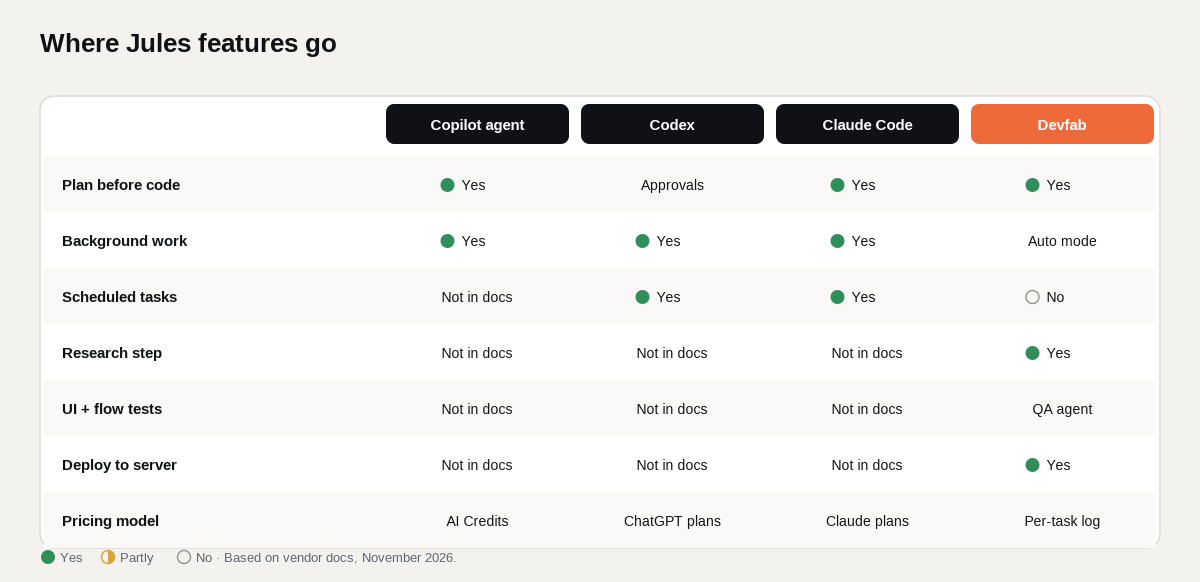
| Tool | Closest Jules habit it replaces | Where it runs | Plan before code | Background or scheduled work | Pricing model |
|---|---|---|---|---|---|
| GitHub Copilot cloud agent | Assign an issue, get a PR | GitHub, IDEs, CLI, mobile | Implementation plan before changes | Cloud agent sessions | Seats plus GitHub AI Credits |
| OpenAI Codex | Async cloud tasks | ChatGPT apps, CLI, IDE, cloud, GitHub, Slack | Approvals and permissions | Cloud tasks, scheduled tasks | Included in ChatGPT plans |
| Claude Code | Plan approval, scheduled work | Terminal, IDEs, desktop, web, mobile | Plan mode | Cloud scheduled tasks | Included in paid Claude plans or API |
| Google Antigravity | Staying with Google and Gemini | Desktop app, CLI, SDK | Not covered in sources we checked | Scheduled background tasks | Google AI plans with usage caps |
| Devfab | Plan approval, for a whole project | Web workspace + your GitHub | Research, then a plan a person approves | Auto mode, asks when needed | Cost logged per task and per project (Beta) |
| Devin | Hand off tickets from chat | Web, Slack, Teams, CLI, API | Scoped tasks with clear criteria | Parallel cloud sessions | Usage-based; ACUs on Enterprise |
The alternatives
1. GitHub Copilot cloud agent
Verdict: the closest match to "label an issue, review the PR." Best for: teams whose issues, code and reviews already live on GitHub. Trade-off: one repository, one branch and one pull request per Actions-based task, with a time cap per session. Pricing: plans billed in GitHub AI Credits. Business is USD 19 and Enterprise USD 39 per seat per month, as of November 2026 (GitHub plans).
- Tasks start from an issue, a pull request, a repository's Agents tab, the Copilot home page, the IDE, the CLI or GitHub Mobile (GitHub Docs).
- The cloud agent can research a repository and create an implementation plan before it changes code (GitHub features).
- Like Jules, it only works with repositories hosted on GitHub.
- A new "Copilot in the cloud" experience reached paid plans on October 28, 2026.
2. OpenAI Codex
Verdict: the best fit if you used Jules mainly for background work. Best for: teams already paying for ChatGPT. Trade-off: OpenAI models only; with an API key instead of a plan, GitHub code review and Slack are not available. Pricing: included in ChatGPT plans, with usage limits and credits beyond them (Codex pricing).
- Cloud tasks keep running after you close your laptop, and you can pick them up from another device (OpenAI Codex).
- It reads AGENTS.md, which Jules also read, so your project instructions carry over (Codex docs).
- Scheduled tasks, automatic pull request review and a GitHub Action are documented.
- The Codex CLI is open source under Apache-2.0 (GitHub).
3. Claude Code
Verdict: the best fit if you liked approving a plan before code changed. Best for: developers who want one agent across terminal, IDE, web and CI. Trade-off: Claude models only; the desktop app needs a paid plan. Pricing: included in paid Claude plans (Pro, Max, Team, Enterprise) or billed per token through the API (Claude pricing).
- Plan mode explores the codebase and proposes an approach for approval before editing (Claude Code docs).
- Cloud scheduled tasks run while your computer is off and can trigger on GitHub events, a close match to Jules' scheduled tasks (Claude Code overview).
- It runs in GitHub Actions and GitLab CI/CD, and accepts AGENTS.md as project instructions.
4. Google Antigravity
Verdict: the path Google points to, but not a like-for-like Jules replacement. Best for: teams that want to stay with Google, Gemini, Firebase and Android tooling. Trade-off: a desktop app and CLI rather than a GitHub-first async agent; reviewers report usage caps. Pricing: tied to Google AI plans; see Google's pricing page.
- Antigravity 2.0 launched at Google I/O in May 2026 with a desktop app, a new CLI built in Go and an SDK (The Next Web).
- It runs several agents at once, supports custom subagent workflows and schedules tasks in the background.
- A June 2026 review reports four quota cuts between December 2025 and March 2026, and notes no JetBrains support because Antigravity is a VS Code fork (DEV review).
- The Jules changelog's export prompt is meant to be run from a CLI coding agent such as Antigravity CLI.
5. Devfab
Verdict: for teams that liked Jules' plan approval and want it for whole projects, plus testing and deployment. Best for: agencies and product teams taking an app from idea or existing repo to production. Trade-off: new and in Beta; not a task-by-task coding agent. Pricing: predictable cost: cost is logged after each run, per task and per project.
Devfab is an AI software factory with seven agents: Researcher, Planner, Coordinator, Developers, Blueprint, QA agent and Deploy. A person approves the plan before tickets are created. See Where Devfab fits.
6. Devin
Verdict: for teams that want to hand tickets to an agent from chat. Best for: backlogs of well-scoped tickets from Linear or Jira. Trade-off: Devin's "brain" always runs in Cognition's cloud, even in dedicated deployments (Devin docs). Pricing: Free, Pro and Max individual tiers, Teams and Enterprise; Enterprise usage in Agent Compute Units (Devin pricing).
- You can tag Devin in Slack or Microsoft Teams, use its CLI, or call the API (Devin docs).
- Cognition says Devin works best on tasks with clear completion criteria that are easy to verify.
Where Devfab fits
Jules automated one task at a time. Devfab automates the process around the tasks. Coding agents automate the developer. Devfab automates the development lifecycle.
- Research before the plan. Before any plan, Devfab's research step maps the domain: key terms, best practices for that kind of app, and competitors. Then it suggests a prototype.
- A plan a person approves. The workspace shows "Your turn: the Planner published the plan. Approve it so the Coordinator can create the tickets." Jules users will recognize the idea, applied to a whole project.
- ChainFlow. Devfab's code-intelligence layer maps which functions and APIs call each other and what is deployed. Developer agents see the impact of a change before they make it. A change to checkout can touch payments, inventory, order confirmation and notifications.
- QA agent. It runs UI and flow tests (screens, buttons and user journeys clicked end to end) plus logic tests. Jules' CI Fixer repaired failing checks; the QA agent tests what users actually click.
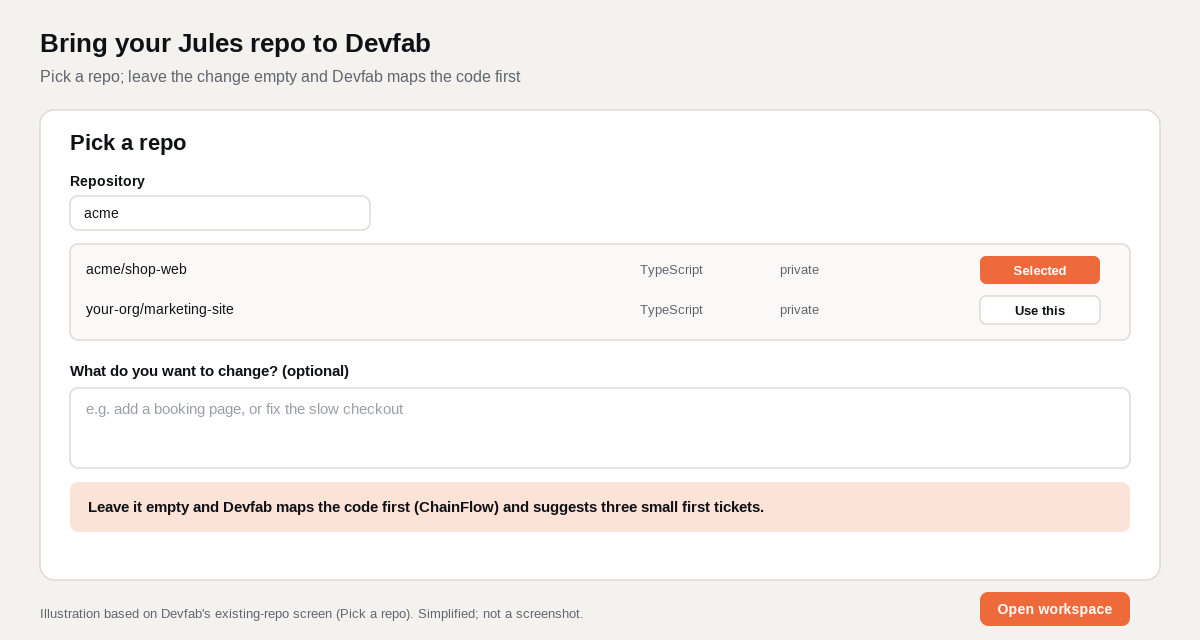
Moving a Jules repo to Devfab:
- Run the Jules export before December 31 and keep
env-variables.jsonprivate. - Your code, branches and pull requests are already in GitHub. Nothing to move.
- In Devfab, choose "Work on an existing project" and pick the repo.
- Leave the change box empty. ChainFlow maps the code first and suggests three small first tickets.
- Approve the plan. The QA agent runs UI, flow and logic tests before work is marked Done.
Code stays in your own GitHub account (or your organization's), and you deploy to your own server. You can choose the model for each agent or keep Devfab's default.
Devfab's honest limits:
- It's new and in Beta, with a smaller community than any tool on this list.
- It has fewer integrations. Jules users who relied on MCP links to Linear or Supabase should check what Devfab connects to today.
- It isn't an editor for hands-on coding, and it isn't built for quick one-off tasks.
- It needs a GitHub account, as Jules did.
Where Google Jules is still the better choice
- Reading your history. Until December 31, Jules is the only place to browse past sessions, plans and activity logs in its own interface. Export them anyway.
- Recovering setup knowledge. Your setup scripts and environment variables in Jules are the fastest way to rebuild environments in a new tool.
- Nothing else, for new work. Jules stopped accepting new tasks on November 11, 2026. Treat it as an archive.
Until then, each alternative beats the others in a specific case. Copilot wins for GitHub-native issue assignment. Codex wins for ChatGPT teams. Claude Code wins for scheduled work across terminal and CI. Antigravity wins if you must stay on Gemini.
How to choose
- You assigned issues with the "jules" label? GitHub Copilot cloud agent.
- You ran many background tasks? OpenAI Codex.
- You ran scheduled tasks and liked plan approval? Claude Code.
- Your team is committed to Google and Gemini? Google Antigravity, after checking its usage caps.
- You want research, an approved plan, UI and flow tests and deploy to your own server for whole projects? Devfab. The AI software factory vs AI coding tools guide explains the difference.
- You hand off tickets from Slack or Teams? Devin.
Whatever you pick, run the export first. It is the one step with a hard deadline.
FAQ
When does Google Jules shut down?
Google announced on October 29, 2026 that Jules winds down on December 31, 2026. Users could finish sessions until November 11, 2026. After that, Jules is read-only until the end of the year.
What happens to my code when Jules closes?
Your code, branches and pull requests stay in GitHub. The Jules export covers what lives inside Jules: settings, environment variables, scheduled tasks, connected repositories, memories, setup scripts and session history, including plans and code patches.
What is the closest replacement for Jules?
For the same habit of assigning a GitHub issue and getting a pull request back, GitHub Copilot's cloud agent is the closest. For background tasks and schedules, OpenAI Codex and Claude Code both fit. Google itself points to Antigravity, its agent platform.
Is Devfab a drop-in replacement for Jules?
No. Jules took single coding tasks. Devfab runs a whole project: research, a plan a person approves, tickets, a QA agent with UI, flow and logic tests, and deploy to your own server. It works on existing GitHub repos, but it is new and in Beta.
Read next
Leaving Jules? Bring your repo and approve the plan first. Try the Devfab Beta
Sources (checked November 13, 2026): Jules changelog; Jules docs; Jules home; Times of AI: Google to shut down Jules (Oct 30, 2026); SmartScope: Google Jules shutting down (Oct 30, 2026); GitHub Docs: About Copilot cloud agent; GitHub Docs: Copilot features; GitHub Docs: Plans for Copilot; OpenAI Codex; ChatGPT + Codex docs; Codex pricing; openai/codex on GitHub; Claude Code overview; Claude Code: Manage costs; Claude pricing; The Next Web: Antigravity 2.0 (May 19, 2026); DEV: Google Antigravity 2.0 review (Jun 2, 2026); Devin docs: Introduction; Devin docs: Enterprise deployment; Devin pricing.
Frequently asked questions
When does Google Jules shut down?
Google announced on October 29, 2026 that Jules winds down on December 31, 2026. Users could finish sessions until November 11, 2026. After that, Jules is read-only until the end of the year.
What happens to my code when Jules closes?
Your code, branches and pull requests stay in GitHub. The Jules export covers what lives inside Jules: settings, environment variables, scheduled tasks, connected repositories, memories, setup scripts and session history, including plans and code patches.
What is the closest replacement for Jules?
For the same habit of assigning a GitHub issue and getting a pull request back, GitHub Copilot's cloud agent is the closest. For background tasks and schedules, OpenAI Codex and Claude Code both fit. Google itself points to Antigravity, its agent platform.
Is Devfab a drop-in replacement for Jules?
No. Jules took single coding tasks. Devfab runs a whole project: research, a plan a person approves, tickets, a QA agent with UI, flow and logic tests, and deploy to your own server. It works on existing GitHub repos, but it is new and in Beta.