Short answer: OpenAI Codex wins: it is active, included in ChatGPT plans, and runs cloud tasks, a CLI, an IDE extension and PR reviews. Google Jules took its last new task on November 11, 2026 and shuts down on December 31, 2026. Jules only wins as a read-only archive you should export before year end.
You liked the idea of assigning a ticket and walking away. Jules and Codex both sold that idea: the agent clones the repo in the cloud, works, and comes back with a pull request. In 2025 people compared them task for task. In late 2026, one of them has an end date.
This page is the referee for teams moving a Jules backlog. Facts come from Google and OpenAI pages re-checked on November 20, 2026.
In this comparison:
- OpenAI Codex and Google Jules at a glance
- Feature comparison
- Cost model by team size
- Switching from one to the other
- Where Devfab fits
The order follows a migration checklist.
OpenAI Codex and Google Jules at a glance
Google Jules is closing. Google announced on October 29, 2026 that Jules winds down on December 31, 2026. New sessions ended on November 11, 2026, and Jules is read-only until year end. Users can export settings, environment variables, scheduled tasks, repos, memories and session history with Jules Tools (Jules changelog). Google says lessons from Jules will feed into Antigravity, with no date given (Times of AI).
Jules ran each task in a cloud virtual machine that cloned your code, installed dependencies and changed files, after a plan you could approve (Jules docs). It added a CI Fixer for failing checks and MCP support for tools such as Linear and Supabase in early 2026 (Jules changelog).
OpenAI Codex is active. Codex runs in the ChatGPT desktop, web and mobile apps, a CLI, an IDE extension, cloud environments, GitHub and Slack (ChatGPT + Codex docs). On July 9, 2026 its desktop app became part of a combined ChatGPT desktop app (The New Stack). Codex cloud tasks create a container, check out the repo, run a setup script and run the agent with internet access off by default, ending with a diff or PR; that docs page is now labeled "Codex Cloud (Legacy)" (Codex cloud environment).
Feature comparison
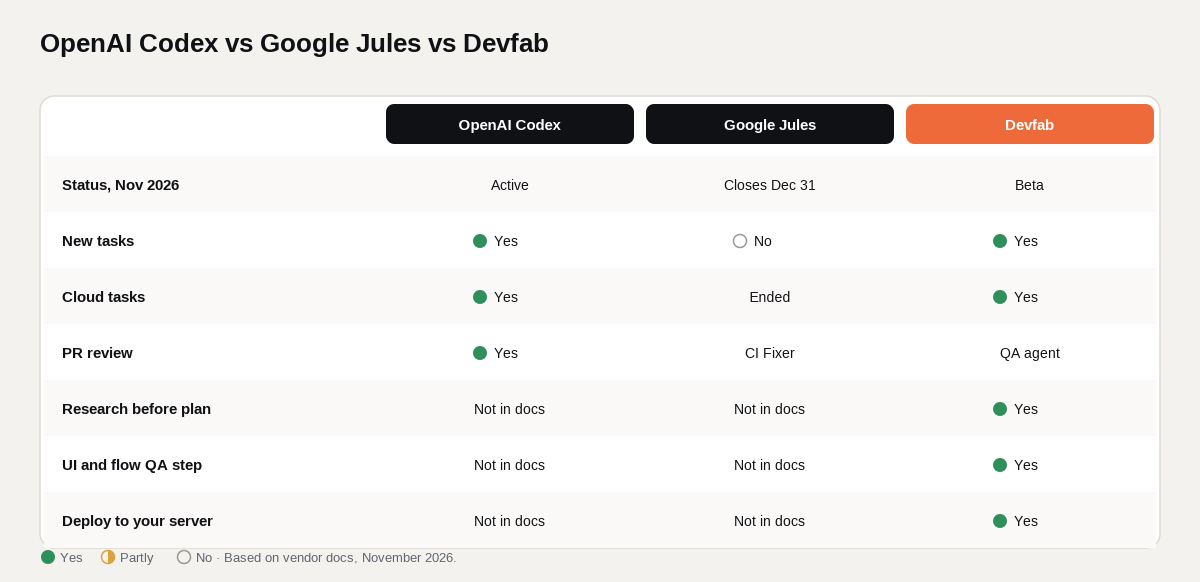
| Aspect | OpenAI Codex | Google Jules | Source |
|---|---|---|---|
| Status, Nov 2026 | Active | No new tasks since Nov 11; closes Dec 31, 2026 | The New Stack; Jules changelog |
| Where it runs | ChatGPT apps, CLI, IDE extension, cloud, GitHub, Slack | Web app, Jules Tools CLI, REST API, GitHub label | ChatGPT + Codex docs; Jules docs |
| Planning | Agent approvals and permissions documented | Plan to review and approve; Planning Critic | ChatGPT + Codex docs; Jules changelog |
| Agent autonomy | Parallel agents; cloud tasks continue after you close your laptop; scheduled tasks | Cloud VM per task; scheduled and suggested tasks | Codex; Jules changelog |
| Testing and review | Checks its own work with computer and browser tools; automatic PR review | CI Fixer for failing checks on its own PRs | Codex; Jules changelog |
| Deploy and hosting | Not covered in the docs we checked | Not covered in the docs we checked | — |
| Repo hosts | GitHub integration; CLI and IDE work on any local repo | GitHub only | ChatGPT + Codex docs; Jules docs |
| Team and admin | Business: SAML SSO, MFA; Enterprise: SCIM, RBAC, audit logs | Not covered in the docs we checked | Codex pricing docs |
| Model choice | OpenAI GPT models | Gemini only | Codex pricing docs; Jules changelog |
| Pricing model | Included in ChatGPT plans; credits after limits | Tied to Google AI plans with daily task caps | Codex pricing docs; Jules |
Cost model by team size
| Team size | OpenAI Codex | Google Jules | Devfab |
|---|---|---|---|
| 1 person | Plus USD 20 per month; Pro from USD 100 per month | Not available for new work | Cost logged per task and per project (Beta) |
| 5 people | Business USD 20 per user per month billed annually (2+ users), or USD 25 billed monthly | Not available for new work | Cost logged per task and per project (Beta) |
| 25 people | Business, or Enterprise via sales | Not available for new work | Cost logged per task and per project (Beta) |
Codex prices as of November 2026 from the ChatGPT + Codex pricing docs. With an API key instead of a plan, GitHub code review and Slack are not available. Jules showed no prices on its page (Jules). Devfab is in Beta and offers predictable cost: cost is logged after each run, per task and per project.
Where OpenAI Codex wins
- Any task you start today. Jules takes no new tasks.
- You want to start work from many places: ChatGPT apps, the terminal, your IDE, GitHub or Slack.
- You want reviews, not only changes. Codex reviews pull requests automatically and answers questions about findings.
- You want an open-source CLI. The Codex CLI is Apache 2.0 (openai/codex).
- Your company needs admin controls: SAML SSO on Business; SCIM, RBAC, audit logs and data residency on Enterprise.
Where Google Jules won, and what to carry over
- Starting tasks from a GitHub label with nothing installed. Recreate this with the Codex GitHub integration.
- A plan before each change, plus a critic for auto-approved plans. Keep a plan step in your AGENTS.md rules.
- CI repair on its own PRs. Add a rule that the agent must get CI green before review.
These were real strengths, but none can be used for new work after November 11, 2026.
Switching from one to the other
From Jules to Codex. Your code, branches and pull requests are already in GitHub. Before December 31, 2026, export settings, environment variables, scheduled tasks and session history with Jules Tools (Jules changelog). Keep your AGENTS.md: Jules read it, and Codex documents AGENTS.md support (ChatGPT + Codex docs). Put the install steps Jules used into a Codex cloud environment setup script, rebuild schedules as Codex scheduled tasks, and re-add MCP servers.
From Codex to Jules. Not possible for new work.
Where Devfab fits
Codex and Jules both automate one ticket at a time. Someone still has to decide what the tickets are, check that the app works for real users, and put it on a server. In the docs we checked, neither covers research before planning, a separate QA step on user journeys, or deployment.
Coding agents automate the developer. Devfab automates the development lifecycle. For a food bank's volunteer scheduling app, Devfab's Researcher maps shift, sign-up and reminder practices before the Planner writes a plan. A person approves the plan, the Coordinator creates tickets, the QA agent tests that a volunteer can sign up, get a reminder and cancel, and Deploy ships to your own server. Devfab is in Beta, has a smaller community and needs a GitHub account. See Devfab vs Google Jules.
FAQ
Is OpenAI Codex a good replacement for Google Jules?
For the same style of work, yes. Both take a task, work on your repo in the cloud and return a diff or pull request. Codex cloud tasks keep running after you close your laptop, Codex reviews pull requests, and it supports AGENTS.md, which Jules also read.
When does Google Jules stop working?
Jules stopped accepting new sessions on November 11, 2026 and is read-only until it shuts down on December 31, 2026. Google announced the wind-down on October 29, 2026. Code, branches and pull requests it created stay in your GitHub repositories.
Does Codex work only with GitHub, like Jules?
Codex has a GitHub integration and GitHub Action, and its CLI and IDE extension work on any local repository. Jules worked with GitHub repositories only. If your code is on another host, test Codex's local tools first.
How much does Codex cost compared with Jules?
Jules tiers were tied to Google AI plans and its page showed no prices. Codex is included in ChatGPT plans; as of November 2026, Plus is USD 20 per month and Business is USD 20 per user per month billed annually, with usage limits and optional credits.
Read next
- What is an AI software factory?
- Google Jules alternatives for teams that ship to production (2026)
- Claude Code vs Google Jules
- Cursor vs OpenAI Codex
Moving your Jules backlog? Plan it, test it and ship it in one place. Try Beta
Sources (checked November 2026): Jules changelog; Jules docs; Jules; Times of AI: Google to shut down Jules (Oct 30, 2026); OpenAI Codex; ChatGPT + Codex docs; ChatGPT + Codex docs: pricing; Codex cloud environment; GitHub: openai/codex; The New Stack: Codex joins ChatGPT desktop app (Jul 9, 2026).
Frequently asked questions
Is OpenAI Codex a good replacement for Google Jules?
For the same style of work, yes. Both take a task, work on your repo in the cloud and return a diff or pull request. Codex cloud tasks keep running after you close your laptop, Codex reviews pull requests, and it supports AGENTS.md, which Jules also read.
When does Google Jules stop working?
Jules stopped accepting new sessions on November 11, 2026 and is read-only until it shuts down on December 31, 2026. Google announced the wind-down on October 29, 2026. Code, branches and pull requests it created stay in your GitHub repositories.
Does Codex work only with GitHub, like Jules?
Codex has a GitHub integration and GitHub Action, and its CLI and IDE extension work on any local repository. Jules worked with GitHub repositories only. If your code is on another host, test Codex's local tools first.
How much does Codex cost compared with Jules?
Jules tiers were tied to Google AI plans and its page showed no prices. Codex is included in ChatGPT plans; as of November 2026, Plus is USD 20 per month and Business is USD 20 per user per month billed annually, with usage limits and optional credits.