Short answer: The main Devin alternatives are Factory (Droids for enterprise engineering teams), OpenHands (open-source and self-hostable), OpenAI Codex and Claude Code (coding agents across terminal, IDE and cloud), GitHub Copilot's cloud agent (agents inside GitHub) and Devfab (an AI software factory that plans, tests and deploys whole projects, with a person approving the plan).
You hand tickets to Devin, but a ticket is not a project. Someone still writes the plan, tests the screens and ships the release. Some teams also need open source, self-hosting or a different price model. The right alternative depends on which of those gaps hurts most.
In this guide, you'll learn:
- What Devin does well
- Six alternatives in one table
- Where Devin is still the better choice
- Where Devfab fits
- How to choose
Each section stands alone, so skip to what you need.
What Devin does well
Devin, from Cognition, is an autonomous AI software engineer built to work through a backlog. It takes Linear and Jira tickets, bug reports, app testing and new features, often in parallel. It also handles migrations and refactors, pull-request review, codebase questions, unit tests and docs. You can start a session in the web app, by tagging Devin in Slack or Microsoft Teams, from the Devin CLI, or through the API, and follow its work in an embedded IDE.
In 2026 Cognition also folded Windsurf into the Devin brand. Since June 2, 2026 the editor is Devin Desktop, with an Agent Command Center that shows local and cloud agent sessions side by side. Devin's own docs give a clear rule of thumb: it works best on well-scoped tasks with clear completion criteria that are easy to verify, and harder work should be broken into smaller steps.
Why teams look for alternatives
- Closed and cloud-managed. Devin is a proprietary product run in Cognition's cloud. Teams that need to inspect source, self-host or route to private models look elsewhere.
- Billing to forecast. Self-serve plans moved to usage-based billing in March 2026, and Enterprise plans use Agent Compute Units, which mix tokens, compute and VM costs. That's flexible, but hard to predict for a fixed client budget.
- Task-sized, not project-sized. Devin is strongest on well-scoped tickets. Someone still has to write the plan, split the work and decide what "done" means for the whole app.
- Editor changes. With Windsurf now Devin Desktop and the old Cascade agent retired, some developers want a different editor or a terminal-first agent.
- Delivery evidence. Agencies and teams handing apps to clients need an approved plan, UI and flow test results and deployment they control, not only pull requests.
How we compared
We compared tools on what each is built for, using vendor documentation and independent reviews as of November 2026. We did not run hands-on tests for this page. We describe pricing models (seats, credits, usage) rather than prices. One review we used is published by OpenHands, a Devin competitor, so we checked its claims against official pages where we could.
Shortlist with a feature table
| Tool | Type | Where you work | Self-host / open source | Pricing model | Beyond code |
|---|---|---|---|---|---|
| Devin (baseline) | Cloud agent + desktop app | Web, Slack, Teams, CLI, Devin Desktop | No | Usage-based; ACUs on Enterprise | PR review, codebase Q&A |
| Factory | Agents for engineering orgs | CLI, desktop app, IDE, tickets, Slack | Self-hosted data plane, air-gapped | Usage-based individual plans; Teams, Business, Enterprise | Review, security, incident work |
| OpenHands | Open-source agent platform | Local, VM, cloud, your VPC | Yes (MIT core) | Free to self-host; hosted plans | Up to you |
| OpenAI Codex | Coding agent | CLI, IDE, desktop app, cloud | No | Included in ChatGPT plans with limits | Up to you |
| Claude Code | Coding agent | Terminal, IDE, desktop, web, Slack | No | Claude subscription or API account | Code review, CI automation |
| GitHub Copilot cloud agent | Agent inside GitHub | GitHub, IDEs | No | Copilot plans; AI credits plus compute allowance | Code review on PRs |
| Devfab | AI software factory | Web workspace + your GitHub | Code in your GitHub, app on your server | Cost logged per task and per project | Research, plan approval, QA agent, deploy, docs |
Factory
Factory's Droids are the closest match to Devin's "hand it a ticket" model. They run from a CLI, a desktop app for macOS and Windows, IDE plugins and an API, and take work from GitHub issues, Linear, Slack and Sentry. Factory now pitches a full loop of triage, planning, build, test, review, security and incident response, with Missions for long multi-agent work.
Best for large engineering organizations with strict data rules: Factory offers hosted, bring-your-own-key, self-hosted data plane, EU and air-gapped deployment. Limits: a 2026 review notes high token use on heavy tasks, and the platform is aimed at large organizations. See Factory.ai alternatives.
OpenHands
OpenHands is an open-source agent platform with an MIT-licensed core. It works with many model providers, including your own keys, and can connect to external agents through the Agent Client Protocol. You can run it locally, in a VM, on OpenHands Cloud or self-hosted in your VPC. Its Enterprise tier adds role-based access, SAML single sign-on, audit logs and budgets.
Best for teams that need source they can inspect, self-hosting and control of where code and prompts go. Limits: you assemble and run more yourself; full data containment still depends on the models and tools you plug in.
OpenAI Codex
Codex runs as a CLI, a VS Code extension, inside the ChatGPT desktop app, and in Codex Cloud, where tasks run on OpenAI-managed machines and continue while your computer sleeps. It's included in all ChatGPT plans with usage limits; cloud tasks need Plus or a higher plan.
Best for teams already on ChatGPT who want background tasks without a new vendor. Limits: planning, QA evidence and deployment are up to you.
Claude Code
Claude Code runs in the terminal, VS Code, JetBrains, a desktop app and the browser. It opens pull requests, runs in GitHub Actions or GitLab CI for review and triage, takes bug reports from Slack, and connects to tools like Jira through MCP. Long tasks can run on the web while you're away, and a lead agent can coordinate subagents.
Best for developers who want an agent they can script and shape with project instructions, skills and hooks. Limits: it's a developer tool, so plan sign-off and hosting are yours to organize.
GitHub Copilot cloud agent
Copilot's cloud agent researches a repository, plans and implements changes in the background, then opens a pull request. You start it from an issue, a pull request, the Copilot home page or a repository's Agents tab. Limits in GitHub's docs: one branch and one pull request per task, a 59-minute cap on Actions-based sessions, and GitHub-hosted repositories only.
Best for teams that already run everything on GitHub. Limits: scoped to single tasks inside GitHub.
Devfab
Devfab is an AI software factory with a team of seven agents: Researcher, Planner, Coordinator, Developers, Blueprint, QA agent and Deploy. A person approves the plan before work starts, and the app ships to your own server. See Where Devfab fits and the full Devfab vs Devin comparison.
Where Devin is still the better choice
- Clearing a backlog of well-scoped tickets. Devin is built for this and runs many tasks in parallel.
- Chat-first teams. Tagging Devin in a Slack or Teams thread about a bug is a natural way to work.
- One vendor for cloud agent and editor. Devin Desktop and Devin Cloud share a brand, billing and a command center.
- Migrations and refactors such as framework upgrades or JavaScript-to-TypeScript conversions, where success is easy to check with CI.
- Maturity. Devin has more integrations and a longer track record than Devfab, which is new and in Beta.
Where Devfab fits
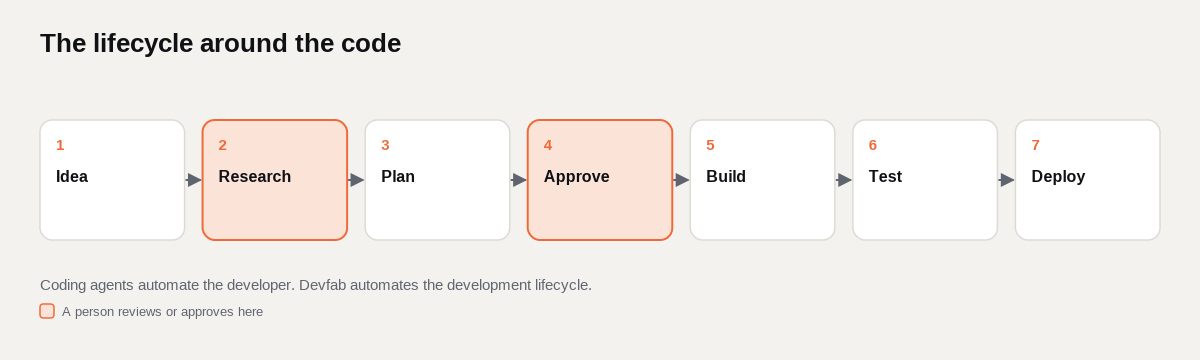
Devin is an engineer you assign work to. Devfab is the process around the work. Coding agents automate the developer. Devfab automates the development lifecycle.
- Research before the plan. Before any plan, Devfab's research step maps the domain: key terms, best practices for that kind of app, and competitors, then suggests a prototype. The Researcher learns your industry first, so the plan isn't built on guesses.
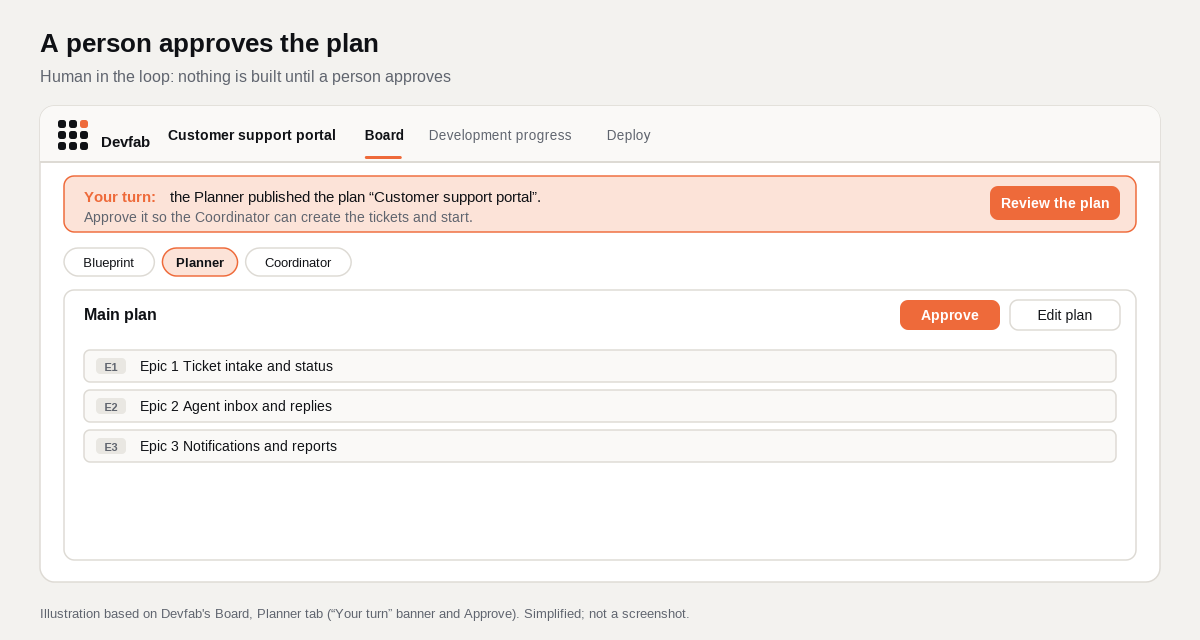
- A plan a person approves. The Planner publishes the plan and the workspace shows "Your turn: the Planner published the plan. Approve it so the Coordinator can create the tickets." Only then does the Coordinator split it into tickets and assign developer agents.
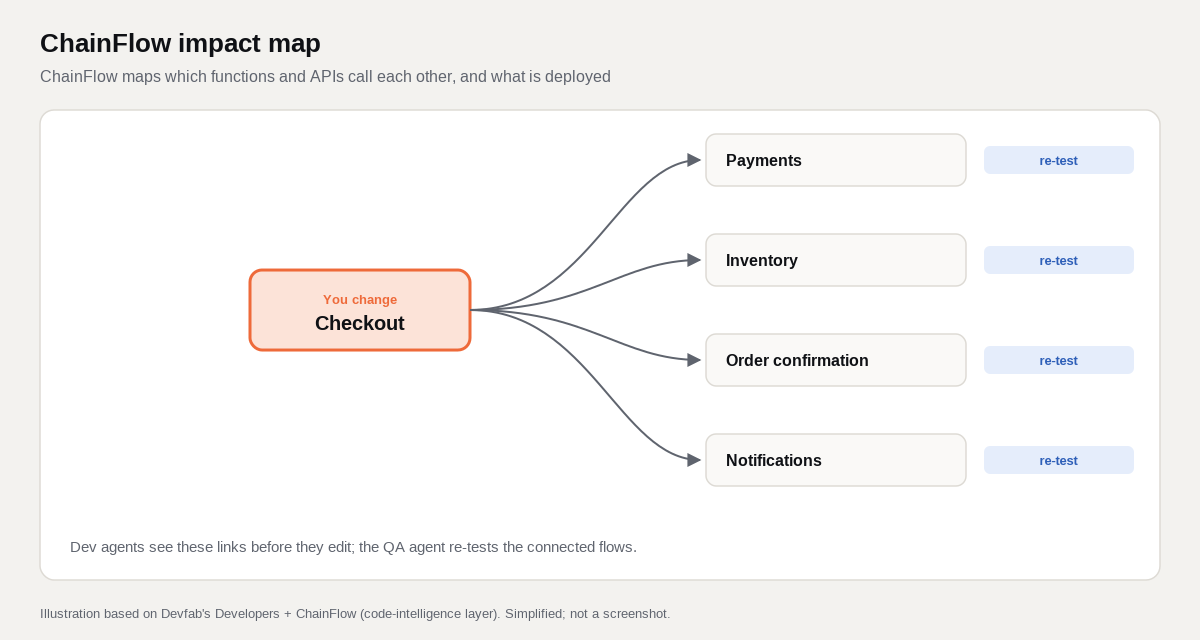
- ChainFlow. Devfab's code-intelligence layer maps which functions and APIs call each other and what is deployed, so developer agents see the impact of a change and don't break connected features. Changing checkout, for example, can affect payments, inventory, order confirmation and notifications.
- QA agent. It runs UI and flow tests (screens, buttons and user journeys clicked end to end) plus logic tests. Turn on "QA agent · review before Done" and nothing is marked Done before review.
On an existing repo, leave the change box empty and Devfab maps the code first with ChainFlow and suggests three small first tickets. That's a safer start than handing an agent a big change on code it hasn't mapped.
Human in the loop is the default; you can switch to Auto in workspace settings, where Devfab asks only when it needs you. You can choose the model for each agent or keep Devfab's default. Code lives in your own GitHub account (or your organization's), and you deploy to your own server. Cost is predictable and visible: it's logged after each run, per task and per project, which helps when you're working to a client budget.
Devfab's honest limits:
- It's new and in Beta, with a much smaller community than Devin.
- It has fewer integrations than Devin. Check that it connects to the tools your team uses for tickets and chat.
- It isn't an editor for hands-on coding. Use your own editor (or Devin Desktop) on the repo.
- It needs a GitHub account.
- For a single well-scoped ticket, a coding agent like Devin is the lighter tool.
How to choose
- Backlog of clear tickets, chat-first team? Stay with Devin.
- Enterprise with strict data rules? Factory.
- Must self-host or inspect the source? OpenHands.
- Already on ChatGPT or Claude plans? Codex or Claude Code.
- Everything on GitHub? Copilot's cloud agent.
- Whole projects with research, an approved plan, UI and flow tests, deploy to your own server and cost per task? Devfab. Our AI software factory vs AI coding tools guide explains the split.
FAQ
What is the best open-source alternative to Devin?
OpenHands is the best-known one. Its core is MIT-licensed, it works with many model providers, and you can run it locally, in your own VPC or on OpenHands Cloud.
Is Windsurf part of Devin now?
Yes. Cognition owns both, and on June 2, 2026 the Windsurf editor became Devin Desktop. It keeps the editor and adds an Agent Command Center for local and cloud agents.
How is Devin billed?
Devin has Free, Pro, Max, Teams and Enterprise plans. Self-serve plans became usage-based in March 2026, and Enterprise plans are billed in Agent Compute Units (ACUs) that reflect tokens, compute and other infrastructure.
How is Devfab different from Devin?
Devin is an agent you hand tasks to. Devfab is a software factory: it researches the domain, writes a plan a person approves, then builds, tests the UI and flows, and deploys to your own server. Coding agents automate the developer. Devfab automates the development lifecycle.
Read next
- What is an AI software factory?
- Devfab vs Devin
- Windsurf alternatives
- Factory vs Devin: which should your team use in 2026?
- OpenHands vs Devin: which should your team use in 2026?
Want the plan, the tests and the deploy, not only the pull request? Try the Devfab Beta
Sources (checked November 2026): Devin docs: Introduction; Devin docs: Usage and billing; Devin docs: Devin Desktop FAQ; DEV: Windsurf is now Devin Desktop; OpenHands: Open-source Devin alternatives; Factory: The software factory; Pickuma on DEV: Factory AI Droids review; OpenAI Help: Codex; Claude Code overview; GitHub Docs: About Copilot coding agent.
Frequently asked questions
What is the best open-source alternative to Devin?
OpenHands is the best-known one. Its core is MIT-licensed, it works with many model providers, and you can run it locally, in your own VPC or on OpenHands Cloud.
Is Windsurf part of Devin now?
Yes. Cognition owns both, and on June 2, 2026 the Windsurf editor became Devin Desktop. It keeps the editor and adds an Agent Command Center for local and cloud agents.
How is Devin billed?
Devin has Free, Pro, Max, Teams and Enterprise plans. Self-serve plans became usage-based in March 2026, and Enterprise plans are billed in Agent Compute Units (ACUs) that reflect tokens, compute and other infrastructure.
How is Devfab different from Devin?
Devin is an agent you hand tasks to. Devfab is a software factory: it researches the domain, writes a plan a person approves, then builds, tests the UI and flows, and deploys to your own server. Coding agents automate the developer. Devfab automates the development lifecycle.