Short answer: Cursor wins for any new work: it is an active AI editor with Plan Mode, cloud agents and Bugbot reviews. Google Jules only wins if you need to read or export past sessions, because it stopped taking new tasks on November 11, 2026 and shuts down on December 31, 2026.
You gave Jules your routine GitHub tickets: version bumps, small fixes, failing CI. Then Google announced the shutdown. Now the question is not which tool is better in theory. It is where those background tasks go next, and whether Cursor can take them.
Most comparisons online still treat both as live options. This page acts as referee with the facts as of November 20, 2026, from vendor docs and changelogs.
In this comparison:
- Cursor and Google Jules at a glance
- Feature comparison
- Where Cursor wins
- Where Google Jules wins
- Switching from one to the other
Start with the status change. It decides most of this page.
Cursor and Google Jules at a glance
Google Jules is closing. Google announced on October 29, 2026 that Jules winds down on December 31, 2026. New sessions ended on November 11, and Jules is read-only until year end (Jules changelog). Google says lessons from Jules will feed into Antigravity, its agent development platform, but has not given a date for that (Times of AI, Oct 30, 2026).
While it ran, Jules was an asynchronous coding agent. It cloned your repo into a virtual machine, installed dependencies, produced a plan you could review and approve, then opened a pull request (Jules docs). It worked with GitHub repositories only and used Gemini models only.
Cursor is active and now owned by SpaceX. Cursor's August 14, 2026 post says it "has officially been acquired by SpaceX" (Cursor blog). Cursor is an AI code editor plus a coding agent that also runs in a CLI, as cloud agents, on mobile and through SDKs (Cursor docs). It calls itself "a coding agent for building ambitious software."
The short version: Jules was a background worker for GitHub tickets. Cursor is an editor first, with background workers added.
Feature comparison
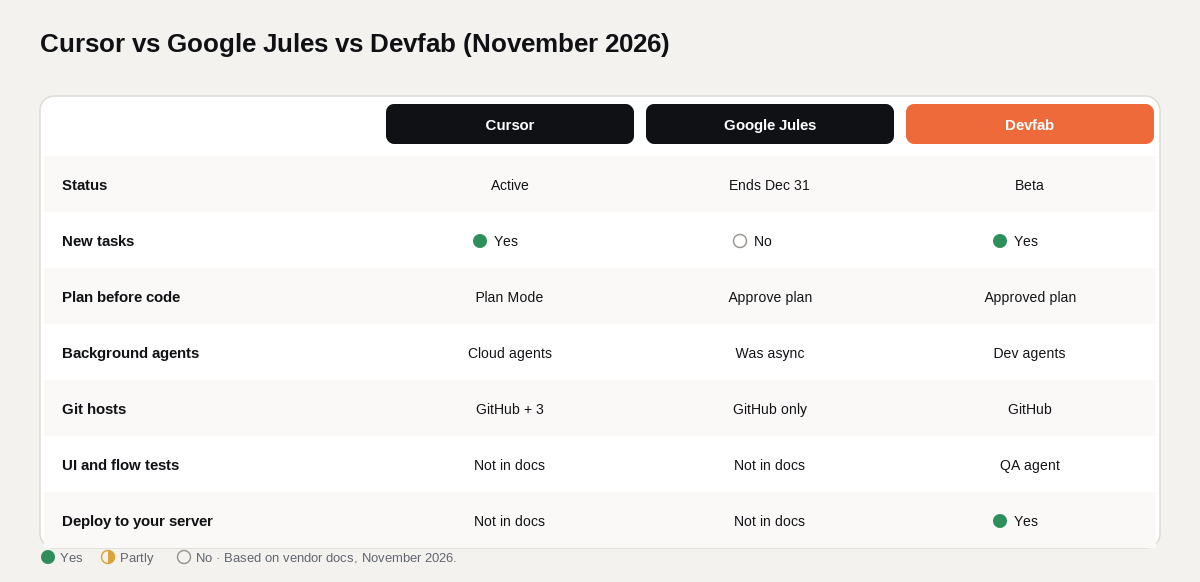
| Aspect | Cursor | Google Jules | Source |
|---|---|---|---|
| Status (Nov 20, 2026) | Active; SpaceX subsidiary | No new tasks since Nov 11; shuts down Dec 31, 2026 | Cursor blog; Jules changelog |
| Where it runs | Desktop editor, CLI, cloud agents, mobile, SDKs | Web app, Jules Tools CLI, REST API, "jules" label on GitHub issues | Cursor docs; Jules docs |
| Planning | Plan Mode asks questions, researches the codebase and drafts an editable plan | Plan you review and approve before code changes | Plan Mode; Jules docs |
| Background agents | Cloud agents in isolated VMs, many in parallel, one branch each | One VM per task; scheduled and suggested tasks | Cloud agents; Jules changelog |
| Review and CI | Bugbot reviews PRs; Autofix pushes fixes | CI Fixer repaired failing checks on Jules' own PRs | Bugbot; Jules changelog |
| Git hosts | GitHub, GitLab, Bitbucket Cloud, Azure DevOps | GitHub only | Cloud agents; Jules docs |
| Team and admin | SSO on Teams; SCIM, audit logs and model restrictions on Enterprise | Tiers tied to Google AI plans with daily task caps | Cursor Enterprise; Jules home |
| Model choice | Claude, Gemini, GPT, Grok, Cursor Composer and others | Gemini only | Cursor docs; Jules changelog |
| Pricing model | Subscription with a weekly usage pool; third-party models at API list price | Was bundled with Google AI plans; no new sign-ups now | Cursor pricing; Jules home |
Cost model by team size
| Team size | Cursor | Google Jules |
|---|---|---|
| 1 person | Free; Plus USD 8 per month (Grok models only); Premium USD 30 per month (includes cloud agents) | Not available for new work |
| 5 people | Teams, USD 30+ per user per month | Not available for new work |
| 25 people | Teams, or Enterprise (custom) with SCIM and audit logs | Not available for new work |
Cursor prices as of November 2026 from Cursor pricing. Cloud agents need Premium or higher, Teams or Enterprise, and a spend limit is set on first use (Cursor cloud agents). Jules status from the Jules changelog.
Where Cursor wins
- You need a tool that will exist next year. Cursor is active and shipping: Projects in September, the Agent SDK in October 2026.
- Your repos are not all on GitHub. Cursor's cloud agents support GitHub, GitLab, Bitbucket Cloud and Azure DevOps.
- You want to pick the model per task. Cursor lists models from Anthropic, Google, OpenAI, xAI and its own Composer.
- You want PR review that can fix. Bugbot flags bugs and security issues, and Autofix starts a cloud agent to push the fix.
- Developers also write code by hand. Cursor is a full editor, not only a task queue.
Where Google Jules wins
- Reading past work before December 31. Jules is read-only, so you can still review session history and plans.
- Exporting your setup. Jules Tools exports settings, environment variables, scheduled tasks, repos, memories and session history.
- Nothing to migrate in code. Branches and pull requests Jules created already live in your GitHub repos.
Beyond those, Jules is not a choice for new work.
Switching from one to the other
From Jules to Cursor (the only direction that makes sense now):
- Export your Jules data with Jules Tools before December 31, 2026 (Jules changelog).
- Keep your
AGENTS.md. Jules read it, and Cursor's rules docs say it readsAGENTS.mdin the project root and subdirectories (Cursor rules). - Recreate scheduled jobs. Jules had scheduled tasks; in Cursor, start cloud agents from Slack, GitHub comments, Linear or the API (Cursor cloud agents).
- Pick a plan that includes cloud agents (Premium, Teams or Enterprise) and set a spend limit.
If you also used Jules' CI Fixer, test Bugbot with Autofix on a few pull requests first. The two are not the same feature: Bugbot reviews PRs, while CI Fixer repaired failing checks.
Where Devfab fits
Jules handled one ticket at a time. Cursor helps one developer at a time. Neither runs a whole project from research to deployment.
Coding agents automate the developer. Devfab automates the development lifecycle. Devfab's Researcher maps the domain before the Planner writes a plan, and a person approves the plan before the Coordinator creates tickets. The QA agent then runs UI and flow tests, clicking screens, buttons and user journeys end to end, plus logic tests. Think of a clinic booking app: Devfab checks that a patient can book, get a confirmation and cancel, not just that the code compiles.
Devfab is in Beta, has a smaller community and fewer integrations, needs a GitHub account and is not an editor for hands-on coding. See Devfab vs Google Jules and Devfab vs Cursor.
FAQ
Is Google Jules shutting down?
Yes. Google announced on October 29, 2026 that Jules winds down on December 31, 2026. New sessions ended on November 11, 2026, and Jules is read-only until the end of the year. Your code, branches and pull requests stay in GitHub.
Can Cursor replace Google Jules?
For background tasks on a GitHub repo, mostly yes. Cursor's cloud agents run in isolated cloud VMs, work on their own branches and push changes, much like Jules did. They need the Premium plan or higher, Teams or Enterprise; Free and Plus do not include them.
What should I export from Jules before it closes?
Jules' changelog says you can export settings, environment variables, scheduled tasks, repos, memories and session history with Jules Tools. Do it before December 31, 2026. Code, branches and pull requests are already in GitHub and are not affected.
Does Google have a direct successor to Jules?
Google says lessons from Jules will feed into Antigravity, its agent development platform. A dated report from October 30, 2026 notes that Google has not given a date for Jules' capabilities to appear there.
Read next
Moving off Jules? Try a factory that plans, tests and deploys the whole project. Try Beta
Sources (checked November 2026): Jules changelog; Jules docs; Jules home; Times of AI: Google to shut down Jules (Oct 30, 2026); Cursor docs; Cursor pricing; Cursor Plan Mode; Cursor cloud agents; Cursor Bugbot; Cursor Enterprise; Cursor rules; Cursor blog: Joining SpaceX; Cursor blog.
Frequently asked questions
Is Google Jules shutting down?
Yes. Google announced on October 29, 2026 that Jules winds down on December 31, 2026. New sessions ended on November 11, 2026, and Jules is read-only until the end of the year. Your code, branches and pull requests stay in GitHub.
Can Cursor replace Google Jules?
For background tasks on a GitHub repo, mostly yes. Cursor's cloud agents run in isolated cloud VMs, work on their own branches and push changes, much like Jules did. They need the Premium plan or higher, Teams or Enterprise; Free and Plus do not include them.
What should I export from Jules before it closes?
Jules' changelog says you can export settings, environment variables, scheduled tasks, repos, memories and session history with Jules Tools. Do it before December 31, 2026. Code, branches and pull requests are already in GitHub and are not affected.
Does Google have a direct successor to Jules?
Google says lessons from Jules will feed into Antigravity, its agent development platform. A dated report from October 30, 2026 notes that Google has not given a date for Jules' capabilities to appear there.