Short answer: Emergent wins for teams and agencies: selectable agent tiers, bring-your-own model keys, Save to GitHub, built-in tests during the build, and RBAC and SSO on Business. Anything wins for a non-technical founder shipping a consumer mobile app with Stripe or RevenueCat payments, a hosted Postgres backend and a browser agent that tests the app.
A bakery chain with six shops wants a loyalty app: stamp cards on the phone, a web page for weekly specials, and a way to sell gift boxes. Both Emergent and Anything can produce the web and the mobile side from one conversation. That is rare, and it is why the two keep landing on the same shortlist.
The arguments for each are different. Emergent's supporters point to control: agent tiers, model keys and GitHub. Anything's supporters point to simplicity for someone who has never opened a code editor. This page acts as referee, using each vendor's docs and dated press, checked in November 2026.
In this comparison:
- Emergent and Anything at a glance
- Feature comparison
- Cost model by team size
- Where Emergent wins
- Where Anything wins
The tables come first; the verdicts follow.
Emergent and Anything at a glance
Emergent (Emergent Labs) is a chat-driven platform where you "Chat with AI agents that design, code, and deploy your application" (Emergent). Status: active. It targets SMB owners, IT agencies, product managers, operations teams and developers. A free in-product assistant, Emmy, launched on July 31, 2026 (Emergent blog). Its default stack is React or Next.js on the front end, React Native with Expo for mobile, Python/FastAPI or Next.js API routes and MongoDB Atlas (Emergent FAQs).
Anything is the former Create.xyz, which relaunched under the new name in August 2025 (Neon blog). Status: active, at createanything.com and anything.com. It is "designed to help nontechnical people generate complete web and mobile applications" (TechCrunch, Sep 29, 2025). One status note matters: Apple removed the Anything iOS builder app in March 2026, restored it and removed it again; Anything responded with an iMessage builder and a planned desktop companion (TechCrunch, Apr 14, 2026). That affects Anything's own builder app, not apps you publish.
Feature comparison
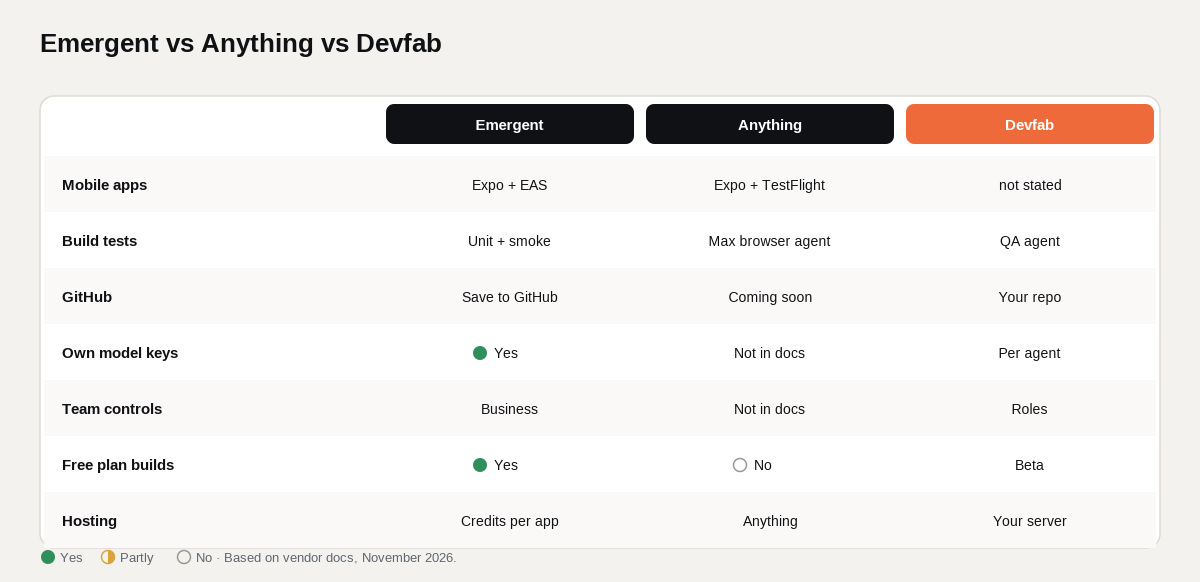
| Aspect | Emergent | Anything | Source |
|---|---|---|---|
| Where it runs | Web app; building from a phone is supported | Hosted web builder; iMessage builder after App Store removals | Emergent help; TechCrunch |
| Mobile output | React Native with Expo; store submission via Expo EAS | Expo (React Native); TestFlight; Google Play (beta, internal testing track) | Emergent FAQs; Anything docs |
| Planning | Not covered in the pages we checked | Plan mode gives "a step-by-step plan before the agent makes any changes"; Discussion mode | Anything docs |
| Agent autonomy | E1, E2, E3 agent tiers; Maxx mode on Pro | Thinking, Fast and Max modes; Max "builds and tests and fixes on its own" | Emergent FAQs; Anything docs |
| Testing | Unit, integration and basic end-to-end smoke tests during the build; pre-publish health check | Max plan adds a browser agent that tests and fixes issues | Emergent FAQs; Anything subscriptions |
| Backend | MongoDB Atlas; FastAPI or Next.js API routes | PostgreSQL via Neon; serverless functions; auth and storage | Emergent FAQs; Anything docs |
| Hosting | emergent.host URL behind a CDN; each published app billed monthly in credits | Custom domains | Emergent deployment; Anything docs |
| Code ownership | Save to GitHub on Standard+; no ZIP button; import only at job start | ZIP from the Code tab; "GitHub sync is coming soon" | Emergent FAQs; Anything export |
| Team and admin | Business: RBAC, SSO, shared workspaces, co-editing; Enterprise: audit logs, VPC deploy | Not covered in the pages we checked | Emergent pricing |
| Model choice | LLM chosen separately; bring OpenAI, Anthropic or Google keys, or a Universal LLM Key | Built-in AI models | Emergent FAQs; Neon blog |
| Pricing model | Credits; Free 10 per month | Credit subscriptions; building needs a paid plan | Emergent pricing; Anything subscriptions |
Cost model by team size
| Team size | Emergent | Anything |
|---|---|---|
| 1 person | Free USD 0 (10 credits per month); Standard USD 20 per month, or USD 17 on annual (100 credits) | Paid plan needed to build; Pro 20k listed at USD 19 per month (see note) |
| 5 people | Pro USD 200 per month, or USD 167 on annual (750 credits); Business (custom) for shared workspaces | Higher credit tiers; team features not covered in the pages we checked |
| 25 people | Business or Enterprise (custom): RBAC, SSO, audit logs | Not covered in the pages we checked |
Emergent prices as of November 2026 from Emergent pricing. Published Emergent apps also consume credits every month: 50 credits at the Starter publishing tier, up to 1,100 (Emergent deployment). Anything's pricing page does not say whether its prices are monthly or annual billing, so treat them as indicative. Anything's monthly credits expire each cycle; top-off credits never expire (Anything subscriptions).
Where Emergent wins
- You want the code in GitHub today. Save to GitHub is on Standard and above. Anything's GitHub sync is still "coming soon".
- You want to control the AI. Pick an agent tier, choose the LLM, or bring your own OpenAI, Anthropic or Google keys.
- A team builds together. Business adds RBAC, SSO, shared workspaces and real-time co-editing; Enterprise adds audit logs and deploy to your own cloud.
- You can try it free. Emergent's Free plan includes monthly credits; Anything needs a paid plan to build.
- Tests run during the build, not only on the top plan: unit, integration and smoke tests, plus a pre-publish health check.
Where Anything wins
- The founder has never coded. Anything is built for nontechnical people, with Discussion and Plan modes to agree changes in plain words.
- The app charges money. Stripe and RevenueCat payments are built in, which suits subscriptions and in-app purchases.
- You prefer Postgres. The database runs on PostgreSQL via Neon, with serverless functions.
- A browser agent tests for you. On the Max plan it tests the app and fixes issues automatically.
- Hosting is not metered per app in the pages we checked, while Emergent bills each published app in credits every month.
Switching from one to the other
From Anything to Emergent. Download the ZIP from Anything's Code tab and push it to a GitHub repo. Emergent can import an existing codebase only when you create a new job, with no mid-job sync (Emergent FAQs). Check the stack first: Anything uses Postgres, while Emergent's default is MongoDB, so expect data work.
From Emergent to Anything. Save the code to GitHub as a reference. The Anything docs we checked describe no import, so you rebuild from a description in Plan mode. See also Anything alternatives and Emergent alternatives.
Where Devfab fits
The bakery's loyalty app will change after launch: new rewards, a second payment method, a points expiry rule. Each change can break something that already works.
App builders automate the first version. Devfab automates the development lifecycle. In Devfab, a person approves the plan before agents build. ChainFlow maps which functions and APIs call each other, so a change to points rules shows its effect on checkout, gift orders and notifications. The QA agent runs UI and flow tests plus logic tests, and Deploy ships to your own server. Devfab is in Beta, needs a GitHub account and has a smaller community than either builder. See Devfab vs Anything.
FAQ
Do Emergent and Anything both build mobile apps?
Yes. Emergent builds React Native apps with Expo and submits them to the App Store and Google Play through Expo EAS, using your own developer accounts. Anything generates Expo (React Native) apps with App Store submission via TestFlight and Google Play publishing in beta.
Which one lets me push code to GitHub?
Emergent has Save to GitHub on Standard and above, but no ZIP download button. Anything lets you download source as a ZIP from the Code tab, and its docs say GitHub sync is coming soon.
Can I build for free?
Emergent's Free plan includes 10 credits per month. Anything's docs say building an app requires a paid plan, and downgrading to Free pauses building.
Does hosting cost extra?
On Emergent, yes: each published app is billed monthly in credits, from 50 credits per month at the Starter publishing tier. Anything's pricing pages describe credit plans for building; hosting charges are not broken out in the pages we checked.
Read next
- What is an AI software factory?
- Emergent alternatives
- Anything alternatives
- Devfab vs Anything
- Replit vs Emergent
Launched the app? Make the next change safe. Try Beta
Sources (checked November 2026): Emergent home; Emergent pricing; Emergent FAQs; Introduction to Emergent; Deployment on Emergent; Meet Emmy (Jul 31, 2026); Anything pricing; Anything subscriptions; Anything export docs; Anything full docs; Neon blog (Aug 7, 2025); TechCrunch (Sep 29, 2025); TechCrunch (Apr 14, 2026).
Frequently asked questions
Do Emergent and Anything both build mobile apps?
Yes. Emergent builds React Native apps with Expo and submits them to the App Store and Google Play through Expo EAS, using your own developer accounts. Anything generates Expo (React Native) apps with App Store submission via TestFlight and Google Play publishing in beta.
Which one lets me push code to GitHub?
Emergent has Save to GitHub on Standard and above, but no ZIP download button. Anything lets you download source as a ZIP from the Code tab, and its docs say GitHub sync is coming soon.
Can I build for free?
Emergent's Free plan includes 10 credits per month. Anything's docs say building an app requires a paid plan, and downgrading to Free pauses building.
Does hosting cost extra?
On Emergent, yes: each published app is billed monthly in credits, from 50 credits per month at the Starter publishing tier. Anything's pricing pages describe credit plans for building; hosting charges are not broken out in the pages we checked.