Short answer: Pick Lovable if you want a guided builder for hosted web apps with a managed backend, team roles and per-person drafts, billed by shared credits rather than seats. Pick Bolt.new if you want more starting points (Figma, GitHub or even a Lovable project), native mobile apps through Expo, and code you edit in a full browser dev environment.
You have an idea and no developer free. Lovable and Bolt.new both promise a working app from a prompt, and most reviews call it a tie. It isn't. They differ on mobile, Git, team billing and what happens when your hosting runs out.
In this comparison:
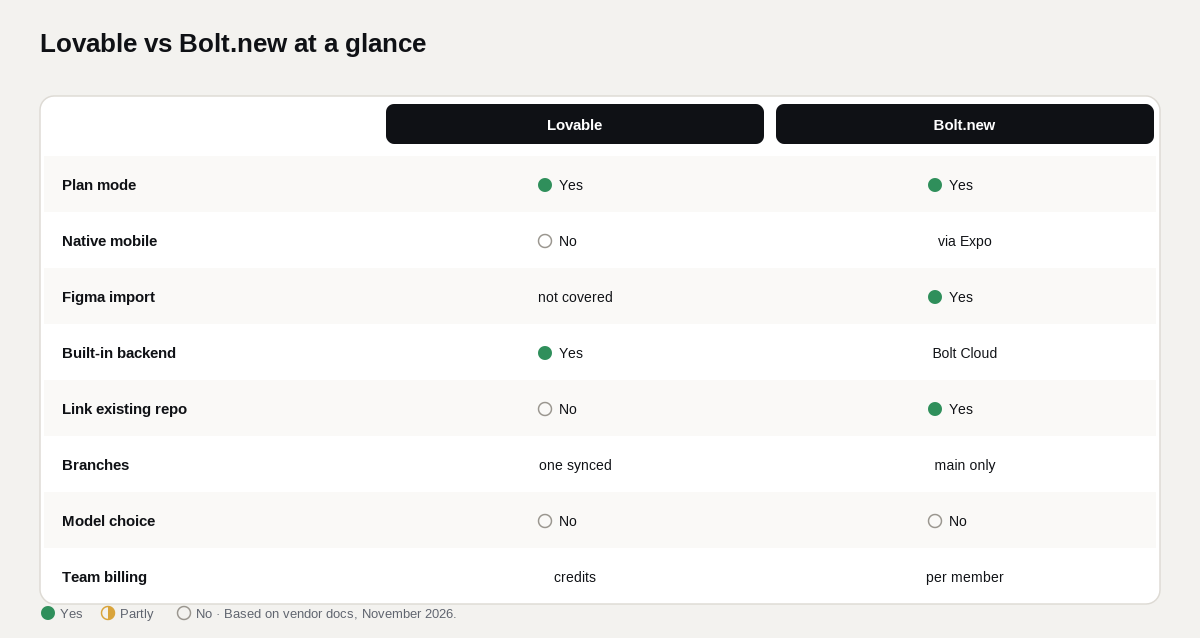
- Lovable and Bolt.new at a glance
- Feature comparison
- Cost model by team size
- Where Lovable wins
- Where Bolt.new wins
Here is the referee's view, one sourced fact at a time.
Lovable and Bolt.new at a glance
Changes in 2026
- Lovable moved new apps to TanStack Start with server rendering on May 13, 2026, and unified its credits into one balance on June 1. From September 9, 2026, Free and Pro data may be used for model training unless users opt out; Business and Enterprise are excluded by default.
- Bolt.new ran Bolt Forge as a research preview from September 14 to October 14, 2026, for individual Pro users. It used open models, with opt-in sharing of anonymized sessions.
Lovable
Lovable is a browser-based AI app builder for people with no coding experience and for developers who read and edit the generated code. It has three modes: Build changes the project, Plan writes a plan for approval first, and Chat answers questions without touching code.
Apps come with a built-in backend (managed PostgreSQL, login and file storage) or Supabase. Publish deploys to a URL with HTTPS, with custom domains on paid plans. A quick security scan runs on every publish. Lovable picks the stack and the model; "Lovable does not offer a choice of framework or database." It builds web apps only.
Teams get Viewer, Editor, Admin and Owner roles. Each person works in their own draft, which is then accepted into the project. Lovable holds SOC 2 Type II and ISO 27001:2022.
Bolt.new
Bolt.new, from StackBlitz, runs a whole development environment in the browser on WebContainers, "so you don't have to install anything." You can start from a prompt, a Figma frame, Google Stitch designs, a GitHub repo or a Lovable project. Build mode writes code; Plan mode works through strategy without generating it.
Bolt Cloud bundles hosting on a free bolt.host subdomain, databases, auth, file storage, server functions and Stripe payments. Native mobile apps come through Expo. Bolt chooses models for you across its Standard and Max agents. It lists SOC 2 Type II.
Feature comparison
| Aspect | Lovable | Bolt.new | Source |
|---|---|---|---|
| Where it runs | Web app; mobile app for building from a phone | Browser dev environment on WebContainers | Lovable FAQ; Intro to Bolt |
| Planning / spec | Plan mode writes a plan for approval | Plan mode works through strategy without code | Lovable FAQ; Bolt glossary |
| What it builds | Web apps only; fixed stack | Websites, web apps, native mobile via Expo | Lovable FAQ; Intro to Bolt |
| Testing | Tests in a browser and writes frontend tests when asked; security scans | Version history to restore saved states | Lovable FAQ; Bolt glossary |
| Deploy / hosting | Publish to a URL with HTTPS; built-in backend | Bolt Cloud: hosting, databases, auth, functions, Stripe | Lovable FAQ; Bolt Cloud |
| Code and export | Git sync to GitHub, GitLab, Bitbucket; always a new repo; ZIP on paid plans | Import repos or create a private repo; stays on main | Lovable GitHub; Bolt Git |
| Team / admin | Roles, per-person drafts; SSO from Business; SCIM, audit logs on Enterprise | Teams: central billing, access management; SSO, audit logs on Enterprise | Lovable collaboration; Bolt pricing |
| Model choice | Lovable picks the model | "Bolt handles model selection behind the scenes" | Lovable FAQ; Bolt agents |
| Pricing model | Monthly credits, not seats; one balance for building and hosting | Tokens; Teams priced per member | Lovable plans; Bolt pricing |
Cost model by team size
| Team size | Lovable | Bolt.new |
|---|---|---|
| 1 person | Free plan can build and publish (5 daily build credits, capped at 30 a month); Pro adds monthly credits that roll over | Free plan with a monthly token allowance and a daily limit; Pro has more tokens and no daily limit |
| 5 people | Priced by credits, not seats: collaborators spend the owner workspace's credits; Business adds SSO | Teams: per member; each member's tokens are their own and not shared |
| 25 people | Enterprise by contract: SCIM, audit logs, admins can approval-gate publishing | Enterprise (custom): SSO and audit logs |
Check Lovable's plans page and Bolt's pricing page for amounts as of November 2026. On Bolt, if a plan's hosting usage runs out, the site "stops displaying publicly until your usage resets." For reference, Devfab (Beta) logs cost after each run, per task and per project.
Where Lovable wins
- Non-developers lead the build. Plan mode, Chat mode and a fixed stack keep choices simple.
- Several people edit one app. Roles and per-person drafts keep changes apart until accepted.
- You want one shared budget. Credits, not seats, cover building, hosting, backend and in-app AI.
- You want security checks built in. A quick scan runs on every publish, with a deep scan on demand.
Where Bolt.new wins
- You need a mobile app. Bolt builds native apps through Expo; Lovable is web only.
- You start from a design. Import a Figma frame or Google Stitch designs.
- You want to edit code like a developer. A full dev environment runs in the browser, with no install.
- You are leaving Lovable. Bolt imports Lovable projects directly.
Switching from one to the other
From Lovable to Bolt.new: choose "import a Lovable project" in Bolt, or sync Lovable to GitHub and import that repo. Bolt keeps the project on main, and only the project owner can connect GitHub.
From Bolt.new to Lovable: this is the harder direction. Lovable's Git sync "always creates a new repository and cannot link an existing one", so it cannot pick up your Bolt repo. Importing outside code was not covered in the Lovable docs we checked.
Where Devfab fits
Both tools are strong at the first version. Trouble starts when a client needs a reviewed plan, tested user journeys and the app on their own server. Lovable doesn't let you choose a framework or database, and Bolt's projects stay on one branch.
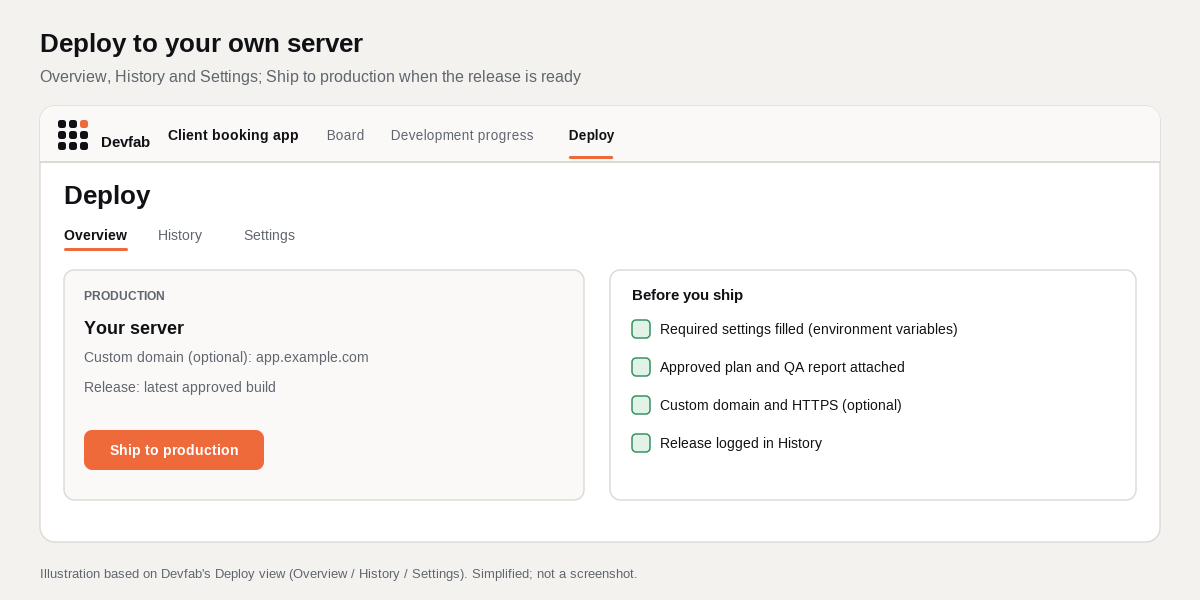
App builders automate the first version. Devfab automates the development lifecycle. Devfab's Researcher maps the domain before the Planner writes. A person approves the plan, and the QA agent runs UI, flow and logic tests. Code lives in your own GitHub account (or your organization's), and Deploy ships to your own server, with a custom domain if you want one.
Honest limits: Devfab is new and in Beta, with a smaller community and fewer integrations. It needs a GitHub account, and for a quick landing page Lovable or Bolt is the simpler choice. See Devfab vs Bolt.new.
FAQ
Can I move a Lovable project to Bolt.new?
Yes. Bolt's docs list importing a Lovable project as a starting point, next to describing an idea, importing a Figma frame or importing a GitHub repo. Going the other way is harder: Lovable's Git sync always creates a new repository and cannot link an existing one.
Which is better for mobile apps?
Bolt.new. It builds native mobile apps through its Expo integration. Lovable's docs say it builds web apps only and does not support React Native projects, though you can build from Lovable's own mobile app.
Which is cheaper for a team?
It depends on how your team works. Lovable prices by monthly credits, not seats, and collaborators spend the owner workspace's credits. Bolt prices Teams per member, and each member's tokens are their own and not shared. Check both pricing pages for current amounts.
Can I use Lovable or Bolt.new for a healthcare app?
Be careful. Lovable's docs say it is not HIPAA-compliant, does not sign BAAs, and its terms do not allow protected health information. Bolt lists SOC 2 Type II; HIPAA was not covered in the Bolt docs we checked. Ask both vendors before handling health data.
Read next
- What is an AI software factory?
- Devfab vs Bolt.new: which fits a team that ships client work?
- Bolt.new alternatives for teams that ship to production (2026)
- Prototype vs MVP vs production app: what's the difference
Take the next version past the prototype. Try Devfab Beta
Sources (checked November 13, 2026): Lovable FAQ; Lovable for Enterprise; Lovable GitHub Git sync; Lovable plans and credits; Lovable subscription plans; Lovable collaboration; Intro to Bolt; Bolt glossary; Bolt: choose an agent; Bolt Git integration; What is Bolt Cloud?; Bolt pricing; SD Times: Bolt.new launches Forge (Sep 17, 2026).
Frequently asked questions
Can I move a Lovable project to Bolt.new?
Yes. Bolt's docs list importing a Lovable project as a starting point, next to describing an idea, importing a Figma frame or importing a GitHub repo. Going the other way is harder: Lovable's Git sync always creates a new repository and cannot link an existing one.
Which is better for mobile apps?
Bolt.new. It builds native mobile apps through its Expo integration. Lovable's docs say it builds web apps only and does not support React Native projects, though you can build from Lovable's own mobile app.
Which is cheaper for a team?
It depends on how your team works. Lovable prices by monthly credits, not seats, and collaborators spend the owner workspace's credits. Bolt prices Teams per member, and each member's tokens are their own and not shared. Check both pricing pages for current amounts.
Can I use Lovable or Bolt.new for a healthcare app?
Be careful. Lovable's docs say it is not HIPAA-compliant, does not sign BAAs, and its terms do not allow protected health information. Bolt lists SOC 2 Type II; HIPAA was not covered in the Bolt docs we checked. Ask both vendors before handling health data.