Short answer: FlutterFlow wins when the product is a native iOS or Android app: its new agent builds it with backend and store submission, and FlutterFlow Studio adds Flutter code export. Lovable wins for web apps and SaaS, with two-way GitHub sync, a ZIP export, Plan mode and team drafts.
Until this month, this comparison was easy: FlutterFlow was a visual builder, Lovable was a chat. On November 4, 2026, FlutterFlow launched its own chat-based agent, and the old builder became FlutterFlow Studio. Now both build by conversation, and the real question is what you're shipping. Lovable's own comparison, published in March 2026, predates the change. This page uses the post-launch docs from both vendors.
In this comparison:
- FlutterFlow and Lovable at a glance
- Feature comparison
- Cost model by team size
- Where FlutterFlow wins and where Lovable wins
- Switching from one to the other
Each section answers one part of the decision.
FlutterFlow and Lovable at a glance
FlutterFlow restructured on November 3 to 4, 2026. The name now means an AI-agent app builder for native iOS and Android: one project, with backend, sign-in, file storage, analytics and store submission built in. The agent works in threads on a copy of your app, asks with Question, Choice or Proposal cards, and checks the code it changed for errors. The classic visual Flutter builder is now FlutterFlow Studio, which still targets mobile, web and desktop and exports Flutter code. One subscription covers both. CEO Abel Mengistu: "We learned that people wanted a conversational way of building."
Lovable is a browser-based AI app builder from Stockholm, founded in 2023 as GPT Engineer. It generates and hosts full-stack web apps; common uses include SaaS products, internal tools, dashboards, CRMs and booking apps. New apps use TanStack Start since May 13, 2026. "Lovable does not offer a choice of framework or database." From September 9, 2026, Free and Pro data may be used for model training unless users opt out.
The split is clean: FlutterFlow ships to app stores. Lovable ships to a URL.
Feature comparison
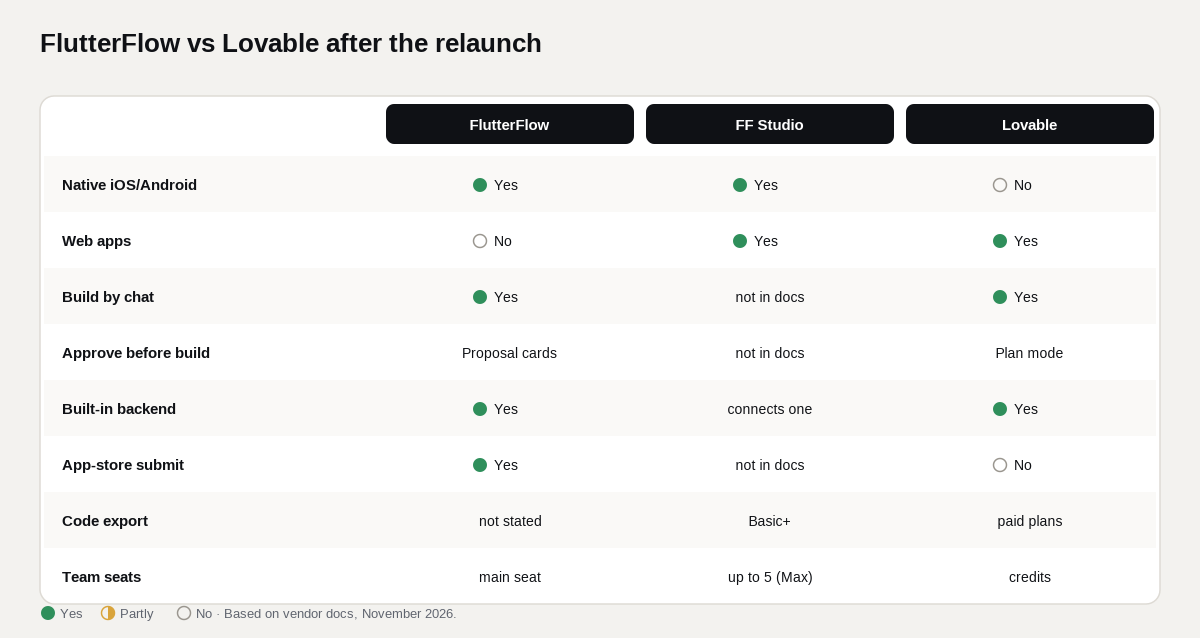
| Aspect | FlutterFlow (new) | FlutterFlow Studio | Lovable | Source |
|---|---|---|---|---|
| Output | iPhone and Android apps | Mobile, web and desktop | Web apps only | FlutterFlow announcement · Studio docs · Lovable FAQ |
| How you build | Chat with an agent in threads | Visual canvas, widgets, custom code | Chat, with a code editor and preview | The agent · Lovable FAQ |
| Planning | Proposal cards wait for approval before building | Not covered in the docs we checked | Plan mode writes a plan for approval | The agent · Lovable FAQ |
| Backend | Backend, sign-in, storage, analytics built in | Firebase or Supabase | Built-in backend, Supabase or third-party APIs | FlutterFlow · Studio docs · Lovable FAQ |
| Testing | Preview, "What changed" review, test sign-in, builds to testers | Local run on devices | Browser and frontend tests when asked; security scan on publish | FlutterFlow docs · Lovable FAQ |
| Deploy | App Store and Google Play submission and updates | Mobile builds and web | Publish to an HTTPS URL; custom domains on paid plans | FlutterFlow docs · Lovable FAQ |
| Code export | Not stated; pricing lists export under Studio | Code and APK download from Basic; GitHub push on Pro and Max | Two-way GitHub sync on one branch; ZIP on paid plans | FlutterFlow pricing · Lovable GitHub |
| Team / admin | Plan's main seat only | Up to 2 editors on Pro, 5 on Max; SSO and audit logs on Enterprise | Roles, per-person drafts; SSO from Business | FlutterFlow pricing · Lovable collaboration |
| Pricing model | One subscription; shared AI allowance shown as a percentage | Same subscription | Monthly credits, not seats | FlutterFlow pricing · Lovable plans |
Cost model by team size
| Team size | FlutterFlow (both products) | Lovable | Devfab |
|---|---|---|---|
| 1 person | Free tier with a free AI allowance; Basic adds Studio code and APK download | Free plan builds and publishes with daily credits; Pro adds monthly credits and ZIP export | Cost logged per task and per project (Beta) |
| 5 people | Max covers up to 5 Studio editors with real-time collaboration; the new FlutterFlow uses the main seat | Credits, not seats; collaborators spend the owner workspace's credits | Cost logged per task and per project (Beta) |
| 25 people | Enterprise: SSO, audit logs, private cloud options | Enterprise: SCIM, audit logs, publish approval gates | Cost logged per task and per project (Beta) |
FlutterFlow's AI meter is one allowance shared by FlutterFlow and Studio. Long agent threads use more of it, and running out pauses messages and pushes until a refill (Pro and Max). Lovable rolls unused monthly credits over while you stay subscribed. Check FlutterFlow's pricing page and Lovable's plans page.
Where FlutterFlow wins
- App-store apps. iOS and Android from one project, with store submission and release updates handled in the platform.
- Mobile essentials built in. Backend, sign-in, file storage and analytics come with the new FlutterFlow.
- Review before changes land. The agent works on a copy; you see "What changed" and nothing reaches the app until you push.
- Flutter code for developers. Studio exports clean Flutter and pushes to GitHub on Pro and Max.
FlutterFlow's agent has documented limits: it cannot push on its own, connect services or store accounts, submit for review or add testers. You do those steps.
Where Lovable wins
- Web apps and SaaS. Lovable lists SaaS products, internal tools, dashboards, CRMs and booking apps as common uses.
- Code handoff. Two-way GitHub sync, plus GitLab and Bitbucket, and a ZIP on paid plans. Lovable's March 2026 guide claims FlutterFlow's GitHub sync is one-way.
- Teams working in parallel. Several people work in one project, each in their own draft.
- Security and compliance. A security scan on every publish; SOC 2 Type II and ISO 27001:2022.
Switching from one to the other
FlutterFlow to Lovable. If you built in Studio, download the code (Basic and up) for reference. Lovable's Git sync creates a new repository and cannot link an existing one, so describe the web version to Lovable and rebuild. Native app-store features don't carry over.
Lovable to FlutterFlow. Sync your project to GitHub or download the ZIP. Describe the mobile app to the new FlutterFlow agent and let it set up backend and sign-in, or use Studio with Supabase if you want to keep a Supabase backend. Remember: Studio projects can't later move into the new FlutterFlow.
Where Devfab fits
Both tools are strong at a first version on their platform. Changing a live app safely is a different job: knowing what a change will break, testing the user journeys again and deploying to infrastructure you control.
App builders automate the first version. Devfab automates the development lifecycle.
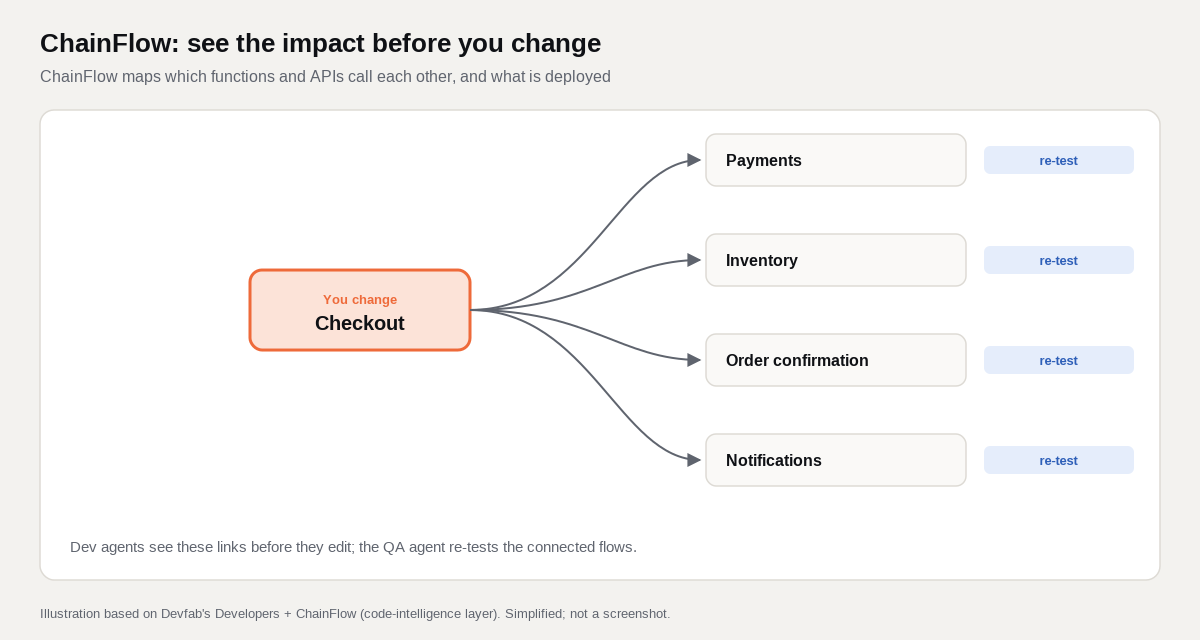
Devfab is an AI software factory that works on a GitHub repository. Connect the repo with "Work on an existing project" and ChainFlow maps which functions and APIs call each other and what is deployed. Change "checkout" and the plan shows the impact on payments, inventory, order confirmation and notifications before any code is written. A person approves the plan, and the QA agent runs UI and flow tests plus logic tests.
Devfab's honest limits: it is new and in Beta, with a smaller community and fewer integrations. It is not an editor for hands-on coding and needs a GitHub account. Its default stacks are for web apps and APIs, so for a native mobile app FlutterFlow is the more direct tool. See Devfab vs FlutterFlow.
FAQ
Is FlutterFlow now a chat-based builder like Lovable?
Yes, since November 4, 2026. The name FlutterFlow now refers to an AI-agent builder for native iOS and Android apps. The classic visual builder continues as FlutterFlow Studio, under the same subscription.
Can Lovable build an iPhone app?
Not natively. Lovable's FAQ says it builds web apps only, with no React Native projects. For an App Store or Google Play app, FlutterFlow is the more direct choice.
Which one gives me the code?
Lovable syncs two ways with GitHub on one branch and lets paid plans download a ZIP. FlutterFlow's pricing page lists code download, APK download and GitHub push as FlutterFlow Studio features, from the Basic and Pro plans respectively.
Can I move a FlutterFlow Studio project into the new FlutterFlow?
No. FlutterFlow's announcement says a Studio project cannot be moved into the new FlutterFlow because it uses a different architecture. Pick the product before you start.
Read next
- What is an AI software factory?
- Devfab vs FlutterFlow
- FlutterFlow alternatives
- Prototype vs MVP vs production app: what's the difference?
Changing a live app? See the impact first. Try Devfab Beta
Sources (checked November 13, 2026): Two ways to build. One FlutterFlow. (FlutterFlow community, Nov 2026); HackerNoon: FlutterFlow launches AI-native app builder (Nov 5, 2026); FlutterFlow homepage; FlutterFlow pricing; FlutterFlow docs; What the FlutterFlow agent can do; FlutterFlow Studio docs; Lovable FAQ; Lovable for Enterprise; Lovable GitHub Git sync; Lovable plans and credits; Lovable subscription plans; Lovable collaboration; Lovable: FlutterFlow vs Lovable (Mar 10, 2026).
Frequently asked questions
Is FlutterFlow now a chat-based builder like Lovable?
Yes, since November 4, 2026. The name FlutterFlow now refers to an AI-agent builder for native iOS and Android apps. The classic visual builder continues as FlutterFlow Studio, under the same subscription.
Can Lovable build an iPhone app?
Not natively. Lovable's FAQ says it builds web apps only, with no React Native projects. For an App Store or Google Play app, FlutterFlow is the more direct choice.
Which one gives me the code?
Lovable syncs two ways with GitHub on one branch and lets paid plans download a ZIP. FlutterFlow's pricing page lists code download, APK download and GitHub push as FlutterFlow Studio features, from the Basic and Pro plans respectively.
Can I move a FlutterFlow Studio project into the new FlutterFlow?
No. FlutterFlow's announcement says a Studio project cannot be moved into the new FlutterFlow because it uses a different architecture. Pick the product before you start.